Thank you for visiting SNEWPapers!
Sign up free
Editorial
July 25, 1849
Morning Star
Limerick, York County, Maine
What is this article about?
This editorial reflects on the 24-year evolution of the Morning Star religious newspaper, defending its improvements in size, content variety, and engagement with moral reforms like temperance, anti-slavery, education, peace, and missions, attributing changes to the partial awakening of church and society.
Clipping
OCR Quality
95%
Excellent
Full Text
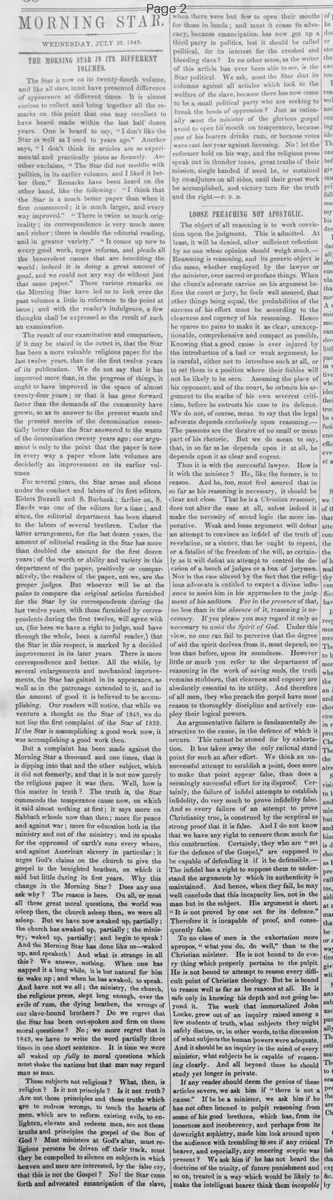
THE MORNING STAR IN ITS DIFFERENT VOLUMES.
The Star is now on its twenty-fourth volume, and like all stars, must have presented difference of appearance at different times. It is almost curious to collect and bring together all the remarks on this point that one may recollect to have heard made within the last half dozen years. One is heard to say, "I don't like the Star as well as I used to years ago." Another says, "I don't think its articles are so experimental and practically pious as formerly. Another exclaims, "The Star did not meddle with politics, in its earlier volumes, and I liked it better then." Remarks have been heard on the other hand, like the following: "I think that the Star is a much better paper than when it first commenced; it is much larger, and every way improved." "There is twice as much originality; its correspondence is very much more and richer; there is double the editorial reading, and in greater variety." "It comes up now to every good work, urges reforms, and pleads all the benevolent causes that are benefiting the world; indeed it is doing a great amount of good, and we could not any way do without just that same paper." These various remarks on the Morning Star have led us to look over the past volumes a little in reference to the point at issue; and with the reader's indulgence, a few thoughts shall be expressed as the result of such an examination.
The result of our examination and comparison, if it may be stated in the outset is, that the Star has been a more valuable religious paper for the last twelve years, than for the first twelve years of its publication. We do not say that it has improved more than, in the progress of things, it ought to have improved in the space of almost twenty-four years; or that it has gone forward faster than the demands of the community have grown, so as to answer to the present wants and the present merits of the denomination essentially better than the Star answered to the wants of the denomination twenty years ago; our argument is only to the point that the paper is now in every way a paper whose late volumes are decidedly an improvement on its earlier volumes.
For several years, the Star arose and shone under the conduct and labors of its first editors, Elders Buzzell and S. Burbank; farther on, S. Beede was one of the editors for a time; and since, the editorial department has been shared to the labors of several brethren. Under the latter arrangement, for the last dozen years, the amount of editorial reading in the Star has more than doubled the amount for the first dozen years; of the worth or ability and variety in this department of the paper, positively or comparatively, the readers of the paper, not we, are the proper judges. But whoever will be at the pains to compare the original articles furnished for the Star by its correspondents during the last twelve years, with those furnished by correspondents during the first twelve, will agree with us, (for here we have a right to judge, and have through the whole, been a careful reader.) that the Star in this respect, is marked by a decided improvement in its later years. There is more correspondence and better. All the while, by several enlargements and mechanical improvements, the Star has gained in its appearance, as well as in the patronage extended to it. and in the amount of good it is believed to be accomplishing. Our readers will notice, that while we venture a thought on the Star of 1849, we do not lisp the first complaint of the Star of 1829. If the Star is accomplishing a good work now, it was accomplishing a good work then.
But a complaint has been made against the Morning Star a thousand and one times, that it is dipping into that and the other subject, which it did not formerly, and that it is not now purely the religious paper it was then. Well, how is this matter in truth? The truth is, the Star commends the temperance cause now, on which it said almost nothing at first; it says more on Sabbath schools now than then; more for peace and against war; more for education both in the ministry and out of the ministry; and its speaks for the oppressed of earth's sons every where, and against American slavery in particular; it urges God's claims on the church to give the gospel to the benighted heathen, on which it said but little during its first years. Why this change in the Morning Star? Does any one ask why? The reason is here. On all, or most all these great moral questions, the world was asleep then, the church asleep then, we were all asleep. But we have now awaked up, partially; the church has awaked up, partially; the ministry, waked up, partially; and begin to speak! And the Morning Star has done like us--waked up, and speaketh! And what is strange in all this? We answer, nothing. When one has napped it a long while, it is but natural for him to wake up; and when he has awaked, to speak. And have not we all; the ministry, the church, the religious press, slept long enough, over the evils of rum, the dying heathen, the wrongs of our slave-bound brothers? Do we regret that the Star has been out-spoken and firm on these moral questions? No; we more regret that in 1849. we have to write the word partially three times in one short sentence. It is time we were all waked up fully to moral questions which must shake the nations but that man may regard man as man.
These subjects not religious? What, then, is religion? Is it not principle? Is it not truth? Are not those principles and those truths which are to redress wrongs, to touch the hearts of men, which are to reform existing evils, to enlighten, elevate and redeem men, are not these truths and principles the gospel of the Son of God? Must ministers at God's altar, must religious persons be driven off their track, must they be compelled to silence on subjects in which heaven and men are interested, by the false cry, that this is not the Gospel? No! the Star came forth and advocated emancipation of the slave when there were but few to open their mouths for those in bonds; and must it cease its advocacy, because emancipation has now got up a third party in politics, lest it should be called political, for its interest for the crushed and bleeding slave? In no other sense, as the writer of this article has ever been able to see, is the Star political. We ask, must the Star shut its columns against all articles which look to the welfare of the slave, because there has now come to be a small political party who are seeking to break the bonds of oppression? Just as rationally must the minister of the glorious gospel avoid to open his mouth on temperance, because one of his hearers drinks rum, or because votes were cast last year against licensing. No! let the reformer hold on his way, and the religious press speak out in thunder tones, great truths of their mission, single handed if need be, or sustained by co-adjutors on all sides, until their great work be accomplished, and victory turn for the truth and the right.-P. S. B.
The Star is now on its twenty-fourth volume, and like all stars, must have presented difference of appearance at different times. It is almost curious to collect and bring together all the remarks on this point that one may recollect to have heard made within the last half dozen years. One is heard to say, "I don't like the Star as well as I used to years ago." Another says, "I don't think its articles are so experimental and practically pious as formerly. Another exclaims, "The Star did not meddle with politics, in its earlier volumes, and I liked it better then." Remarks have been heard on the other hand, like the following: "I think that the Star is a much better paper than when it first commenced; it is much larger, and every way improved." "There is twice as much originality; its correspondence is very much more and richer; there is double the editorial reading, and in greater variety." "It comes up now to every good work, urges reforms, and pleads all the benevolent causes that are benefiting the world; indeed it is doing a great amount of good, and we could not any way do without just that same paper." These various remarks on the Morning Star have led us to look over the past volumes a little in reference to the point at issue; and with the reader's indulgence, a few thoughts shall be expressed as the result of such an examination.
The result of our examination and comparison, if it may be stated in the outset is, that the Star has been a more valuable religious paper for the last twelve years, than for the first twelve years of its publication. We do not say that it has improved more than, in the progress of things, it ought to have improved in the space of almost twenty-four years; or that it has gone forward faster than the demands of the community have grown, so as to answer to the present wants and the present merits of the denomination essentially better than the Star answered to the wants of the denomination twenty years ago; our argument is only to the point that the paper is now in every way a paper whose late volumes are decidedly an improvement on its earlier volumes.
For several years, the Star arose and shone under the conduct and labors of its first editors, Elders Buzzell and S. Burbank; farther on, S. Beede was one of the editors for a time; and since, the editorial department has been shared to the labors of several brethren. Under the latter arrangement, for the last dozen years, the amount of editorial reading in the Star has more than doubled the amount for the first dozen years; of the worth or ability and variety in this department of the paper, positively or comparatively, the readers of the paper, not we, are the proper judges. But whoever will be at the pains to compare the original articles furnished for the Star by its correspondents during the last twelve years, with those furnished by correspondents during the first twelve, will agree with us, (for here we have a right to judge, and have through the whole, been a careful reader.) that the Star in this respect, is marked by a decided improvement in its later years. There is more correspondence and better. All the while, by several enlargements and mechanical improvements, the Star has gained in its appearance, as well as in the patronage extended to it. and in the amount of good it is believed to be accomplishing. Our readers will notice, that while we venture a thought on the Star of 1849, we do not lisp the first complaint of the Star of 1829. If the Star is accomplishing a good work now, it was accomplishing a good work then.
But a complaint has been made against the Morning Star a thousand and one times, that it is dipping into that and the other subject, which it did not formerly, and that it is not now purely the religious paper it was then. Well, how is this matter in truth? The truth is, the Star commends the temperance cause now, on which it said almost nothing at first; it says more on Sabbath schools now than then; more for peace and against war; more for education both in the ministry and out of the ministry; and its speaks for the oppressed of earth's sons every where, and against American slavery in particular; it urges God's claims on the church to give the gospel to the benighted heathen, on which it said but little during its first years. Why this change in the Morning Star? Does any one ask why? The reason is here. On all, or most all these great moral questions, the world was asleep then, the church asleep then, we were all asleep. But we have now awaked up, partially; the church has awaked up, partially; the ministry, waked up, partially; and begin to speak! And the Morning Star has done like us--waked up, and speaketh! And what is strange in all this? We answer, nothing. When one has napped it a long while, it is but natural for him to wake up; and when he has awaked, to speak. And have not we all; the ministry, the church, the religious press, slept long enough, over the evils of rum, the dying heathen, the wrongs of our slave-bound brothers? Do we regret that the Star has been out-spoken and firm on these moral questions? No; we more regret that in 1849. we have to write the word partially three times in one short sentence. It is time we were all waked up fully to moral questions which must shake the nations but that man may regard man as man.
These subjects not religious? What, then, is religion? Is it not principle? Is it not truth? Are not those principles and those truths which are to redress wrongs, to touch the hearts of men, which are to reform existing evils, to enlighten, elevate and redeem men, are not these truths and principles the gospel of the Son of God? Must ministers at God's altar, must religious persons be driven off their track, must they be compelled to silence on subjects in which heaven and men are interested, by the false cry, that this is not the Gospel? No! the Star came forth and advocated emancipation of the slave when there were but few to open their mouths for those in bonds; and must it cease its advocacy, because emancipation has now got up a third party in politics, lest it should be called political, for its interest for the crushed and bleeding slave? In no other sense, as the writer of this article has ever been able to see, is the Star political. We ask, must the Star shut its columns against all articles which look to the welfare of the slave, because there has now come to be a small political party who are seeking to break the bonds of oppression? Just as rationally must the minister of the glorious gospel avoid to open his mouth on temperance, because one of his hearers drinks rum, or because votes were cast last year against licensing. No! let the reformer hold on his way, and the religious press speak out in thunder tones, great truths of their mission, single handed if need be, or sustained by co-adjutors on all sides, until their great work be accomplished, and victory turn for the truth and the right.-P. S. B.
What sub-type of article is it?
Moral Or Religious
Social Reform
Slavery Abolition
What keywords are associated?
Morning Star
Religious Press
Moral Reform
Slavery Abolition
Temperance
Church Awakening
Social Benevolence
What entities or persons were involved?
Morning Star
Elders Buzzell
S. Burbank
S. Beede
P. S. B.
Editorial Details
Primary Topic
Improvement And Moral Evolution Of The Morning Star Newspaper
Stance / Tone
Defensive Affirmation Of Progress And Moral Engagement
Key Figures
Morning Star
Elders Buzzell
S. Burbank
S. Beede
P. S. B.
Key Arguments
The Star Has Improved In Editorial Content, Correspondence, Size, And Appearance Over 24 Years.
Later Volumes Show More Variety And Value Than Earlier Ones.
The Paper Now Addresses Moral Issues Like Temperance, Sabbath Schools, Peace, Education, Anti Slavery, And Missions, Which It Largely Ignored Initially.
This Shift Reflects The Partial Awakening Of Society, Church, And Ministry To These Causes.
Engaging These Topics Is Inherently Religious And Part Of The Gospel, Not Political Meddling.
The Star Should Continue Advocating For Reforms Despite Political Associations.