Thank you for visiting SNEWPapers!
Sign up free
The New Hampshire Gazette And General Advertiser
Portsmouth, Exeter, Rockingham County, New Hampshire
What is this article about?
John Sullivan, New Hampshire Attorney General, defends against 'Cincinnatus'' accusations in the Gazette of neglecting to appropriate absentees' estates for soldiers and widows. He cites his recent appointment, prior legal engagements, wartime disruptions, and peace treaty articles prohibiting confiscations, appealing to citizens' judgment.
Merged-components note: These four components form a single continuous letter to the editor from John Sullivan, split across columns on page 1 and continuing to page 2.
Clippings
1 of 2
OCR Quality
Full Text
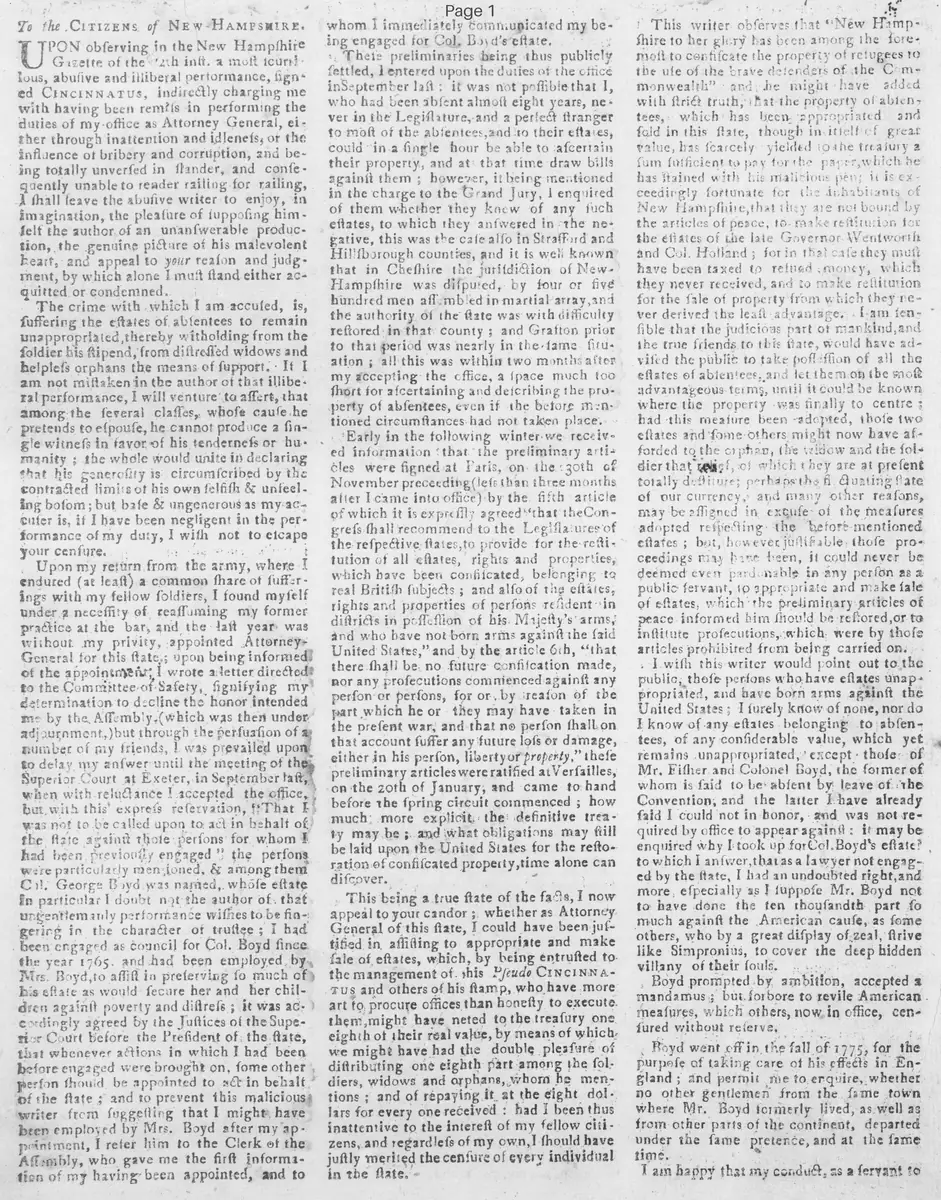
Upon observing in the New Hampshire Gazette of the 2d inst. a most scurrilous, abusive and illiberal performance, signed Cincinnatus, indirectly charging me with having been remiss in performing the duties of my office as Attorney General, either through inattention and idleness, or the influence of bribery and corruption, and being totally unversed in slander, and consequently unable to render railing for railing, I shall leave the abusive writer to enjoy, in imagination, the pleasure of supposing himself the author of an unanswerable production, the genuine picture of his malevolent heart, and appeal to your reason and judgment, by which alone I must stand either acquitted or condemned.
The crime with which I am accused, is, suffering the estates of absentees to remain unappropriated, thereby withholding from the soldier his stipend, from distressed widows and helpless orphans the means of support. If I am not mistaken in the author of that illiberal performance, I will venture to assert, that among the several classes, whose cause he pretends to espouse, he cannot produce a single witness in favor of his tenderness or humanity: the whole would unite in declaring that his generosity is circumscribed by the contracted limits of his own selfish & unfeeling bosom; but base & ungenerous as my accuser is, if I have been negligent in the performance of my duty, I wish not to escape your censure.
Upon my return from the army, where I endured (at least) a common share of sufferings with my fellow soldiers, I found myself under a necessity of reassuming my former practice at the bar, and the day year was without my privity, appointed Attorney General for this state: upon being informed of the appointment, I wrote a letter directed to the Committee of Safety, signifying my determination to decline the honor intended me by the Assembly (which was then under adjournment) but through the persuasion of a number of my friends, I was prevailed upon to delay my answer until the meeting of the Superior Court at Exeter, in September last, when with reluctance I accepted the office, but with this express reservation: That I was not to be called upon to act in behalf of the state against those persons for whom I had been previously engaged; the persons were particularly mentioned, & among them Col. George Boyd was named, whose estate in particular I doubt not the author of that ungentlemanly performance wishes to be suffering in the character of trustee; I had been engaged as counsel for Col. Boyd since the year 1768, and had been employed by Mrs. Boyd to assist in preserving so much of his estate as would secure her and her children against poverty and distress; it was accordingly agreed by the Justices of the Superior Court before the President of the state, that whenever actions in which I had been before engaged were brought on, some other person should be appointed to act in behalf of the state; and to prevent this malicious writer from suggesting that I might have been employed by Mrs. Boyd after my appointment, I refer him to the Clerk of the Assembly, who gave me the first information of my having been appointed, and to
whom I immediately communicated my being engaged for Col. Boyd's estate.
These preliminaries being thus publicly settled, I entered upon the duties of the office in September last: it was not possible that I, who had been absent almost eight years, never in the Legislature, and a perfect stranger to most of the absentees, and to their estates, could in a single hour be able to ascertain their property, and at that time draw bills against them; however, it being mentioned in the charge to the Grand Jury, I enquired of them whether they knew of any such estates, to which they answered in the negative, this was the case also in Strafford and Hillsborough counties, and it is well known that in Cheshire the jurisdiction of New-Hampshire was disputed by four or five hundred men assembled in martial array, and the authority of the state was with difficulty restored in that county; and Grafton prior to that period was nearly in the same situation: all this was within two months after my accepting the office, a space much too short for ascertaining and describing the property of absentees, even if the before mentioned circumstances had not taken place.
Early in the following winter we received information that the preliminary articles were signed at Paris, on the 20th of November preceding (less than three months after I came into office) by the fifth article of which it is expressly agreed "that the Congress shall recommend to the Legislatures of the respective states, to provide for the restitution of all estates, rights and properties, which have been confiscated, belonging to real British subjects; and also of the estates, rights and properties of persons resident in districts in possession of his Majesty's arms, and who have not borne arms against the said United States." and by the article 6th, "that there shall be no future Confiscation made, nor any prosecutions commenced against any person or persons, for, or by reason of the part which he or they may have taken in the present war, and that no person shall on that account suffer any future loss or damage, either in his person, liberty or property." these preliminary articles were ratified at Versailles, on the 20th of January: and came to hand before the spring circuit commenced; how much more explicit the definitive treaty may be; and what obligations may still be laid upon the United States for the restoration of confiscated property, time alone can discover.
This being a true state of the facts, I now appeal to your Candor; whether as Attorney General of this state, I could have been justified in, assisting to appropriate and make sale of estates, which, by being entrusted to the management of his Pseudo Cincinnatus and others of his stamp, who have more art to procure offices than honesty to execute them, might have netted to the treasury one eighth of their real value, by means of which, we might have had the double pleasure of distributing one eighth part among the soldiers, widows and orphans, whom he mentions: and of repaying it at the eight dollars for every one received: had I been thus inattentive to the interest of my fellow citizens, and regardless of my own, I should have justly merited the censure of every individual in the state.
This writer observes that "New Hampshire to her glory has been among the foremost to confiscate the property of refugees to the use of the brave defenders of the Commonwealth" and, he might have added with strict truth, that the property of absentees, which has been appropriated and sold in this state, though in itself of great value, has scarcely yielded to the treasury a sum sufficient to pay for the paper, which he has obtained with his malicious pen; it is exceedingly fortunate for the inhabitants of New Hampshire, that they are not bound by the articles of peace, to make restitution for the estates of the late Governor Wentworth and Col. Holland: for in that case they must have been taxed to refund money, which they never received, and to make restitution for the sale of property from which they never derived the least advantage. I am sensible that the judicious part of mankind, and the true friends to this state, would have advised the public to take possession of all the estates of absentees, and let them on the most advantageous terms, until it could be known where the property was finally to centre; had this measure been adopted, those two estates and some others might now have afforded to the orphan, the widow and the soldier that relief, of which they are at present totally destitute; perhaps the fluctuating state of our currency, and many other reasons, may be assigned in excuse of the measures adopted respecting the before mentioned estates: but, however justifiable those proceedings may have been, it could never be deemed even pardonable in any person as a public servant, to appropriate and make sale of estates, which the preliminary articles of peace informed him should be restored, or to institute prosecutions, which were by those articles prohibited from being carried on.
I wish this writer would point out to the public, those persons who have estates unappropriated, and have borne arms against the United States: I surely know of none, nor do I know of any estates belonging to absentees, of any considerable value, which yet remains unappropriated, except those of Mr. Fisher and Colonel Boyd, the former of whom is said to be absent by leave of the Convention: and the latter I have already said I could not in honor, and was not required by office to appear against: it may be enquired why I took up for Col. Boyd's estate? to which I answer, that as a lawyer not engaged by the state, I had an undoubted right, and more, especially as I suppose Mr. Boyd not to have done the ten thousandth part of much against the American cause, as some others, who by a great display of zeal, strive like Simpronius, to cover the deep hidden villany of their souls.
Boyd prompted by ambition, accepted a mandamus: but forbore to revile American measures, which others, now in office, censured without reserve. Boyd went off in the fall of 1775, for the purpose of taking care of his effects in England; and permit me to enquire, whether no other gentlemen from the same town where Mr. Boyd formerly lived, as well as from other parts of the continent, departed under the same pretence, and at the same time.
I am happy that my conduct, as a servant to
Be pleas'd is well known throughout the United States, it has ever been open and uniform: I have not during the contest with Great-Britain, been the inveterate tory or the rancorous whig: I confess myself unequal to the task of deceiving mankind, by flying from the extreme of one of those characters to that of the other; I have never approved the measures of Britain, or solemnly protested against those of America; neither have I ever merited the character of an idle drone. or has my public conduct ever been called in question, until a certain Junto, composed of this political Chamelion, his friend the special Justice at Concord, and one or two others of like talents, and political honesty, thought proper to make the attack. I am always happy in laying my conduct and the reason therefor before the public: and doubt not that your candor and good judgment will induce you to approve the measures, which as your servant, I have adopted. If the Grand Jury had found bills against them: but for me to have filed informations against any estates, I should undoubtedly have drawn of my own head, and put the state to the expence of prosecutions, when there was not a possibility that the public would reap even the least advantage therefrom, must have excited the astonishment of all mankind, and an "injured people."
JOHN SULLIVAN.
Durham, July 21.
What sub-type of article is it?
What themes does it cover?
What keywords are associated?
What entities or persons were involved?
Letter to Editor Details
Author
John Sullivan
Recipient
To The Citizens Of New Hampshire
Main Argument
john sullivan defends his conduct as attorney general against charges of negligence or corruption in failing to appropriate absentees' estates, explaining his recent appointment, prior commitments, practical obstacles, and the peace treaty's prohibitions on confiscations and prosecutions.
Notable Details