Thank you for visiting SNEWPapers!
Sign up free
Letter to Editor
September 18, 1793
Gazette Of The United States
New York, New York County, New York
What is this article about?
Dr. Edward Stevens responds to the College of Physicians' request by describing the contagious malignant disorder affecting the city, its symptoms, and a treatment plan emphasizing early intervention with tonics like bark and wine, cold baths, rest, and avoiding evacuations to mitigate its severity.
Clipping
OCR Quality
95%
Excellent
Full Text
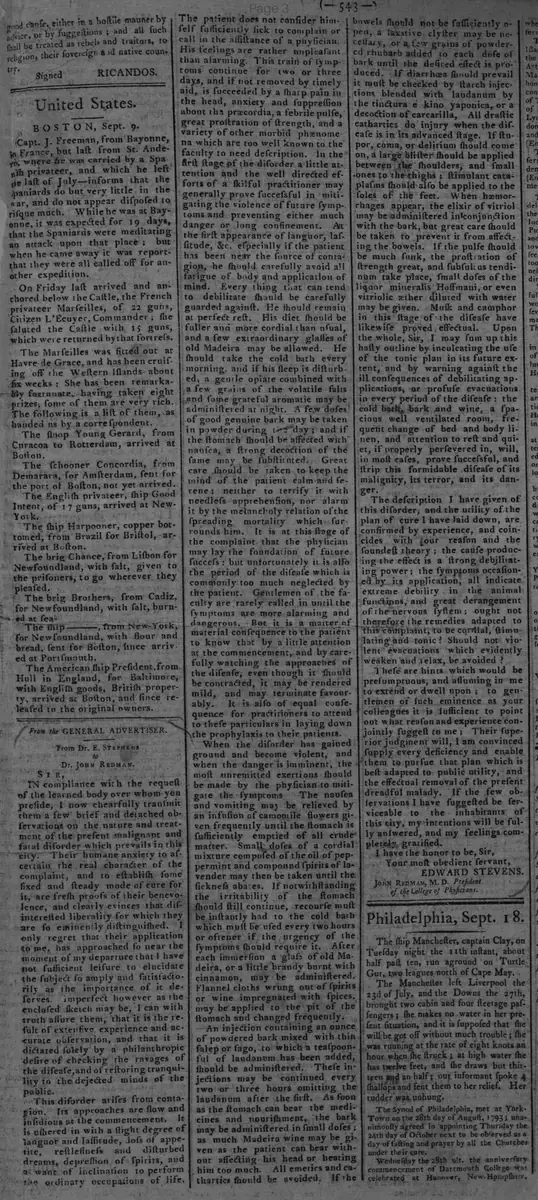
From the GENERAL ADVERTISER.
From Dr. E. STEPHENS to Dr. John REDMAN.
SIR,
IN compliance with the request of the learned body over whom you preside, I now cheerfully transmit to them a few brief and detached observations on the nature and treatment of the present malignant and fatal disorder which prevails in this city. Their humane anxiety to ascertain the real character of the complaint, and to establish some fixed and steady mode of cure for it, are fresh proofs of their benevolence, and clearly evinces that disinterested liberality for which they are so eminently distinguished. I only regret that their application to me, has approached so near the moment of my departure that I have not sufficient leisure to elucidate the subject so amply and satisfactorily as the importance of it deserves. Imperfect however as the enclosed sketch may be, I can with truth assure them, that it is the result of extensive experience and accurate observation, and that it is dictated solely by a philanthropic desire of checking the ravages of the disease, and of restoring tranquility to the dejected minds of the public.
This disorder arises from contagion. Its approaches are slow and insidious at the commencement. It is ushered in with a light degree of languor and lassitude, loss of appetite, restlessness and disturbed dreams, depression of spirits, and a want of inclination to perform the ordinary occupations of life.
The patient does not consider himself sufficiently sick to complain or call in the assistance of a physician. His feelings are rather unpleasant than alarming. This train of symptoms continue for two or three days, and if not removed by timely aid, is succeeded by a sharp pain in the head, anxiety and oppression about the precordia, a febrile pulse, great prostration of strength, and a variety of other morbid phenomena which are too well known to the faculty to need description. In the first stage of the disorder a little attention and the well directed efforts of a skillful practitioner may generally prove successful in mitigating the violence of future symptoms and preventing either much danger or long confinement. At the first appearance of languor, lassitude, &c. especially if the patient has been near the source of contagion, he should carefully avoid all fatigue of body and application of mind. Every thing that can tend to debilitate should be carefully guarded against. He should remain at perfect rest. His diet should be fuller and more cordial than usual, and a few extraordinary glasses of old Madeira may be allowed. He should take the cold bath every morning, and if his sleep is disturbed, a gentle opiate combined with a few grains of the volatile salts and some grateful aromatic may be administered at night. A few doses of good genuine bark may be taken in powder during the day; and if the stomach should be affected with nausea, a strong decoction of the same may be substituted. Great care should be taken to keep the mind of the patient calm and serene; neither to terrify it with needless apprehension, nor alarm it by the melancholy relation of the spreading mortality which surrounds him. It is at this stage of the complaint, that the physician may lay the foundation of future success: but unfortunately it is also the period of the disease which is commonly too much neglected by the patient. Gentlemen of the faculty are rarely called in until the symptoms are more alarming and dangerous. But it is a matter of material consequence to the patient to know that by a little attention at the commencement, and by carefully watching the approaches of the disease, even though it should be contracted, it may be rendered mild, and may terminate favorably. It is also of equal consequence for practitioners to attend to these particulars in laying down the prophylaxis to their patients.
When the disorder has gained ground and become violent, and when the danger is imminent, the most unremitted exertions should be made by the physician to mitigate the symptoms. The nausea and vomiting may be relieved by an infusion of camomile flowers given frequently until the stomach is sufficiently emptied of all crude matter. Small doses of a cordial mixture composed of the oil of peppermint and compound spirits of lavender may then be taken until the sickness abates. If notwithstanding the irritability of the stomach should still continue, recourse must be instantly had to the cold bath which must be used every two hours or oftener if the urgency of the symptoms should require it. After each immersion a glass of old Madeira, or a little brandy burnt with cinnamon, may be administered.
Flannel cloths wrung out of spirits or wine impregnated with spices, may be applied to the pit of the stomach and changed frequently.
An injection containing an ounce of powdered bark mixed with thin ale or ago, to which a teaspoonful of laudanum has been added, should be administered. These injections may be continued every two or three hours omitting the laudanum after the first. As soon as the stomach can bear the medicines and nourishment, the bark may be administered in small doses; as much Madeira wine may be given as the patient can bear without affecting his head or heating him too much. All emetics and cathartics should be avoided. If the bowels should not be sufficiently open, a laxative clyster may be necessary, or a few grains of powdered rhubarb added to each dose of bark until the desired effect is produced. If diarrhoea should prevail it must be checked by starch injections blended with laudanum by the tinctura ekino yaponica, or a decoction of carcarilla. All drastic cathartics do injury when the disease is in its advanced stage. If stupor, coma, or delirium should come on, a large blister should be applied between the shoulders, and small ones to the thighs; stimulant cataplasms should also be applied to the soles of the feet. When haemorrhages appear, the elixir of vitriol may be administered in conjunction with the bark, but great care should be taken to prevent it from affecting the bowels. If the pulse should be much sunk, the prostration of strength great, and subsultus tendinum take place, small doses of the liquor mineralis Hoffmani, or even vitriolic ether diluted with water may be given. Milk and camphor in this stage of the disease have likewise proved effectual.
Upon the whole, Sir, I may sum up this hasty outline by inculcating the use of the tonic plan in its future extent, and by warning against the ill consequences of debilitating applications, or profuse evacuations in every period of the disease: the cold bath, bark and wine, a spacious well ventilated room, frequent change of bed and body linen, and attention to rest and quiet, if properly persevered in, will, in most cases, prove successful, and strip this formidable disease of its malignity, its terror, and its danger.
The description I have given of this disorder, and the utility of the plan of cure I have laid down, are confirmed by experience, and coincides with your reason and the soundest theory; the cause producing the effect is a strong debilitating power; the symptoms occasioned by its application, all indicate extreme debility in the animal functions, and great derangement of the nervous system; ought not therefore the remedies adapted to this complaint, to be cordial, stimulating and tonic? Should not violent evacuations which evidently weaken and relax, be avoided?
These are hints which would be presumptuous, and assuming in me to extend or dwell upon; to gentlemen of such eminence as your colleagues it is sufficient to point out what reason and experience conjointly suggest to me; Their superior judgment will, I am convinced, supply every deficiency and enable them to pursue that plan which is best adapted to public utility, and the effectual removal of the present dreadful malady. If the few observations I have suggested be serviceable to the inhabitants of this city, my intentions will be fully answered, and my feelings completely gratified.
I have the honor to be, Sir,
Your most obedient servant,
EDWARD STEVENS.
JOHN REDMAN, M. D. President of the College of Physicians.
From Dr. E. STEPHENS to Dr. John REDMAN.
SIR,
IN compliance with the request of the learned body over whom you preside, I now cheerfully transmit to them a few brief and detached observations on the nature and treatment of the present malignant and fatal disorder which prevails in this city. Their humane anxiety to ascertain the real character of the complaint, and to establish some fixed and steady mode of cure for it, are fresh proofs of their benevolence, and clearly evinces that disinterested liberality for which they are so eminently distinguished. I only regret that their application to me, has approached so near the moment of my departure that I have not sufficient leisure to elucidate the subject so amply and satisfactorily as the importance of it deserves. Imperfect however as the enclosed sketch may be, I can with truth assure them, that it is the result of extensive experience and accurate observation, and that it is dictated solely by a philanthropic desire of checking the ravages of the disease, and of restoring tranquility to the dejected minds of the public.
This disorder arises from contagion. Its approaches are slow and insidious at the commencement. It is ushered in with a light degree of languor and lassitude, loss of appetite, restlessness and disturbed dreams, depression of spirits, and a want of inclination to perform the ordinary occupations of life.
The patient does not consider himself sufficiently sick to complain or call in the assistance of a physician. His feelings are rather unpleasant than alarming. This train of symptoms continue for two or three days, and if not removed by timely aid, is succeeded by a sharp pain in the head, anxiety and oppression about the precordia, a febrile pulse, great prostration of strength, and a variety of other morbid phenomena which are too well known to the faculty to need description. In the first stage of the disorder a little attention and the well directed efforts of a skillful practitioner may generally prove successful in mitigating the violence of future symptoms and preventing either much danger or long confinement. At the first appearance of languor, lassitude, &c. especially if the patient has been near the source of contagion, he should carefully avoid all fatigue of body and application of mind. Every thing that can tend to debilitate should be carefully guarded against. He should remain at perfect rest. His diet should be fuller and more cordial than usual, and a few extraordinary glasses of old Madeira may be allowed. He should take the cold bath every morning, and if his sleep is disturbed, a gentle opiate combined with a few grains of the volatile salts and some grateful aromatic may be administered at night. A few doses of good genuine bark may be taken in powder during the day; and if the stomach should be affected with nausea, a strong decoction of the same may be substituted. Great care should be taken to keep the mind of the patient calm and serene; neither to terrify it with needless apprehension, nor alarm it by the melancholy relation of the spreading mortality which surrounds him. It is at this stage of the complaint, that the physician may lay the foundation of future success: but unfortunately it is also the period of the disease which is commonly too much neglected by the patient. Gentlemen of the faculty are rarely called in until the symptoms are more alarming and dangerous. But it is a matter of material consequence to the patient to know that by a little attention at the commencement, and by carefully watching the approaches of the disease, even though it should be contracted, it may be rendered mild, and may terminate favorably. It is also of equal consequence for practitioners to attend to these particulars in laying down the prophylaxis to their patients.
When the disorder has gained ground and become violent, and when the danger is imminent, the most unremitted exertions should be made by the physician to mitigate the symptoms. The nausea and vomiting may be relieved by an infusion of camomile flowers given frequently until the stomach is sufficiently emptied of all crude matter. Small doses of a cordial mixture composed of the oil of peppermint and compound spirits of lavender may then be taken until the sickness abates. If notwithstanding the irritability of the stomach should still continue, recourse must be instantly had to the cold bath which must be used every two hours or oftener if the urgency of the symptoms should require it. After each immersion a glass of old Madeira, or a little brandy burnt with cinnamon, may be administered.
Flannel cloths wrung out of spirits or wine impregnated with spices, may be applied to the pit of the stomach and changed frequently.
An injection containing an ounce of powdered bark mixed with thin ale or ago, to which a teaspoonful of laudanum has been added, should be administered. These injections may be continued every two or three hours omitting the laudanum after the first. As soon as the stomach can bear the medicines and nourishment, the bark may be administered in small doses; as much Madeira wine may be given as the patient can bear without affecting his head or heating him too much. All emetics and cathartics should be avoided. If the bowels should not be sufficiently open, a laxative clyster may be necessary, or a few grains of powdered rhubarb added to each dose of bark until the desired effect is produced. If diarrhoea should prevail it must be checked by starch injections blended with laudanum by the tinctura ekino yaponica, or a decoction of carcarilla. All drastic cathartics do injury when the disease is in its advanced stage. If stupor, coma, or delirium should come on, a large blister should be applied between the shoulders, and small ones to the thighs; stimulant cataplasms should also be applied to the soles of the feet. When haemorrhages appear, the elixir of vitriol may be administered in conjunction with the bark, but great care should be taken to prevent it from affecting the bowels. If the pulse should be much sunk, the prostration of strength great, and subsultus tendinum take place, small doses of the liquor mineralis Hoffmani, or even vitriolic ether diluted with water may be given. Milk and camphor in this stage of the disease have likewise proved effectual.
Upon the whole, Sir, I may sum up this hasty outline by inculcating the use of the tonic plan in its future extent, and by warning against the ill consequences of debilitating applications, or profuse evacuations in every period of the disease: the cold bath, bark and wine, a spacious well ventilated room, frequent change of bed and body linen, and attention to rest and quiet, if properly persevered in, will, in most cases, prove successful, and strip this formidable disease of its malignity, its terror, and its danger.
The description I have given of this disorder, and the utility of the plan of cure I have laid down, are confirmed by experience, and coincides with your reason and the soundest theory; the cause producing the effect is a strong debilitating power; the symptoms occasioned by its application, all indicate extreme debility in the animal functions, and great derangement of the nervous system; ought not therefore the remedies adapted to this complaint, to be cordial, stimulating and tonic? Should not violent evacuations which evidently weaken and relax, be avoided?
These are hints which would be presumptuous, and assuming in me to extend or dwell upon; to gentlemen of such eminence as your colleagues it is sufficient to point out what reason and experience conjointly suggest to me; Their superior judgment will, I am convinced, supply every deficiency and enable them to pursue that plan which is best adapted to public utility, and the effectual removal of the present dreadful malady. If the few observations I have suggested be serviceable to the inhabitants of this city, my intentions will be fully answered, and my feelings completely gratified.
I have the honor to be, Sir,
Your most obedient servant,
EDWARD STEVENS.
JOHN REDMAN, M. D. President of the College of Physicians.
What sub-type of article is it?
Informative
Persuasive
What themes does it cover?
Health Medicine
What keywords are associated?
Malignant Disorder
Contagion
Treatment Plan
Bark
Cold Bath
Wine
Tonics
Yellow Fever
What entities or persons were involved?
Edward Stevens
Dr. John Redman, President Of The College Of Physicians
Letter to Editor Details
Author
Edward Stevens
Recipient
Dr. John Redman, President Of The College Of Physicians
Main Argument
the malignant disorder is contagious and arises from debility; early treatment with rest, tonics like bark and wine, cold baths, and avoiding evacuations can mitigate its severity and prevent fatal outcomes.
Notable Details
Arises From Contagion
Use Of Bark, Wine, And Cold Bath
Avoid Emetics And Cathartics
Confirmed By Experience And Theory