Thank you for visiting SNEWPapers!
Sign up free
The Augusta Courier
Augusta, Richmond County, Georgia
What is this article about?
Alex A. Lawrence, a Savannah lawyer, speaks to the Magna Carta Dames about the historical struggle in England and America to restrain tyrannical rulers under law, criticizing the modern U.S. Supreme Court for assuming dictatorial power akin to past kings, urging recognition of judicial absolutism as a threat to liberty.
Merged-components note: Full article reporting Alex A. Lawrence's speech on tyranny in black robes (Supreme Court), historical context from Magna Carta, continued across pages 1 to 2 to 4, indicated by continuation phrases; relabeled from editorial to story as it is a reported speech, not opinion piece.
Clippings
1 of 3
OCR Quality
Full Text
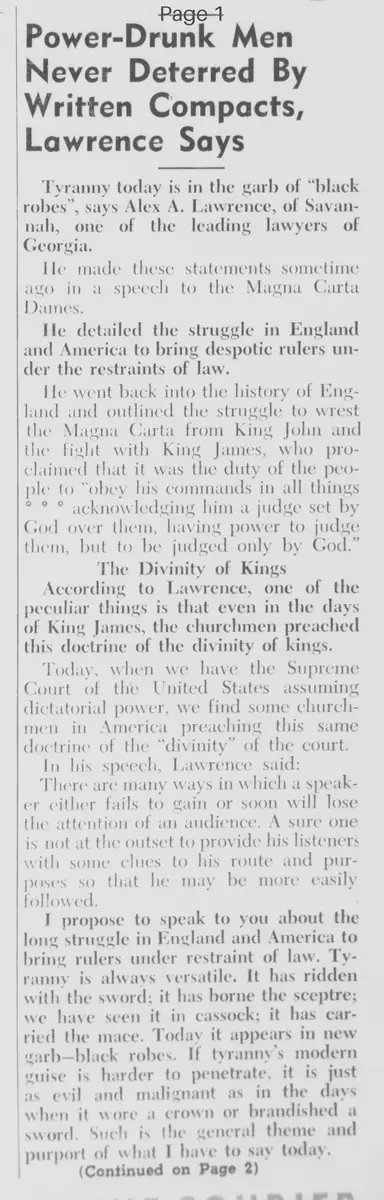
Lawrence Says
Tyranny today is in the garb of "black robes", says Alex A. Lawrence, of Savannah, one of the leading lawyers of Georgia.
He made these statements sometime ago in a speech to the Magna Carta Dames.
He detailed the struggle in England and America to bring despotic rulers under the restraints of law.
He went back into the history of England and outlined the struggle to wrest the Magna Carta from King John and the fight with King James, who proclaimed that it was the duty of the people to "obey his commands in all things acknowledging him a judge set by God over them, having power to judge them, but to be judged only by God."
The Divinity of Kings
According to Lawrence, one of the peculiar things is that even in the days of King James, the churchmen preached this doctrine of the divinity of kings.
Today, when we have the Supreme Court of the United States assuming dictatorial power, we find some churchmen in America preaching this same doctrine of the "divinity" of the court.
In his speech, Lawrence said:
There are many ways in which a speaker either fails to gain or soon will lose the attention of an audience. A sure one is not at the outset to provide his listeners with some clues to his route and purposes so that he may be more easily followed.
I propose to speak to you about the long struggle in England and America to bring rulers under restraint of law. Tyranny is always versatile. It has ridden with the sword; it has borne the sceptre; we have seen it in cassock; it has carried the mace. Today it appears in new garb-black robes. If tyranny's modern guise is harder to penetrate, it is just as evil and malignant as in the days when it wore a crown or brandished a sword. Such is the general theme and purport of what I have to say today.
Power-Drunk Men Never Deterred By
(Continued from Page 1)
John Was A Tyrant
Nowhere is the importance of Magna Carta better illustrated than in the fact that one who travels the way I am taking starts out from the June day nearly 750 years ago when the barons met King John in the meadow which is called Runnymede between Windsor and Staines. John was a tyrant, pure and simple. Of the man from whom the barons wrested Magna Carta in the year 1215 a contemporary said: "Foul as it is, hell itself is defiled by the fouler presence of John." We do not see his like again in English history. We shall, however, see other tyrants. They have an evil characteristic in common, the control or attempted control of justice. The Curia Regis of Angevin days was indeed a king's court. The monarch frequently sat there in person. Justice was purchased and sold there like a commodity. We do not need the 40th chapter of Magna Carta to prove that fact; many examples of the vending of justice are brazenly recorded on the rolls of the exchequer of those times.
The great place of Magna Carta in constitutional history rests in the fact that the unlimited prerogative of kings was for the first time brought under restraint. Thereafter the crown was to be under the rule of law. The Great Charter symbolizes the end of absolute and the beginning of limited monarchy. Under it England became a nation and not a Norman appendage.
Blood and Valor
But tyranny is never deterred by written compacts. Scarcely was the Great Charter sealed before it was repudiated by King John. Pope Innocent III issued a papal bull declaring the charter void. The barons were excommunicated. Tyrants, as we shall see, often ride in high company. Despite its confirmation by English kings on upwards of 30 occasions (11 times alone in the reign of Edward I), Magna Carta was dishonored in the breach rather than honored by observance during the next 400 years. Arbitrary imprisonment was the rule in England. Personal liberty was unknown.
During those centuries the royal prerogative grew in malignance. The mass of English people were docile. Masses are always docile. Large gains in freedom and liberty are usually achieved by the blood and valor of a few great souls.
With the coming of the Stuart kings, England emerged from the Middle Ages. Though its trappings remained, medievalism was dead. It was the high destiny of Englishmen of that century to establish after bitter struggle the concept of limited monarchy; of a Crown that was not above the law. The human leaven at work in the Tudor period perhaps made a struggle for supremacy between King and Parliament inevitable. James I hurled the gage of battle at the feet of the Commons. The royal prerogative was so unbounded, he claimed, as to be "no subject for the tongue of a lawyer nor is it lawful to be disputed." He repeatedly informed Parliament that its privileges were exercisable under his pleasure and that it had no more business inquiring as to what he might lawfully do than as to what the Deity could.
The ductie, and allegiance of the people to their lawful King," wrote this monarch, was to "obey his commands in all things acknowledging him a judge set by God over them, having power to judge them, but to be judged only by God." Churchmen of the day preached this doctrine of the divinity of kings.
Edward Coke
It is "a thing regal and proper to a king," James I declared, "to keep every court within its bounds." Chief Justice Edward Coke had described Magna Carta as "such a fellow that he will have no sovereign." He was dismissed from office because he did not see eye to eye with the Crown. The attorney general of Charles I argued to a sympathetic king's bench in 1627: "Should anyone say, the King cannot do this? No, we may only say, he will not do this." In modern days there are attorney generals who claim a similar prerogative for the Federal judiciary. And there are those among us who maintain that we have as little right to challenge the United States Supreme Court as the Deity.
Fortunately for freedom the light of Magna Carta shone across 400 years of darkness into the 17th century. The Great Charter was now to play its greatest role. It became for this era the very symbol of man's freedom. There were Englishmen in the time of the Stuarts who were as undaunted by tyrants as the barons were in the time of John. They forced through Parliament the celebrated Petition of Right. In spirit and purpose the blood brother of the Charter, it drew a line in certain areas which marked the end of the King's prerogative and the beginning the reign of law. The writ of habeas corpus was to lie even when an arrest was by command of the King or the Star Chamber.
But parchments make poor fetters for tyrants. The petition was repudiated by Charles I and the Parliamentary leaders were imprisoned. The executioner's axe later descended upon his royal neck. The death sentence declared that he had ruled, not by law, but by his own will.
Tyranny Never Dies
However, tyranny was not dead. Tyranny never dies; it merely sleeps. The second Charles and the second James piously professed deep respect for law. Tyrants live comfortably under law-or rather under the mere form of it. Courts can be controlled when judges are controllable. (Courts can still be controlled by advance screening of the judicial philosophy of appointees.) Charles II dismissed two lord chancellors, three chief justices, and six judges. James II went further. Seldom has the judiciary been so disgraced by partiality and arrogance as in this era. Judges prostituted themselves in advancing every royal encroachment. In riding the "Bloody Assizes" Chief Justice Jeffreys and his colleagues were on the King's business under the King's orders. James II placed troops at their beck and call. The history of tyranny moves in circles not vertically. Present always meets past at some point. In modern days an itinerant judge, equally partial, is sent down by Department of Justice on the business of superiors. Troops pour in to enforce his edict at bayonet point. History ran a full circle in Arkansas. The difference was that 17th century Englishmen saw and knew what was going on; 20th century Americans will not look.
The Declaration of Rights enacted by Parliament in 1689 following the Glorious Revolution that dethroned James II was the crowning glory of a century that saw the establishment or vindication of many of the basic principles and cherished liberties that were later to find expression in the Federal Constitution and the original amendments. Unknowing people sometimes are heard to say that the Bill of Rights in the Constitution of the United States gives them the privilege to this or that. The Bill of Rights gives nothing. It only reaffirms and rescues liberties won long before by Anglo-Saxon struggle and sacrifice. It is easy to take hereditary rights for granted. That is why liberty is often lost. Freedom lives in men's hearts; it withers on paper. "Liberty," Lord Acton once said, is something never established for the future; but something which each age must provide for itself.
Depravity of Mankind
Tyranny did not pass with the Stuarts. So long as lust for power is a depravity of mankind, so long will despotism be resilient. Thwarted in England in the 17th century, it reared itself in America in the next century. The royal prerogative was extended across the Atlantic under George III. A great revolution settled the issue. A new nation came into being, dedicated to the idea of the bridling of absolute power through government under a written constitution. Like Magna Carta, the genius of the Federal Constitution was the restraint of absolutism by law. Under expressly delegated powers, carefully counter-balanced and always limited, it couldn't happen here.
Oh Magna Carta Dames, proud in the accomplishments of your forebears at Runnymede, do you not see that the curse of King John is over your own land? Tyranny is, indeed, often difficult to see. What is hard to detect is hard to deter. Even when recognized, men tend to endure rather than overthrow it. Charles I might have died an absolute monarch if he had not attempted to impose the episcopacy on Scotland; James II was chased off the throne mainly because he was a papist, not because he was a tyrant. Judicial despotism is more insidious than any other form of absolutism. The Supreme Court of the United States is a "noiseless, and therefore unalarming instrument;" the Federal judiciary is "a subtle corps of sappers and miners." Those are not my words. Thomas Jefferson said that.
A man could feel a Tudor lash across his back or a Stuart pillory about his neck. Despotism is obvious when it arbitrarily crops men's ears or chops off their heads. But a berobed Chief Justice with law book in hand (a moderate sociological tome between its covers) is harder to recognize for what he really is. Absolutism is the same bad merchandise in all eras. Packages and trademarks change.
An eminent jurist, Judge Learned Hand, has recently declared that the basis on which the Supreme Court set itself up as a third legislative chamber can rest on nothing else than a "coup de main" - or a pure usurpation, one might say, if the French had not given us a phrase for it. The Court has evolved into an anomalous body, unknown to the Founding Fathers: unknown to the Federal Constitution: unknown, indeed to anything in the history of constitutional Total Law. It has become a sort of constitutional convention always in session and clearly busy at making our Constitution read like modern judges want it to be read.
The Supreme Court Justice is no longer a jurist, he is a zealot. A lawyer in name, he is a reformer at heart. The philosophy that the Court should use its enormous power for so-called wholesome social purposes is rampant in our generation. The liberal and activist elements on the Court have unabashedly thrown off all restraint. One of the Justices glibly announces that "stare decisis has little place in American constitutional law." Members of the Court explain that the process of amendment of the Constitution is too slow. Others cooly tell us that if they are wrong the next generation of judges can correct them. Mr. Justice Stone significantly pointed out in 1936 that "while unconstitutional exercise of power by the executive and legislative branches of the Government is subject to judicial restraint, the only check upon our exercise of power is our own sense of self-restraint." At that type of restraint tyrants in all ages have laughed while populaces weep.
Liberty held at the arbitrary will of another is the illusion of liberty. Power which is only self-restrained is absolutism.
Over A Century
For over a century there were limitations of a sort upon the Supreme Court. For one thing, the judges looked for the meaning of the Constitution in the intent of the framers and ratifiers of that document. It meant what the Founding Fathers intended it to mean; not what judges thought it ought to mean for their own day and time. The touchstone of original intent was, to some extent, a check on arbitrary will in constitutional interpretation. There was another restraint - the rule of common law that courts must stand by settled judicial precedents. Once the meaning of a provision of the Constitution is fixed by a decision the judges are under a duty in later cases to follow the rule previously established by it.
Both in theory and practice these restraints upon raw judicial power have been abandoned in our highest Court. The sheet anchors of the ship have been willfully cut loose by her crew. In large areas the Supreme Court rules by uncontrolled will. So did John and James and Charles.
It is a peculiar irony that due process guarantees intended to secure individual freedom have become the very source and breeding place of arbitrary rule by courts. Weapons intended to keep men free have been remolded in the judicial forge into shackles by which men are reenchained. As an able writer says:
The well understood words of Magna Carta moved across six centuries into the 5th and 14th amendments. Once they were our freedom-now they are our chains. No student of constitutional history would suppose that the 39th chapter of Magna Carta and the words "due process of law" in the statute of Edward III meant more than that ordinary legal processes must precede any sentence, judgment, or action by which a man is 'deprived of his life, liberty, or property. The same words in the 14th amendment have been tortured by the courts into the meaning that State action of any kind must be constitutionally tested by its conformity to what is called fundamental principles of liberty and of justice or by equally nebulous formulas. What this means is nothing more than the notions and predilections of judges on the particular subject. This is not law, it is whim.
Soft On Commies
The caprice and the favoritism that mark its hegemony in constitutional interpretation is reflected in hundreds of decisions exhibiting a tender solicitude for the rights of criminal, Communist and crank while the rights of sovereign States go begging in the same Court.
Power-Drunk Men
(Continued from Page 2)
It is an old tale. After all, the 10th amendment is but a parchment compact. Judicial absolutism is more awesome when its expression is legislation in the guise of court decrees affecting and dictating the pattern of daily life for millions of Americans. It is the more frightening in the hands of men (one man when there is a close division on the bench) elected by nobody; responsible to none but themselves and appointed for life by politicians. Despotism is the more artful when it parades as justice and law. It is the more absolute when people are cajoled into believing that court decisions are the law of the land to which unquestioning obeisance is due.
Obeisance. Across three centuries there come to us the words of John Selden who asked by what statute resistance to tyranny can be justified, majestically replied, "by the custom of England, which is part of the law of the land."
It is a sort of law of political science that governmental bodies possessing powers whose limits are adumbral or unprecisely defined inevitably tend to exert authority to the outermost bounds of the area of doubt. Power always expands into vacuums. Our Constitution has become but the gloss of decisions of the Supreme Court. That tribunal has now cast aside the restraints by which courts ordinarily police themselves. The high prerogative which it exercises is practically unlimited. Judicial independence has become judicial arrogance.
Constitutional Crisis
Somehow we must find some way to impose some measure of restraint on the powers of the Supreme Court. No one would destroy the court. The halter of law is not a mark of servility; it is the hallmark of liberty. This is not the occasion to discuss the nature of the curb; whether it takes the form of elimination of judicial review of state action save where the same impinges on the delegated powers of the Federal Government; whether the Federal judiciary should be denied power to veto State legislation because of the 14th amendment or the Federal Bill of Rights: whether the method of selection of Federal judges should be reformed, including divorcement of the judiciary from the Department of Justice: or whatever other means may be devised to bring the Supreme Court under a restraint wholly lacking now. It is more important at the moment to get people to realize that judicial absolutism exists today in America and that it is dangerous to liberty.
Facing in our time a constitutional crisis as grave as that which confronted 17th century England, a great task lies ahead of us. Absolutism is always formidable. It is never without powerful allies. In the coming struggle may God give us the courage of the men who centuries ago at Runnymede put rulers under the rule of law for the first time.
What sub-type of article is it?
What themes does it cover?
What keywords are associated?
What entities or persons were involved?
Where did it happen?
Story Details
Key Persons
Location
England, United States
Event Date
Sometime Ago; Historical Events From 1215
Story Details
Alex A. Lawrence recounts the history of struggles against tyrannical rulers in England from Magna Carta in 1215 to the Stuarts, paralleling them to the modern U.S. Supreme Court's unchecked power, arguing that written compacts fail to deter power-drunk men and calling for restraints on judicial absolutism to preserve liberty.