Thank you for visiting SNEWPapers!
Sign up free
Letter to Editor
December 29, 1856
Alexandria Gazette
Alexandria, Alexandria County, District Of Columbia
What is this article about?
Col. Benton corrects errors in a newspaper report of his speech, specifically denying use of 'lady' when referencing Job's daughters as a blessing, and explains his aversion to the term based on biblical, historical, and cultural reasons.
Clipping
OCR Quality
95%
Excellent
Full Text
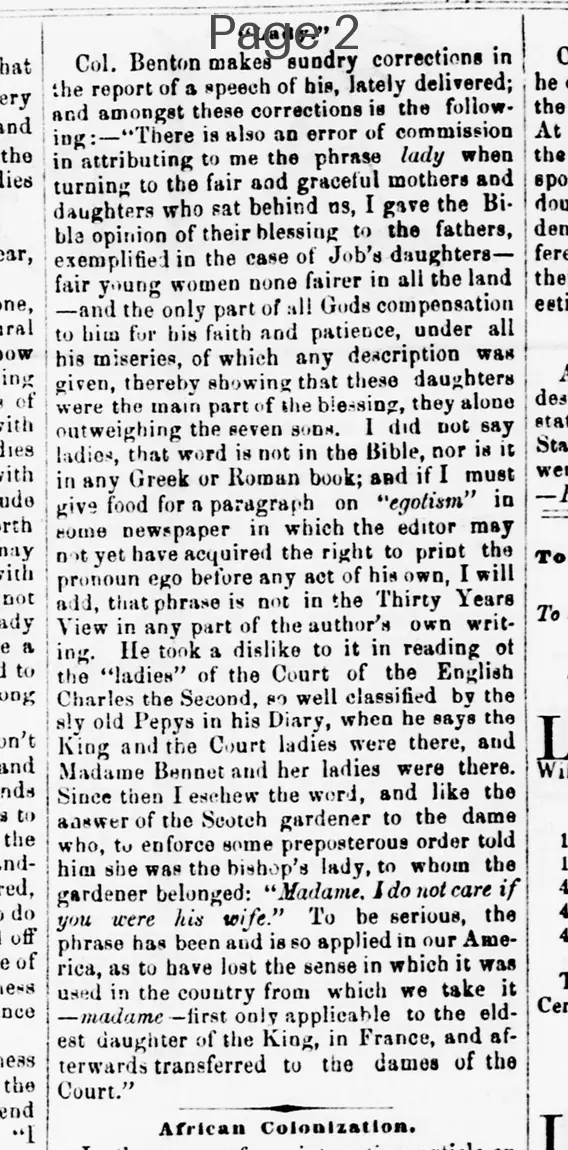
Col. Benton makes sundry corrections in the report of a speech of his, lately delivered; and amongst these corrections is the following:--"There is also an error of commission in attributing to me the phrase lady when turning to the fair and graceful mothers and daughters who sat behind us, I gave the Bible opinion of their blessing to the fathers, exemplified in the case of Job's daughters-- fair young women none fairer in all the land --and the only part of all God's compensation to him for his faith and patience, under all his miseries, of which any description was given, thereby showing that these daughters were the main part of the blessing, they alone outweighing the seven sons. I did not say ladies, that word is not in the Bible, nor is it in any Greek or Roman book; and if I must give food for a paragraph on "egotism" in some newspaper in which the editor may not yet have acquired the right to print the pronoun ego before any act of his own, I will add, that phrase is not in the Thirty Years View in any part of the author's own writing. He took a dislike to it in reading of the "ladies" of the Court of the English Charles the Second, so well classified by the sly old Pepys in his Diary, when he says the King and the Court ladies were there, and Madame Bennet and her ladies were there. Since then I eschew the word, and like the answer of the Scotch gardener to the dame who, to enforce some preposterous order told him she was the bishop's lady, to whom the gardener belonged: "Madame, I do not care if you were his wife." To be serious, the phrase has been and is so applied in our America, as to have lost the sense in which it was used in the country from which we take it --madame--first only applicable to the eldest daughter of the King, in France, and afterwards transferred to the dames of the Court."
What sub-type of article is it?
Informative
Reflective
What themes does it cover?
Politics
Press Freedom
What keywords are associated?
Col Benton
Speech Correction
Lady Word
Job Daughters
Pepys Diary
Etymology
What entities or persons were involved?
Col. Benton
Letter to Editor Details
Author
Col. Benton
Main Argument
col. benton corrects a newspaper report attributing the word 'lady' to him in a speech, explaining he used biblical phrasing about job's daughters instead, and discusses the word's historical and cultural connotations, preferring to avoid it.
Notable Details
Bible Reference To Job's Daughters
Thirty Years View
Pepys Diary On Charles Ii Court
Scotch Gardener Anecdote