Thank you for visiting SNEWPapers!
Sign up free
Wood County Reporter
Wisconsin Rapids, Wood County, Wisconsin
What is this article about?
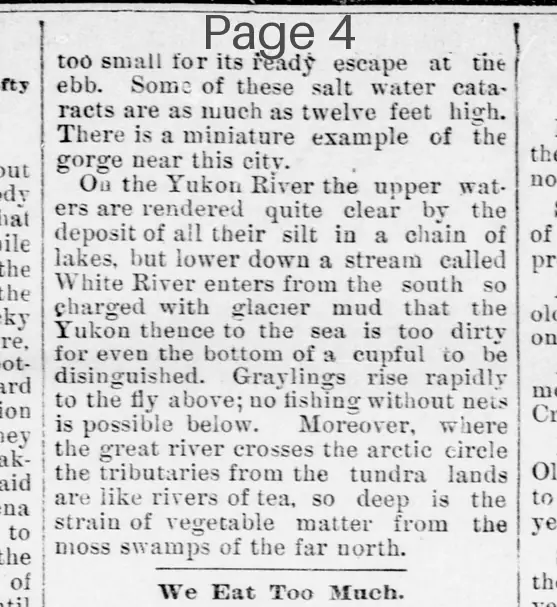
Description of salt water cataracts too small for escape at ebb, up to twelve feet high, with a miniature gorge near the city. On the Yukon River, upper waters clear due to lake silt deposits, but White River adds glacier mud making it opaque to the sea; graylings fished above but nets needed below. Tributaries at arctic circle resemble tea from tundra moss.
Clipping
OCR Quality
Full Text
On the Yukon River the upper waters are rendered quite clear by the deposit of all their silt in a chain of lakes, but lower down a stream called White River enters from the south so charged with glacier mud that the Yukon thence to the sea is too dirty for even the bottom of a cupful to be distinguished. Graylings rise rapidly to the fly above; no fishing without nets is possible below. Moreover, where the great river crosses the arctic circle the tributaries from the tundra lands are like rivers of tea, so deep is the strain of vegetable matter from the moss swamps of the far north.
What sub-type of article is it?
What themes does it cover?
What keywords are associated?
Where did it happen?
Story Details
Location
Yukon River, White River, Arctic Circle, Tundra Lands, Near This City
Story Details
Salt water cataracts up to twelve feet high prevent escape at ebb, with a miniature gorge near the city. Yukon River's upper waters clear from silt in lakes, but White River's glacier mud dirties it to the sea, affecting fishing; arctic circle tributaries tea-like from tundra moss.