Thank you for visiting SNEWPapers!
Sign up free
Smyrna Times
Smyrna, Kent County, Delaware
What is this article about?
University of Delaware nutrition specialist Miss Gertrude Holloway discusses USDA study findings that protein-rich breakfasts, such as those with milk and eggs, enhance well-being and delay fatigue more effectively than low-protein meals, based on tests with laboratory workers.
Clipping
OCR Quality
Full Text
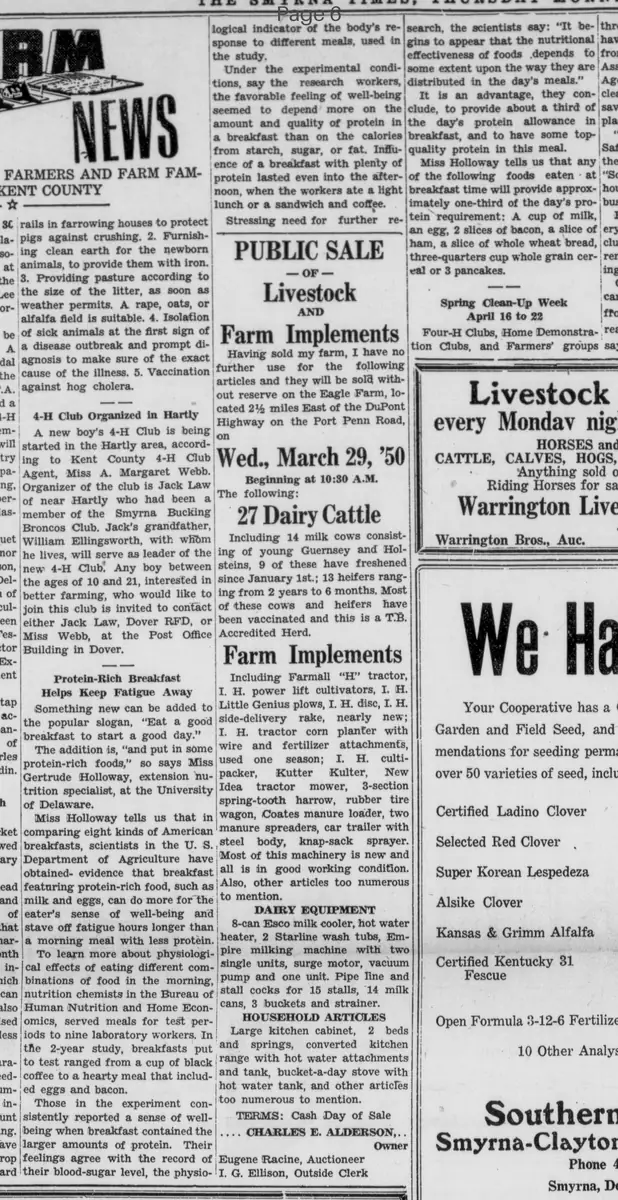
Something new can be added to the popular slogan, "Eat a good breakfast to start a good day." The addition is, "and put in some protein-rich foods," so says Miss Gertrude Holloway, extension nutrition specialist, at the University of Delaware.
Miss Holloway tells us that in comparing eight kinds of American breakfasts, scientists in the U. S. Department of Agriculture have obtained evidence that breakfast featuring protein-rich food, such as milk and eggs, can do more for the eater's sense of well-being and stave off fatigue hours longer than a morning meal with less protein.
To learn more about physiological effects of eating different combinations of food in the morning, nutrition chemists in the Bureau of Human Nutrition and Home Economics, served meals for test periods to nine laboratory workers. In the 2-year study, breakfasts put to test ranged from a cup of black coffee to a hearty meal that included eggs and bacon.
Those in the experiment consistently reported a sense of well-being when breakfast contained the larger amounts of protein. Their feelings agree with the record of their blood-sugar level, the physiological indicator of the body's response to different meals, used in the study.
Under the experimental conditions, say the research workers, the favorable feeling of well-being seemed to depend more on the amount and quality of protein in a breakfast than on the calories from starch, sugar or fat. Influence of a breakfast with plenty of protein lasted even into the afternoon, when the workers ate a light lunch or a sandwich and coffee.
Stressing need for further research, the scientists say: "It begins to appear that the nutritional effectiveness of foods depends to some extent upon the way they are distributed in the day's meals."
It is an advantage, they conclude, to provide about a third of the day's protein allowance in breakfast, and to have some top-quality protein in this meal.
Miss Holloway tells us that any of the following foods eaten at breakfast time will provide approximately one-third of the day's protein requirement: A cup of milk, an egg, 2 slices of bacon, a slice of ham, a slice of whole wheat bread, three-quarters cup whole grain cereal or 3 pancakes.
What sub-type of article is it?
What keywords are associated?
What entities or persons were involved?
Where did it happen?
Domestic News Details
Primary Location
University Of Delaware
Key Persons
Outcome
breakfasts with protein-rich foods like milk and eggs improve sense of well-being and stave off fatigue longer than those with less protein; effects last into the afternoon even with light lunch.
Event Details
Miss Gertrude Holloway, extension nutrition specialist at the University of Delaware, reports on a U.S. Department of Agriculture study comparing eight kinds of American breakfasts. Nutrition chemists in the Bureau of Human Nutrition and Home Economics tested meals on nine laboratory workers over two years, ranging from black coffee to eggs and bacon. Participants reported better well-being with higher protein amounts, confirmed by blood-sugar levels. Protein quality and amount mattered more than calories from starch, sugar, or fat. Scientists recommend one-third of daily protein in breakfast from top-quality sources like a cup of milk, an egg, 2 slices of bacon, a slice of ham, a slice of whole wheat bread, three-quarters cup whole grain cereal, or 3 pancakes.