Thank you for visiting SNEWPapers!
Sign up free
Kentucky Gazette
Lexington, Fayette County, Kentucky
What is this article about?
An article from the Pittsburg Mercury discusses Mexico's geography, historical Spanish atrocities as described by Bishop Las Casas in 1542, the current Mexican struggle for independence from Spain in 1812, and U.S. political support including congressional debates and expeditions led by Bernardo and Magee.
Clipping
OCR Quality
Full Text
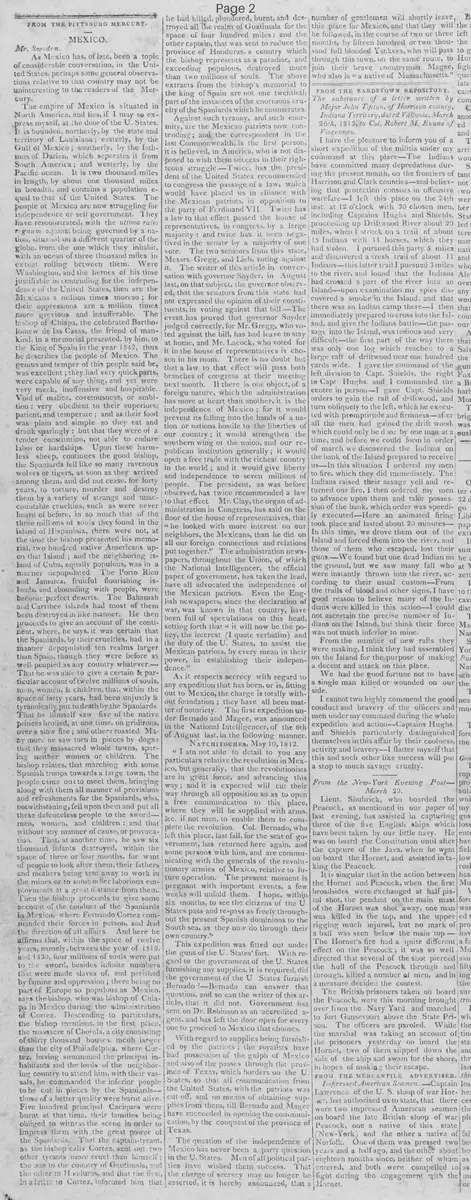
MEXICO.
Mr. Swoden.
As Mexico has, of late, been a topic of considerable conversation, in the United States, perhaps some general observations relative to that country may not be uninteresting to the readers of the Mercury.
The empire of Mexico is situated in North America, and lies, if I may so express myself, at the door of the U. States. It is bounded, northerly, by the state and territory of Louisiana; easterly, by the Gulf of Mexico: southerly, by the Isthmus of Darien, which separates it from South America; and westerly, by the Pacific ocean. It is two thousand miles in length, by about one thousand miles in breadth, and contains a population equal to that of the United States. The people of Mexico are now struggling for independence or self government. They have remonstrated, with the ultimatum against being governed by a nation, situated on a different quarter of the globe, from the one which they inhabit, with an ocean of three thousand miles in extent rolling between them. Were Washington, and the heroes of his time justifiable in contending for the independence of the United States, then are the Mexicans a million times more so; for their oppressions are a million times more grievous and insufferable. The bishop of Chiapa, the celebrated Bartholomew de las Casas, the friend of mankind, in a memorial presented, by him, to the King of Spain in the year 1542, thus he describes the people of Mexico. The genius and temper of this people said he, was excellent; they had very quick parts, were capable of any thing, and yet were very meek, inoffensive and hospitable. Void of malice, covetousness, or ambition: very obedient to their superiors, patient, and temperate; and as their food was plain and simple so they eat and drank sparingly: but that they were of a tender constitution, not able to endure labor or hardships. Upon these harmless sheep, continues the good bishop, the Spaniards fell like so many ravenous wolves or tigers, as soon as they arrived among them, and did not cease, for forty years, to torture, murder and destroy them by a variety of strange and unaccountable cruelties, such as were never heard of before, in so much that of the three millions of souls they found in the island of Hispaniola, there were not, at the time the bishop presented his memorial, two hundred native Americans upon that Island; and the neighboring island of Cuba, equally populous, was in a manner depopulated The Porto Rico and Jamaica, fruitful flourishing islands, and abounding with people, were become perfect deserts. The Bahama and Carribee islands had most of them been destroyed in like manner. He then proceeds to give an account of the continent, where, he says, it was certain that the Spaniards, by their cruelties, had in a manner depopulated ten realms larger than Spain, though they were before as well peopled as any country whatever.— That he was able to give a certain & particular account of twelve millions of souls, men, women, & children, that, within the space of forty years, had been unjustly & tyrannically put to death by the Spaniards. That he himself saw five of the native princes broiled, at one time, on gridirons, over a slow fire; and others roasted. Many more he saw torn in pieces by dogs: that they massacred whole towns, sparing neither women or children. The bishop relates, that marching with some Spanish troops towards a large town, the people came out to meet them, bringing along with them all manner of provisions and refreshments for the Spaniards, who, notwithstanding, fell upon them and put all these defenceless people to the sword— men, women, and children : and that without any manner of cause, or provocation. That, at another time, he saw six thousand infants destroyed, within the space of three or four months, for want of people to look after them, their fathers and mothers being sent away to work in the mines or to some other laborious employments at a great distance from them. Then the bishop proceeds to give some account of the conduct of the Spaniards in Mexico, where Fernando Cortez commanded their forces in person, and had the direction of all affairs And here he affirms that, within the space of twelve years, namely, between the year of 1518, and 1530, four millions of souls were put to the sword, besides infinite numbers that were made slaves of, and perished by famine and oppression ; there being no part of Europe so populous as Mexico, says the bishop, who was bishop of Chiapa in Mexico during the administration of Cortez. Descending to particulars, the bishop mentions, in the first place, the massacre of Cholula, a city consisting of thirty thousand houses, much larger than the city of Philadelphia, where Cortez, having summoned the principal inhabitants and the lords of the neighboring country to attend him, with their vassals, he commanded the inferior people to be cut in pieces by the Spaniards— those of a better quality were burnt alive. Five hundred principal Caciques were burnt at that time, their families being obliged to witness the scene in order to impress them with the great power of the Spaniards. That the captain-tyrant, as the bishop calls Cortez, sent out two other tyrants more cruel than himself: the one to the country of Guatemala, and the other to Honduras, and that the first in a letter to Cortez, informed him that he had killed, plundered, burnt, and destroyed all the realm of Guatemala for the space of four hundred miles: and the other captain, that was sent to reduce the province of Honduras, a country which the bishop represents as a paradise, and exceeding populous, destroyed more than two millions of souls. The above extracts from the bishop's memorial to the king of Spain are not one twentieth part of the instances of the enormous cruelty of the Spaniards which he enumerates. Against such tyranny, and such enormity, are the Mexican patriots now contending; and the correspondent in the last Commonwealth, is the first person, it is believed, in America, who is not disposed to wish them success in their righteous struggle.--Twice, has the president of the United States recommended to congress the passage of a law, which would have placed us in alliance with the Mexican patriots, in opposition to the party of Ferdinand VII. Twice has a law to that effect passed the house of representatives, in congress, by a large majority : and twice has it been negatived in the senate by a majority of one vote. The two senators from this state, Messrs. Gregg, and Lieb, voting against it. The writer of this article in conversation with governor Snyder, in August last, on that subject, the governor observed, that the senators from this state had not expressed the opinion of their constituents, in voting against that bill.--The event has proved that governor Snyder judged correctly, for Mr. Gregg, who voted against the bill, has had leave to stay at home, and Mr. Lacock, who voted for it in the house of representatives is chosen in his room. There is no doubt but that a law to that effect will pass both branches of congress at their meeting next month. If there is one object, of a foreign nature, which the administration has more at heart than another, it is the independence of Mexico ; for it would prevent its falling into the hands of a nation or nations hostile to the liberties of our country; it would strengthen the southern wing of the union, and our republican institution generally; it would open a free trade with the richest country in the world; and it would give liberty and independence to seven millions of people. The president, as was before observed, has twice recommended a law to that effect. Mr. Clay, the organ of administration in Congress, has said on the floor of the house of representatives, that "he looked with more interest on our neighbors, the Mexicans, than he did on all our foreign connections and relations put together." The administration newspapers, throughout the Union, of which the National Intelligencer, the official paper of government, has taken the lead, have all advocated the independence of the Mexican patriots. Even the English newspapers, since the declaration of war, was known in that country, have been full of speculations on this head, setting forth that " it will now be the policy, the interest (I quote verbatim) and the duty of the U. States, to assist the Mexican patriots, by every mean in their power, in establishing their independence."
As it respects secrecy with regard to any expedition that has been, or is, fitting out to Mexico, the charge is totally without foundation ; they have all been matter of notoriety. The first expedition under Bernardo and Magee, was announced in the National Intelligencer, of the 6th of August last, in the following manner.
Natchitoches, May 10, 1812.
" I am not able to detail to you any particulars relative the revolution in Mexico, but generally, that the revolutionists are in great force, and advancing this way; and it is expected will cut their way through all opposition so as to open a free communication to this place, where they will be supplied with arms, &c. if not men, to enable them to complete the revolution. Col. Bernardo, who left this place, last fall, for the seat of government, has returned here again, and some persons with him, and are communicating with the generals of the revolutionary armies of Mexico, relative to future operation. The present moment is pregnant with important events, a few weeks will unfold them. I hope, within six months, to see the citizens of the U States pass and re-pass as freely throughout the present Spanish dominions to the South sea, as they now do through their own country."
This expedition was fitted out under the guns of the U. States' fort. With regard to the government of the U. States furnishing any supplies, it is required, did the government of the U States furnish Bernardo?-Bernardo can answer that question, and so can the writer of this article, that it did not. Government has sent on Dr. Robinson as an accredited agent, and has left the door open for every one to proceed to Mexico that chooses.
With regard to supplies being furnished by the patriots ; the royalists have had possession of the gulph of Mexico and also of the passes through the province of Texas, which borders on the U. States, so that all communication from the United States, with the patriots was cut off, and no means of obtaining supplies from them, till Bernardo and Magee have succeeded in opening the communication, by the conquest of the province of Texas.
The question of the independence of Mexico has never been a party question in the U. States. Men of all political parties have wished them success. That the charge of secrecy may no longer be asserted, it is hereby announced, that a number of gentlemen will shortly leave this place for Mexico, and that they will be followed, in the course of two or three months, by fifteen hundred or two thousand full blooded Yankees, who will pass through this town, on the same route, to join their brave countryman Magee, who also is " a native of Massachusetts."
What sub-type of article is it?
What keywords are associated?
What entities or persons were involved?
Where did it happen?
Foreign News Details
Primary Location
Mexico
Event Date
1812
Key Persons
Outcome
historical spanish atrocities killed millions, including 12 million in 40 years and 4 million in mexico from 1518-1530; ongoing mexican independence struggle with u.s. support expected to succeed.
Event Details
The article describes Mexico's geography and population, recounts Bishop Las Casas' 1542 memorial detailing Spanish cruelties that depopulated regions and killed millions, including specifics on massacres in Cholula, Guatemala, and Honduras. It supports the current Mexican patriots' fight for independence from Spain, highlights U.S. presidential recommendations, congressional debates, and expeditions by Bernardo and Magee opening Texas, with announcements of further U.S. volunteers.