Thank you for visiting SNEWPapers!
Sign up free
The Massachusetts Spy, And Worcester County Advertiser
Worcester, Worcester County, Massachusetts
What is this article about?
In a congressional speech, Mr. Everett opposes Mr. M'Duffie's resolutions to amend the US Constitution for presidential elections, defending the current system's success in selecting able leaders and arguing against mandating uniform district elections, citing historical uniformity issues and state discretions.
Merged-components note: Continuation of Mr. Everett's speech on amending the Constitution, spanning pages 1 and 2.
Clippings
1 of 2
OCR Quality
Full Text
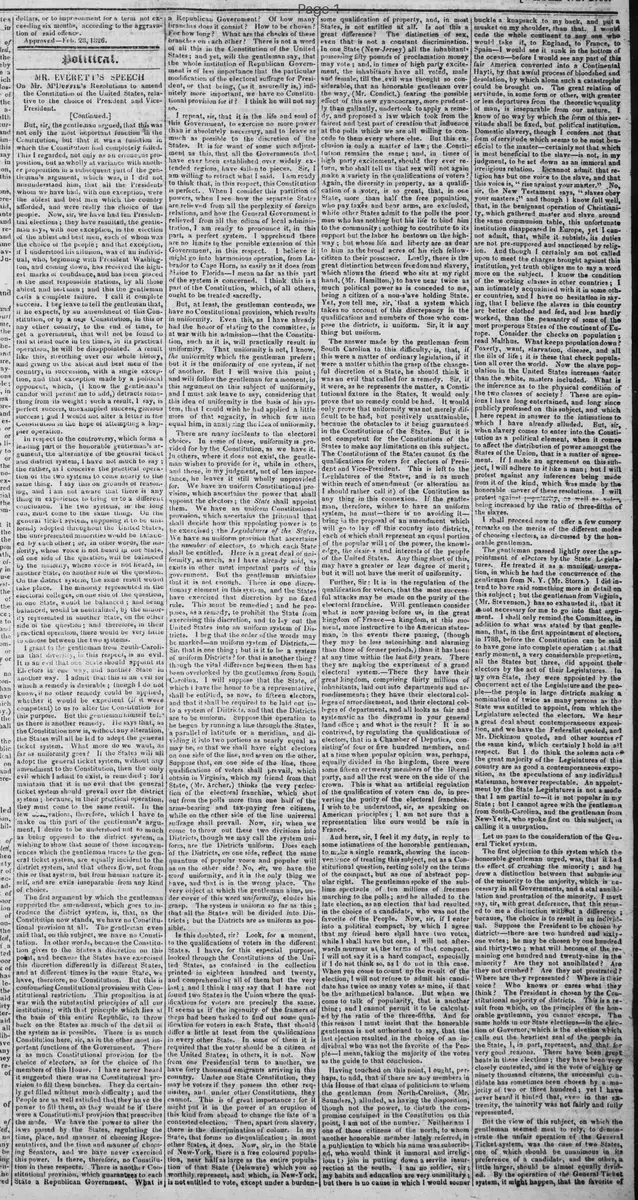
MR. EVERETT'S SPEECH
On Mr. M'Duffie's Resolutions to amend
the Constitution of the United States, rela-
tive to the choice of President and Vice-
President.
[Continued.]
But, sir, the gentleman argued, that this was
not only the most important function in the
Constitution, but that it was a function in
which the Constitution had completely failed.
This I regarded, not only as an erroneous pro-
position, but as wholly at variance with anoth-
er proposition in a subsequent part of the get-
tleman's argument, which was, if I did not
misunderstand him, that all the Presidents
whom we have had, with one exception, were
the ablest and best men which the country
afforded, and were really the choice of the
people. Now, sir, we have had ten Presiden-
tial elections; they have resulted, the gentle-
man says, with one exception, in the election
of the ablest and best men, each of whom was
the choice of the people; and that exception,
if I understood his allusion, was of an individ-
ual, who, beginning with President Washing-
ton, and coming down, has received the high-
est marks of confidence, and has been placed
in the most responsible stations, by all those
ablest and best men: and this the gentleman
calls a complete failure. I call it complete
success. I beg leave to tell the gentleman that,
if he expects, by an amendment of this Con-
stitution, or by a new Constitution, in this or
any other country, to the end of time, to
get a government, that will not be found to
fail at least once in ten times, in its practical
operation, he will be disappointed. A result
like this, stretching over our whole history,
and giving us the ablest and best men of the
country, in succession, with a single excep-
tion, and that exception made by a political
opponent, which, (I know the gentleman's
candor will permit me to add,) detracts some-
thing from its weight: such a result, I say, is
perfect success, unexampled success, glorious
success ; and I would not alter a letter in the
Constitution in the hope of attempting a hap-
pier operation.
In respect to the controversy, which forms a
leading part of the honorable gentleman's ar-
gument, the alternative of the general ticket
and district system, I have not much to say ;
the rather, as I conceive the practical opera-
tion of the two systems to come nearly to the
same thing. I say this on grounds of reason-
ing, and I am not aware that there is any
thing in experience to bring us to a different
conclusion. The two systems, in the long
run, must come to the same thing. On the
general ticket system, supposing it to be un-
iformly adopted throughout the United States,
the unrepresented minorities would be balanc-
ed by each other; or, in other words, the mi-
nority, whose voice is not heard in one State,
on one side of the question, will be balanced
by the minority, whose voice is not heard, in
another State, on another side of the question.
On the district system, the same result would
take place. The minority represented in the
electoral colleges, on one side of the question,
in one State, would be balanced; and being
balanced, would be neutralized, by the mi-
nority represented in another State, on the other
side of the question; and therefore, in their
practical operation, there would be very little
to choose between the two systems.
I grant to the gentleman from South-Caroli-
na that diversity, in this respect, is an evil.
It is an evil that one State should appoint its
Electors in one way, and another State in
another way. I admit that this is an evil for
which a remedy is desirable; though I do not
know, if no other remedy could be applied,
whether it would be expedient (if it were
competent) to us to alter the Constitution for
this purpose. But the gentleman himself tells
us there is another remedy. He says that, as
the Constitution now is, without any alteration,
the States will all be led to adopt the general
ticket system. What more do we want, as
far as uniformity goes? If the States will all
adopt the general ticket system, without any
amendment to the Constitution, then the only
evil which I admit to exist, is remedied; for I
maintain that it is no evil that the general
ticket system should prevail over the district
system; because, in their practical operation,
they must come to the same result. In the
few observations, therefore, which I have to
make on this part of the gentleman's argu-
ment, I desire to be understood not so much
as being opposed to the district system, as
wishing to show that some of those inconven-
iences which the gentleman traces to the gen-
eral ticket system, are equally incident to the
district system, and that others flow, not from
this or that system, but from human nature it-
self, and are evils inseparable from any kind
of choice.
The first argument by which the gentleman
supported the amendment, which goes to in-
troduce the district system, is, that, as the
Constitution now stands, we have no Consti-
tutional provision at all. The gentleman even
said that, on this subject, we have no Consti-
tution. In other words, because the Constitu-
tion gives to the States a discretion on this
point, and because the States have exercised
this discretion differently in different States,
and at different times in the same State, we
have, therefore, no Constitution. But this is
confounding Constitutional provision with Con-
stitutional restriction. This proposition is at
war with the substantial principles of all our
institutions: with that principle which lies at
the basis of this entire Republic, to throw
back on the States as much of the detail of
the system as is possible. There is as much
Constitution here, sir, as in the other most im-
portant functions of the Government. There
is as much Constitutional provision for the
choice of electors, as for the choice of the
members of this House. I have never heard
it suggested there was no Constitutional pro-
vision to fill these benches. They do certain-
ly get filled without much difficulty: and the
People are as well satisfied that they have the
power to fill them, as they would be if there
were a Constitutional provision that prescribes
the mode. We have the power to alter the
laws passed by the States, regulating the
time, place, and manner of choosing Repre-
sentatives, and the time and manner of choos-
ing Senators, and we have never exercised
this power. Is there, therefore, no Consti-
tution in these respects. There is another Con-
stitutional provision, which guarantees to each
State a Republican Government. What is
a Republican Government? Of how many
branches does it consist? How to be chosen?
For how long? What are the checks of these
branches on each other? There is not a word
of all this in the Constitution of the United
States; and yet, will the gentleman say, that
the whole institution of Republican Govern-
ment is of less importance than the particular
modification of the electoral suffrage for Presi-
dent, or that being, (as it assuredly is,) infi-
nitely more important, we have no Constitu-
tional provision for it ? I think he will not say
so.
I repeat, sir, that it is the life and soul of
this Government, to exercise no more power
than is absolutely necessary, and to leave as
much as possible to the discretion of the
States. It is for want of some such adjust-
ment as this, that all the Governments that
have ever been established over widely ex-
tended regions, have fallen to pieces. Sir, I
am willing to retract what I said. I am ready
to think that, in this respect, this Constitution
is perfect. When I consider this partition of
powers, when I see how the separate States
are relieved from all the perplexity of foreign
relations, and how the General Government is
relieved from all the odium of local adminis-
tration, I am ready to pronounce it. in this
part, a perfect system. I apprehend there
are no limits to the possible extension of this
Government, in this respect. I believe it
might go into harmonious operation, from La-
brador to Cape Horn, as easily as it does from
Maine to Florida--I mean as far as this part
of the system is concerned. I think this is a
part of the Constitution, which, of all others,
ought to be treated sacredly.
But, at least, the gentleman contends, we
have no Constitutional provision, which results
in uniformity. Even this, as I have already
had the honor of stating to the committee, is
at war with his admission--that the Constitu-
tion, such as it is, will practically result in
uniformity. That uniformity is not, I know,
the uniformity which the gentleman prefers;
but it is the uniformity of one system, if not
of another. But I will waive this point;
and will follow the gentleman for a moment, in
this argument on this subject of uniformity,
and I must ask leave to say, considering that
this idea of uniformity is the basis of his sys-
tem, that I could wish he had applied a little
more of that sagacity, in which few men
equal him, in analyzing the idea of uniformity.
There are many incidents to the electoral
choice. In some of these, uniformity is pro-
vided for by the Constitution, as we have it.
In others, where it does not exist, the gentle-
man wishes to provide for it, while in others,
and those, in my judgment, not of less impor-
tance, he leaves it still wholly unprovided
for. We have an uniform Constitutional pro-
vision, which ascertains the power that shall
appoint the electors; the State shall appoint
them. We have an uniform Constitutional
provision, which ascertains the tribunal that
shall decide how this appointing power is to
be exercised; the Legislatures of the States.
We have an uniform provision that ascertains
the number of electors, to which each State
shall be entitled. Here is a great deal of uni-
formity, as much, as I have already said, as
exists in other most important parts of this
government. But the gentleman maintains
that it is not enough. There is one discre-
tionary element in this system, and the States
have exercised that discretion by no fixed
rule. This must be remedied; and he pro-
poses, as a remedy, to prohibit the State from
exercising this discretion, and to lay out the
United States into an uniform system of Dis-
tricts. I beg that the order of the words may
be marked--an uniform system of Districts.-
Sir, that is one thing; but is it to be a system
of uniform Districts ? for that is another thing?
though the vital difference between them has
been overlooked by the gentleman from South
Carolina. I will suppose that the State, of
which I have the honor to be a representative,
shall be entitled, as now, to fifteen electors,
and that it shall be required to be laid out in-
o a system of Districts, and that the Districts
are to be uniform. Suppose this operation to
be begun by running a line through the States,
a parallel of latitude or a meridian, and di-
viding it into two portions as nearly equal as
may be, so that we shall have eight electors
on one side of the line, and seven on the other.
Suppose that, on one side of the line, those
qualifications of voters shall prevail, which
obtain in Virginia, which my friend from that
State, (Mr. Archer,) thinks the very perfec-
tion of the electoral franchise, which shut
out from the polls more than one half of the
arms-bearing and tax-paying free citizens,
while on the other side of the line universal
suffrage shall prevail. Now, sir, when we
come to throw out these two divisions into
Districts, though we may call the system uni-
form, are the Districts uniform. Does each
of the Districts, on one side, reflect the same
quantum of popular voice and popular will
as on the other side? No, sir, we have the
word uniformity, and it is the only thing we
have, and that is in the wrong place. The
very object at which the gentleman aims, un-
der cover of this word uniformly, eludes his
grasp. The system is uniform so far as this;
that all the States will be divided into Dis-
tricts; but the Districts are as uniform as pos-
sible.
Is this doubted, sir? Look, for a moment,
to the qualifications of voters in the different
States. I have, for this especial purpose,
looked through the Constitutions of the Uni-
ted States, as contained in the collection
printed in eighteen hundred and twenty,
and comprehending all of them but the very
last; and I think I may say that I have not
found two States in the Union where the qual-
ifications for voters are precisely the same.
It seems as if the ingenuity of the framers of
them had been tasked to find out some qual-
ification for voters in each State. that should
differ a little at least from the qualifications
in every other State. In some of them it is
required that the voter should be a citizen of
the United States: in others, it is not. Now
from one Presidential term to another, we
have forty thousand emigrants arriving in this
country. Under one State Constitution, they
may be voters if they possess the other req-
quisites, and under other Constitutions, they
cannot. This is of great importance: or it
might put it in the power of an corruption of
this kind from abroad to change the fate of a
contested election. Then, apart from slavery,
there is the discrimination of colour. In my
State, that forms no disqualification: in most
other States, it does. Now, sir, in the State
of New-York. there is a free coloured popula-
tion, near half as large as the entire popula-
tion of that State (Delaware) which you so
worthily represent, and which, in New-York,
is not entitled to vote, except under a burden-
some qualification of property, and, in most
States, is not entitled at all. Is not this a
great difference? The distinction of sex,
even that is not a constant discrimination.
In one State (New-Jersey) all the inhabitants
possessing fifty pounds of proclamation money
may vote ; and, in times of high party excite-
ment, the inhabitants have all voted, male
and female, till the evil was thought so con-
siderable, that an honorable gentleman over
the way, (Mr. Condict,) fearing the possible
effect of this new gynecocracy, more prudent-
ly than gallantly, undertook to apply a reme-
dy, and proposed a law which took from the
fairest and best part of creation that influence
at the polls which we are all willing to con-
cede to them every where else. But this ex-
clusion is only a matter of law: the Consti-
tution remains the same; and, in times of
high party excitement, should they ever re-
turn, who shall tell us that sex will not again
make a variety in the qualifications of voters?
Again, the diversity in property, as a qualifi-
cation of a voter, is so great, that, in one
State, more than half the free population,
who pay taxes and bear arms, are excluded,
while other States admit to the polls the poor
man who has nothing but his life to bind him
to the community: nothing to contribute to its
support but the labor he bestows on the high-
way; but whose life and liberty are as dear
to him as the broad acres of his rich fellow-
citizen to their possessor. Lastly, there is the
great distinction between freedom and slavery,
which allows the friend who sits at my right
hand, (Mr. Hamilton,) to have near twice as
much political power as is conceded to me,
being a citizen of a non-slave holding State.
Yet. you tell me, sir, 'that a system which
takes no account of this discrepancy in the
qualifications and numbers of those who com-
pose the districts, is uniform. Sir, it is any
thing but uniform.
The answer made by the gentleman from
South Carolina to this difficulty, is, that, if
this were a matter of ordinary legislation, if it
were a matter within the grasp of the change-
ful discretion of a State, he should think it
was an evil that called for a remedy. Sir, if
it were, as he represents the matter, a Consti-
tutional fixture in the States, it would only
prove that no remedy could be had. It would
only prove that uniformity was not merely dif-
ficult to be had, but positively unattainable,
because the obstacles to it being guaranteed
in the Constitutions of the States. But it is
not competent for the Constitutions of the
States to make any limitations on this subject.
The Constitutions of the States cannot fix the
qualifications for voters for electors of Presi-
dent and Vice-President. This is left to the
Legislatures of the States, and is as much
within reach of amendment (or alteration as
I should rather call it) of the Constitution as
any thing in this connection. If the gentle-
man, therefore, wishes to have an uniform
system, he must--there is no avoiding it--
bring in the proposal of an amendment which
will go to lay off this country into districts,
each of which shall represent an equal portion
of the popular will; of the power, the knowl-
edge, the desires and interests of the people
of the United States. Any thing short of this,
may have a greater or less degree of merit;
but it will not have the merit of uniformity.
Further, Sir: It is in the regulation of the
qualification for voters, that the most success-
ful attacks may be made on the purity of the
electoral franchise. Will gentlemen consider
what is now passing before us, in the great
kingdom of France--a kingdom, at this mo-
ment, more instructive to the American states-
man, in the events there passing, (though
they may be less astonishing and alarming
than those of former periods,) than it has been
at any time within the last fifty years. There
they are making the experiment of a grand
electoral system.--There they have their
great kingdom, comprising thirty millions of
inhabitants, laid out into departments and ar-
ron disse ments; they have their electoral col-
leges of arrondissement, and their electoral col-
leges of department. and all looks as fair and
systematic as the diagrams in your general
land office ; and what is the result? It is so
contrived, by regulating the qualifications of
electors, that in a Chamber of Deputies, con-
sisting of four or five hundred members, and
at a time when popular opinion was, perhaps,
equally divided in the kingdom, there were
some fifteen or twenty members of the liberal
party, and all the rest were on the side of the
crown. This is what an artificial regulation
of the qualification of voters can do, in pre-
venting the purity of the electoral franchise.
I wish to be understood, sir, as speaking on
American principles; I am not sure that a
representation like ours would be safe in
France.
And here, sir, I feel it my duty, in reply to
some intimations of the honorable gentleman,
to make a single remark, showing the incon-
venience of treating this subject, not as a Con-
stitutional question, resting solely on the terms
of the compact, but as one of abstract pop-
ular right. The gentleman spoke of the sub-
lime spectacle of ten millions of freemen
marching to the polls: and he alluded to the
late election, as an election that had resulted
in the choice of a candidate, who was not the
favorite of the People. Now, sir, if I enter
into a political compact, by which I agree
that my friend here shall have two votes,
while I shall have but one, I will not after-
wards murmur at the terms of that compact.
I will not say it is a hard compact, especially
if I do not think so, as I do not in this case.
When you come to count up the result of the
election. I will not refuse to admit his candi-
date has twice as many votes as mine, if that
be the arithmetical balance. But when we
come to talk of popularity, that is another
thing; and I cannot permit it to be calculat-
ed by the ratio of the three-fifths. And for
this reason I must insist that the honorable
gentleman is not authorized to say, that the
last election resulted in the choice of an in-
dividual who was not the favorite of the Peo-
ple--I mean, taking the majority of the votes
as the guide to that conclusion.
Having touched on this point, I ought, per-
haps, to add, that if there are any members in
this House of that class of politicians to whom
the gentleman from North-Carolina, (Mr.
Saunders,) alluded, as having the disposition.
though not the power, to disturb the com-
promise contained in the Constitution on this
point, I am not of the number. Neither am I
one of those citizens of the north, to whom
another honorable member lately referred, in
a publication to which his name was subscrib-
ed, who would think it immoral and irrelig-
ious to join in putting down a servile insur-
rection at the south. I am no soldier, sir;
my habits and education are very unmilitary;
but there is no cause in which I would sooner
buckle a knapsack to my back, and put a
musket on my shoulder, than that. I would
cede the whole continent to any one who
would take it, to England, to France, to
Spain--I would see it sunk in the bottom of
the ocean--before I would see any part of this
fair America converted into a Continental
Hayti, by that awful process of bloodshed and
desolation, by which alone such a catastrophe
could be brought on. The great relation of
servitude, in some form or other, with greater
or less departures from the theoretic equality
of man, is inseparable from our nature. I
know of no way by which the form of this ser-
vitude shall be fixed, but political institution.
Domestic slavery, though I confess not that
form of servitude which seems to be most ben-
eficial to the master--certainly not that which
is most beneficial to the slave--is not, in my
judgment, to be set down as an immoral and
irreligious relation. I cannot admit that re-
ligion has but one voice to the slave, and that
this voice is, "rise against your master." No,
sir, the New Testament says, "slaves obey
your masters;" and though I know full well,
that, in the benignant operation of Christiani-
ty, which gathered master and slave around
the same communion table, this unfortunate
institution disappeared in Europe, yet I can-
not admit, that, while it subsists, its duties
are not pre-supposed and sanctioned by relig-
ion. And though I certainly am not called
upon to meet the charges brought against this
institution, yet truth obliges me to say a word
more on the subject. I know the condition
of the working classes in other countries; I
am intimately acquainted with it in some oth-
er countries, and I have no hesitation in say-
ing, that I believe the slaves in this country
are better clothed and fed, and less hardly
worked, than the peasantry of some of the
most prosperous States of the continent of Eu-
rope. Consider the checks on population:
read Malthus. What keeps population down?
Poverty, want, starvation, disease, and all
the ills of life ; it is these that check popula-
tion all over the world. Now the slave pop-
ulation in the United States increases faster
than the white, masters included. What is
the inference as to the physical condition of
the two classes of society? These are opin-
ions I have long entertained, and long since
publicly professed on this subject, and which
I here repeat in answer to the intimations to
which I have already alluded. But, sir,
when slavery comes to enter into the Consti-
tution as a political element, when it comes
to affect the distribution of power amongst the
States of the Union, that is a matter of agree-
ment. If I make an agreement on this sub-
ject, I will adhere to it like a man; but I will
protest against any inferences being made
from it of the kind, which was made by the
honorable mover of these resolutions. I will
protect against power
as well as voice
being increased by the ratio of three-fifths of
the slaves.
I shall proceed now to offer a few cursory
remarks on the merits of the different modes
of choosing electors, as discussed by the hon-
orable gentleman.
The gentleman passed lightly over the ap-
pointment of electors by the State Legisla-
tures. He treated it as a manifest usurpa-
tion, in which he had the concurrence of the
gentleman from N. Y. (Mr. Storrs.) I did in-
tend to have said something more in detail on
this subject; but the gentleman from Virginia,
(Mr. Stevenson,) has so exhausted it, that it
is not necessary for me to go into that argu-
ment. I shall only remind the Committee, in
addition to what was stated by that gentle-
man, that, in the first appointment of electors,
in 1788, before the Constitution can be said
to have gone into complete operation ; at that
early moment, a very considerable proportion,
all the States but three, did appoint their
electors by the act of their Legislatures. In
my own State, they were appointed by the
concurrent act of the Legislature and the peo-
ple--the people in large districts making a
nomination of twice as many persons as the
State was entitled to appoint, from which the
Legislature selected the electors. We hear
a great deal about contemporaneous exposi-
tion, and we have the Federalist quoted, and
Mr. Dickinson quoted, and other sources of
the same kind, which certainly I hold in all
respect. But I do think the solemn acts of
the great majority of the Legislatures of this
country are as good a contemporaneous expo-
sition, as the speculations of any individual
statesman, however respectable. An appoint-
ment by the State Legislatures is not a mode
that I am partial to--it is not popular in my
State; but I cannot agree with the gentleman
from South-Carolina, and the gentleman from
New-York, who spoke first on this subject, in
calling it a usurpation.
Let us pass to the consideration of the Gen-
eral Ticket system.
The first objection to this system which the
honorable gentleman urged, was, that it had
the effect of crushing the minority ; and he
drew a distinction between that submission
of the minority to the majority, which is ne-
cessary in all Governments, and a total annihi-
l ation and prostration of the minority. I must
say, sir, with great deference, that this seem-
ed to me a distinction without a difference
because, the choice is to result in an individ-
ual. Suppose the President to be chosen by
districts--there are two hundred and sixty-
one votes: he may be chosen by one hundred
and thirty-two ; what will become of the re-
main ing one hundred and twenty-nine in the
minority? Are they not annihilated? Are
they not crushed? Are they not prostrated?
Where are they represented? Where is their
voice? Who knows or cares what they
think? The President is chosen by the Con-
stitutional majority of districts. This is a re-
sult from which, on the principles of the hon-
orable gentleman, you cannot escape. The
same holds in our State elections--in the elec-
tion of Governor, which is the election which
calls out the heartiest zeal of the people in
the State, I, in part, represent, and that for
very good reasons. There have been, great
heats in these elections; they have been very
closely contested, and in the vote of eighty or
ninety thousand citizens, the successful can-
didate has sometimes been chosen by a ma-
jority of two or three hundred; yet I have
never heard it hinted that, even in that ex-
tremity, the minority was not fairly and fully
represented.
But the view of this subject. on which the
gentleman seemed most to rely, to demon-
strate the unfair operation of the General
Ticket system, was the case of two States,
one of which should be unanimous in its
preference of a candidate, and the other, a
little larger, should be almost equally divid-
ed. By the operation of the General Ticket
system, it might happen, that the favorite of
the majority in the large State, though the choice of but about a quarter part of the aggregate population of the two States, would still be chosen. Why sir, that is one possible result of the General Ticket system, as considered between two States. But I will show you another result, not only equally possible, but far more probable. Take the case of Pennsylvania and New-York. Pennsylvania, being unanimous, and giving twenty-eight votes to her candidate: New-York, not being quite unanimous, but giving thirty-one votes to her favorite candidate. There is a great contest between these rival States; their candidates are each aiming, and their States for them, at the brightest, the most glorious prize in the world, and you call in the small, discontented, factious minority of New-York, five votes only out of thirty-six, and say to this minority, you shall be the umpires in this great question; we will leave it to you, impartial, unprejudiced men! to assign this most precious prize. Sir, to whom will they assign it, under the influence of those feelings, which cannot but actuate so small a minority in so great a struggle? Unquestionably, to the Pennsylvania candidate, unquestionably against the majority in their own State. Is this a result which would tend to harmonize our Republic? No, sir, it would tend to civil war, as much as any ground of contention between two powerful and neighboring States in this Union, on the subject of this election.
But, I have a better answer to the case of the honorable gentleman. It is a case which, on his principles, cannot happen. The remedy he provides is predicated on the non-existence of the disease. If his premises are true—I will not say his conclusions do not follow—I say they cannot follow. What is his general supposition? That States are not unanimous—that States have minorities and the evil is, that those minorities should be unrepresented. What is the gentleman's particular case? Why that out of two States, one is unanimous, and one is not; whereas, the first supposition is, that the States are not unanimous. Now, if out of two States, one is unanimous, out of twenty-four States, twelve will not be unanimous. The probability is, that States will not be unanimous; the probability is, that the minority in one State will be balanced by the minority in another; the further probability is, that if there be an unanimous State in one part of the Union, on one side of the question, there will be an unanimous State in another part of the Union, on the other side of the question. In contradiction to these premises, the gentleman puts a case, amounting to this, that out of any two States, one will be unanimous, and that one will be nearly equally divided. The supposition, therefore, is contrary to his own premises.
This leads me to remark, that the fair protection of the minority is in the majority of the other States, and it is not necessary to make any further constitutional provision for it. The gentleman from South-Carolina seems to be, as was very forcibly shown by the gentleman from Virginia, (Mr. Archer,) in the error in confounding the choice of an Executive officer—who is a Representative of no part of the People, not even of those who choose him—with the constitution of a representative body—like this, for which it is necessary that the country should be divided into the smallest practicable sections, and that each section should have its representative, in order that its local peculiarities and interests should be attended to. But far different is the case of the President; he is an executive officer: he must carry the laws into execution, equally for all—Troas Rutulusve—he is not the President of this or that party. He cannot say, if he would, this law, which bears hard on my friends, shall not go into execution against them; but for those others, my opponents, I will grind them to powder with it. If the representative of any, he is a representative of all, and this by the necessity of his office: it is not a matter of choice with him.
Now, in creating this President, the Constitution provides two hundred and sixty-one moments of power. To New-York it gives thirty-six of them; and how shall New-York exercise this, her share of that power? In such a way, certainly, as to gratify the greatest portion of her citizens: and, to obtain that result, the question must be put to a vote of the people, as the people of New-York. No, says the gentleman, if New-York happens to be divided, as nineteen to seventeen, I will take away thirty-four thirty-sixths of her power. Just in proportion as her citizens deviate from unanimity, I will mulct them in a thirty-sixth of their voice in the election of the President, and when they are equally divided, they shall have no power at all. The gentleman will contend that this evil will find a remedy in other States, where a similar result will be produced, and what New-York loses in one way she will gain in another. That, sir, I grant, is the practical operation I have allowed; I have urged, that on this very principle of compensation, there is between the general ticket and the district system, very little practical difference. But in the one system it is a stipulated provision, in the other, it is a practical effect. The majority, not the minority, are entitled to the stipulated provision, that their will shall prevail; and it is enough to console the minority, that, in the practical operation, what they lose at home they gain abroad.
[To be continued.]
What sub-type of article is it?
What themes does it cover?
What keywords are associated?
What entities or persons were involved?
Where did it happen?
Story Details
Key Persons
Location
United States House Of Representatives
Event Date
Circa 1824
Story Details
Mr. Everett argues against amending the Constitution to mandate district elections for presidential electors, defending the current system's success in producing able presidents, equivalence of general ticket and district systems in practice, and state discretion in voter qualifications and methods.