Thank you for visiting SNEWPapers!
Sign up free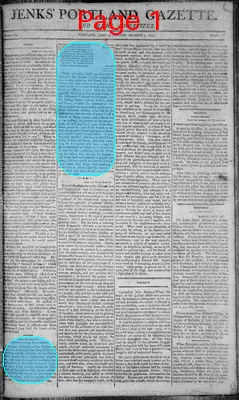
Editorial
October 3, 1803
Jenks' Portland Gazette. And Maine Advertiser
Portland, Cumberland County, Maine
What is this article about?
Editorial from the Minerva opposes the Louisiana Purchase, arguing its $30.7 million total cost, including interest, will impose a severe tax burden on citizens, comparing it to the unpopular direct tax under Adams and warning of financial ruin under Jefferson.
Clipping
OCR Quality
95%
Excellent
Full Text
From the Minerva
(Published at Raleigh, North-Carolina.)
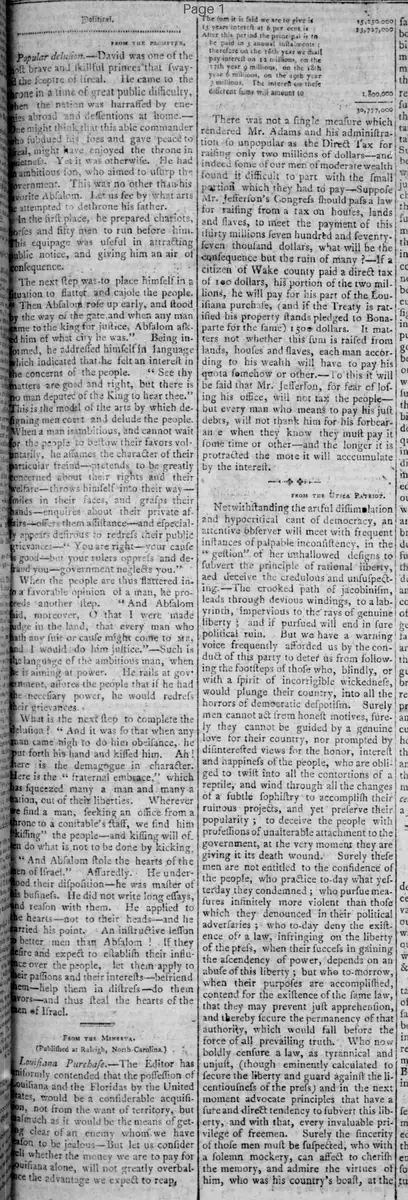
Louisiana Purchase.--The Editor has uniformly contended that the possession of Louisiana and the Floridas by the United States, would be a considerable acquisition, not from the want of territory, but inasmuch as it would be the means of getting clear of an enemy whom we have reason to be jealous--But let us consider well whether the money we are to pay for Louisiana alone, will not greatly overbalance the advantage we expect to reap,
The sum it is said we are to give is 15,250,000
15 years interest at 6 per cent is 13,727,000
After this period the principal is to be paid in 5 annual instalments; therefore on the 16th year we shall pay interest on 12 millions, on the 17th year 9 millions, on the 18th year 6 millions, on the 19th year 3 millions. The interest on these different sums will amount to 1,800,000
30,777,000
There was not a single measure which rendered Mr. Adams and his administration so unpopular as the Direct Tax for raising only two millions of dollars--and indeed some of our men of moderate wealth found it difficult to part with the small portion which they had to pay--Suppose Mr. Jefferson's Congress should pass a law for raising from a tax on houses, lands and slaves, to meet the payment of this thirty millions seven hundred and seventy-seven thousand dollars, what will be the consequence but the ruin of many?--If a citizen of Wake county paid a direct tax of 100 dollars, his portion of the two millions, he will pay for his part of the Louisiana purchase, (and if the Treaty is ratified his property stands pledged to Bonaparte for the same) 1500 dollars. It matters not whether this sum is raised from lands, houses and slaves, each man according to his wealth will have to pay his quota somehow or other.--To this it will be said that Mr. Jefferson, for fear of losing his office, will not tax the people-- but every man who means to pay his just debts, will not thank him for his forbearance when they know they must pay it some time or other--and the longer it is protracted the more it will accumulate by the interest.
(Published at Raleigh, North-Carolina.)
Louisiana Purchase.--The Editor has uniformly contended that the possession of Louisiana and the Floridas by the United States, would be a considerable acquisition, not from the want of territory, but inasmuch as it would be the means of getting clear of an enemy whom we have reason to be jealous--But let us consider well whether the money we are to pay for Louisiana alone, will not greatly overbalance the advantage we expect to reap,
The sum it is said we are to give is 15,250,000
15 years interest at 6 per cent is 13,727,000
After this period the principal is to be paid in 5 annual instalments; therefore on the 16th year we shall pay interest on 12 millions, on the 17th year 9 millions, on the 18th year 6 millions, on the 19th year 3 millions. The interest on these different sums will amount to 1,800,000
30,777,000
There was not a single measure which rendered Mr. Adams and his administration so unpopular as the Direct Tax for raising only two millions of dollars--and indeed some of our men of moderate wealth found it difficult to part with the small portion which they had to pay--Suppose Mr. Jefferson's Congress should pass a law for raising from a tax on houses, lands and slaves, to meet the payment of this thirty millions seven hundred and seventy-seven thousand dollars, what will be the consequence but the ruin of many?--If a citizen of Wake county paid a direct tax of 100 dollars, his portion of the two millions, he will pay for his part of the Louisiana purchase, (and if the Treaty is ratified his property stands pledged to Bonaparte for the same) 1500 dollars. It matters not whether this sum is raised from lands, houses and slaves, each man according to his wealth will have to pay his quota somehow or other.--To this it will be said that Mr. Jefferson, for fear of losing his office, will not tax the people-- but every man who means to pay his just debts, will not thank him for his forbearance when they know they must pay it some time or other--and the longer it is protracted the more it will accumulate by the interest.
What sub-type of article is it?
Economic Policy
Foreign Affairs
What keywords are associated?
Louisiana Purchase
Financial Burden
Taxation
Direct Tax
Jefferson Administration
Adams Administration
Bonaparte
What entities or persons were involved?
Mr. Adams
Mr. Jefferson
Bonaparte
United States
Louisiana
Floridas
Editorial Details
Primary Topic
Financial Critique Of The Louisiana Purchase
Stance / Tone
Opposition Due To Excessive Cost And Tax Burden
Key Figures
Mr. Adams
Mr. Jefferson
Bonaparte
United States
Louisiana
Floridas
Key Arguments
Possession Of Louisiana Removes A Jealous Enemy But Cost May Outweigh Benefits
Total Payment For Louisiana: $15,250,000 Principal Plus $13,727,000 Interest Over 15 Years And $1,800,000 Additional Interest During Repayment
Overall Cost: $30,777,000
Adams' Direct Tax For $2 Million Was Unpopular And Burdensome
Jefferson's Administration May Impose Taxes On Houses, Lands, And Slaves To Cover Cost, Leading To Ruin
Example: Wake County Citizen's Tax Rises From $100 To $1,500
Property Pledged To Bonaparte If Treaty Ratified
Delaying Payment Increases Interest Accumulation