Thank you for visiting SNEWPapers!
Sign up free
Editorial
May 25, 1852
The Woodville Republican
Woodville, Wilkinson County, Mississippi
What is this article about?
Editorial reviews Mr. Fletcher's book on Negro Slavery, proposing the black race originates from Cain's mark transmitted through Ham's wife Naamah to Canaan. Defends domestic slavery as the natural order and safeguard of rational liberty, using historical examples from ancient Greece and Rome to argue against democratic equality and class mixing.
Clipping
OCR Quality
88%
Good
Full Text
Book of the Months.
For the Woodville Republican.
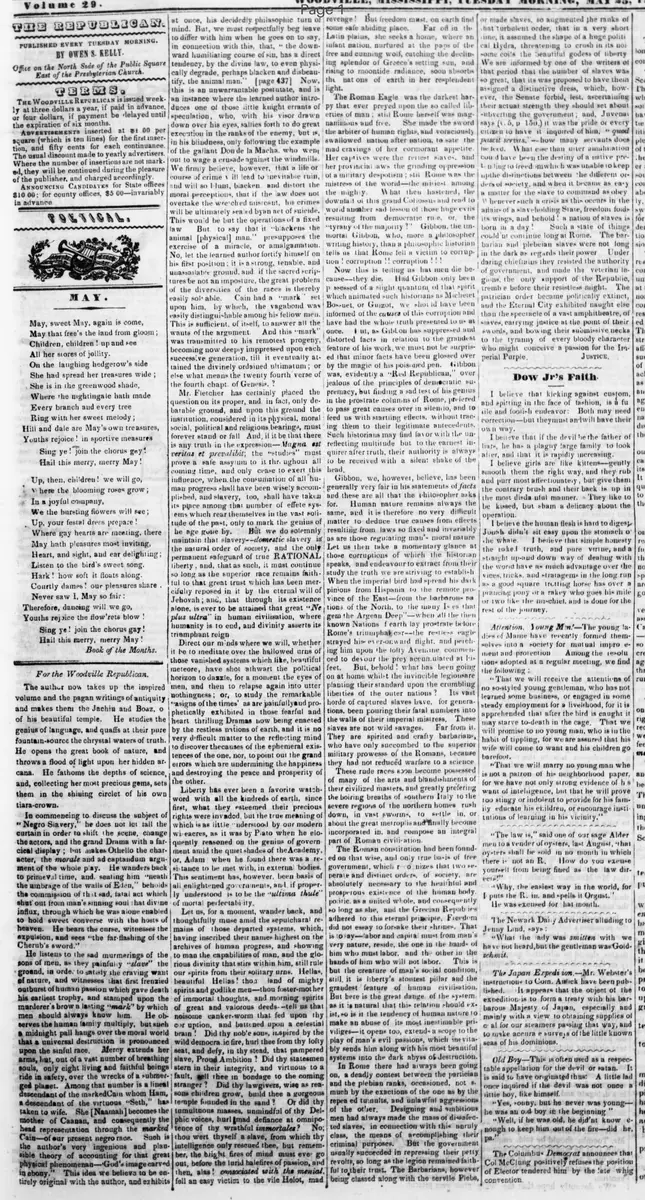
The author now takes up the inspired volume and the pagan writings of antiquity and makes them the Jachin and Boaz, of his beautiful temple. He studies the genius of language, and quaffs at their pure fountain-source the chrystal waters of truth. He opens the great book of nature, and throws a flood of light upon her hidden arcana. He fathoms the depths of science, and, collecting her most precious gems, sets them in the shining circlet of his own tiara-crown.
In commencing to discuss the subject of "Negro Slavery," he does not let fall the curtain in order to shift the scene, change the actors, and the grand Drama with a farcical display: but makes Othello the character, the morale and ad captandum argument of the whole play. He wanders back to primeval time, and, seating him "neath the umbrage of the walls of Eden," beholds the commission of that sad, fatal act which shut out from man's sinning soul that divine influx, through which he was alone enabled to hold sweet converse with the hosts of heaven. He bears the curse, witnesses the expulsion, and sees "the far-flashing of the Cherub's sword."
He listens to the sad murmurings of the sons of men, as they painfully "glave" the ground, in order to satisfy the craving want of nature, and witnesses that first frenzied outburst of human passion which gave death his earliest trophy, and stamped upon the murderer's brow a lasting "mark" by which men should always know him. He observes the human family multiply, but such a midnight pall hangs over the moral world that a universal destruction is pronounced upon the sinful race. Mercy extends her arms, but, out of a vast number of breathing souls, only eight living and faithful beings ride in safety, over the wrecks of a submerged planet. Among that number is a lineal descendant of the marked Cain whom Ham, a descendant of the virtuous "Seth," has taken to wife. She [Naamah] becomes the mother of Canaan, and consequently the head representation through the marked Cain-of our present negro race. Such is the author's very ingenious and plausible theory of accounting for that great physical phenomena—'God's image carved in ebony.' This idea we believe to be entirely original with the author, and exhibits at once, his decidedly philosophic turn of mind. But, we must respectfully beg leave to differ with him when he goes on to say, in connection with this, that, "the downward humiliating course of sin, has a direct tendency, by the divine law, to even physically degrade, perhaps blacken and disbeautify. the animal man." (page 437) Now, this is an unwarrantable postulate, and is an instance where the learned author introduces one of those little knight errants of speculation, who, with his visor drawn down over his eyes, sallies forth to do great execution in the ranks of the enemy, but is, in his blindness, only following the example of the gallant Don de la Mancha. who went out to wage a crusade against the windmills.
We firmly believe, however, that a life or course of crime will lead to inevitable ruin, and will so taint, blacken and distort the moral perceptions, that if the law does not overtake the wretched miscreant, his crimes will be ultimately sealed by an act of suicide. This would be but the operations of a fixed law But to say that it "blackens the animal [physical] man." presupposes the exercise of a miracle, or amalgamation. No, let the learned author fortify himself on his first position: it is a strong, tenable, and unassailable ground. and if the sacred scriptures be not an imposture, the great problem of the diversities of the races is thereby easily solvable. Cain had a "mark" set upon him, by which, the vagabond was easily distinguishable among his fellow men. This is sufficient, of itself, to answer all the wants of the argument. And this "mark" was transmitted to his remotest progeny, becoming now deeply impressed upon each successive generation, till it eventually attained the divinely ordained ultimatum; or else what means the twenty fourth verse of the fourth chapter of Genesis.?
Mr. Fletcher has certainly placed the question on its proper, and, in fact, only debatable ground, and upon this ground the institution, considered in its physical, moral, social, political and religious bearings, must forever stand or fall And, if it be that there is any truth in the expression—Magna est veritas et prevalebit; the "studies" must prove a safe asylum to it through all coming time, and only cease to exert this influence, when, the consummation of all human progress shall have been wisely accomplished, and slavery, too, shall have taken its place among that number of effete systems which rear themselves in the vast solitude of the past, only to mark the genius of the age gone by. But we do solemnly maintain that slavery—domestic slavery is the natural order of society, and the only permanent safeguard of true RATIONAL liberty, and, that as such, it must continue so long as the superior race remains faithful to that great trust which has been mercifully reposed in it by the eternal will of Jehovah; and, that through its existence alone, is ever to be attained that great "Ne plus ultra" in human civilisation, where humanity is to end, and divinity asserts its triumphant reign
Direct our minds where we will, whether it be to meditate over the hallowed urns of those vanished systems which like, beautiful meteors, have shot athwart the political horizon to dazzle, for a moment the eyes of men, and then to relapse again into utter nothingness; or, to study the remarkable "signs of the times" as are painfully and prophetically exhibited in those fearful and heart thrilling Dramas now being enacted by the restless nations of earth, and it is no very difficult matter to the reflecting mind to discover the causes of the ephemeral existences of the one, nor, to point out the grand errors which are undermining the happiness and destroying the peace and prosperity of the other.
Liberty has ever been a favorite watch-word with all the kindreds of earth, since first, what they esteemed their precious rights were invaded, but the true meaning of which is as little understood by our modern wiseacres, as it was by Plato when he eloquently reasoned on the genius of government amid the quiet shades of the Academy. or, Adam when he found there was a resistance to be met with, in external bodies. This sentiment has, however, been basis of all enlightened governments, and, if properly understood is to be the "ultima thule" of mortal perfectability.
Let us, for a moment, wander back, and thoughtfully muse amid the sepulchral remains of those departed systems, which, having inscribed their names highest on the archives of human progress, and showing to man the capabilities of man, and the glorious divinity that stirs within him, still rule our spirits from their solitary urns. Hellas, beautiful Hellas! thou land of mighty spirits and godlike men—thou foster-mother of immortal thoughts, and morning spirits of great and valorous deeds—tell us that noisome canker-worm that fed upon thy corruption, and battened upon a celestial brain! Did thy noble sons, inspired by the wild democratic fire, hurl thee from thy lofty seat, and defy, in thy stead, that pampered slave, Proud Ambition? Did thy statesmen stern in their integrity, and virtuous to a fault, sell thee in bondage to the coming stranger? Did thy lawgivers, wise as reason's children grow, build thee a gorgeous temple founded in the sand? Or did thy tumultuous masses, unmindful of thy Delphic voices, hurl mad defiance at omnipotence of thy wrathful immortals? No; thou wert thyself a slave, from which thy intelligence only rescued thee, but remember, the bright fires of mind must ever go out, before the lurid balefires of passion, and then, alas! consociated with the menial, fell an easy victim to the vile Helot, mad revenge! But freedom must, on earth find some safe abiding place. Far off in the Latin plains, she seeks a home, where an infant nation, nurtured at the paps of the free and cunning wolf, catching the declining splendor of Greece's setting sun, and rising to moontide radiance, soon absorbs the nations of earth in her resplendent light.
The Roman Eagle was the darkest harpy that ever preyed upon the so called liberties of man; still Rome herself was magnanimous and free. She made the sword the arbiter of human rights, and voraciously swallowed nation after nation, to sate the mad cravings of her cormorant appetite. Her captives were the veriest slaves, and her provincial laws the grinding oppression of a military despotism; still Rome was the mistress of the world—the mightiest among the mighty. What then hastened the downfall of this grand Colossus and read to world another sad lesson of those huge evils resulting from democratic rule, or, the "tyranny of the majority?" Gibbon, the immortal Gibbon, who, more a philosopher writing history, than a philosophic historian tells us that Rome fell a victim to corruption! corruption!! corruption!!!
Now this is telling us that men die because—they die. Had Gibbon only been possessed of a slight quantum of that spirit which animated such historians as Michelet Bossuet, or Guizot, we should have been informed of the causes of this corruption and have had the whole truth presented to us at once. But, as Gibbon has suppressed and distorted facts in relation to the grandest feature of his work, we must not be surprised that minor facts have been glossed over by the magic of his poisoned pen. Gibbon was, evidently a "Red Republican," over jealous of the principles of democratic supremacy, but finding a sad test of his genius in the prostrate columns of Rome, preferred to pass great causes over in silence, and to feed us with startling effects, without tracing them to their legitimate antecedents. Such historians may find favor with the unreflecting multitude but to the earnest inquirer after truth, their authority is always to be received with a silent shake of the head.
Gibbon, we, however, believe, has been generally very fair in his statements of facts and these are all that the philosopher asks for. Human nature remains always the same, and it is therefore no very difficult matter to deduce true causes from effects resulting from laws so fixed and invariably as are those regulating man's moral nature Let us then take a momentary glance at those corruptions of which the historian speaks, and endeavour to extract from their study the truth we are striving to establish When the imperial bird had spread his dark pinions from Hispania to the remote province of the East—from the barbarous nations of the North, to the many isles that gem the Aegean Deep”—when all the then known Nations earth lay prostrate before Rome's triumphal car—the restless eagle strayed his ever-onward flight, and perching him upon the lofty Aventine commenced to devour the prey accumulated at his feet. But, behold! what has been going on at home whilst the invincible legions are planting their standard upon the crumbling liberties of the outer nations? Its vast horde of captured slaves have, for generations, been pouring their fatal numbers into the walls of their imperial mistress. These slaves are not wild savages. Far from it. They are spirited and crafty barbarians who have only succumbed to the superior military prowess of the Romans, because they had not reduced warfare to a science These rude races soon become possessed of many of the arts and blandishments of their civilized masters, and greatly preferring the balmy breaths of southern Italy to the severe regions of the northern homes rush down, in vast swarms, to settle in, or about the great metropolis and finally become incorporated in, and compose an integral part of Roman civilization.
The Roman constitution had been founded on that wise, and only true basis of free government, which recognizes that two separate and distinct orders, of society, are absolutely necessary to the healthful and prosperous existence of the human body politic, as a united whole, and consequently so long as she, and the Grecian Republics adhered to this eternal principle. Freedom did not essay to forsake their shrines. That is to say—labor and capital must from man's very nature, reside, the one in the hands of him who must labor, and the other in the hands of him who will not labor. This is but the creature of man's social condition, still, it is liberty's stoutest pillar and the grandest feature of human civilisation.
But here is the great danger of the system. as it is natural that this relation should exist, so is it the tendency of human nature to make an abuse of its most inestimable privileges—it opens too, extended a scope to the play of man's evil passions, which inevitably sends him along with his most beautiful systems into the dark abyss of destruction.
In Rome there had always been going on, a deadly contest between the patrician and the plebeian ranks, occasioned, not so much by the exactions of the one as by the repeated tumults, and unlawful aggressions of the other. Designing and ambitious men had always made the mass or dissatisfied slaves, in connection with this unruly class, the means of accomplishing their criminal purposes. But the government usually succeeded in repressing their petty revolts, so long as the legion remained faithful to their trust. The Barbarians, however being classed along with the servile Plebs, or made slaves, so augmented the ranks of that turbulent order, that in a very short time, it assumed the shape of a huge political hydra, threatening to crush in its noisome coils the beautiful goddess of liberty We are informed by one of the writers of that period that the number of slaves was so great, that it was proposed to have them assigned a distinctive dress, which, however, the Senate forbid, lest, ascertaining their actual strength they should set about subverting the government; and, Juvenal says (s.5, p 150.) it was the pride of every citizen to have it inquired of him, "quod priscit servus,"—how many servants does he keep. What else than utter annihilation could have been the destiny of a nation pretending to freedom when he was unable to keep up the distinctions between the different orders of society, and when it became as easy a matter for the slave to command as obey The never such a crisis as this occurs in the affairs of a slaveholding State, freedom folds its wings, and behold: a nation of slaves is born in a day! Such a state of things could not continue long at Rome. The barbarian and plebeian slaves were not long in the dark as regards their power. Under daring chieftains they resisted the authority of government, and made the veteran legions, the only support of the Republic, tremble before their resistless might. The patrician order became politically extinct, and the Eternal City exhibited naught else than the spectacle of a vast amphitheatre, of slaves, carrying justice at the point of their swords, and bowing their submissive necks to the tyranny of every bloody character who might conceive a passion for the Imperial Purple.
For the Woodville Republican.
The author now takes up the inspired volume and the pagan writings of antiquity and makes them the Jachin and Boaz, of his beautiful temple. He studies the genius of language, and quaffs at their pure fountain-source the chrystal waters of truth. He opens the great book of nature, and throws a flood of light upon her hidden arcana. He fathoms the depths of science, and, collecting her most precious gems, sets them in the shining circlet of his own tiara-crown.
In commencing to discuss the subject of "Negro Slavery," he does not let fall the curtain in order to shift the scene, change the actors, and the grand Drama with a farcical display: but makes Othello the character, the morale and ad captandum argument of the whole play. He wanders back to primeval time, and, seating him "neath the umbrage of the walls of Eden," beholds the commission of that sad, fatal act which shut out from man's sinning soul that divine influx, through which he was alone enabled to hold sweet converse with the hosts of heaven. He bears the curse, witnesses the expulsion, and sees "the far-flashing of the Cherub's sword."
He listens to the sad murmurings of the sons of men, as they painfully "glave" the ground, in order to satisfy the craving want of nature, and witnesses that first frenzied outburst of human passion which gave death his earliest trophy, and stamped upon the murderer's brow a lasting "mark" by which men should always know him. He observes the human family multiply, but such a midnight pall hangs over the moral world that a universal destruction is pronounced upon the sinful race. Mercy extends her arms, but, out of a vast number of breathing souls, only eight living and faithful beings ride in safety, over the wrecks of a submerged planet. Among that number is a lineal descendant of the marked Cain whom Ham, a descendant of the virtuous "Seth," has taken to wife. She [Naamah] becomes the mother of Canaan, and consequently the head representation through the marked Cain-of our present negro race. Such is the author's very ingenious and plausible theory of accounting for that great physical phenomena—'God's image carved in ebony.' This idea we believe to be entirely original with the author, and exhibits at once, his decidedly philosophic turn of mind. But, we must respectfully beg leave to differ with him when he goes on to say, in connection with this, that, "the downward humiliating course of sin, has a direct tendency, by the divine law, to even physically degrade, perhaps blacken and disbeautify. the animal man." (page 437) Now, this is an unwarrantable postulate, and is an instance where the learned author introduces one of those little knight errants of speculation, who, with his visor drawn down over his eyes, sallies forth to do great execution in the ranks of the enemy, but is, in his blindness, only following the example of the gallant Don de la Mancha. who went out to wage a crusade against the windmills.
We firmly believe, however, that a life or course of crime will lead to inevitable ruin, and will so taint, blacken and distort the moral perceptions, that if the law does not overtake the wretched miscreant, his crimes will be ultimately sealed by an act of suicide. This would be but the operations of a fixed law But to say that it "blackens the animal [physical] man." presupposes the exercise of a miracle, or amalgamation. No, let the learned author fortify himself on his first position: it is a strong, tenable, and unassailable ground. and if the sacred scriptures be not an imposture, the great problem of the diversities of the races is thereby easily solvable. Cain had a "mark" set upon him, by which, the vagabond was easily distinguishable among his fellow men. This is sufficient, of itself, to answer all the wants of the argument. And this "mark" was transmitted to his remotest progeny, becoming now deeply impressed upon each successive generation, till it eventually attained the divinely ordained ultimatum; or else what means the twenty fourth verse of the fourth chapter of Genesis.?
Mr. Fletcher has certainly placed the question on its proper, and, in fact, only debatable ground, and upon this ground the institution, considered in its physical, moral, social, political and religious bearings, must forever stand or fall And, if it be that there is any truth in the expression—Magna est veritas et prevalebit; the "studies" must prove a safe asylum to it through all coming time, and only cease to exert this influence, when, the consummation of all human progress shall have been wisely accomplished, and slavery, too, shall have taken its place among that number of effete systems which rear themselves in the vast solitude of the past, only to mark the genius of the age gone by. But we do solemnly maintain that slavery—domestic slavery is the natural order of society, and the only permanent safeguard of true RATIONAL liberty, and, that as such, it must continue so long as the superior race remains faithful to that great trust which has been mercifully reposed in it by the eternal will of Jehovah; and, that through its existence alone, is ever to be attained that great "Ne plus ultra" in human civilisation, where humanity is to end, and divinity asserts its triumphant reign
Direct our minds where we will, whether it be to meditate over the hallowed urns of those vanished systems which like, beautiful meteors, have shot athwart the political horizon to dazzle, for a moment the eyes of men, and then to relapse again into utter nothingness; or, to study the remarkable "signs of the times" as are painfully and prophetically exhibited in those fearful and heart thrilling Dramas now being enacted by the restless nations of earth, and it is no very difficult matter to the reflecting mind to discover the causes of the ephemeral existences of the one, nor, to point out the grand errors which are undermining the happiness and destroying the peace and prosperity of the other.
Liberty has ever been a favorite watch-word with all the kindreds of earth, since first, what they esteemed their precious rights were invaded, but the true meaning of which is as little understood by our modern wiseacres, as it was by Plato when he eloquently reasoned on the genius of government amid the quiet shades of the Academy. or, Adam when he found there was a resistance to be met with, in external bodies. This sentiment has, however, been basis of all enlightened governments, and, if properly understood is to be the "ultima thule" of mortal perfectability.
Let us, for a moment, wander back, and thoughtfully muse amid the sepulchral remains of those departed systems, which, having inscribed their names highest on the archives of human progress, and showing to man the capabilities of man, and the glorious divinity that stirs within him, still rule our spirits from their solitary urns. Hellas, beautiful Hellas! thou land of mighty spirits and godlike men—thou foster-mother of immortal thoughts, and morning spirits of great and valorous deeds—tell us that noisome canker-worm that fed upon thy corruption, and battened upon a celestial brain! Did thy noble sons, inspired by the wild democratic fire, hurl thee from thy lofty seat, and defy, in thy stead, that pampered slave, Proud Ambition? Did thy statesmen stern in their integrity, and virtuous to a fault, sell thee in bondage to the coming stranger? Did thy lawgivers, wise as reason's children grow, build thee a gorgeous temple founded in the sand? Or did thy tumultuous masses, unmindful of thy Delphic voices, hurl mad defiance at omnipotence of thy wrathful immortals? No; thou wert thyself a slave, from which thy intelligence only rescued thee, but remember, the bright fires of mind must ever go out, before the lurid balefires of passion, and then, alas! consociated with the menial, fell an easy victim to the vile Helot, mad revenge! But freedom must, on earth find some safe abiding place. Far off in the Latin plains, she seeks a home, where an infant nation, nurtured at the paps of the free and cunning wolf, catching the declining splendor of Greece's setting sun, and rising to moontide radiance, soon absorbs the nations of earth in her resplendent light.
The Roman Eagle was the darkest harpy that ever preyed upon the so called liberties of man; still Rome herself was magnanimous and free. She made the sword the arbiter of human rights, and voraciously swallowed nation after nation, to sate the mad cravings of her cormorant appetite. Her captives were the veriest slaves, and her provincial laws the grinding oppression of a military despotism; still Rome was the mistress of the world—the mightiest among the mighty. What then hastened the downfall of this grand Colossus and read to world another sad lesson of those huge evils resulting from democratic rule, or, the "tyranny of the majority?" Gibbon, the immortal Gibbon, who, more a philosopher writing history, than a philosophic historian tells us that Rome fell a victim to corruption! corruption!! corruption!!!
Now this is telling us that men die because—they die. Had Gibbon only been possessed of a slight quantum of that spirit which animated such historians as Michelet Bossuet, or Guizot, we should have been informed of the causes of this corruption and have had the whole truth presented to us at once. But, as Gibbon has suppressed and distorted facts in relation to the grandest feature of his work, we must not be surprised that minor facts have been glossed over by the magic of his poisoned pen. Gibbon was, evidently a "Red Republican," over jealous of the principles of democratic supremacy, but finding a sad test of his genius in the prostrate columns of Rome, preferred to pass great causes over in silence, and to feed us with startling effects, without tracing them to their legitimate antecedents. Such historians may find favor with the unreflecting multitude but to the earnest inquirer after truth, their authority is always to be received with a silent shake of the head.
Gibbon, we, however, believe, has been generally very fair in his statements of facts and these are all that the philosopher asks for. Human nature remains always the same, and it is therefore no very difficult matter to deduce true causes from effects resulting from laws so fixed and invariably as are those regulating man's moral nature Let us then take a momentary glance at those corruptions of which the historian speaks, and endeavour to extract from their study the truth we are striving to establish When the imperial bird had spread his dark pinions from Hispania to the remote province of the East—from the barbarous nations of the North, to the many isles that gem the Aegean Deep”—when all the then known Nations earth lay prostrate before Rome's triumphal car—the restless eagle strayed his ever-onward flight, and perching him upon the lofty Aventine commenced to devour the prey accumulated at his feet. But, behold! what has been going on at home whilst the invincible legions are planting their standard upon the crumbling liberties of the outer nations? Its vast horde of captured slaves have, for generations, been pouring their fatal numbers into the walls of their imperial mistress. These slaves are not wild savages. Far from it. They are spirited and crafty barbarians who have only succumbed to the superior military prowess of the Romans, because they had not reduced warfare to a science These rude races soon become possessed of many of the arts and blandishments of their civilized masters, and greatly preferring the balmy breaths of southern Italy to the severe regions of the northern homes rush down, in vast swarms, to settle in, or about the great metropolis and finally become incorporated in, and compose an integral part of Roman civilization.
The Roman constitution had been founded on that wise, and only true basis of free government, which recognizes that two separate and distinct orders, of society, are absolutely necessary to the healthful and prosperous existence of the human body politic, as a united whole, and consequently so long as she, and the Grecian Republics adhered to this eternal principle. Freedom did not essay to forsake their shrines. That is to say—labor and capital must from man's very nature, reside, the one in the hands of him who must labor, and the other in the hands of him who will not labor. This is but the creature of man's social condition, still, it is liberty's stoutest pillar and the grandest feature of human civilisation.
But here is the great danger of the system. as it is natural that this relation should exist, so is it the tendency of human nature to make an abuse of its most inestimable privileges—it opens too, extended a scope to the play of man's evil passions, which inevitably sends him along with his most beautiful systems into the dark abyss of destruction.
In Rome there had always been going on, a deadly contest between the patrician and the plebeian ranks, occasioned, not so much by the exactions of the one as by the repeated tumults, and unlawful aggressions of the other. Designing and ambitious men had always made the mass or dissatisfied slaves, in connection with this unruly class, the means of accomplishing their criminal purposes. But the government usually succeeded in repressing their petty revolts, so long as the legion remained faithful to their trust. The Barbarians, however being classed along with the servile Plebs, or made slaves, so augmented the ranks of that turbulent order, that in a very short time, it assumed the shape of a huge political hydra, threatening to crush in its noisome coils the beautiful goddess of liberty We are informed by one of the writers of that period that the number of slaves was so great, that it was proposed to have them assigned a distinctive dress, which, however, the Senate forbid, lest, ascertaining their actual strength they should set about subverting the government; and, Juvenal says (s.5, p 150.) it was the pride of every citizen to have it inquired of him, "quod priscit servus,"—how many servants does he keep. What else than utter annihilation could have been the destiny of a nation pretending to freedom when he was unable to keep up the distinctions between the different orders of society, and when it became as easy a matter for the slave to command as obey The never such a crisis as this occurs in the affairs of a slaveholding State, freedom folds its wings, and behold: a nation of slaves is born in a day! Such a state of things could not continue long at Rome. The barbarian and plebeian slaves were not long in the dark as regards their power. Under daring chieftains they resisted the authority of government, and made the veteran legions, the only support of the Republic, tremble before their resistless might. The patrician order became politically extinct, and the Eternal City exhibited naught else than the spectacle of a vast amphitheatre, of slaves, carrying justice at the point of their swords, and bowing their submissive necks to the tyranny of every bloody character who might conceive a passion for the Imperial Purple.
What sub-type of article is it?
Slavery Abolition
Moral Or Religious
What keywords are associated?
Negro Slavery
Cain Mark
Biblical Origins
Roman Fall
Greek Democracy
Social Orders
Pro Slavery
Racial Theory
What entities or persons were involved?
Mr. Fletcher
Cain
Ham
Naamah
Canaan
Gibbon
Rome
Greece
Hellas
Plato
Juvenal
Editorial Details
Primary Topic
Defense Of Negro Slavery Via Biblical Origins And Historical Lessons From Greece And Rome
Stance / Tone
Strongly Pro Slavery, Portraying It As Natural Order And Safeguard Of Liberty Against Democratic Excess
Key Figures
Mr. Fletcher
Cain
Ham
Naamah
Canaan
Gibbon
Rome
Greece
Hellas
Plato
Juvenal
Key Arguments
Black Race Descends From Cain's Marked Lineage Through Naamah, Wife Of Ham, Mother Of Canaan
Sin Degrades Morally But Not Physically; Cain's Mark Explains Racial Differences
Domestic Slavery Is Natural Societal Order And Permanent Safeguard Of Rational Liberty
Fall Of Ancient Greece Due To Internal Slavery And Passion Over Intelligence
Fall Of Rome Resulted From Corruption Via Influx Of Barbarian Slaves Eroding Class Distinctions
Democratic Rule And Tyranny Of Majority Lead To Societal Destruction Without Separate Labor And Capital Orders
True Liberty Requires Distinct Social Orders; Mixing Leads To Anarchy And Loss Of Freedom