Thank you for visiting SNEWPapers!
Sign up free
Letter to Editor
October 14, 1789
Gazette Of The United States
New York, New York County, New York
What is this article about?
Reader C.D. shares a historical account identifying the Man with the Iron Mask as the Duke de Vermandois, illegitimate son of Louis XIV, imprisoned for life after striking the Dauphin. The king faked his death in the Flanders army camp and confined him to St. Margaret's island, then the Bastille, where he wore a mask.
Clipping
OCR Quality
95%
Excellent
Full Text
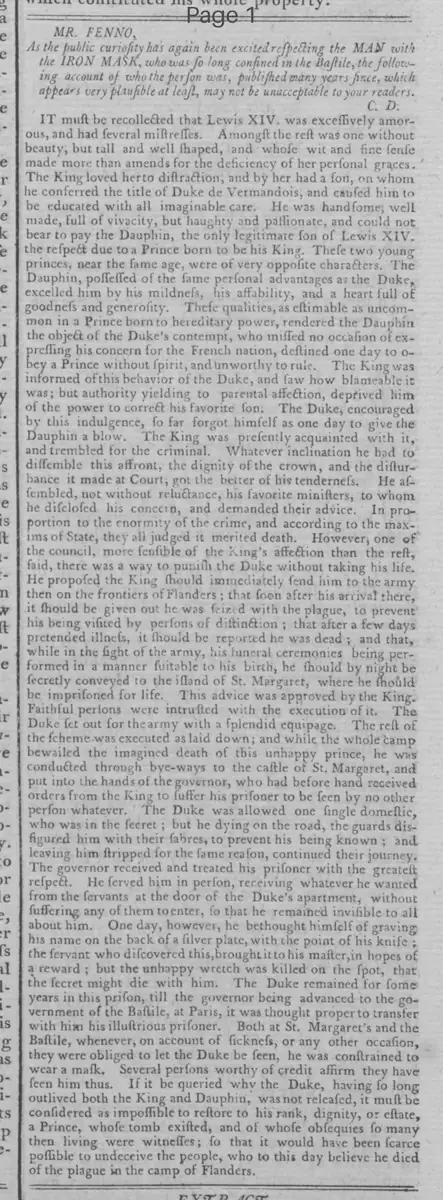
MR. FENNO,
As the public curiosity has again been excited respecting the MAN with
the IRON MASK, who was so long confined in the Bastile, the follow-
ing account of who the person was, published many years since, which
appears very plausible at least, may not be unacceptable to your readers.
C.D.
IT must be recollected that Lewis XIV. was excessively amorous,
and had several mistresses. Amongst the rest was one without
beauty, but tall and well shaped, and whose wit and fine sense
made more than amends for the deficiency of her personal graces.
The King loved her to distraction, and by her had a son, on whom
he conferred the title of Duke de Vermandois, and caused him to
be educated with all imaginable care. He was handsome; well
made, full of vivacity, but haughty and passionate, and could not
bear to pay the Dauphin, the only legitimate son of Lewis XIV.
the respect due to a Prince born to be his King. These two young
princes, near the same age, were of very opposite characters. The
Dauphin, possessed of the same personal advantages as the Duke,
excelled him by his mildness, his affability, and a heart full of
goodness and generosity. These qualities, as estimable as uncommon
in a Prince born to hereditary power, rendered the Dauphin
the object of the Duke's contempt, who missed no occasion of ex-
pressing his concern for the French nation, destined one day to obey
a Prince without spirit, and unworthy to rule. The King was
informed of this behavior of the Duke, and saw how blameable it
was; but authority yielding to parental affection, deprived him
of the power to correct his favorite son. The Duke, encouraged
by this indulgence, so far forgot himself as one day to give the
Dauphin a blow. The King was presently acquainted with it,
and trembled for the criminal. Whatever inclination he had to
dissemble this affront, the dignity of the crown, and the disturbance
it made at Court, got the better of his tenderness. He as-
sembled, not without reluctance, his favorite ministers, to whom
he disclosed his concern, and demanded their advice. In pro-
portion to the enormity of the crime, and according to the max-
ims of State, they all judged it merited death. However, one of
the council, more sensible of the King's affection than the rest,
said, there was a way to punish the Duke without taking his life.
He proposed the King should immediately send him to the army
then on the frontiers of Flanders; that soon after his arrival there,
it should be given out he was seized with the plague, to prevent
his being visited by persons of distinction; that after a few days
pretended illness, it should be reported he was dead; and that,
while in the sight of the army, his funeral ceremonies being per-
formed in a manner suitable to his birth, he should by night be
secretly conveyed to the island of St. Margaret, where he should
be imprisoned for life. This advice was approved by the King.
Faithful persons were intrusted with the execution of it. The
Duke set out for the army with a splendid equipage. The rest of
the scheme was executed as laid down; and while the whole camp
bewailed the imagined death of this unhappy prince, he was
conducted through bye-ways to the castle of St. Margaret, and
put into the hands of the governor, who had before hand received
orders from the King to suffer his prisoner to be seen by no other
person whatever. The Duke was allowed one single domestic,
who was in the secret; but he dying on the road, the guards dis-
figured him with their sabres, to prevent his being known; and
leaving him stripped for the same reason, continued their journey.
The governor received and treated his prisoner with the greatest
respect. He served him in person, receiving whatever he wanted
from the servants at the door of the Duke's apartment, without
suffering any of them to enter, so that he remained invisible to all
about him. One day, however, he bethought himself of graving
his name on the back of a silver plate, with the point of his knife;
the servant who discovered this, brought it to his master, in hopes of
a reward; but the unhappy wretch was killed on the spot, that
the secret might die with him. The Duke remained for some
years in this prison, till the governor being advanced to the go-
vernment of the Bastile, at Paris, it was thought proper to transfer
with him his illustrious prisoner. Both at St. Margaret's and the
Bastile, whenever, on account of sickness, or any other occasion,
they were obliged to let the Duke be seen, he was constrained to
wear a mask. Several persons worthy of credit affirm they have
seen him thus. If it be queried why the Duke, having so long
outlived both the King and Dauphin, was not released, it must be
considered as impossible to restore to his rank, dignity, or estate,
a Prince, whose tomb existed, and of whose obsequies so many
then living were witnesses; so that it would have been scarce
possible to undeceive the people, who to this day believe he died
of the plague in the camp of Flanders.
As the public curiosity has again been excited respecting the MAN with
the IRON MASK, who was so long confined in the Bastile, the follow-
ing account of who the person was, published many years since, which
appears very plausible at least, may not be unacceptable to your readers.
C.D.
IT must be recollected that Lewis XIV. was excessively amorous,
and had several mistresses. Amongst the rest was one without
beauty, but tall and well shaped, and whose wit and fine sense
made more than amends for the deficiency of her personal graces.
The King loved her to distraction, and by her had a son, on whom
he conferred the title of Duke de Vermandois, and caused him to
be educated with all imaginable care. He was handsome; well
made, full of vivacity, but haughty and passionate, and could not
bear to pay the Dauphin, the only legitimate son of Lewis XIV.
the respect due to a Prince born to be his King. These two young
princes, near the same age, were of very opposite characters. The
Dauphin, possessed of the same personal advantages as the Duke,
excelled him by his mildness, his affability, and a heart full of
goodness and generosity. These qualities, as estimable as uncommon
in a Prince born to hereditary power, rendered the Dauphin
the object of the Duke's contempt, who missed no occasion of ex-
pressing his concern for the French nation, destined one day to obey
a Prince without spirit, and unworthy to rule. The King was
informed of this behavior of the Duke, and saw how blameable it
was; but authority yielding to parental affection, deprived him
of the power to correct his favorite son. The Duke, encouraged
by this indulgence, so far forgot himself as one day to give the
Dauphin a blow. The King was presently acquainted with it,
and trembled for the criminal. Whatever inclination he had to
dissemble this affront, the dignity of the crown, and the disturbance
it made at Court, got the better of his tenderness. He as-
sembled, not without reluctance, his favorite ministers, to whom
he disclosed his concern, and demanded their advice. In pro-
portion to the enormity of the crime, and according to the max-
ims of State, they all judged it merited death. However, one of
the council, more sensible of the King's affection than the rest,
said, there was a way to punish the Duke without taking his life.
He proposed the King should immediately send him to the army
then on the frontiers of Flanders; that soon after his arrival there,
it should be given out he was seized with the plague, to prevent
his being visited by persons of distinction; that after a few days
pretended illness, it should be reported he was dead; and that,
while in the sight of the army, his funeral ceremonies being per-
formed in a manner suitable to his birth, he should by night be
secretly conveyed to the island of St. Margaret, where he should
be imprisoned for life. This advice was approved by the King.
Faithful persons were intrusted with the execution of it. The
Duke set out for the army with a splendid equipage. The rest of
the scheme was executed as laid down; and while the whole camp
bewailed the imagined death of this unhappy prince, he was
conducted through bye-ways to the castle of St. Margaret, and
put into the hands of the governor, who had before hand received
orders from the King to suffer his prisoner to be seen by no other
person whatever. The Duke was allowed one single domestic,
who was in the secret; but he dying on the road, the guards dis-
figured him with their sabres, to prevent his being known; and
leaving him stripped for the same reason, continued their journey.
The governor received and treated his prisoner with the greatest
respect. He served him in person, receiving whatever he wanted
from the servants at the door of the Duke's apartment, without
suffering any of them to enter, so that he remained invisible to all
about him. One day, however, he bethought himself of graving
his name on the back of a silver plate, with the point of his knife;
the servant who discovered this, brought it to his master, in hopes of
a reward; but the unhappy wretch was killed on the spot, that
the secret might die with him. The Duke remained for some
years in this prison, till the governor being advanced to the go-
vernment of the Bastile, at Paris, it was thought proper to transfer
with him his illustrious prisoner. Both at St. Margaret's and the
Bastile, whenever, on account of sickness, or any other occasion,
they were obliged to let the Duke be seen, he was constrained to
wear a mask. Several persons worthy of credit affirm they have
seen him thus. If it be queried why the Duke, having so long
outlived both the King and Dauphin, was not released, it must be
considered as impossible to restore to his rank, dignity, or estate,
a Prince, whose tomb existed, and of whose obsequies so many
then living were witnesses; so that it would have been scarce
possible to undeceive the people, who to this day believe he died
of the plague in the camp of Flanders.
What sub-type of article is it?
Historical
Informative
What themes does it cover?
Politics
Morality
What keywords are associated?
Man With Iron Mask
Louis Xiv
Duke De Vermandois
Dauphin
Bastille
French Monarchy
Historical Account
What entities or persons were involved?
C.D.
Mr. Fenno
Letter to Editor Details
Author
C.D.
Recipient
Mr. Fenno
Main Argument
the man with the iron mask was the duke de vermandois, illegitimate son of louis xiv, imprisoned for life after striking the dauphin, with his death faked to maintain secrecy.
Notable Details
Louis Xiv's Amorous Nature And Illegitimate Son
Duke De Vermandois Strikes The Dauphin
Faked Plague Death In Flanders Army
Imprisonment On St. Margaret's Island Then Bastille
Wore Mask When Seen Due To Secrecy
Attempt To Engrave Name Discovered And Servant Killed