Thank you for visiting SNEWPapers!
Sign up free
Literary
August 24, 1803
Alexandria Advertiser And Commercial Intelligencer
Alexandria, Virginia
What is this article about?
A reflective prose fragment on life's disappointments, illustrated by a girl's dead flower, parents' lost son to vice or disease, and a beautiful girl's decline due to unrequited love, ending with a verse stanza on fading beauty.
Clipping
OCR Quality
95%
Excellent
Full Text
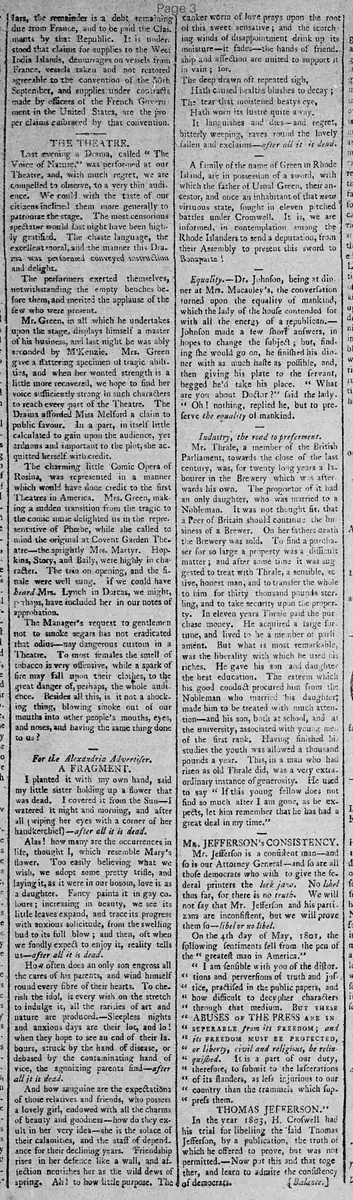
For the Alexandria Advertiser.
A FRAGMENT.
I planted it with my own hand, said
my little sister holding up a flower that
was dead. I covered it from the Sun—I
watered it night and morning, and after
all (wiping her eyes with a corner of her
handkerchief)—after all it is dead.
Alas! how many are the occurrences in
life, thought I, which resemble Mary's
flower. Too easily believing what we
wish, we adopt some pretty trifle, and
laying it, as it were in our bosom, love it as
a daughter. Fancy paints it in gay colours;
increasing in beauty, we see its
little leaves expand, and trace its progress
with anxious solicitude, from the swelling
bud to its full blow; and then, oft when
we fondly expect to enjoy it, reality tells
us—after all it is dead.
How often does an only son engross all
the cares of his parents, and wind himself
round every fibre of their hearts. To cherish the idol, is every wish on the stretch
to indulge it, all the rarities of art and
nature are produced.—Sleepless nights
and anxious days are their lot, and lo!
when they hope to see an end of their labours, struck by the hand of disease, or
debased by the contaminating hand of
vice, the agonizing parents find—after
all it is dead.
And how sanguine are the expectations
of those relatives and friends, who possess
a lovely girl, endowed with all the charms
of beauty and goodness—how do they exult in her very idea—she is the solace of
their calamities, and the staff of dependence for their declining years. Friendship
rises in her defence like a wall, and affection nourishes her as the wild dews of
spring. Ah! to how little purpose. The
canker worm of love preys upon the root
of this sweet sensitive; and the scorching
winds of disappointment drink up its
moisture—it fades—the hands of friendship and affection are united to support it
in vain; for,
The deep drawn oft repeated sigh,
Hath caused health's blushes to decay;
The tear that moistened beauty's eye,
Hath worn its lustre quite away.
It languishes and dies—and regret,
bitterly weeping, raves round the lovely
fallen and exclaims—after all it is dead.
A FRAGMENT.
I planted it with my own hand, said
my little sister holding up a flower that
was dead. I covered it from the Sun—I
watered it night and morning, and after
all (wiping her eyes with a corner of her
handkerchief)—after all it is dead.
Alas! how many are the occurrences in
life, thought I, which resemble Mary's
flower. Too easily believing what we
wish, we adopt some pretty trifle, and
laying it, as it were in our bosom, love it as
a daughter. Fancy paints it in gay colours;
increasing in beauty, we see its
little leaves expand, and trace its progress
with anxious solicitude, from the swelling
bud to its full blow; and then, oft when
we fondly expect to enjoy it, reality tells
us—after all it is dead.
How often does an only son engross all
the cares of his parents, and wind himself
round every fibre of their hearts. To cherish the idol, is every wish on the stretch
to indulge it, all the rarities of art and
nature are produced.—Sleepless nights
and anxious days are their lot, and lo!
when they hope to see an end of their labours, struck by the hand of disease, or
debased by the contaminating hand of
vice, the agonizing parents find—after
all it is dead.
And how sanguine are the expectations
of those relatives and friends, who possess
a lovely girl, endowed with all the charms
of beauty and goodness—how do they exult in her very idea—she is the solace of
their calamities, and the staff of dependence for their declining years. Friendship
rises in her defence like a wall, and affection nourishes her as the wild dews of
spring. Ah! to how little purpose. The
canker worm of love preys upon the root
of this sweet sensitive; and the scorching
winds of disappointment drink up its
moisture—it fades—the hands of friendship and affection are united to support it
in vain; for,
The deep drawn oft repeated sigh,
Hath caused health's blushes to decay;
The tear that moistened beauty's eye,
Hath worn its lustre quite away.
It languishes and dies—and regret,
bitterly weeping, raves round the lovely
fallen and exclaims—after all it is dead.
What sub-type of article is it?
Essay
Poem
What themes does it cover?
Death Mortality
Moral Virtue
Love Romance
What keywords are associated?
Disappointment
Loss
Expectations
Family
Flower Metaphor
Vice
Unrequited Love
Literary Details
Title
A Fragment
Form / Style
Prose Reflection With Concluding Verse Stanza
Key Lines
I Planted It With My Own Hand, Said My Little Sister Holding Up A Flower That Was Dead. I Covered It From The Sun—I Watered It Night And Morning, And After All (Wiping Her Eyes With A Corner Of Her Handkerchief)—After All It Is Dead.
After All It Is Dead.
The Deep Drawn Oft Repeated Sigh, Hath Caused Health's Blushes To Decay; The Tear That Moistened Beauty's Eye, Hath Worn Its Lustre Quite Away.
It Languishes And Dies—And Regret, Bitterly Weeping, Raves Round The Lovely Fallen And Exclaims—After All It Is Dead.