Thank you for visiting SNEWPapers!
Sign up free
Story
February 2, 1912
The Tupelo Journal
Tupelo, Lee County, Mississippi
What is this article about?
In a small shop on Main Street, dealer Eben Googins sells an antique fender to an unknowing customer for half price by referencing the famed Judge Allen's collection, exploiting her lack of familiarity.
Clipping
OCR Quality
100%
Excellent
Full Text
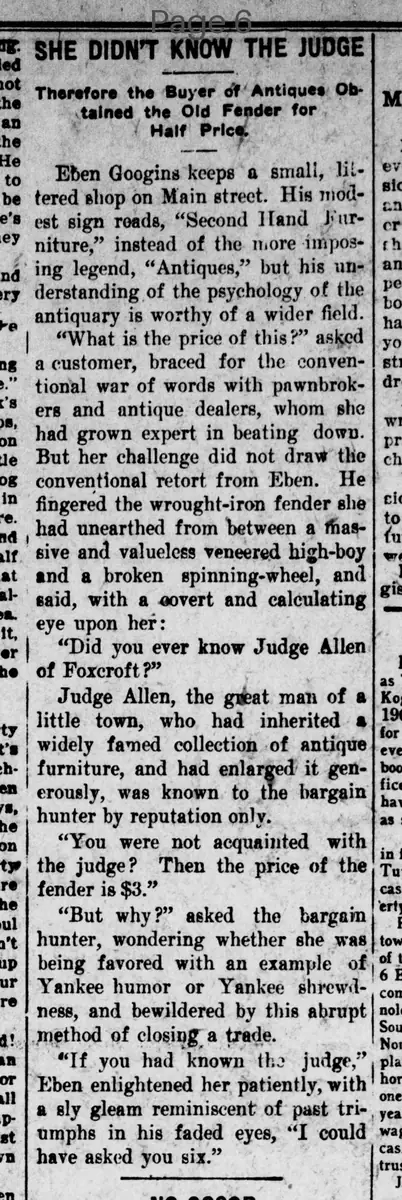
SHE DIDN'T KNOW THE JUDGE
Therefore the Buyer of Antiques Obtained the Old Fender for Half Price.
Eben Googins keeps a small, littered shop on Main street. His modest sign reads, "Second Hand Furniture," instead of the more imposing legend, "Antiques," but his understanding of the psychology of the antiquary is worthy of a wider field.
"What is the price of this?" asked a customer, braced for the conventional war of words with pawnbrokers and antique dealers, whom she had grown expert in beating down.
But her challenge did not draw the conventional retort from Eben. He fingered the wrought-iron fender she had unearthed from between a massive and valueless veneered high-boy and a broken spinning-wheel, and said, with a covert and calculating eye upon her:
"Did you ever know Judge Allen of Foxcroft?"
Judge Allen, the great man of a little town, who had inherited widely famed collection of antique furniture, and had enlarged it generously, was known to the bargain hunter by reputation only.
"You were not acquainted with the judge? Then the price of the fender is $3."
"But why?" asked the bargain hunter, wondering whether she was being favored with an example of Yankee humor or Yankee shrewdness, and bewildered by this abrupt method of closing a trade.
"If you had known the judge," Eben enlightened her patiently, with a sly gleam reminiscent of past triumphs in his faded eyes, "I could have asked you six."
Therefore the Buyer of Antiques Obtained the Old Fender for Half Price.
Eben Googins keeps a small, littered shop on Main street. His modest sign reads, "Second Hand Furniture," instead of the more imposing legend, "Antiques," but his understanding of the psychology of the antiquary is worthy of a wider field.
"What is the price of this?" asked a customer, braced for the conventional war of words with pawnbrokers and antique dealers, whom she had grown expert in beating down.
But her challenge did not draw the conventional retort from Eben. He fingered the wrought-iron fender she had unearthed from between a massive and valueless veneered high-boy and a broken spinning-wheel, and said, with a covert and calculating eye upon her:
"Did you ever know Judge Allen of Foxcroft?"
Judge Allen, the great man of a little town, who had inherited widely famed collection of antique furniture, and had enlarged it generously, was known to the bargain hunter by reputation only.
"You were not acquainted with the judge? Then the price of the fender is $3."
"But why?" asked the bargain hunter, wondering whether she was being favored with an example of Yankee humor or Yankee shrewdness, and bewildered by this abrupt method of closing a trade.
"If you had known the judge," Eben enlightened her patiently, with a sly gleam reminiscent of past triumphs in his faded eyes, "I could have asked you six."
What sub-type of article is it?
Deception Fraud
Curiosity
What themes does it cover?
Deception
What keywords are associated?
Antique Dealer
Shrewd Pricing
Bargain Hunter
Judge Allen
Wrought Iron Fender
What entities or persons were involved?
Eben Googins
Judge Allen
Where did it happen?
Main Street
Story Details
Key Persons
Eben Googins
Judge Allen
Location
Main Street
Story Details
Antique buyer gets a wrought-iron fender for $3 because she doesn't know Judge Allen; dealer Eben Googins would have charged $6 if she did, using the judge's reputation to imply value.