Thank you for visiting SNEWPapers!
Sign up free
Letter to Editor
July 15, 1823
The Virginian
Lynchburg, Virginia
What is this article about?
A detailed critique of Virginia's poor laws, arguing they foster pauperism and idleness via compulsory parish levies and contracts, while neglecting family ties and voluntary charity. The author advocates reform inspired by Scotland and Quakers, warning of England's burdensome system.
Clipping
OCR Quality
85%
Good
Full Text
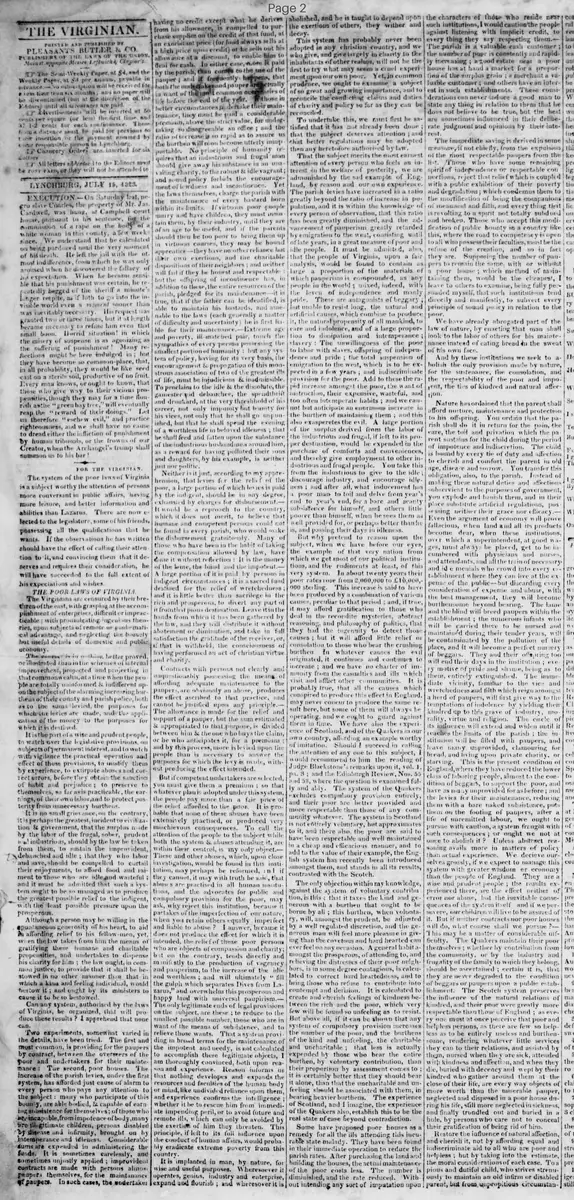
FOR THE VIRGINIAN.
The system of the poor laws of Virginia is a subject worthy the attention of persons more conversant in public affairs, having more leisure, and better information and abilities than Lazarus. There are now elected to the legislature, some of his friends, possessing all the qualifications that he wants. If the observations he has written should have the effect of calling their attention to it, and convincing them that it deserves and requires their consideration, he will have succeeded to the full extent of his expectations and wishes.
THE POOR LAWS OF VIRGINIA.
The Virginians are censured by their brethren of the east, with grasping at the accomplishment of enterprises, difficult or impracticable; with promulgating ingenious theories, upon subjects of remote or problematical advantage, and neglecting the homely but useful details of domestic and public economy.
The report is in most instances better founded than in the schemes of internal improvement, projected and projecting in that commonwealth, at a time when the people are totally uninformed & indifferent upon the subject of the alarming increasing burden of their county and parish police, both as to the sums levied, the purposes for which the levies are made, and the application of the money to the purposes for which it is destined.
It is the part of a wise and prudent people, to watch over the legislative provisions, on subjects of permanent interest, and to watch with vigilance the practical operation and effect of those provisions, to modify them by experience, to extirpate abuses and correct errors, before they obtain the sanction of habit and prejudice; to preserve to themselves, so far as is practicable, the earnings, of their own labor, and to protect posterity from unnecessary burthens.
It is no small grievance, on the contrary. it is perhaps the greatest, incident to civilization & government, that the surplus made by the labor of the frugal, sober, prudent and industrious, should by the law be taken from them, to sustain the improvident, debauched and idle; that they who labor and save, should be compelled to curtail their enjoyments, to afford food and raiment to those who are idle and wasteful: and it must be admitted that such a system ought to be so managed as to produce the greatest possible relief to the indigent, with the least possible pressure upon the prosperous.
Although a person may be willing in the spontaneous generosity of his heart, to aid in affording relief to his fellow-men, yet, when the law takes from him the means of gratifying these humane and charitable propensities, and undertakes to dispense his charity for him; the law ought, in common justice, to provide that it shall be bestowed in no other manner than that in which a kind and feeling individual, would bestow it; and ought by its ministers to cause it to be so bestowed.
Can any system, authorized by the laws of Virginia, be organized, that will produce these results? I apprehend that none can.
Two experiments, somewhat varied in the details, have been tried. The first and most common, is providing for the paupers by contract, between the overseers of the poor and undertakers for their maintenance: The second, poor houses. The increase of the parish levies, under the first system, has afforded just cause of alarm to every person who pays any attention to the subject: many who participate of this bounty, are able bodied, & capable of earning subsistence for themselves; of those who are incapable, from impotence of body, many are illegitimate children, persons disabled by disease and infirmity, brought on by intemperance and idleness. Considerable sums are expended in administering the funds, It is sometimes carelessly, and sometimes unjustly applied; improvident contracts are made with persons almost paupers themselves, for the maintenance of paupers. In such cases, the undertaker having no credit except what he derives from his allowance, is compelled to purchase supplies on the credit of that fund, at an exorbitant price (for food always sells at a high price upon credit) or else sells out his allowance at a discount, to enable him to deal for cash. In either case, more is paid by the parish, than comes to the use of the pauper; and it frequently happens, that both the undertaker and pauper are actually in want of the most common necessaries of life before the end of the year. Those in better circumstances undertake their maintenance, they must be paid a considerable premium, above the strict value, for undertaking so disagreeable an office; and the ratio of increase is so rapid as to assure us the burthen will soon become utterly insupportable. No principle of humanity requires that an industrious and frugal man should give away his substance in an unavailing charity, to the robust & idle vagrant: and sound policy forbids the encouragement of lewdness and incontinence. Yet the laws themselves, charge the parish with the maintenance of every bastard born within its limits. If virtuous poor people marry and have children, they must maintain them, by their industry, until they are of an age to be useful, and if the parents should then be too poor to bring them up in virtuous courses, they may be bound apprentice—they have no other reliance but their own exertions, and the charitable dispositions of their neighbors; and neither will fail if they be honest and respectable: but the offspring of incontinence has, in addition to these, the entire resources of the parish, pledged for its maintenance—it is true, that if the father can be identified, is able to maintain his bastards, and amenable to the laws (each generally a matter of difficulty and uncertainty) he is first liable for their maintenance.—Extreme age and poverty, ill-matched pair, touch the sympathies of every person possessing the smallest portion of humanity: but any system of policy, having for its very basis, the encouragement & propagation of this monstrous association of two of the greatest ills of life, must be injudicious & inadmissible. To proclaim to the idle & the dissolute, the gamester and debauchee, the spendthrift and drunkard, at the very threshold of his career, not only impunity but bounty for his vices, not only that he shall go unpunished, but that he shall spend the evening of a worthless life in beloved idleness; that he shall feed and fatten upon the substance of the industrious husbandmen around him, as a reward for having polluted their sons and daughters, by his example, is neither just nor politic.
Neither is it just, according to my apprehension, that levies for the relief of the poor, a large portion of which levies is paid by the indigent, should be in any degree. exhausted by charges for disbursement.— It would be a reproach to the country. which it does not merit, to believe that humane and competent persons could not be found in every parish, who would make the disbursement gratuitously. Many of those who have been in the habit of taking the compensation allowed by law, have done it without reflection: It is the money of the lame, the blind and the impotent.— A large portion of it is paid by persons in indigent circumstances; it is a sacred fund destined for the relief of wretchedness: and it is little better than sacrilege in the rich and prosperous, to divert any part of it from that pious destination. Leave it in the hands from which it has been gathered by the law, and they will distribute it without abatement or diminution, and take in full satisfaction the gratitude of the receiver, or, if that is withheld, the consciousness of having performed an act of christian virtue and charity.
Contracts with persons not clearly and unquestionably possessing the means of affording adequate maintenance to the paupers, are obviously an abuse, produces the effect ascribed to that practice. and cannot be justified upon any principle.— The allowance is made for the "relief and support of a pauper, but the sum estimated & appropriated to that purpose, is divided between him & the one who buys the claim, or he who anticipates it, for a premium; and by this process, more is levied upon the people than is necessary to answer the purposes for which the levy is made, without producing the effect intended.
But if competent undertakers are selected you must give them a premium; so that whatever plan is adopted under this system, the people pay more than a fair price of the relief afforded to the poor. It is probable that none of these abuses have been extensively practised, or produced very mischievous consequences. To call the attention of the people to the subject while both the system & abuses attending it, are within their control, is my only object.— These and other abuses, which, upon close investigation, would be found in this institution, may perhaps be reformed, and if they cannot, it may with truth be said, that abuses are practised in all human institutions, and the advocates for public and compulsory provision for the poor, may ask, why reject this institution, because it partakes of the imperfection of our nature. when you retain others equally imperfect and liable to abuse? I answer, because it does not produce the effect for which it is intended, the relief of those poor persons who are objects of compassion and charity: but on the contrary, tends directly and manifestly to the production of vagrancy and pauperism, to the increase of the idle and worthless; and will ultimately "fill the gulph which separates Dives from Lazarus," and overwhelm this prosperous and happy land with universal pauperism.— The only legitimate ends of legal provisions on the subject, are these; to reduce to the smallest possible number, those who are in want of the means of subsistence, and to relieve those wants. That a system providing in broad terms for the maintenance of the impotent and needy, is not calculated to accomplish these legitimate objects, I am thoroughly convinced, both upon reason and experience. Reason informs us that nothing develops and expands the resources and faculties of the human body or mind, like undivided reliance upon them, and experience confirms the intelligence; whether it be to rescue him from immediate impending peril, or to avoid future and remote ills, which can only be avoided by the exertion of him they threaten. This principle, if left to its full influence upon the conduct of human affairs, would probably eradicate extreme poverty from this country.
It is implanted in man, by nature, for wise and useful purposes. Wheresoever it operates, genius, industry and enterprise, expand and flourish; and wheresoever it is abolished, and he is taught to depend upon the exertions of others, they wither and decay.
This system has probably never been adopted in any christian country, and we who give, and give largely in charity to the inhabitants of other realms, will not be the first to try what may seem a cruel experiment upon our own poor. Yet, in common prudence, we ought to examine a subject of so great and growing importance, and to reconcile the conflicting claims and duties of charity and policy so far as they can be reconciled.
To undertake this, we must first be satisfied that it has not already been done: that the subject deserves attention; and that better regulations may be adopted than any heretofore authorized by law.
That the subject merits the most earnest attention of every person who feels an interest in the welfare of posterity, we are admonished by the sad example of England, by reason and our own experience. The parish levies have increased in a ratio greatly beyond the ratio of increase in population, and it is within the knowledge of every person of observation, that this ratio has been greatly diminished, and the advancement of pauperism greatly retarded by emigration to the west, consisting until of late years, in a great measure of poor and idle people. It must be admitted, also, that the people of Virginia, upon a fair analysis, would be found to contain as large a proportion of the materials of which pauperism is compounded, as any people in the world; mixed, indeed, with the leaven of independence and manly pride. These are antagonists of beggary: but unable to resist long, the natural and artificial causes, which combine to produce it, the natural propensity of all mankind, to care and indolence, and of a large proportion to dissipation and intemperance: Slavery: The unwillingness of the poor to labor with slaves. Offspring of independence and pride; the total suspension of emigration to the west, which is to be expected in a few years; and indiscriminate provision for the poor. Add to these the rapid increase amongst the poor, the want of instruction, their expensive, wasteful, and too often intemperate habits; and we cannot but anticipate an enormous increase in the burthen of maintaining them; and this also exasperates the evil. A large portion of the surplus derived from the labor of the industrious and frugal, if left to its proper destination, would be expended in the purchase of comforts and conveniences. and thereby give employment to other industrious and frugal people. You take this from the industrious to give to the idle: discourage industry, and encourage idleness; and after all, what inducement has a poor man to toil and delve from year's end to year's end, for a bare and scanty subsistence for himself, and others little poorer than himself, when he sees them as well provided for, or perhaps better than he is, and passing their days in idleness.
But why pretend to reason upon the subject, when we have before our eyes, the example of that very nation from which we get most of our political institutions, and the rudiments at least, of this very system. In about twenty years their poor rates rose from 2,000,000 to £8,000,000 sterling. This increase is said to have been produced by a combination of various causes, peculiar to that period: and, if true, it may afford gratification to those who deal in the recondite mysteries. abstract reasoning, and philosophy of politics, that they had the ingenuity to detect those causes; but it will afford little relief or consolation to those who bear the crushing burthen In whatever causes the evil originated, it continues and continues to increase: and we have no charter of immunity from the casualties and ills which visit and afflict other communities. It is probably true. that all the causes which conspired to produce this effect in England. may never concur to produce the same result here, but some of them will always be operating, and we ought to guard against them in time. We have also the experience of Scotland, and of the Quakers in our own country, affording an example worthy of imitation. Should I succeed in calling the attention of any one to this subject, I would recommend to him the reading of Judge Blackstone's remarks upon it, vol. 1. pa. 8; and the Edinburgh Review, Nos. 55 and 58, where the question is examined fully and ably. The system of the Quakers excludes compulsory provision entirely and their poor are better provided and more respectable than those of any community whatever. The system in Scotland is not entirely voluntary, but approximates to it, and there also. the poor are said to have been respectable and well maintained in a cheap and efficacious manner, and to add to the value of their example, the English system has recently been introduced amongst them, and stands in all its results. contrasted with the Scotch.
The only objection within my knowledge against the system of voluntary contribution, is this; that it taxes the Kind and generous with a burthen that ought to be borne by all; this burthen, when voluntary, will, amongst the prudent, be adjusted by a well regulated discretion, and the generous man will feel more pleasure in giving than the covetous and hard hearted can ever feel on any occasion. A general habit among the prosperous, of attending to, and relieving the distresses of their poor neighbors, is in some degree contagious, is calculated to correct hard heartedness, and to bring those who refuse to contribute into contempt and derision, It is calculated to create and cherish feelings of kindness between the rich and the poor, which very few will be found so unfeeling as to resist. But above all, if it can be shown that any system of compulsory provision increases the number of the poor, and the burthens of the kind and unfeeling, the charitable and uncharitable; that less is actually expended by those who bear the entire burthen, by voluntary contribution, than their proportion by assessment comes to: it is certainly better that they should bear it alone. than that the uncharitable and unfeeling should be associated with them, in bearing heavier burthens. The experience of Scotland, and I imagine, the experience of the Quakers also, establish this to be the real state of case beyond contradiction.
Some have proposed poor houses as a remedy for all the ills attending this incurable state malady. They have been found in their immediate operation to reduce the parish rates. After purchasing the land and building the houses, the actual maintenance of the poor costs less. The number is diminished, and the rate reduced. Without intending any sort of imputation upon the characters of those who reside near such institutions, I would caution the people against listening with implicit credit, to every thing they say respecting them.— The parish is a valuable cash customer; the number of poor is constantly and rapidly increasing; a good estate near a poor house has at hand a market for a proportion of the surplus grain; a merchant a valuable customer; and others have an interest in such establishments. These considerations can never induce a good man to state any thing in relation to them that he does not believe to be true, but the best are sometimes influenced in their deliberate judgment and opinions by their interest.
The immediate saving is derived in some measure, if not chiefly, from the expulsion of the most respectable paupers from the list. Those who have some remaining spirit of independence or respectable connections, reject that relief which is coupled with a public exhibition of their poverty and degradation; which condemns them to the mortification of being the companions of meanness and filth, and every thing that is revolting to a spirit not totally subdued and broken. Those who accept this modification of public bounty in a country like this, where the road to competency is open for all who possess their faculties, must be the refuse of the creation, and so in fact they are. Supposing the number of paupers to remain the same, with or without a poor house; which method of maintaining them, would be the cheapest, I leave to others to examine, being fully persuaded myself, that such institutions tend directly and manifestly, to subvert every principle of sound policy in relation to the poor.
We have already abrogated part of the law of nature, by enacting that man shall look to the labor of others for his maintenance instead of eating bread in the sweat of his own face.
And by these institutions we seek to abolish the only provision made by nature. for the sustenance, the consolation, and the respectability of the poor and impotent, the ties of kindred and natural affection.
Nature has ordained that the parent shall afford nurture, maintenance and protection to his offspring. You ordain that the parish shall do it in return for the pain, the care, the toil and privation which the parent sustains for the child during the period of impotence and indiscretion. "The child is bound by every tie of duty and affection to cherish and comfort the parent in old age, disease and sorrow. You transfer this obligation, also, to the parish. Instead of making these natural duties and affections subservient to the purposes of government you explode and banish them, and in their place substitute artificial regulations, possessing neither their grace nor efficacy.— Even the argument of economy will prove fallacious, when land and all its products become dear, when these institutions. over which a superintendent, at good wages, must always be placed, get to be encumbered with physicians and nurses. and attendants, and all the train of necessary and idle menials who crowd into every establishment where they can live at the expense of the public—but discarding every consideration of expense and abuse, with the best management, they will become burthensome beyond bearing. The lame and the blind will breed paupers within the establishment; the numerous infants who will be carried there to be nursed and maintained during their tender years, will be contaminated by the pollution of the place, and it will become a perfect nursery of beggars. They and their offspring too will end their days in the institution; every motive of pride and shame, being as to them, entirely extinguished. The immediate vicinity, familiar to the vices and wretchedness and filth which reign amongst a herd of paupers, will first give way to the temptations of indolence by yielding their kindred up to this grave of industry, morality, virtue and religion. The circle of its influence will extend and widen until it reaches the limits of the parish; the institution will be filled with paupers, and leave many unprovided, clamouring for bread, and living upon private charity, or starving. This is the present condition of England, where they have reduced the lower class of laboring people, almost to the condition of beggars. to support the poor, and have as many unprovided for as before; and the levies for their maintenance, reducing them with a bare naked subsistence. puts them on the footing of paupers, after a life of unremitted labour, we ought to pursue with caution, a system fraught with such consequences; or ought we not at once to abolish it? Unless abstract reasoning avails more in matters of policy than actual experience. We deceive ourselves grossly, if we expect to manage this system with greater wisdom or economy than the people of England. They are a wise and prudent people; the results experienced there, are the effect neither of error nor abuse, but the inevitable consequences of the system itself and if we persevere, our children will live to be assured of it. But if neither contracts nor poor houses will do, what course shall we pursue?— This may be a matter of considerable difficulty. The Quakers maintain their poor themselves; whether by contribution from the community, or by the industry and frugality of the family to which they belong should be ascertained; certain it is, that they are never degraded to the condition of beggars or paupers upon a public establishment. The Scotch system preserves the influence of the natural relations of kindred, and their poor were greatly more respectable than those of England; as everyone must at once perceive that poor and helpless persons, as there are few so helpless as to be entirely useless and burthensome, rendering whatever little services they can to their relations, and assisted by them, nursed when they are sick, attended with kindness and affection, and when they die, buried with decency and wept by their kindred who gather around them at the close of their life, are every way objects of more worth than the miserable pauper. neglected and disposed in a poor house during his life, still more neglected in sickness, and finally trundled out and buried in a hole, by persons who care not to conceal their gratification of being rid of him.
Restore the influence of natural affection. and cherish it, not by affording equal and indiscriminate aid to all who are poor and helpless; but by taking into the estimate, the moral considerations of each case. To a pious and dutiful child, who strives strenuously to maintain an old infirm or disabled parent, but from unpropitious circumstances, strives in vain, afford relief with a liberal hand; you encourage exertion and prevent the child from viewing the parent as a burthen, a circumstance always calculated to impair the natural affections. To those less meritorious, give with less liberality, until you get down to the vagrant and reprobate who ought not to partake of any public bounty. They certainly ought not to be allowed to demand any part of a fund provided for the poor and impotent.— What, let them starve? There is no necessity for this consequence. Let them work when they ask charity; let it be given them on condition that they fall to work heartily; hunger is a good antagonist to indolence; let them fight it out, and we shall hear of no starvation. Let every thing in the system be directed towards keeping of the poor with their kindred: propagate amongst them learning and religion, by such means as the wisdom of the legislature may devise, aided by the exertions and example of the rich and influential. These will, perhaps, be the best means of promoting the prosperity of public charities; but whether such institutions ought to be retained at all, is a question deserving great consideration. This disease is certainly incurable. To ascertain and apply the best palliatives, is all that human wisdom can do, and human wisdom cannot, in my opinion, be more usefully employed.
LAZARUS.
The system of the poor laws of Virginia is a subject worthy the attention of persons more conversant in public affairs, having more leisure, and better information and abilities than Lazarus. There are now elected to the legislature, some of his friends, possessing all the qualifications that he wants. If the observations he has written should have the effect of calling their attention to it, and convincing them that it deserves and requires their consideration, he will have succeeded to the full extent of his expectations and wishes.
THE POOR LAWS OF VIRGINIA.
The Virginians are censured by their brethren of the east, with grasping at the accomplishment of enterprises, difficult or impracticable; with promulgating ingenious theories, upon subjects of remote or problematical advantage, and neglecting the homely but useful details of domestic and public economy.
The report is in most instances better founded than in the schemes of internal improvement, projected and projecting in that commonwealth, at a time when the people are totally uninformed & indifferent upon the subject of the alarming increasing burden of their county and parish police, both as to the sums levied, the purposes for which the levies are made, and the application of the money to the purposes for which it is destined.
It is the part of a wise and prudent people, to watch over the legislative provisions, on subjects of permanent interest, and to watch with vigilance the practical operation and effect of those provisions, to modify them by experience, to extirpate abuses and correct errors, before they obtain the sanction of habit and prejudice; to preserve to themselves, so far as is practicable, the earnings, of their own labor, and to protect posterity from unnecessary burthens.
It is no small grievance, on the contrary. it is perhaps the greatest, incident to civilization & government, that the surplus made by the labor of the frugal, sober, prudent and industrious, should by the law be taken from them, to sustain the improvident, debauched and idle; that they who labor and save, should be compelled to curtail their enjoyments, to afford food and raiment to those who are idle and wasteful: and it must be admitted that such a system ought to be so managed as to produce the greatest possible relief to the indigent, with the least possible pressure upon the prosperous.
Although a person may be willing in the spontaneous generosity of his heart, to aid in affording relief to his fellow-men, yet, when the law takes from him the means of gratifying these humane and charitable propensities, and undertakes to dispense his charity for him; the law ought, in common justice, to provide that it shall be bestowed in no other manner than that in which a kind and feeling individual, would bestow it; and ought by its ministers to cause it to be so bestowed.
Can any system, authorized by the laws of Virginia, be organized, that will produce these results? I apprehend that none can.
Two experiments, somewhat varied in the details, have been tried. The first and most common, is providing for the paupers by contract, between the overseers of the poor and undertakers for their maintenance: The second, poor houses. The increase of the parish levies, under the first system, has afforded just cause of alarm to every person who pays any attention to the subject: many who participate of this bounty, are able bodied, & capable of earning subsistence for themselves; of those who are incapable, from impotence of body, many are illegitimate children, persons disabled by disease and infirmity, brought on by intemperance and idleness. Considerable sums are expended in administering the funds, It is sometimes carelessly, and sometimes unjustly applied; improvident contracts are made with persons almost paupers themselves, for the maintenance of paupers. In such cases, the undertaker having no credit except what he derives from his allowance, is compelled to purchase supplies on the credit of that fund, at an exorbitant price (for food always sells at a high price upon credit) or else sells out his allowance at a discount, to enable him to deal for cash. In either case, more is paid by the parish, than comes to the use of the pauper; and it frequently happens, that both the undertaker and pauper are actually in want of the most common necessaries of life before the end of the year. Those in better circumstances undertake their maintenance, they must be paid a considerable premium, above the strict value, for undertaking so disagreeable an office; and the ratio of increase is so rapid as to assure us the burthen will soon become utterly insupportable. No principle of humanity requires that an industrious and frugal man should give away his substance in an unavailing charity, to the robust & idle vagrant: and sound policy forbids the encouragement of lewdness and incontinence. Yet the laws themselves, charge the parish with the maintenance of every bastard born within its limits. If virtuous poor people marry and have children, they must maintain them, by their industry, until they are of an age to be useful, and if the parents should then be too poor to bring them up in virtuous courses, they may be bound apprentice—they have no other reliance but their own exertions, and the charitable dispositions of their neighbors; and neither will fail if they be honest and respectable: but the offspring of incontinence has, in addition to these, the entire resources of the parish, pledged for its maintenance—it is true, that if the father can be identified, is able to maintain his bastards, and amenable to the laws (each generally a matter of difficulty and uncertainty) he is first liable for their maintenance.—Extreme age and poverty, ill-matched pair, touch the sympathies of every person possessing the smallest portion of humanity: but any system of policy, having for its very basis, the encouragement & propagation of this monstrous association of two of the greatest ills of life, must be injudicious & inadmissible. To proclaim to the idle & the dissolute, the gamester and debauchee, the spendthrift and drunkard, at the very threshold of his career, not only impunity but bounty for his vices, not only that he shall go unpunished, but that he shall spend the evening of a worthless life in beloved idleness; that he shall feed and fatten upon the substance of the industrious husbandmen around him, as a reward for having polluted their sons and daughters, by his example, is neither just nor politic.
Neither is it just, according to my apprehension, that levies for the relief of the poor, a large portion of which levies is paid by the indigent, should be in any degree. exhausted by charges for disbursement.— It would be a reproach to the country. which it does not merit, to believe that humane and competent persons could not be found in every parish, who would make the disbursement gratuitously. Many of those who have been in the habit of taking the compensation allowed by law, have done it without reflection: It is the money of the lame, the blind and the impotent.— A large portion of it is paid by persons in indigent circumstances; it is a sacred fund destined for the relief of wretchedness: and it is little better than sacrilege in the rich and prosperous, to divert any part of it from that pious destination. Leave it in the hands from which it has been gathered by the law, and they will distribute it without abatement or diminution, and take in full satisfaction the gratitude of the receiver, or, if that is withheld, the consciousness of having performed an act of christian virtue and charity.
Contracts with persons not clearly and unquestionably possessing the means of affording adequate maintenance to the paupers, are obviously an abuse, produces the effect ascribed to that practice. and cannot be justified upon any principle.— The allowance is made for the "relief and support of a pauper, but the sum estimated & appropriated to that purpose, is divided between him & the one who buys the claim, or he who anticipates it, for a premium; and by this process, more is levied upon the people than is necessary to answer the purposes for which the levy is made, without producing the effect intended.
But if competent undertakers are selected you must give them a premium; so that whatever plan is adopted under this system, the people pay more than a fair price of the relief afforded to the poor. It is probable that none of these abuses have been extensively practised, or produced very mischievous consequences. To call the attention of the people to the subject while both the system & abuses attending it, are within their control, is my only object.— These and other abuses, which, upon close investigation, would be found in this institution, may perhaps be reformed, and if they cannot, it may with truth be said, that abuses are practised in all human institutions, and the advocates for public and compulsory provision for the poor, may ask, why reject this institution, because it partakes of the imperfection of our nature. when you retain others equally imperfect and liable to abuse? I answer, because it does not produce the effect for which it is intended, the relief of those poor persons who are objects of compassion and charity: but on the contrary, tends directly and manifestly to the production of vagrancy and pauperism, to the increase of the idle and worthless; and will ultimately "fill the gulph which separates Dives from Lazarus," and overwhelm this prosperous and happy land with universal pauperism.— The only legitimate ends of legal provisions on the subject, are these; to reduce to the smallest possible number, those who are in want of the means of subsistence, and to relieve those wants. That a system providing in broad terms for the maintenance of the impotent and needy, is not calculated to accomplish these legitimate objects, I am thoroughly convinced, both upon reason and experience. Reason informs us that nothing develops and expands the resources and faculties of the human body or mind, like undivided reliance upon them, and experience confirms the intelligence; whether it be to rescue him from immediate impending peril, or to avoid future and remote ills, which can only be avoided by the exertion of him they threaten. This principle, if left to its full influence upon the conduct of human affairs, would probably eradicate extreme poverty from this country.
It is implanted in man, by nature, for wise and useful purposes. Wheresoever it operates, genius, industry and enterprise, expand and flourish; and wheresoever it is abolished, and he is taught to depend upon the exertions of others, they wither and decay.
This system has probably never been adopted in any christian country, and we who give, and give largely in charity to the inhabitants of other realms, will not be the first to try what may seem a cruel experiment upon our own poor. Yet, in common prudence, we ought to examine a subject of so great and growing importance, and to reconcile the conflicting claims and duties of charity and policy so far as they can be reconciled.
To undertake this, we must first be satisfied that it has not already been done: that the subject deserves attention; and that better regulations may be adopted than any heretofore authorized by law.
That the subject merits the most earnest attention of every person who feels an interest in the welfare of posterity, we are admonished by the sad example of England, by reason and our own experience. The parish levies have increased in a ratio greatly beyond the ratio of increase in population, and it is within the knowledge of every person of observation, that this ratio has been greatly diminished, and the advancement of pauperism greatly retarded by emigration to the west, consisting until of late years, in a great measure of poor and idle people. It must be admitted, also, that the people of Virginia, upon a fair analysis, would be found to contain as large a proportion of the materials of which pauperism is compounded, as any people in the world; mixed, indeed, with the leaven of independence and manly pride. These are antagonists of beggary: but unable to resist long, the natural and artificial causes, which combine to produce it, the natural propensity of all mankind, to care and indolence, and of a large proportion to dissipation and intemperance: Slavery: The unwillingness of the poor to labor with slaves. Offspring of independence and pride; the total suspension of emigration to the west, which is to be expected in a few years; and indiscriminate provision for the poor. Add to these the rapid increase amongst the poor, the want of instruction, their expensive, wasteful, and too often intemperate habits; and we cannot but anticipate an enormous increase in the burthen of maintaining them; and this also exasperates the evil. A large portion of the surplus derived from the labor of the industrious and frugal, if left to its proper destination, would be expended in the purchase of comforts and conveniences. and thereby give employment to other industrious and frugal people. You take this from the industrious to give to the idle: discourage industry, and encourage idleness; and after all, what inducement has a poor man to toil and delve from year's end to year's end, for a bare and scanty subsistence for himself, and others little poorer than himself, when he sees them as well provided for, or perhaps better than he is, and passing their days in idleness.
But why pretend to reason upon the subject, when we have before our eyes, the example of that very nation from which we get most of our political institutions, and the rudiments at least, of this very system. In about twenty years their poor rates rose from 2,000,000 to £8,000,000 sterling. This increase is said to have been produced by a combination of various causes, peculiar to that period: and, if true, it may afford gratification to those who deal in the recondite mysteries. abstract reasoning, and philosophy of politics, that they had the ingenuity to detect those causes; but it will afford little relief or consolation to those who bear the crushing burthen In whatever causes the evil originated, it continues and continues to increase: and we have no charter of immunity from the casualties and ills which visit and afflict other communities. It is probably true. that all the causes which conspired to produce this effect in England. may never concur to produce the same result here, but some of them will always be operating, and we ought to guard against them in time. We have also the experience of Scotland, and of the Quakers in our own country, affording an example worthy of imitation. Should I succeed in calling the attention of any one to this subject, I would recommend to him the reading of Judge Blackstone's remarks upon it, vol. 1. pa. 8; and the Edinburgh Review, Nos. 55 and 58, where the question is examined fully and ably. The system of the Quakers excludes compulsory provision entirely and their poor are better provided and more respectable than those of any community whatever. The system in Scotland is not entirely voluntary, but approximates to it, and there also. the poor are said to have been respectable and well maintained in a cheap and efficacious manner, and to add to the value of their example, the English system has recently been introduced amongst them, and stands in all its results. contrasted with the Scotch.
The only objection within my knowledge against the system of voluntary contribution, is this; that it taxes the Kind and generous with a burthen that ought to be borne by all; this burthen, when voluntary, will, amongst the prudent, be adjusted by a well regulated discretion, and the generous man will feel more pleasure in giving than the covetous and hard hearted can ever feel on any occasion. A general habit among the prosperous, of attending to, and relieving the distresses of their poor neighbors, is in some degree contagious, is calculated to correct hard heartedness, and to bring those who refuse to contribute into contempt and derision, It is calculated to create and cherish feelings of kindness between the rich and the poor, which very few will be found so unfeeling as to resist. But above all, if it can be shown that any system of compulsory provision increases the number of the poor, and the burthens of the kind and unfeeling, the charitable and uncharitable; that less is actually expended by those who bear the entire burthen, by voluntary contribution, than their proportion by assessment comes to: it is certainly better that they should bear it alone. than that the uncharitable and unfeeling should be associated with them, in bearing heavier burthens. The experience of Scotland, and I imagine, the experience of the Quakers also, establish this to be the real state of case beyond contradiction.
Some have proposed poor houses as a remedy for all the ills attending this incurable state malady. They have been found in their immediate operation to reduce the parish rates. After purchasing the land and building the houses, the actual maintenance of the poor costs less. The number is diminished, and the rate reduced. Without intending any sort of imputation upon the characters of those who reside near such institutions, I would caution the people against listening with implicit credit, to every thing they say respecting them.— The parish is a valuable cash customer; the number of poor is constantly and rapidly increasing; a good estate near a poor house has at hand a market for a proportion of the surplus grain; a merchant a valuable customer; and others have an interest in such establishments. These considerations can never induce a good man to state any thing in relation to them that he does not believe to be true, but the best are sometimes influenced in their deliberate judgment and opinions by their interest.
The immediate saving is derived in some measure, if not chiefly, from the expulsion of the most respectable paupers from the list. Those who have some remaining spirit of independence or respectable connections, reject that relief which is coupled with a public exhibition of their poverty and degradation; which condemns them to the mortification of being the companions of meanness and filth, and every thing that is revolting to a spirit not totally subdued and broken. Those who accept this modification of public bounty in a country like this, where the road to competency is open for all who possess their faculties, must be the refuse of the creation, and so in fact they are. Supposing the number of paupers to remain the same, with or without a poor house; which method of maintaining them, would be the cheapest, I leave to others to examine, being fully persuaded myself, that such institutions tend directly and manifestly, to subvert every principle of sound policy in relation to the poor.
We have already abrogated part of the law of nature, by enacting that man shall look to the labor of others for his maintenance instead of eating bread in the sweat of his own face.
And by these institutions we seek to abolish the only provision made by nature. for the sustenance, the consolation, and the respectability of the poor and impotent, the ties of kindred and natural affection.
Nature has ordained that the parent shall afford nurture, maintenance and protection to his offspring. You ordain that the parish shall do it in return for the pain, the care, the toil and privation which the parent sustains for the child during the period of impotence and indiscretion. "The child is bound by every tie of duty and affection to cherish and comfort the parent in old age, disease and sorrow. You transfer this obligation, also, to the parish. Instead of making these natural duties and affections subservient to the purposes of government you explode and banish them, and in their place substitute artificial regulations, possessing neither their grace nor efficacy.— Even the argument of economy will prove fallacious, when land and all its products become dear, when these institutions. over which a superintendent, at good wages, must always be placed, get to be encumbered with physicians and nurses. and attendants, and all the train of necessary and idle menials who crowd into every establishment where they can live at the expense of the public—but discarding every consideration of expense and abuse, with the best management, they will become burthensome beyond bearing. The lame and the blind will breed paupers within the establishment; the numerous infants who will be carried there to be nursed and maintained during their tender years, will be contaminated by the pollution of the place, and it will become a perfect nursery of beggars. They and their offspring too will end their days in the institution; every motive of pride and shame, being as to them, entirely extinguished. The immediate vicinity, familiar to the vices and wretchedness and filth which reign amongst a herd of paupers, will first give way to the temptations of indolence by yielding their kindred up to this grave of industry, morality, virtue and religion. The circle of its influence will extend and widen until it reaches the limits of the parish; the institution will be filled with paupers, and leave many unprovided, clamouring for bread, and living upon private charity, or starving. This is the present condition of England, where they have reduced the lower class of laboring people, almost to the condition of beggars. to support the poor, and have as many unprovided for as before; and the levies for their maintenance, reducing them with a bare naked subsistence. puts them on the footing of paupers, after a life of unremitted labour, we ought to pursue with caution, a system fraught with such consequences; or ought we not at once to abolish it? Unless abstract reasoning avails more in matters of policy than actual experience. We deceive ourselves grossly, if we expect to manage this system with greater wisdom or economy than the people of England. They are a wise and prudent people; the results experienced there, are the effect neither of error nor abuse, but the inevitable consequences of the system itself and if we persevere, our children will live to be assured of it. But if neither contracts nor poor houses will do, what course shall we pursue?— This may be a matter of considerable difficulty. The Quakers maintain their poor themselves; whether by contribution from the community, or by the industry and frugality of the family to which they belong should be ascertained; certain it is, that they are never degraded to the condition of beggars or paupers upon a public establishment. The Scotch system preserves the influence of the natural relations of kindred, and their poor were greatly more respectable than those of England; as everyone must at once perceive that poor and helpless persons, as there are few so helpless as to be entirely useless and burthensome, rendering whatever little services they can to their relations, and assisted by them, nursed when they are sick, attended with kindness and affection, and when they die, buried with decency and wept by their kindred who gather around them at the close of their life, are every way objects of more worth than the miserable pauper. neglected and disposed in a poor house during his life, still more neglected in sickness, and finally trundled out and buried in a hole, by persons who care not to conceal their gratification of being rid of him.
Restore the influence of natural affection. and cherish it, not by affording equal and indiscriminate aid to all who are poor and helpless; but by taking into the estimate, the moral considerations of each case. To a pious and dutiful child, who strives strenuously to maintain an old infirm or disabled parent, but from unpropitious circumstances, strives in vain, afford relief with a liberal hand; you encourage exertion and prevent the child from viewing the parent as a burthen, a circumstance always calculated to impair the natural affections. To those less meritorious, give with less liberality, until you get down to the vagrant and reprobate who ought not to partake of any public bounty. They certainly ought not to be allowed to demand any part of a fund provided for the poor and impotent.— What, let them starve? There is no necessity for this consequence. Let them work when they ask charity; let it be given them on condition that they fall to work heartily; hunger is a good antagonist to indolence; let them fight it out, and we shall hear of no starvation. Let every thing in the system be directed towards keeping of the poor with their kindred: propagate amongst them learning and religion, by such means as the wisdom of the legislature may devise, aided by the exertions and example of the rich and influential. These will, perhaps, be the best means of promoting the prosperity of public charities; but whether such institutions ought to be retained at all, is a question deserving great consideration. This disease is certainly incurable. To ascertain and apply the best palliatives, is all that human wisdom can do, and human wisdom cannot, in my opinion, be more usefully employed.
LAZARUS.
What sub-type of article is it?
Persuasive
Ethical Moral
Social Critique
What themes does it cover?
Social Issues
Economic Policy
Morality
What keywords are associated?
Poor Laws
Virginia
Pauperism
Parish Levies
Voluntary Charity
Poor Houses
Family Support
Social Reform
What entities or persons were involved?
Lazarus
The Virginian
Letter to Editor Details
Author
Lazarus
Recipient
The Virginian
Main Argument
virginia's poor laws promote pauperism and idleness through compulsory levies and ineffective systems like contracts and poor houses; reform towards voluntary charity, family support, and moral considerations is urged, drawing lessons from england, scotland, and quakers to minimize burdens and encourage self-reliance.
Notable Details
References England's Poor Rates Increase From £2,000,000 To £8,000,000
Cites Blackstone Vol. 1 Pa. 8 And Edinburgh Review Nos. 55, 58
Alludes To Biblical Lazarus And Dives
Critiques Support For Illegitimate Children And Vagrants
Praises Quaker And Scottish Voluntary Systems