Thank you for visiting SNEWPapers!
Sign up free
Gazette Of The United States, & Philadelphia Daily Advertiser
Philadelphia, Philadelphia County, Pennsylvania
What is this article about?
U.S. House of Representatives debate on March 29, 1798, in committee of the whole on the state of the union: Mr. Giles refutes charges of inconsistency and pro-French bias by Mr. Harper, defends Monroe's actions, opposes rash war with France, and critiques British influence. Mr. Harper replies, denying Jacobin ties and correcting trade figures. On March 30, routine business includes reports, petitions against arming merchant vessels, and a resolution requesting envoys' dispatches from the President, leading to adjournment.
Merged-components note: Continuation of Congressional debate on the state of the Union (March 29-30, 1798) across pages; relabel 'story' component to 'domestic_news' for consistency.
Clippings
1 of 2
OCR Quality
Full Text
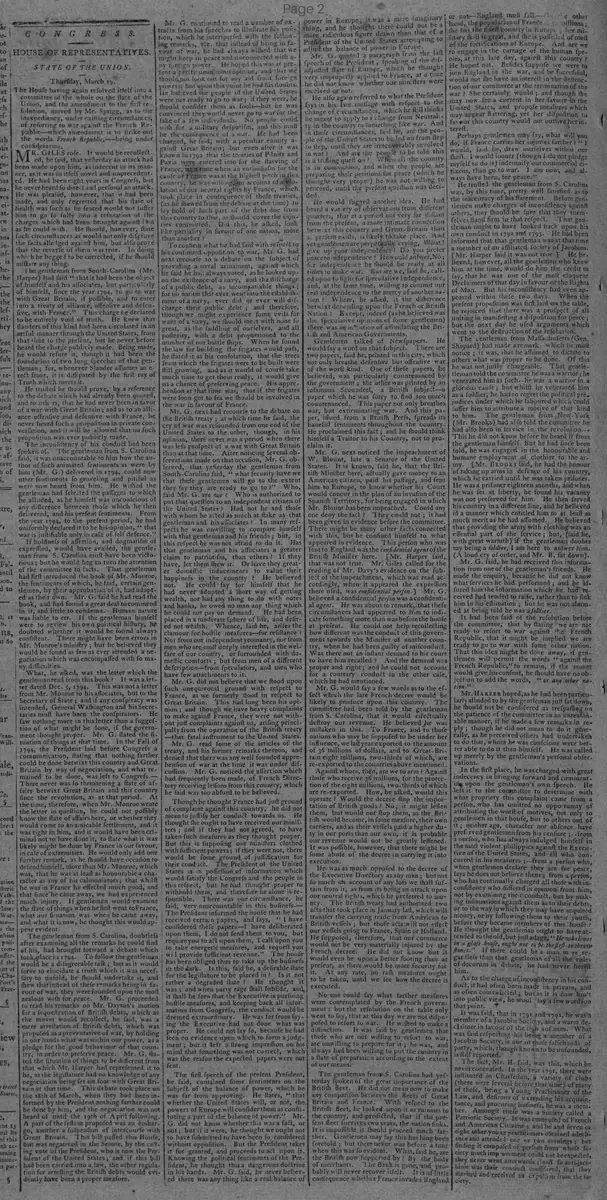
HOUSE OF REPRESENTATIVES.
STATE OF THE UNION.
Thursday, March 29.
The House having again resolved itself into a committee of the whole on the state of the Union, and the amendment to the first resolution, moved by Mr. Sprigg, as to the inexpediency, under existing circumstances, of resorting to war against the French Republic—which amendment is to strike out the words French Republic,—being under consideration,
Mr. GILES rose. It would be recollected, he said, that yesterday an attack had been made upon him, as indecent in its manner, as it was in itself novel and unprecedented. He had been eight years in Congress, but he never heard so direct and personal an attack. He was pleased, however, that it had been made, and only regretted that his state of health was such as he feared would not suffer him to go so fully into a refutation of the charges which had been brought against him as he could wish. He should, however, state such circumstances as would not only disprove the facts alledged against him, but also prove that the reverse of them was true. In doing which he begged to be corrected, if he should misstate anything.
The gentleman from South-Carolina (Mr. Harper) had said "that it had been the object of himself and his associates, but particularly of himself, since the year 1794, to go to war with Great Britain, if possible, and to enter into a treaty of alliance, offensive and defensive, with France." This charge he declared to be entirely void of truth. He knew that slanders of this kind had been circulated in an artful manner through the United States, from that time to the present, but he never before heard the charge publicly made. Being made, he would refute it, though it had been the foundation of two long speeches of that gentleman; for, whenever Slander assumes an erect front, it is dissipated by the first ray of Truth which meets it.
He trusted he should prove, by a reference to the debate which had already been quoted, and to others, that he had never been in favor of a war with Great Britain; and as to an alliance offensive and defensive with France, he never heard such a proposition in private conversation, and it will be allowed that no such proposition was ever publicly made.
The inconsistency of his conduct had been spoken of. The gentleman from S. Carolina said, it was unaccountable to him how the author of such animated sentiments as were by him (Mr. G.) delivered in 1794, could now utter sentiments so groveling and pitiful as were now heard from him. He wished the gentleman had selected the passages to which he alluded, as he himself was unconscious of any difference between those which he then delivered, and his present sentiments. From the year 1794, to the present period, he had uniformly declared it to be his opinion, "that war is justifiable only in case of self defence."
If boldness of assertion, and dogmatism of expression, would have availed, the gentleman from S. Carolina must have been victorious; but he would beg to turn the attention of the committee to facts. That gentleman had first introduced the book of Mr. Monroe, the sentiments of which, he said, certain gentlemen, by their approbation of it, had adopted as their own. Mr. G. said he had read the book, and had found a great deal to commend in it, and little to condemn. Human nature was liable to err. If the gentleman himself were to review his own political history, he doubted whether it would be found always consistent. There might have been errors in Mr. Monroe's ministry; but he believed they would be found as few as ever attended a negotiation which was encompassed with so many difficulties.
What, he asked, was the letter which the gentleman read from this book? It was a letter dated Dec. 5, 1794. This was not a letter from Mr. Monroe to his associates, but to the Secretary of State; and if any conspiracy was intended, General Washington and his Secretaries must have been the conspirators. He saw nothing more in this letter than a suggestion of what might be done, if the government thought proper. Mr. G. stated the situation of things at that time. In the Fall of 1794, the President laid before Congress a communication, stating that nothing farther could be done betwixt this country and Great Britain by way of negotiation, and what remained to be done, was left to Congress.—
There never was so threatening a state of affairs betwixt Great Britain and this country since the revolution, as at that period. At the time, therefore, when Mr. Monroe wrote the letter in question, he could not possibly know the state of affairs here, or whether they would come to an amicable settlement, and it was right in him, and it would have been criminal not to have done it, to state what it was likely might be done by France in our favour, in case of extremities. He would only add one further remark, as he should have occasion to defend himself, more than Mr. Monroe, which was, that he was at least as honourable a character as any of his calumniators; that whilst he was in France he effected much good, and that since he came away, we had experienced much injury. If gentlemen would examine the state of things when he first went to France, what our situation was when he came away, and what it is now, he thought this would appear evident.
The gentleman from S. Carolina, doubtless after examining all the remarks he could find of his, had brought forward a debate which took place in 1794. To follow the gentleman would be a disagreeable task; but as it would serve to elucidate a truth which it was necessary to unfold, he should undertake it, and show that instead of these remarks being in favour of war, they were founded upon the most zealous wish for peace. Mr. G. proceeded to read his remarks on Mr. Dayton's motion for a sequestration of British debts, which as the mover would recollect, he said, was a mere arrestation of British debts, which was proposed as a preventative of war, by holding in our hands what was within our power, as a pledge for the good behaviour of that country, in order to preserve peace. Mr. G. stated the situation of things to be different from that which Mr. Harper had represented it to be, as the legislature had no knowledge of any negotiation being set on foot with Great Britain at that time. This debate took place on the 28th of March, when they had been informed by the President nothing farther could be done by him, and the negotiation was not heard of until the 19th of April following.
A part of the system proposed was an embargo, another a suspension of intercourse with Great Britain. This bill passed this House, but was negatived in the Senate, by the casting vote of the President, who is now the President of the United States; and if this bill had been carried into a law, the other regulation for arresting the British debts would evidently have been a proper measure
Mr. G. continued to read a number of extracts from his speeches to illustrate his position, which he interspersed with the following remarks, viz. that instead of being in favour of war, he had always wished that we might keep in peace and unconnected with any foreign power. He hoped this was at present a pretty unanimous opinion, and that we should not look out for any aid from foreign powers; but upon this point he had his doubts. He believed the people of the United States were not ready to go to war; if they were, he should consider them as fools—but he was convinced they would never go to war for the sake of a few individuals. No people could wish for a military despotism, and this must be the consequence of a war. He had been charged, he said, with a peculiar enmity against Great Britain; but even after it was known in 1793 that the treaties of Pilnitz and Pavia were entered into for the starving of France, at a time when an enthusiasm for the cause of France was at the highest pitch in this country, he was willing, on account of a violation of our neutral rights by France, which took place in consequence of those treaties, (as he shewed from the debate at the time) to lay hold of such part of the debt due from this country to that, as should cover the injuries committed. Did this, he asked, look like partiality in favour of one nation, more than another?
To confirm what he had said with respect to his continued opposition to war, Mr. G. had next recourse to a debate on the subject of providing a naval armament, against which he said he had always voted, as he looked upon the existence of a navy, and the discharge of a public debt, as incompatible things; for no nation that ever went into the establishment of a navy, ever did or ever will discharge their public debt; and therefore, though we might experience some evils for want of a navy, we should meet with none so great, as the saddling of ourselves, and all posterity, with a debt proportioned to the number of our battle ships. When he found the law for building the frigates would pass, he stated it as his consolation, that the trees from which the frigates were to be built were still growing, and as it would of course take much time to get them ready, it would give us a chance of preserving peace. His apprehension at that time was, that if the frigates were soon got to sea we should be involved in the war in favour of France.
Mr. G. next had recourse to the debate on the British treaty; at which time he said, the cry of war was resounded from one end of the United States to the other, though, in his opinion, there never was a period when there was less prospect of a war with Great Britain than at that time. After noticing several observations made on that occasion, Mr. G. observed, that yesterday the gentleman from South-Carolina said, "what Security have we that these gentlemen will go to the extent they say they are ready to go to?" Who, said Mr. G. are we? Who is authorized to put that question to an independent citizen of the United States? Had not he and those with whom he acted as much at stake as that gentleman and his associates? In many respects he was unwilling to compare himself with that gentleman and his friends; but, in this respect he was not afraid to do it. Has that gentleman and his associates a greater claim to patriotism, than others? If they have, let them shew it. Or have they greater domestic inducements to value their happiness in the country? He believed not. He could say for himself that he had never adopted a short way of getting wealth, nor had any thing to do with notes and banks, he owed no man any thing which he could not pay on demand. He had been placed in a moderate sphere of life, and desired not wealth. Whence, said he, arises the clamour for hostile measures—for resistance? Not from our independent yeomanry, nor from men who are most deeply interested in the welfare of our country, or surrounded with domestic comforts; but from men of a different description—from speculators, and men who have few attachments to it.
Mr. G. did not believe that we stood upon such unequivocal ground with respect to France, as we formerly stood in respect to Great Britain. This had long been his opinion; and though we have heavy complaints to make against France, they were not without just complaints against us, arising principally from the operation of the British treaty
Mr. G. read some of the articles of the treaty, and his former remarks thereon, and denied that there was any well founded apprehension of war at the time it was under discussion. Mr. G. noticed the assertion which had frequently been made, of French Directory receiving lessons from this country, which he said was too absurd to be believed.
Though he thought France had just ground of complaint against this country, he did not mean to justify her conduct towards us. He thought she ought to have received our ministers; and if they had not agreed, to have taken such measures as they thought proper. But this is supposing our ministers clothed with sufficient powers; if they were not, there would be some ground of justification for their conduct. The President of the United States is in possession of information which would satisfy the Congress and the people in this respect, but he had thought proper to withhold them, and therefore he alone is responsible. There was one circumstance, he said, very unaccountable in this business.—
The President informed the house that he had received certain papers, and says, "I have considered these papers—I have deliberated upon them, I do not send them to you, but require you to act upon them, I call upon you to take energetic measures, and request you will provide sufficient revenue." The house has been obliged thus to take up the business in the dark. Is this, said he, a desirable state for the legislature to be placed in? Is it not rather a degraded state? He thought it was; and when party rage shall subside, and it shall be seen that the Executive is pursuing hostile measures, and keeping back all information from Congress, the conduct would be deemed extraordinary. He was far from saying the Executive had not done what was proper. He could not say so, because he had seen no evidence upon which to form a judgment; but it left a strong impression on his mind that something was not correct, which was the reason the expected papers were not sent.
The first speech of the present President, he said, contained some sentiments on the subject of the balance of power, which he was far from approving. He states, "that whether the United States will, or not, the powers of Europe will consider them as constituting a part of the balance of power." Mr. G. did not know whether this was a fact, or not; but if it were, he thought we ought not to have submitted to have been so considered without opposition. But the President takes it for granted, and proceeds to act upon it. Knowing the political sentiments of the President, he thought this a dangerous doctrine in his hands. Mr. G. said, he never believed there was any thing like a real balance of power in Europe; it was a mere imaginary thing, and he thought there could not be a more ridiculous figure drawn than that of a President of the United States attempting to adjust the balance of power in Europe.
Mr. G. quoted a paragraph from the last speech of the President, speaking of the disadjusted state of Europe, which he thought very improperly applied to France, at a time when he did not know whether our ministers were received or not.
He also again referred to what the President says in his late message with respect to the change of circumstances, which he still thinks he meant to apply to a change from Neutrality in the country to something like war. And in these circumstances, said he, are the people of the United States to be led on from step to step, until they are irrecoverably involved in war? And are the people to be told this is a trifling question? When all the country is in commotion, and when the people are preparing their petitions for peace (which he thought very proper) he was not willing to proceed, until the present question was decided.
He would suggest another idea. He had heard a variety of observations from different quarters, that at a period not very far distant from the present, a more intimate connection betwixt this country and Great-Britain than at present exists, is likely to take place. And yet gentlemen are perpetually crying, What! give up your independence! Do you prefer peace to independence? He would answer, No; for independence he should be ready at all times to make war. But are we, said he, called upon to fight for speculative Independence, and, at the same time, willing to commit our real independence to the mercy of another nation? Where, he asked, is the difference betwixt depending upon the French or British Nation? Except, indeed (as he believed was the speculative opinions of some gentlemen) there was an intention of assimilating the British and American Governments.
Gentlemen talked of Newspapers. He would say a word on that subject. There are two papers, said he, printed in this city, which not only breathe defensive but offensive war of the worst kind. One of these papers, he believed, was particularly countenanced by the government; the other was printed by an infamous Scoundrel, a British subject—a paper which he was sorry to find too much countenanced. This paper not only breathes war, but exterminating war. And this paper, issued from a British Press, spreads its baneful sentiments throughout the country. He proclaimed this fact; and he should think himself a Traitor to his Country, not to proclaim it.
Mr. G. next noticed the impeachment of W. Blount, late a Senator of the United States. It is known, said he, that the British Minister here, actually gave money to an American citizen, paid his passage, and sent him to Europe, to know whether his Court would concur in the plan of an invasion of the Spanish Territory, for being engaged in which Mr. Blount has been impeached. Could any one deny the fact? They could not; it had been given in evidence before the committee. There might be many other facts connected with this, but he confined himself to what appeared in evidence. This person who was sent to England was the confidential agent of the British Minister here. Mr. Harper said, that was not true. Mr. Giles called for the reading of Mr. Davy's evidence on the subject of the impeachment, which was read accordingly, when it appeared the expression there used, was confidential person.] Mr. G. believed a confidential person was a confidential agent. He was about to remark, that these circumstances had appeared to him to indicate something more than was before the house at present. He could not help recollecting how different was the conduct of this government towards the Minister of another country, when he had been guilty of misconduct. Was there not an instant demand to his court to have him recalled? And the demand was proper and right; and he could not account for a contrary conduct in the other case, which he had mentioned.
Mr. G. would say a few words as to the effect which the late French decree would be likely to produce upon this country. The committee had been told by the gentleman from S. Carolina, that it would effectually destroy our revenue. He believed he was mistaken in this. To France, and to those nations who may be supposed to be under her influence, we last year exported to the amount of 36 millions of dollars, and to Great-Britain eight millions, two-thirds of which, are re-exported to the countries above mentioned. Against whom, then, are we to arm? Against those who receive 6 millions, for the protection of the eight millions, two-thirds of which are re-exported. How, he asked, would this operate? Would the decree stop the importation of British goods? No; it might lessen them, but would not stop them, as the British would become, in some measure, their own carriers, and as their vessels paid a higher duty in our ports than our own, it is probable our revenue would not be greatly lessened.
It was possible, however, that there might be some abuse of the decree in carrying it into execution.
He was as much opposed to the decree of the Executive Directory as any man; but not so much on account of any loss we shall sustain from it, as from its being an attack upon our neutral rights, which he preferred to money. The British treaty had authorized two acts that took place in January last, which will transfer the carrying trade from American to British vessels; but those acts will not affect our vessels going to France, Spain or Holland. He supposed, therefore, that our commerce would not be very materially injured by the French decree. He did not know but it would even be upon a better footing than at present, as there would be more security for it. At any rate, no rash measures ought to be taken, until we see how the decree is executed.
No one could say what farther measures were contemplated by the French government; but the resolution on the table only went to say, that at this day we are not disposed to resort to war. He wished to make a distinction. It was said by gentlemen that those who are not willing to resort to war, are unwilling to prepare for it; he was, and always had been willing to put the country in a state of preparation according to the extent of our means.
The gentleman from S. Carolina had yesterday spoken of the great importance of the British fleet. He did not mean now to make any comparison between the fleets of Great Britain and France. With respect to the British fleet, he looked upon it as ruinous to the country, and predicted, that if the present fleet survives two years, the nation sinks. It is impossible it should proceed much farther. Gentlemen may say this has long been foretold; but there never was before a time when this was so evident. What, said he, are the British now supported by? By the body of merchants. The Bank is gone, and probably will never recover itself. It is of little consequence whether France invades England or not—England must fall.—On the other hand, the population of France is 30 millions; she has the finest country in Europe; her military skill is great, and she is possessed of most of the fortifications of Europe. And are we to engage in the carnage of the human species, at this late day, against this country? He hoped not. Besides suppose we were to join England in the war, and be successful, would not she have an interest in the destruction of our commerce at the termination of the war? She certainly would; and though she may now see a current in her favour in the United States, and propose measures which may appear flattering, yet her disposition to favour this country would not outlive her interest.
Perhaps gentlemen may say, what will you do, if France carries her injuries farther " I would, said he, draw ourselves within our shell. I would sooner (though I do not pledge myself to do it) indemnify our commercial citizens, than go to war. I am now, and always have been, for peace."
He trusted the gentleman from S. Carolina was, by this time, pretty well satisfied as to the inaccuracy of his statement. Before gentlemen make charges of inconsistency against others, they should be sure that they themselves stand firm in that respect. That gentleman ought to have looked back upon his own conduct in 1792 and 1793. He had been informed that that gentleman was at that time a member of an affiliated society of Jacobins. [Mr. Harper said it was not true.] He believed, however, all the gentlemen who knew him at the time, would do him the credit to say, that he was one of the most eloquent Declaimers of that day in favour of the Rights of Man. But his inconsistency had even appeared within these two days. When the present proposition was first laid on the table, he rejoiced that there was a prospect of all uniting in manifesting a disposition for peace; but the next day he used arguments which went to the destruction of the resolution.
The gentleman from Massachusetts (Gen. Shepard) had made a remark, which he must notice; it was, that he assumed to dictate to others what was proper to be done. Of this he was not justly chargeable. That gentleman told the committee he was a warrior; he venerated him as such—he was a warrior in a glorious cause; but whilst he venerated him as a soldier, he had to regret the political prejudices under which he laboured which could suffer him to attribute a motive of that kind to him. The gentleman from New-York (Mr. Brooks) had also told the committee he had also been in service in the revolution.—This he did not know before he heard it from the gentleman himself. But he had since been told, he was engaged in the honourable and humane employment of clothier to the army. [Mr. Brooks said, he had the honour of taking up arms in defence of his country, which he carried until he was taken prisoner. He was a prisoner eighteen months, and when he was set at liberty, he found his vacancy was not preserved for him. He then served his country in a different line, and he believed in a manner which entitled him to at least as much merit as he had assumed. He believed that providing the army with clothing was an essential part of the service; but, said he, with great warmth) if the gentleman doubts my being a soldier, I am here to answer him. (A loud cry of order, and Mr. B. sat down).
Mr. G. said, he had received this information from one of the gentleman's friends. He made the enquiry, because he did not know what services he had performed; and he assured him the information which he had received had tended to raise, rather than to sink him in his estimation; but he was not alarmed at being told he was a soldier.
It had been said of the resolution before the committee, that by stating we are not ready to resort to war against the French Republic, that it might be implied we are ready to go to war with some other nation. That this idea might be done away, if gentlemen will permit the words "against the French Republic," to remain, if the mover would give his consent, he should have no objection to add the words, "or any other nation."
Mr. Harper hoped, as he had been particularly alluded to by the gentleman just sat down, he should not be considered as trespassing on the patience of the committee in an unreasonable manner, if he made a few remarks in reply; though he did not mean to do it generally, as he perceived others had undertaken to do that, whom he was conscious were better able to do it than himself. He was called up merely by the gentleman's personal observations.
In the first place, he was charged with great indecency in bringing forward and commenting upon the gentleman's own speech. He left it to the committee to determine with what propriety this complaint came from a person, who has omitted no opportunity of attributing the worst of motives, not only to gentlemen in that house, but to others out of it; neither age, character nor absence have preserved gentlemen from his censure ;—from a person, who has always indulged himself in the most violent philippics against the Executive of the United States, and all who concurred in his measures ;—from a person, who, when gentlemen declare they are for peace, says he does not believe them ; from a person, who has continually charged all those with inconsistency who differed in opinion from him, not by examining their conduct, but by making insinuations against them as to their debts, or to the way in which they may have acquired money, or by following them to their youth, before they became members of this house?
He thought the gentleman ought to have attended to the old, but just adage, "He who lives in a glass house, ought not to be the first to throw stones." If there could be a man more regardless than that gentleman of all the rules of decorum in debate, he had never heard him.
As to the charge of inconsistency in his conduct, it had often been made in private, and as often contradicted; but as it is now bro't into public view, he would say a few words on that point.
It was said, that in 1791 and 1792, he was a member of a Jacobin Society, and a warm declaimer in favour of the rights of man. What was said respecting his being a member of a Jacobin Society, is one of those falsehoods of party, which, though known to be unfounded, is still reported.
The fact, Mr. H. said, was this, which he never concealed. In the year 1791, there were instituted in Charleston, a variety of clubs (there were several before that time) of many of these, being a Young Practitioner of the Law, and desirous of extending his acquaintance, and procuring business, he was a member. Amongst these was a Society called a Patriotic Society. It was composed of French and American Citizens; and he and seven or eight other young practitioners obtained admittance and attended one or two evenings; but finding it composed of persons from whose society much improvement could not be expected, they never went afterwards; and so anti-jacobin was their conduct considered, that they merited and received an expulsion from the society.
As to being a declaimer in favour of the rights of man in 1791 and 1792, he owned he partook of that enthusiasm which at that time raged in America; because he was deceived. He then believed the French had been unjustly attacked, but he now found they were the first assailants. He then believed that the treaties of Pilnitz and Pavia, of which they had heard so much, were realities; but he now found them contemptible forgeries. With respect to earlier parts of the French Revolution, he then believed that the principal actors in it were virtuous Patriots, but he had since discovered that they were a set of worthless scoundrels and mad-headed enthusiasts, who, in endeavouring to reduce their fallacious schemes to practice, have introduced more calamities into the world, than ages of good government will be able to cure.
Mr. H. said he never was a declaimer in favour of what gentlemen meant by the rights of man. He held them and their author in merited contempt. The pretended factitious rights of man to which gentlemen referred, were the rights of a few noisy demagogues over the rights of the people. Though he always believed this, he did not know it so well, in 1791 and 1792, as he knew it 1794 and since. And, therefore, he was not a declaimer in favour of what the gentlemen mean by the rights of man, but he was a warm admirer of the French Revolution, when he thought the object was the establishment of the true rights of man; but since he discovered that this was neither the object nor would it be the effect, instead of viewing that revolution as a blessing to the world, which he once thought it, he now viewed it as the greatest curse that ever afflicted mankind; as a vial of wrath from heaven, the bitterest that ever was poured out upon the earth.
There was a certain species of the rights of man of which he had always been the defender, in favour of which his voice would always be heard. He had, in a well known instance, advocated those rights of his fellow citizens in the best manner he was able, and in a way which had obtained for him their thanks and their remembrance. How he conducted that defence, was well known to some of his colleagues in that house.
Mr. H. denied that he had been inconsistent with respect to the proposition before the committee. He then noticed what had fallen from Mr. Giles with respect to the decree of the French Directory not being so inimical to this country as it had been supposed to be.
Mr. H. charged Mr. G. with being much mistaken in supposing that only the amount of eight millions of dollars was exported to Great Britain and her dominions, or that 36 millions were exported to France, and to countries connected with her. Out of the 51 millions exported from this country during last year, it appeared from the statement before them, that 8,500,000 were sent to Great Britain, 9,000,000 to the Hanse towns, to France and her dominions, 1,000,000. But he asked if the gentleman from Virginia knew the reason why this amount to France appeared so large? If not, he would tell him. All the produce shipped for the British West Indies in 1797, was almost constantly cleared out for French ports, in order to avoid the effects of the plundering decrees of French West Indies, and this was the reason why six or even millions appeared under this head, which ought to appear under another. But the gentleman seemed to suppose that all which did not go to Great Britain, went to France, and countries connected with her. At least 20 millions, out of the 51, went to countries over whom France had no power; and when to these were added what was sent to Great Britain, and 6 or 7 millions were deducted on the ground he had mentioned, the gentleman would find the balance was not very considerable.
Mr. H. said he should not notice what the gentleman had chose to say respecting the British Minister, except as to the improper manner in which he had called a confidential person, a confidential agent of the Minister, and to say he could not see any analogy betwixt this case, and that of the French Minister who fitted out privateers, and levied troops in our country, without permission from the President of the United States.
The gentleman from Virginia had entered fully, not only into a justification of himself but his friends. How far he had acquitted himself and them from the weighty charges which he had exhibited, he was not the proper person to judge, he left the public to determine. He must, however, beg leave to correct him in one of his facts. He informed the committee that the letter of Mr. Monroe, which had been quoted, was written in December, 1794, whereas it was dated, Paris, Sept. 10, 1795, long after that minister had been officially informed by our minister in London, that the British treaty was concluded and signed; yet this letter recommends the taking of the posts, the invasion of Canada, and the cutting up of British commerce by privateers. He did not say that this letter was a proof of conspiracy; but of a system of policy which was very contrary to a peace system.
But the gentleman says, he (Mr. G.) never proposed war against Great-Britain. He knew it. The gentleman always spoke of peace, but pursued measures which led to war. He did not speak of war, when he recommended sequestrations, confiscations, &c. because he loved peace. He did not talk of war; but whilst he and his friends opposed measures of defence, they were in favour of every measure which led to war. Whilst they were irritating a nation to war, they opposed the building of the frigates.
He could not say what were the views of gentlemen in doing this, but he would say what appearance it had on his mind, when he was far removed from the seat of government. He thought it seemed as if gentlemen believed it would be well to get to war, and then rely upon their favorite nation for support.
The Speaker here alluded to the paper called "the second treaty of Pilnitz" which he declares to be a forgery. The first treaty of Pilnitz was a mere conditional agreement between the Emperor and the King of Prussia, that if either of them should be attacked by France, they would unite in their defence. This treaty they avowed; and when, on the acceptance of the new Constitution by the King of France, better prospects of a peaceable conduct on the part of that nation were entertained, they suspended this treaty by a formal declaration.
[This Debate to be Continued.]
Friday, March 30.
The Speaker laid before the house a report from the Secretary of the Treasury on the subject of contracts for the subsistence of the army, which was ordered to be printed.
Mr. Clopton, from the committee of enrolment, reported as duly enrolled, the bill prohibiting for a limited time the exportation of arms and ammunition, and for encouraging the importation thereof.
Mr. Otis presented a petition from the freeholders and others, of Roxbury, in the state of Massachusetts, stating, that they hear with concern, that liberty is intended to be given to Merchants to arm their vessels for self defence, knowing that Masters of vessels consist of a great variety of character; that amongst them there are men of violent passions, and that the distance betwixt putting arms into a man's hands and the commencement of hostility, may be very short, they deprecate the idea of the Peace and Happiness of this Country being placed on so uncertain a foundation as the pride, caprice or passion of the master of a merchant vessel, they pray, therefore, that vessels of this description may not be permitted to arm. Referred to the committee of the whole on the State of the Union.
Mr. Thatcher presented the petition of Jonathan Young, jun. a soldier in the late war, praying to be placed upon the pension list. Referred to the committee of claims.
Mr. Harper, from the committee of ways and means, reported a bill making appropriations for the Military Establishment of the year 1798, which was committed for Monday.
The amendments from the Senate to the bill for the relief of refugees from Canada and Nova Scotia, as agreed to by the committees of conference, were agreed to by the house.
Mr. Allen observed that when the President of the United States sent his first Message to the house, announcing the receipt of dispatches from our Commissioners in Paris, he stated that it would take some time to decypher the dispatches which he had received. Some days afterwards, on the 19th instant, he sent another message informing the house, "that it was incumbent upon him to declare that he saw no ground of expectation that the object of their mission could be accomplished, on terms compatible with the safety, honour, or the essential interests of the nation."
It had been observed, in the course of the debate in the committee of the whole on the State of the Union, and not in the most candid and proper manner, that the papers received from our commissioners ought to have been laid before the House, and the President had been charged with withholding them. He supposed gentlemen would have been satisfied, and he was, with the information which the President had already communicated, that our commissioners are not received, and that France refuses to hear us. But, though he was himself satisfied with the information he had at present, as he believed there are many gentlemen in the House who wish for more; because there is a paper printed in this city which is continually insinuating that there is something in these dispatches which, if they were made known, would shew that the conduct of our Executive has been improper; because he found that paper often speaking the language of gentlemen in this House, and which spoke it, he believed on this occasion; and because, if this is not true, he wished the people to be undeceived; or if true, that he and those who thought with him, that no such blame existed, might be convinced of their error; he proposed the following resolution, to which he hoped there would be no objection.
"Resolved, That the President of the United States be requested to communicate to this house, the dispatches from the Envoys Extraordinary of the United States to the French Republic, mentioned in his message of the 19th inst. or such parts thereof as considerations of public safety and interest, in his opinion, may permit."
Mr. Livingston moved to amend this resolution by striking out that part which is printed in italic, and by adding, before the word "dispatches." instructions to.
After some observations had taken place on this amendment, a motion was made by Mr. Harper to adjourn the farther consideration of this resolution till Monday (the previous and ordinary motion when the house adjourns, it will adjourn till Monday having been passed) which was carried 47 to 41.
The order of the day being called for, Mr. Allen hoped that it would also be postponed until the resolution which had already been postponed, should be decided upon.
This motion produced a debate which continued till two o'clock, when a motion was made and carried to adjourn. A sketch of the debate on Monday. The House adjourned till Monday.
What sub-type of article is it?
What keywords are associated?
What entities or persons were involved?
Domestic News Details
Event Date
Thursday, March 29, 1798 And Friday, March 30, 1798
Key Persons
Outcome
debate continues without resolution; motions to adjourn carried; various bills reported and petitions referred; resolution on dispatches postponed to monday.
Event Details
In committee of the whole on the state of the union, Mr. Giles defends his consistent opposition to war except in self-defense, refutes pro-French alliance charges using past debates and Monroe's writings, criticizes British influence and Executive withholding of information, opposes rash measures against France. Mr. Harper replies, denies Jacobin past, corrects trade export figures, accuses Giles of measures leading to war. On March 30, routine proceedings include army subsistence report, arms export bill enrollment, petitions from Roxbury against arming merchant vessels and from Jonathan Young, jun. for pension, military appropriations bill, refugee relief amendments agreed, and Mr. Allen's resolution requesting envoys' dispatches, amended by Mr. Livingston and postponed.