Thank you for visiting SNEWPapers!
Sign up free
Story
February 2, 1843
The Daily Madisonian
Washington, District Of Columbia
What is this article about?
A letter dated January 30, 1843, from New York encloses an article from the Journal of Commerce refuting Mr. Davis' bill to reduce customs house employees, arguing that increased business volume and duties justify the larger staff despite lower revenue collections compared to 1826-27.
Clipping
OCR Quality
98%
Excellent
Full Text
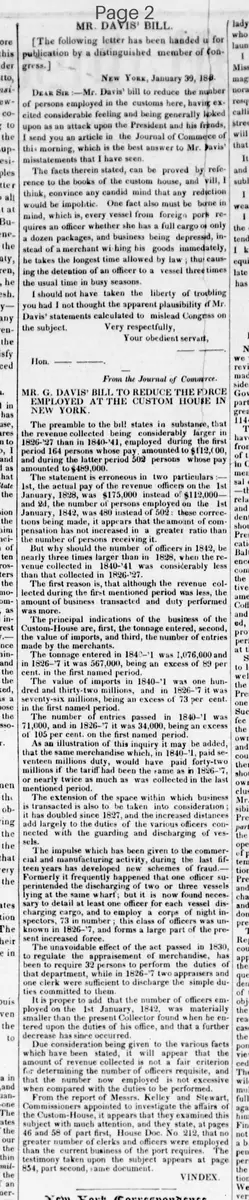
MR. DAVIS' BILL.
[The following letter has been handed in for publication by a distinguished member of congress.]
New York, January 30, 1843.
Dear Sir: Mr. Davis' bill to reduce the number of persons employed in the customs here, having excited considerable feeling and being generally looked upon as an attack upon the President and his friends, I send you an article in the Journal of Commerce of this morning, which is the best answer to Mr. Davis misstatements that I have seen.
The facts therein stated, can be proved by reference to the books of the custom house, and will, I think, convince any candid mind that any reduction would be impolitic. One fact also must be borne in mind, which is, every vessel from foreign ports requires an officer whether she has a full cargo or only a dozen packages, and business being depressed, instead of a merchant wishing his goods immediately, he takes the longest time allowed by law; thus causing the detention of an officer to a vessel three times the usual time in busy seasons.
I should not have taken the liberty of troubling you had I not thought the apparent plausibility of Mr. Davis' statements calculated to mislead Congress on the subject.
Very respectfully,
Your obedient servant,
From the Journal of Commerce.
MR. G. DAVIS' BILL TO REDUCE THE FORCE EMPLOYED AT THE CUSTOM HOUSE IN NEW YORK.
The preamble to the bill states in substance, that the revenue collected being considerably larger in 1826-'27 than in 1840-'41, employed during the first period 164 persons whose pay, amounted to $112,000, and during the latter period 502 persons whose pay amounted to $489,000.
The statement is erroneous in two particulars:—
1st, the actual pay of the revenue officers on the 1st January, 1828, was $175,000 instead of $112,000—
and 2d, the number of persons employed on the 1st January, 1842, was 480 instead of 502: these corrections being made, it appears that the amount of compensation has not increased in a greater ratio than the number of persons receiving it.
But why should the number of officers in 1842, be nearly three times larger than in 1828, when the revenue collected in 1840-'41 was considerably less than that collected in 1826-'27.
The first reason is, that although the revenue collected during the first mentioned period was less, the amount of business transacted and duty performed was more.
The principal indications of the business of the Custom-House are, first, the tonnage entered, second, the value of imports, and third, the number of entries made by the merchants.
The tonnage entered in 1840-'41 was 1,076,000 and in 1826-'7 it was 567,000, being an excess of 89 per cent. in the first named period.
The value of imports in 1840-'41 was one hundred and thirty-two millions, and in 1826-'7 it was seventy-six millions, being an excess of 73 per cent. in the first named period.
The number of entries passed in 1840-'41 was 71,000, and in 1826-'7 it was 34,000, being an excess of 105 per cent. on the first named period.
As an illustration of this inquiry it may be added, that the same merchandise which, in 1840-'41, paid seventeen millions duty, would have paid forty-two millions if the tariff had been the same as in 1826-'7, or nearly twice as much as was collected in the last mentioned period.
The extension of the space within which business is transacted is also to be taken into consideration; it has doubled since 1827, and the increased distances add largely to the duties of the various officers connected with the guarding and discharging of vessels.
The impulse which has been given to the commercial and manufacturing activity, during the last fifteen years has developed new schemes of fraud.— Formerly it frequently happened that one officer superintended the discharging of two or three vessels lying at the same wharf; but it is now found necessary to detail at least one officer for each vessel discharging cargo, and to employ a corps of night inspectors, 73 in number; this class of officers was unknown in 1826-'7, and forms a large part of the present increased force.
The unavoidable effect of the act passed in 1830 to regulate the appraisement of merchandise, has been to require 32 persons to perform the duties of that department. while in 1826-'7 two appraisers and one clerk were sufficient to discharge the simple duties committed to them.
It is proper to add that the number of officers employed on the 1st January, 1842, was materially smaller than the present Collector found when he entered upon the duties of his office, and that a further decrease has since occurred.
Due consideration being given to the various facts which have been stated, it will appear that the amount of revenue collected is not a fair criterion for determining the number of officers requisite, and that the number now employed is not excessive when compared with the duties to be performed.
From the report of Messrs. Kelley and Stewart. Commissioners appointed to investigate the affairs of the Custom-House, it appears that they examined this subject with much attention, and they state, at pages 46 and 58 of part first, House Doc. No 212, that no greater number of clerks and officers were employed than the current business of the port requires." The testimony taken upon the subject appears at page 854, part second, same document.
VINDEX.
[The following letter has been handed in for publication by a distinguished member of congress.]
New York, January 30, 1843.
Dear Sir: Mr. Davis' bill to reduce the number of persons employed in the customs here, having excited considerable feeling and being generally looked upon as an attack upon the President and his friends, I send you an article in the Journal of Commerce of this morning, which is the best answer to Mr. Davis misstatements that I have seen.
The facts therein stated, can be proved by reference to the books of the custom house, and will, I think, convince any candid mind that any reduction would be impolitic. One fact also must be borne in mind, which is, every vessel from foreign ports requires an officer whether she has a full cargo or only a dozen packages, and business being depressed, instead of a merchant wishing his goods immediately, he takes the longest time allowed by law; thus causing the detention of an officer to a vessel three times the usual time in busy seasons.
I should not have taken the liberty of troubling you had I not thought the apparent plausibility of Mr. Davis' statements calculated to mislead Congress on the subject.
Very respectfully,
Your obedient servant,
From the Journal of Commerce.
MR. G. DAVIS' BILL TO REDUCE THE FORCE EMPLOYED AT THE CUSTOM HOUSE IN NEW YORK.
The preamble to the bill states in substance, that the revenue collected being considerably larger in 1826-'27 than in 1840-'41, employed during the first period 164 persons whose pay, amounted to $112,000, and during the latter period 502 persons whose pay amounted to $489,000.
The statement is erroneous in two particulars:—
1st, the actual pay of the revenue officers on the 1st January, 1828, was $175,000 instead of $112,000—
and 2d, the number of persons employed on the 1st January, 1842, was 480 instead of 502: these corrections being made, it appears that the amount of compensation has not increased in a greater ratio than the number of persons receiving it.
But why should the number of officers in 1842, be nearly three times larger than in 1828, when the revenue collected in 1840-'41 was considerably less than that collected in 1826-'27.
The first reason is, that although the revenue collected during the first mentioned period was less, the amount of business transacted and duty performed was more.
The principal indications of the business of the Custom-House are, first, the tonnage entered, second, the value of imports, and third, the number of entries made by the merchants.
The tonnage entered in 1840-'41 was 1,076,000 and in 1826-'7 it was 567,000, being an excess of 89 per cent. in the first named period.
The value of imports in 1840-'41 was one hundred and thirty-two millions, and in 1826-'7 it was seventy-six millions, being an excess of 73 per cent. in the first named period.
The number of entries passed in 1840-'41 was 71,000, and in 1826-'7 it was 34,000, being an excess of 105 per cent. on the first named period.
As an illustration of this inquiry it may be added, that the same merchandise which, in 1840-'41, paid seventeen millions duty, would have paid forty-two millions if the tariff had been the same as in 1826-'7, or nearly twice as much as was collected in the last mentioned period.
The extension of the space within which business is transacted is also to be taken into consideration; it has doubled since 1827, and the increased distances add largely to the duties of the various officers connected with the guarding and discharging of vessels.
The impulse which has been given to the commercial and manufacturing activity, during the last fifteen years has developed new schemes of fraud.— Formerly it frequently happened that one officer superintended the discharging of two or three vessels lying at the same wharf; but it is now found necessary to detail at least one officer for each vessel discharging cargo, and to employ a corps of night inspectors, 73 in number; this class of officers was unknown in 1826-'7, and forms a large part of the present increased force.
The unavoidable effect of the act passed in 1830 to regulate the appraisement of merchandise, has been to require 32 persons to perform the duties of that department. while in 1826-'7 two appraisers and one clerk were sufficient to discharge the simple duties committed to them.
It is proper to add that the number of officers employed on the 1st January, 1842, was materially smaller than the present Collector found when he entered upon the duties of his office, and that a further decrease has since occurred.
Due consideration being given to the various facts which have been stated, it will appear that the amount of revenue collected is not a fair criterion for determining the number of officers requisite, and that the number now employed is not excessive when compared with the duties to be performed.
From the report of Messrs. Kelley and Stewart. Commissioners appointed to investigate the affairs of the Custom-House, it appears that they examined this subject with much attention, and they state, at pages 46 and 58 of part first, House Doc. No 212, that no greater number of clerks and officers were employed than the current business of the port requires." The testimony taken upon the subject appears at page 854, part second, same document.
VINDEX.
What sub-type of article is it?
Historical Event
What themes does it cover?
Deception
Justice
What keywords are associated?
Customs House
Davis Bill
New York Port
Revenue Officers
Business Volume
Tariff Changes
Fraud Prevention
What entities or persons were involved?
Mr. Davis
Mr. G. Davis
Messrs. Kelley And Stewart
Vindex
Where did it happen?
New York Custom House
Story Details
Key Persons
Mr. Davis
Mr. G. Davis
Messrs. Kelley And Stewart
Vindex
Location
New York Custom House
Event Date
January 30, 1843
Story Details
A letter encloses an article refuting Mr. Davis' bill to cut customs staff, correcting his figures on employment and pay from 1826-27 vs. 1840-41, and explaining increased business tonnage, imports, entries, fraud prevention, and legislative changes justify the larger force.