Thank you for visiting SNEWPapers!
Sign up free
Literary
May 28, 1800
The Providence Journal, And Town And Country Advertiser
Providence, Providence County, Rhode Island
What is this article about?
Review from Baltimore Telegraphe praises Thomas Campbell's 'The Pleasures of Hope' as a work of genius. Excerpt depicts Conrad's emotional farewell to daughter Ellenor before exile to Sydney Cove, emphasizing hope's enduring power amid death and separation.
Clipping
OCR Quality
95%
Excellent
Full Text
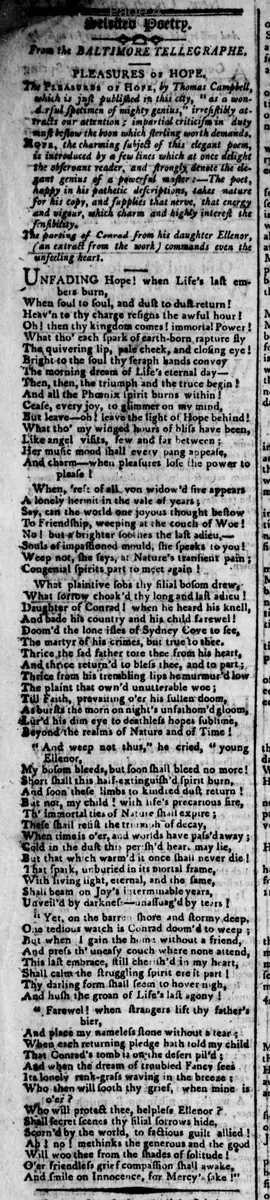
SELECTED POETRY.
From the BALTIMORE TELEGRAPHE.
ON THE PLEASURES OF HOPE.
The Pleasures of Hope, by Thomas Campbell, which is just published in this city, "as a wonderful specimen of mighty genius," irresistibly attracts our attention; impartial criticism in duty must bestow the boon which sterling worth demands.
Hope, the charming subject of this elegant poem, is introduced by a few lines which at once delight the observant reader, and strongly denote the elegant genius of a powerful master:--The poet, happy in his pathetic descriptions, takes nature for his copy, and supplies that nerve, that energy and vigour, which charm and highly interest the sensibility.
The parting of Conrad from his daughter Ellenor, (an extract from the work) commands even the unfeeling heart.
UNFADING Hope! when Life's last embers burn,
When soul to soul, and dust to dust return!
Heav'n to thy charge resigns the awful hour!
Oh! then thy kingdom comes! immortal Power!
What tho' each spark of earth-born rapture fly
The quivering lip, pale cheek, and closing eye!
Bright to the soul thy seraph hands convey
The morning dream of Life's eternal day--
Then, then; the triumph and the truce begin!
And all the Phoenix spirit burns within!
Cease, every joy, to glimmer on my mind,
But leave oh! leave the light of Hope behind!
What tho' my winged hours of bliss have been,
Like angel visits, few and far between;
Her magic mood shall every pang assuage,
And chase--when pleasures lose the power to please!
When, 'reft of all, worn widow'd Nature appears
A lonely hermit in the vale of years;
Say, can the world one joyous thought bestow
To Friendship, weeping at the couch of Woe!
No! but a brighter spot his last adieu,--
Souls of impassioned mould, he speaks to you!
Weep not, he says, at Nature's transient pain;
Congenial spirits part to meet again!
What plaintive sobs thy filial bosom drew,
What sorrow choak'd thy long and last adieu!
Daughter of Conrad! when he heard his knell,
And bade his country and his child farewell!
Doom'd the lone isles of Sydney Cove to see,
The martyr of his crimes, but true to thee.
Thrice the sad father tore thee from his heart,
And thrice return'd to bless thee, and to part;
Thrice from his trembling lips he murmur'd low
The plaint that own'd unalterable woe;
Till--Faith, prevailing o'er his fallen doom,
As bursts the morn on night's unfathom'd gloom,
Lur'd his dim eye to deathless hopes sublime,
Beyond the realms of Nature and of Time!
"And weep not thus," he cried, "young Ellenor,
My bosom bleeds, but soon shall bleed no more!
Short shall this half-extinguish'd spirit burn,
And soon these limbs to kindred dust return!
But not, my child! with life's precarious fire,
The immortal ties of Nature shall expire;
These shall resist the triumph of decay,
When time is o'er, and worlds have pass'd away!
Cold in the dust this perish'd heart may lie,
But that which warm'd it once shall never die!
That spark, unburied in its mortal frame,
With living light, eternal, and the same,
Shall beam on Joy's interminable years,
Unveil'd by darkness--unimpair'd by tears!
"
Yet, on the barren shore and stormy deep,
One tedious watch is Conrad doom'd to weep;
But when I gain the home without a friend,
And press th' uneasy couch where none attend,
This last embrace, till cherish'd in my heart;
Shall calm the struggling spirit ere it part.
Thy darling form shall seem to hover nigh,
And hush the groan of Life's last agony!
"Farewell! when strangers lift thy father's bier,
And place my nameless stone without a tear;
When each returning pledge hath told my child
That Conrad's tomb is on the desert pil'd;
And when the dream of troubled Fancy sees
Its lonely rank-grass waving in the breeze;
Who then will soothe thy grief, when mine is o'er?
Who will protect thee, helpless Ellenor?
Shall secret scenes thy filial sorrows hide,
Scorn'd by the world, to factious guilt allied!
Ah! no: methinks the generous and the good
Will woo thee from the shades of solitude!
O'er friendless grief compassion shall awake,
And smile on Innocence, for Mercy's sake!"
From the BALTIMORE TELEGRAPHE.
ON THE PLEASURES OF HOPE.
The Pleasures of Hope, by Thomas Campbell, which is just published in this city, "as a wonderful specimen of mighty genius," irresistibly attracts our attention; impartial criticism in duty must bestow the boon which sterling worth demands.
Hope, the charming subject of this elegant poem, is introduced by a few lines which at once delight the observant reader, and strongly denote the elegant genius of a powerful master:--The poet, happy in his pathetic descriptions, takes nature for his copy, and supplies that nerve, that energy and vigour, which charm and highly interest the sensibility.
The parting of Conrad from his daughter Ellenor, (an extract from the work) commands even the unfeeling heart.
UNFADING Hope! when Life's last embers burn,
When soul to soul, and dust to dust return!
Heav'n to thy charge resigns the awful hour!
Oh! then thy kingdom comes! immortal Power!
What tho' each spark of earth-born rapture fly
The quivering lip, pale cheek, and closing eye!
Bright to the soul thy seraph hands convey
The morning dream of Life's eternal day--
Then, then; the triumph and the truce begin!
And all the Phoenix spirit burns within!
Cease, every joy, to glimmer on my mind,
But leave oh! leave the light of Hope behind!
What tho' my winged hours of bliss have been,
Like angel visits, few and far between;
Her magic mood shall every pang assuage,
And chase--when pleasures lose the power to please!
When, 'reft of all, worn widow'd Nature appears
A lonely hermit in the vale of years;
Say, can the world one joyous thought bestow
To Friendship, weeping at the couch of Woe!
No! but a brighter spot his last adieu,--
Souls of impassioned mould, he speaks to you!
Weep not, he says, at Nature's transient pain;
Congenial spirits part to meet again!
What plaintive sobs thy filial bosom drew,
What sorrow choak'd thy long and last adieu!
Daughter of Conrad! when he heard his knell,
And bade his country and his child farewell!
Doom'd the lone isles of Sydney Cove to see,
The martyr of his crimes, but true to thee.
Thrice the sad father tore thee from his heart,
And thrice return'd to bless thee, and to part;
Thrice from his trembling lips he murmur'd low
The plaint that own'd unalterable woe;
Till--Faith, prevailing o'er his fallen doom,
As bursts the morn on night's unfathom'd gloom,
Lur'd his dim eye to deathless hopes sublime,
Beyond the realms of Nature and of Time!
"And weep not thus," he cried, "young Ellenor,
My bosom bleeds, but soon shall bleed no more!
Short shall this half-extinguish'd spirit burn,
And soon these limbs to kindred dust return!
But not, my child! with life's precarious fire,
The immortal ties of Nature shall expire;
These shall resist the triumph of decay,
When time is o'er, and worlds have pass'd away!
Cold in the dust this perish'd heart may lie,
But that which warm'd it once shall never die!
That spark, unburied in its mortal frame,
With living light, eternal, and the same,
Shall beam on Joy's interminable years,
Unveil'd by darkness--unimpair'd by tears!
"
Yet, on the barren shore and stormy deep,
One tedious watch is Conrad doom'd to weep;
But when I gain the home without a friend,
And press th' uneasy couch where none attend,
This last embrace, till cherish'd in my heart;
Shall calm the struggling spirit ere it part.
Thy darling form shall seem to hover nigh,
And hush the groan of Life's last agony!
"Farewell! when strangers lift thy father's bier,
And place my nameless stone without a tear;
When each returning pledge hath told my child
That Conrad's tomb is on the desert pil'd;
And when the dream of troubled Fancy sees
Its lonely rank-grass waving in the breeze;
Who then will soothe thy grief, when mine is o'er?
Who will protect thee, helpless Ellenor?
Shall secret scenes thy filial sorrows hide,
Scorn'd by the world, to factious guilt allied!
Ah! no: methinks the generous and the good
Will woo thee from the shades of solitude!
O'er friendless grief compassion shall awake,
And smile on Innocence, for Mercy's sake!"
What sub-type of article is it?
Poem
What themes does it cover?
Death Mortality
Moral Virtue
What keywords are associated?
Pleasures Of Hope
Thomas Campbell
Unfading Hope
Conrad
Ellenor
Parting
Exile
Immortality
Sydney Cove
What entities or persons were involved?
Thomas Campbell
Literary Details
Title
The Pleasures Of Hope
Author
Thomas Campbell
Subject
The Parting Of Conrad From His Daughter Ellenor
Key Lines
Unfading Hope! When Life's Last Embers Burn,
When Soul To Soul, And Dust To Dust Return!
Heav'n To Thy Charge Resigns The Awful Hour!
Oh! Then Thy Kingdom Comes! Immortal Power!
What Tho' Each Spark Of Earth Born Rapture Fly
The Quivering Lip, Pale Cheek, And Closing Eye!
"And Weep Not Thus," He Cried, "Young Ellenor,
My Bosom Bleeds, But Soon Shall Bleed No More!
That Spark, Unburied In Its Mortal Frame,
With Living Light, Eternal, And The Same,
Shall Beam On Joy's Interminable Years,
Unveil'd By Darkness Unimpair'd By Tears!