Thank you for visiting SNEWPapers!
Sign up free
Southern Christian Advocate
Charleston, Charleston County, South Carolina
What is this article about?
In a letter to the Southern Christian Advocate, W. J. S. from Alabama defends the Methodist Itinerant system as superior to stationary ministry for fostering church-wide awareness, upholding authority, suiting human psychology, resolving conflicts, and enabling widespread Gospel dissemination. Dated December 30, 1842.
Merged-components note: Part III of the article 'THE ITINERANT SYSTEM' continued across pages, including the dateline and signature; original labels included 'letter_to_editor' and 'story', so label changed to 'letter_to_editor' as it fits the series format.
Clippings
1 of 2
OCR Quality
Full Text
THE ITINERANT SYSTEM.--NO. III.
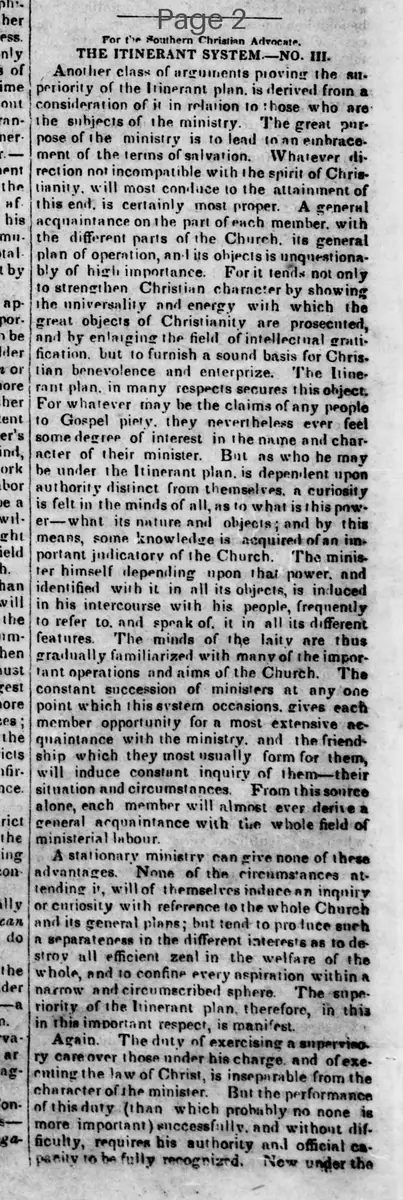
Another class of arguments proving the superiority of the Itinerant plan, is derived from a consideration of it in relation to those who are the subjects of the ministry. The great purpose of the ministry is to lead to an embracement of the terms of salvation. Whatever direction not incompatible with the spirit of Christianity, will most conduce to the attainment of this end, is certainly most proper. A general acquaintance on the part of each member, with the different parts of the Church, its general plan of operation, and its objects is unquestionably of high importance. For it tends not only to strengthen Christian character by showing the universality and energy with which the great objects of Christianity are prosecuted, and by enlarging the field of intellectual gratification, but to furnish a sound basis for Christian benevolence and enterprise. The Itinerant plan, in many respects secures this object. For whatever may be the claims of any people to Gospel piety, they nevertheless ever feel some degree of interest in the name and character of their minister. But as who he may be under the Itinerant plan, is dependent upon authority distinct from themselves, a curiosity is felt in the minds of all, as to what is this power--what its nature and objects; and by this means, some knowledge is acquired of an important judicatory of the Church. The minister himself depending upon that power, and identified with it in all its objects, is induced in his intercourse with his people, frequently to refer to, and speak of, it in all its different features. The minds of the laity are thus gradually familiarized with many of the important operations and aims of the Church. The constant succession of ministers at any one point which this system occasions, gives each member opportunity of a most extensive acquaintance with the ministry, and the friendship which they most usually form for them, will induce constant inquiry of them their situation and circumstances. From this source alone, each member will almost ever derive a general acquaintance with the whole field of ministerial labour.
A stationary ministry can give none of these advantages. None of the circumstances attending it, will of themselves induce an inquiry or curiosity with reference to the whole Church and its general plans; but tend to produce such a separateness in the different interests as to destroy all efficient zeal in the welfare of the whole, and to confine every inspiration within a narrow and circumscribed sphere. The superiority of the Itinerant plan, therefore, in this important respect, is manifest.
Again. The duty of exercising a supervisory care over those under his charge, and of executing the law of Christ, is inseparable from the character of the minister. But the performance of this duty (than which probably no one is more important) successfully, and without difficulty, requires his authority and official capacity to be fully recognized. Now under the Itinerant plan, this recognition is more complete and satisfactory. The minister comes not as the choice of the people, but as the representative of the Church. He is known to be sent by those who are responsible for his qualifications and character. He is the organ of a power which they cannot resist, and which they are bound to obey. His official station is thus exalted in their view, and his authority clothed with a sacredness derived from its source. Under a stationary ministry, the minister is the choice of the people. They select him for themselves, and feel that they have a right to control him. His authority is thus weakened, and his supervisory care rendered inefficient. The Itinerant plan, therefore, by elevating the ministerial character, and securing a proper recognition of authority, contributes essentially to the faithful discharge of duty, and to the purity and efficiency of the Church.
DECEMBER 30, 1842
stationary or local system. through the familiarity which subsists between the parties.
the capacity and intimacy of their associations,
official character and capacity are gradually
lost sight of, and special authority merged into
that of those whose duty it is to yield. Thus,
in the execution of law, or in the enforcement
of a statutory discipline, ministerial authority is
disregarded. and there is apt to be perpetual
friction, or the existence of a loose and unwholesome
some condition of affairs. But the Itinerant
plan by the constant change of the ministry.
Lends to fix the attention upon the office itself
its powers and privileges, and the shortness of
the stay of each does not admit of that intimacy.
cy and homely familiarity destructive of minis
terial authority; and hence the Itinerant min.
ister whose course is characterized by prudence,
will rarely find difficulty in the legitimate
performance of any duty.
But this system is better calculated to ac-
complish the objects of the ministry than all
others. from the fact that its operations are bet-
ter adapted to the nature of the human mind.
Man is fond of change and novelty.. And
sameness, if it be not necessary to existence,
will eventually beget indifference. Under the
Itinerant plan, this quality of the mind is met
and gratified. Its very element is change.-
And while it is not so frequent as to be incom-
patible with a competent mutual acquaintance
between the ministry and their charge. yet suf.
ficiently so to preclude the probability of sameness reaching the point of inefficiency or harm.
Every other system being in this respect, oppo-
site in character, must fail to secure this desira-
ble end, to the same extent.
The Itinerant plan is better adapted to the
nature of the mind from the fact that it meets
more effectually all the variety of tastes and
feelings which exists among men. Since the
temperaments and mental constitutions of men
differ. it is certain that the character and
style of discourse best adapted to each, must
likewise differ. Public speaking is general-
ly most effective to those whose constitution
of mind bears most resemblance to the author
of it. Hence, with the same truth that it is
said that preaching is calculated to effect good.
may it be said that every variety of people
should have a variety of preachers, or a suc.
cession of different preachers. This end is se.
cured by the Itinerant system. But under the
stationary plan, while a portion of the people
are suited in their tastes and intellectual con-
stitutions. the remainder are permitted to be un
satisfied and unbenefited. These are facts im
portant in their results. but too little recognized
and provided for by the world in general.
The superiority of this system is shown, in
the next place, by the fact that it better provides
for the contingencies of nature. A mutual
good understanding and cordiality of feeling
between the minister and his charge, are essen
tial to the prosperity of religion. But man is
imperfect and exceedingly fallible, and, there-
fore, in the various intercourse which must ne.
cessarily occur, there is constant liability to the
excitation of unpleasant, and often violent feel.
ing which. in so far as it exists, is exceedingly
hurtful. But a change in the ministry which
this system supposes, fully meets this difficulty.
and removes the disaffection by a removal of its
cause.
But the strongest argument in support of
our position, is the facilities which this system
affords above all others for extending the preach.
ing of the Gospel to all parts of the land. and
to every people. If the obligation exists to
preach the Gospel to one community. with the
same force it must exist to proclaim it to every
community. That system, then. which pro
vides best for the discharge of this obligation.
is not only most eligible, but all others in
which this end is not fully compassed and re
garded of primary importance, are certainly gros
ly defective. - The Itinerant system is the only
one in which every community can have the
benefit of regular and constant ministerial in.
struction. or in which the field of ministerial
labour can so extend with the wants and de.
mands of the people. A stationary ministry
in general, demands almost the elements of a
Church, before the commencement of its ope.
rations. Whereas, the Itinerant ministry are
competent to precede all preliminary prepara-
tions, and prepared to operate wherever the
sons of men are to be found.
Having thus shown the compatibility of the
Itinerant system with the spirit of Christianity.
and its superiority above all others in accom-
plishing the great objects of the Christian min-
istry, we conclude that there can be no debate
as to the propriety of its adoption. All prac-
tice calculated to destroy its vitality must be
criminal, and all promptings of conscience to
an entrance upon it must be obeyed.
Alabama, 1842.
W. J. S.
What sub-type of article is it?
What themes does it cover?
What keywords are associated?
What entities or persons were involved?
Letter to Editor Details
Author
W. J. S.
Recipient
Southern Christian Advocate
Main Argument
the itinerant system is superior to the stationary ministry because it promotes general knowledge of church operations, ensures recognition of ministerial authority, adapts to human nature's need for change and variety, handles interpersonal conflicts through rotation, and best facilitates the extension of gospel preaching to all communities.
Notable Details