Thank you for visiting SNEWPapers!
Sign up free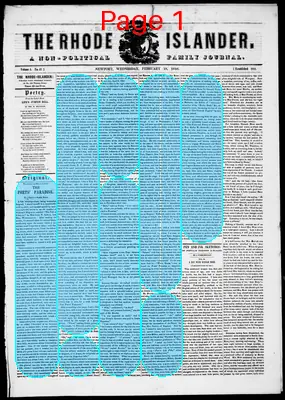
Literary
February 18, 1846
The Rhode Islander
Newport, Newport County, Rhode Island
What is this article about?
In a dream inspired by Jane T. Lomax's article, the narrator visits Poets' Paradise, a utopian afterlife for worthy poets judged by the nine muses. He encounters figures like Petrarch and Laura, Dante and Beatrice, Shakespeare, Pope, and others, observing their reunions and discussions, with satirical notes on admissions and expulsions.
Clipping
OCR Quality
95%
Excellent
Full Text
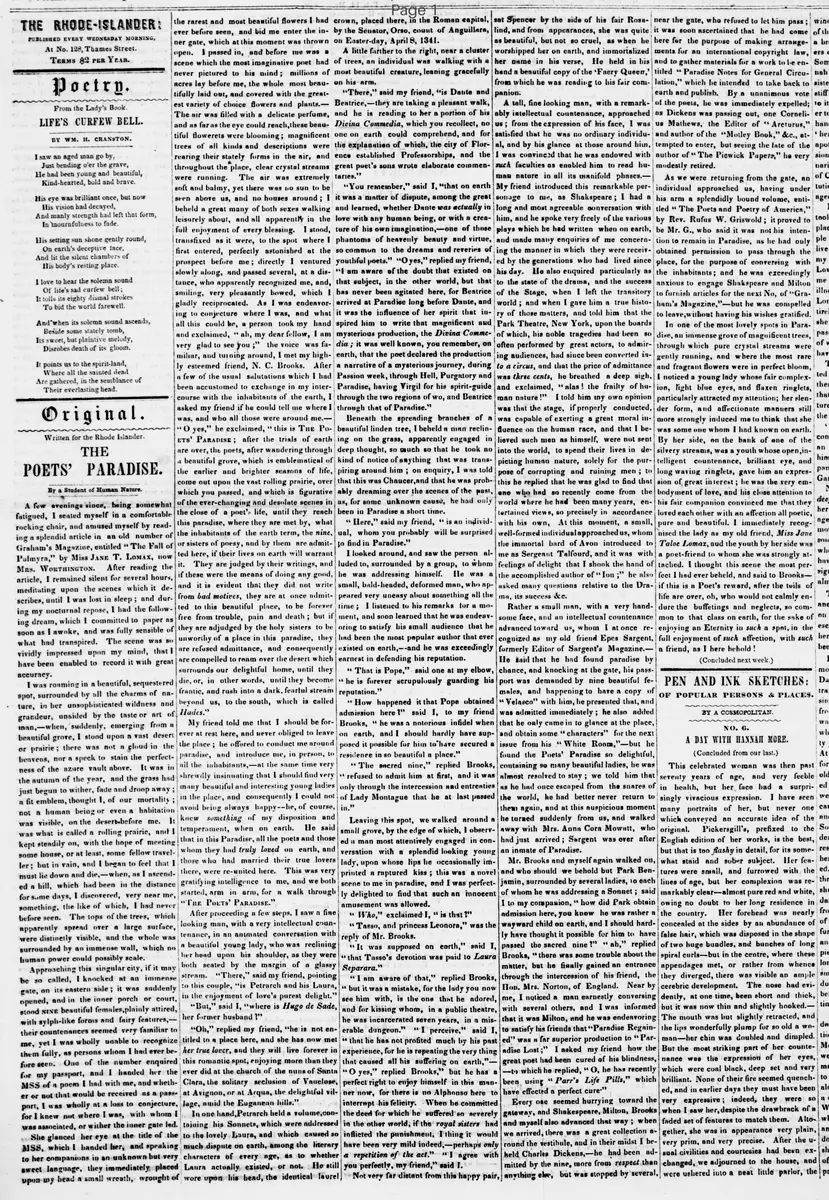
Original.
Written for the Rhode Islander.
THE POETS' PARADISE.
By a Student of Human Nature.
A few evenings since, being somewhat fatigued, I seated myself in a comfortable rocking chair, and amused myself by reading a splendid article in an old number of Graham's Magazine, entitled "The Fall of Palmyra," by Miss Jane T. Lomax, now MRS. WORTHINGTON.
After reading the article, I remained silent for several hours, meditating upon the scenes which it describes, until I was lost in sleep; and during my nocturnal repose, I had the following dream, which I committed to paper as soon as I awoke, and was fully sensible of what had transpired. The scene was so vividly impressed upon my mind, that I have been enabled to record it with great accuracy.
I was roaming in a beautiful, sequestered spot, surrounded by all the charms of nature, in her unsophisticated wildness and grandeur, unaided by the taste or art of man,—when, suddenly, emerging from a beautiful grove, I stood upon a vast desert or prairie; there was not a cloud in the heavens, nor a speck to stain the perfectness of the azure vault above. It was in the autumn of the year, and the grass had just begun to wither, fade and droop away; a fit emblem, thought I, of our mortality; not a human being or even a habitation was visible, on the desert before me. It was what is called a rolling prairie, and I kept steadily on, with the hope of meeting some house, or at least, some fellow traveller; but in vain, and I began to feel that I must lie down and die,—when, as I ascended a hill, which had been in the distance for some days, I discovered, very near me, something, the like of which, I had never before seen. The tops of the trees, which apparently spread over a large surface, were distinctly visible, and the whole was surrounded by an immense wall, which no human power could possibly scale.
Approaching this singular city, if it may be so called, I knocked at an immense gate, on its eastern side; it was suddenly opened, and in the inner porch or court, stood nine beautiful females, plainly attired, with sylph-like forms and fairy features,— their countenances seemed very familiar to me, yet I was wholly unable to recognize them fully, as persons whom I had ever before seen. One of the number enquired for my passport, and I handed her the MSS of a poem I had with me, and whether or not that would be received as a passport, I was wholly at a loss to conjecture, for I knew not where I was, with whom I was associated, or whither the inner gate led.
She glanced her eye at the title of the MSS, which I handed her, and speaking to her companions in an unknown but very sweet language, they immediately placed upon my head a small wreath, wrought of the rarest and most beautiful flowers I had ever before seen, and bid me enter the inner gate, which at this moment was thrown open. I passed in, and before me was a scene which the most imaginative poet had never pictured to his mind; millions of acres lay before me, the whole most beautifully laid out, and covered with the greatest variety of choice flowers and plants.— The air was filled with a delicate perfume, and as far as the eye could reach, these beautiful flowerets were blooming; magnificent trees of all kinds and descriptions were rearing their stately forms in the air, and throughout the place, clear crystal streams were running.
The air was extremely soft and balmy, yet there was no sun to be seen above us, and no houses around; I beheld a great many of both sexes walking leisurely about, and all apparently in the full enjoyment of every blessing. I stood, transfixed as it were, to the spot where I first entered, perfectly astonished at the prospect before me; directly I ventured slowly along, and passed several, at a distance, who apparently recognized me, and, smiling, very pleasantly bowed, which I gladly reciprocated. As I was endeavoring to conjecture where I was, and what all this could be, a person took my hand and exclaimed, "ah, my dear fellow, I am very glad to see you;" the voice was familiar, and turning around, I met my highly esteemed friend, N. C. Brooks. After a few of the usual salutations which I had been accustomed to exchange in my intercourse with the inhabitants of the earth, I asked my friend if he could tell me where I was, and who all those were around me.—
"O yes," he exclaimed, "this is The Poets' Paradise; after the trials of earth are over, the poets, after wandering through a beautiful grove, which is emblematical of the earlier and brighter seasons of life, come out upon the vast rolling prairie, over which you passed, and which is figurative of the ever-changing and desolate scenes in the close of a poet's life, until they reach this paradise, where they are met by, what the inhabitants of the earth term, the nine, or sisters of poesy, and by them are admitted here, if their lives on earth will warrant it. They are judged by their writings, and if these were the means of doing any good, and it is evident that they did not write from bad motives, they are at once admitted to this beautiful place, to be forever free from trouble, pain and death; but if they are adjudged by the holy sisters to be unworthy of a place in this paradise, they are refused admittance, and consequently are compelled to roam over the desert which surrounds our delightful home, until they die, or, in other words, until they become frantic, and rush into a dark, fearful stream beyond us, to the south, which is called Hades."
My friend told me that I should be forever at rest here, and never obliged to leave the place; he offered to conduct me around paradise, and introduce me, in person, to all the inhabitants,—at the same time very shrewdly insinuating that I should find very many beautiful and interesting young ladies in the place, and consequently I could not avoid being always happy—he, of course, knew something of my disposition and temperament, when on earth. He said that in this Paradise, all the poets and those whom they had truly loved on earth, and those who had married their true lovers there, were re-united here. This was very gratifying intelligence to me, and we both started, arm in arm, for a walk through "The Poets' Paradise.
After proceeding a few steps, I saw a fine looking man, with a very intellectual countenance, in an animated conversation with a beautiful young lady, who was reclining her head upon his shoulder, as they were both seated by the margin of a glassy stream.
"There," said my friend, pointing to this couple, "is Petrarch and his Laura, in the enjoyment of love's purest delight."
"But," said I, "where is Hugo de Sade, her former husband?"
"Oh," replied my friend, "he is not entitled to a place here, and she has now met her true lover, and they will live forever in this romantic spot, enjoying more than they ever did at the church of the nuns of Santa Clara, the solitary seclusion of Vaucluse at Avignon, or at Arqua, the delightful village, amid the Euganean hills."
In one hand, Petrarch held a volume, containing his Sonnets, which were addressed to the lovely Laura, and which caused so much dispute on earth, among the literary characters of every age, as to whether Laura actually existed, or not. He still wore upon his head, the identical laurel crown, placed there, in the Roman capital, by the Senator, Orso, count of Anguillara, on Easter-day, April 8, 1341.
A little farther to the right, near a cluster of trees, an individual was walking with a most beautiful creature, leaning gracefully on his arm.
"There," said my friend, "is Dante and Beatrice,—they are taking a pleasant walk, and he is reading to her a portion of his Divina Commedia, which you recollect, no one on earth could comprehend, and for the explanation of which, the city of Florence established Professorships, and the great poet's sons wrote elaborate commentaries.
"You remember," said I, "that on earth it was a matter of dispute, among the great and learned, whether Dante was actually in love with any human being, or with a creature of his own imagination,—one of those phantoms of heavenly beauty and virtue, so common to the dreams and reveries of youthful poets." "O yes," replied my friend, "I am aware of the doubt that existed on that subject, in the other world, but that has never been agitated here, for Beatrice arrived at Paradise long before Dante, and it was the influence of her spirit that inspired him to write that magnificent and mysterious production, the Divina Commedia; it was well known, you remember, on earth, that the poet declared the production a narrative of a mysterious journey, during Passion week, through Hell, Purgatory and Paradise, having Virgil for his spirit-guide through the two regions of woe, and Beatrice through that of Paradise."
Beneath the spreading branches of a beautiful linden tree, I beheld a man reclining on the grass, apparently engaged in deep thought, so much so that he took no kind of notice of anything that was transpiring around him; on enquiry, I was told that this was Chaucer, and that he was probably dreaming over the scenes of the past, as, for some unknown cause, he had only been in Paradise a short time.
"Here," said my friend, "is an individual, whom you probably will be surprised to find in Paradise."
I looked around, and saw the person alluded to, surrounded by a group, to whom he was addressing himself. He was a small, bald-headed, deformed man, who appeared very uneasy about something all the time; I listened to his remarks for a moment, and soon learned that he was endeavoring to satisfy his small audience that he had been the most popular author that ever existed on earth,—and he was exceedingly earnest in defending his reputation.
"That is Pope," said one at my elbow, "he is forever scrupulously guarding his reputation."
"How happened it that Pope obtained admission here?" said I, to my friend Brooks, "he was a notorious infidel when on earth, and I should hardly have supposed it possible for him to have secured a residence in so beautiful a place."
"The sacred nine," replied Brooks, "refused to admit him at first, and it was only through the intercession and entreaties of Lady Montague that he at last passed in."
Leaving this spot, we walked around a small grove, by the edge of which, I observed a man most attentively engaged in conversation with a splendid looking young lady, upon whose lips he occasionally imprinted a raptured kiss; this was a novel scene to me in paradise, and I was perfectly delighted to find that such an innocent amusement was allowed.
"Who," exclaimed I, "is that?"
"Tasso, and princess Leonora," was the reply of Mr. Brooks.
"It was supposed on earth," said I, "that Tasso's devotion was paid to Laura Separata."
"I am aware of that," replied Brooks, "but it was a mistake, for the lady you now see him with, is the one that he adored, and for kissing whom, in a public theatre, he was incarcerated seven years, in a miserable dungeon."
"I perceive," said I, "that he has not profited much by his past experience, for he is repeating the very thing that caused all his suffering on earth,"—
"O yes," replied Brooks, "but he has a perfect right to enjoy himself in this manner now, or there is no Alphonso here to interrupt his felicity. When he committed the deed for which he suffered so severely in the other world; if the royal sisters had inflicted the punishment, I think it would have been very mild indeed,—perhaps only a repetition of the act." "I agree with you perfectly, my friend," said I.
Not very far distant from this happy pair, sat Spenser by the side of his fair Rosalind, and from appearances, she was quite as beautiful, but not so cruel, as when he worshipped her on earth, and immortalized her name in his verse. He held in his hand a beautiful copy of the 'Faery Queen,' from which he was reading to his fair companion:
A tall, fine looking man, with a remarkably intellectual countenance, approached us; from the expression of his face, I was satisfied that he was no ordinary individual, and by his glance at those around him, I was convinced that he was endowed with such faculties as enabled him to read human nature in all its manifold phases.— My friend introduced this remarkable personage to me, as Shakspeare; I had a long and most agreeable conversation with him, and he spoke very freely of the various plays which he had written when on earth, and made many enquiries of me concerning the manner in which they were received by the generations who had lived since his day. He also enquired particularly as to the state of the drama, and the success of the Stage, when I left the transitory world; and when I gave him a true history of those matters, and told him that the Park Theatre, New York, upon the boards of which, his noble tragedies had been so often performed by great actors, to admiring audiences, had since been converted into a circus, and that the price of admittance was three cents, he breathed a deep sigh, and exclaimed, "alas! the frailty of human nature!" I told him my own opinion was that the stage, if properly conducted, was capable of exerting a great moral influence on the human race, and that I believed such men as himself, were not sent into the world, to spend their lives in depicting human nature, solely for the purpose of corrupting and ruining men; to this he replied that he was glad to find that one who had so recently come from the world where he had been many years, entertained views, so precisely in accordance with his own. At this moment, a small, well-formed individual approached us, whom the immortal bard of Avon introduced to me as Sergeant Talfourd, and it was with feelings of delight that I shook the hand of the accomplished author of "Ion;" he also asked many questions relative to the Drama, its success &c.
Rather a small man, with a very handsome face, and an intellectual countenance advanced toward us, whom I at once recognized as my old friend Epes Sargent, formerly Editor of Sargent's Magazine.— He said that he had found paradise by chance, and knocking at the gate, his passport was demanded by nine beautiful females, and happening to have a copy of "Velasco" with him, he presented that, and was admitted immediately; he also added that he only came in to glance at the place, and obtain some "characters" for the next issue from his "White Room,"—but he found the Poets' Paradise so delightful, containing so many beautiful ladies, he was almost resolved to stay; we told him that as he had once escaped from the snares of the world, he had better never return to them again, and at this auspicious moment he turned suddenly from us, and walked away with Mrs. Anna Cora Mowatt, who had just arrived; Sargent was overjoyed at becoming an inmate of Paradise.
Mr. Brooks and myself again walked on, and who should we behold but Park Benjamin, surrounded by several ladies, to each of whom he was addressing a Sonnet; said I to my companion, "how did Park obtain admission here, you know he was rather a wayward child on earth, and I should hardly have thought it possible for him to have passed the sacred nine?"
"Ah," replied Brooks, "there was some trouble about the matter, but he finally gained an entrance through the intercession of his friend, the Hon. Mrs. Norton, of England. Near by me, I noticed a man earnestly conversing with several others, and I was informed that it was Milton, and he was endeavoring to satisfy his friends that 'Paradise Regained' was a far superior production to 'Paradise Lost;' I asked my friend how the great poet had been cured of his blindness, —to which he replied, 'O, he has recently been using "Parr's Life Pills," which have effected a perfect cure.'"
Every one seemed hurrying toward the gateway, and Shakespeare, Milton, Brooks and myself also advanced that way; when we arrived, there was a great collection around the vestibule, and in their midst I beheld Charles Dickens,—he had been admitted by the nine, more from respect than anything else, but was stopped by several near the gate, who refused to let him pass; it was soon ascertained that he had come here for the purpose of making arrangements for an international copyright law, and to gather materials for a work to be entitled "Paradise Notes for General Circulation," which he intended to take back to earth and publish. By a unanimous vote of the poets, he was immediately expelled; as Dickens was passing out, one Cornelius Mathews, the Editor of "Arcturus," and author of the "Motley Book," &c., attempted to enter, but seeing the fate of the author of "The Pickwick Papers," he very modestly retired.
As we were returning from the gate, an individual approached us, having under his arm a splendidly bound volume, entitled "The Poets and Poetry of America," by Rev. Rufus W. Griswold; it proved to be Mr. G., who said it was not his intention to remain in Paradise, as he had only obtained permission to pass through the place, for the purpose of conversing with the inhabitants; and he was exceedingly anxious to engage Shakspeare and Milton to furnish articles for the next No. of "Graham's Magazine,"—but he was compelled to leave, without having his wishes gratified.
In one of the most lovely spots in Paradise, an immense grove of magnificent trees, through which pure crystal streams were gently running, and where the most rare and fragrant flowers were in perfect bloom, I noticed a young lady whose fair complexion, light blue eyes, and flaxen ringlets, particularly attracted my attention; her slender form, and affectionate manners still more strongly induced me to think that she was some one whom I had known on earth. By her side, on the bank of one of the silvery streams, was a youth whose open, intelligent countenance, brilliant eye, and long waving ringlets, gave him an expression of great interest; he was the very embodiment of love, and his close attention to his fair companion convinced me that they loved each other with an affection all poetic, pure and beautiful. I immediately recognized the lady as my old friend, Miss Jane T. Lomax, and the youth by her side was a poet-friend to whom she was strongly attached. I thought this scene the most perfect I had ever beheld, and said to Brooks— if this is a Poet's reward, after the toils of life are over, oh, who would not calmly endure the buffetings and neglects, so common to that class on earth, for the sake of enjoying an Eternity in such a spot, in the full enjoyment of such affection, with such a friend, as I here behold!
(Concluded next week.)
Written for the Rhode Islander.
THE POETS' PARADISE.
By a Student of Human Nature.
A few evenings since, being somewhat fatigued, I seated myself in a comfortable rocking chair, and amused myself by reading a splendid article in an old number of Graham's Magazine, entitled "The Fall of Palmyra," by Miss Jane T. Lomax, now MRS. WORTHINGTON.
After reading the article, I remained silent for several hours, meditating upon the scenes which it describes, until I was lost in sleep; and during my nocturnal repose, I had the following dream, which I committed to paper as soon as I awoke, and was fully sensible of what had transpired. The scene was so vividly impressed upon my mind, that I have been enabled to record it with great accuracy.
I was roaming in a beautiful, sequestered spot, surrounded by all the charms of nature, in her unsophisticated wildness and grandeur, unaided by the taste or art of man,—when, suddenly, emerging from a beautiful grove, I stood upon a vast desert or prairie; there was not a cloud in the heavens, nor a speck to stain the perfectness of the azure vault above. It was in the autumn of the year, and the grass had just begun to wither, fade and droop away; a fit emblem, thought I, of our mortality; not a human being or even a habitation was visible, on the desert before me. It was what is called a rolling prairie, and I kept steadily on, with the hope of meeting some house, or at least, some fellow traveller; but in vain, and I began to feel that I must lie down and die,—when, as I ascended a hill, which had been in the distance for some days, I discovered, very near me, something, the like of which, I had never before seen. The tops of the trees, which apparently spread over a large surface, were distinctly visible, and the whole was surrounded by an immense wall, which no human power could possibly scale.
Approaching this singular city, if it may be so called, I knocked at an immense gate, on its eastern side; it was suddenly opened, and in the inner porch or court, stood nine beautiful females, plainly attired, with sylph-like forms and fairy features,— their countenances seemed very familiar to me, yet I was wholly unable to recognize them fully, as persons whom I had ever before seen. One of the number enquired for my passport, and I handed her the MSS of a poem I had with me, and whether or not that would be received as a passport, I was wholly at a loss to conjecture, for I knew not where I was, with whom I was associated, or whither the inner gate led.
She glanced her eye at the title of the MSS, which I handed her, and speaking to her companions in an unknown but very sweet language, they immediately placed upon my head a small wreath, wrought of the rarest and most beautiful flowers I had ever before seen, and bid me enter the inner gate, which at this moment was thrown open. I passed in, and before me was a scene which the most imaginative poet had never pictured to his mind; millions of acres lay before me, the whole most beautifully laid out, and covered with the greatest variety of choice flowers and plants.— The air was filled with a delicate perfume, and as far as the eye could reach, these beautiful flowerets were blooming; magnificent trees of all kinds and descriptions were rearing their stately forms in the air, and throughout the place, clear crystal streams were running.
The air was extremely soft and balmy, yet there was no sun to be seen above us, and no houses around; I beheld a great many of both sexes walking leisurely about, and all apparently in the full enjoyment of every blessing. I stood, transfixed as it were, to the spot where I first entered, perfectly astonished at the prospect before me; directly I ventured slowly along, and passed several, at a distance, who apparently recognized me, and, smiling, very pleasantly bowed, which I gladly reciprocated. As I was endeavoring to conjecture where I was, and what all this could be, a person took my hand and exclaimed, "ah, my dear fellow, I am very glad to see you;" the voice was familiar, and turning around, I met my highly esteemed friend, N. C. Brooks. After a few of the usual salutations which I had been accustomed to exchange in my intercourse with the inhabitants of the earth, I asked my friend if he could tell me where I was, and who all those were around me.—
"O yes," he exclaimed, "this is The Poets' Paradise; after the trials of earth are over, the poets, after wandering through a beautiful grove, which is emblematical of the earlier and brighter seasons of life, come out upon the vast rolling prairie, over which you passed, and which is figurative of the ever-changing and desolate scenes in the close of a poet's life, until they reach this paradise, where they are met by, what the inhabitants of the earth term, the nine, or sisters of poesy, and by them are admitted here, if their lives on earth will warrant it. They are judged by their writings, and if these were the means of doing any good, and it is evident that they did not write from bad motives, they are at once admitted to this beautiful place, to be forever free from trouble, pain and death; but if they are adjudged by the holy sisters to be unworthy of a place in this paradise, they are refused admittance, and consequently are compelled to roam over the desert which surrounds our delightful home, until they die, or, in other words, until they become frantic, and rush into a dark, fearful stream beyond us, to the south, which is called Hades."
My friend told me that I should be forever at rest here, and never obliged to leave the place; he offered to conduct me around paradise, and introduce me, in person, to all the inhabitants,—at the same time very shrewdly insinuating that I should find very many beautiful and interesting young ladies in the place, and consequently I could not avoid being always happy—he, of course, knew something of my disposition and temperament, when on earth. He said that in this Paradise, all the poets and those whom they had truly loved on earth, and those who had married their true lovers there, were re-united here. This was very gratifying intelligence to me, and we both started, arm in arm, for a walk through "The Poets' Paradise.
After proceeding a few steps, I saw a fine looking man, with a very intellectual countenance, in an animated conversation with a beautiful young lady, who was reclining her head upon his shoulder, as they were both seated by the margin of a glassy stream.
"There," said my friend, pointing to this couple, "is Petrarch and his Laura, in the enjoyment of love's purest delight."
"But," said I, "where is Hugo de Sade, her former husband?"
"Oh," replied my friend, "he is not entitled to a place here, and she has now met her true lover, and they will live forever in this romantic spot, enjoying more than they ever did at the church of the nuns of Santa Clara, the solitary seclusion of Vaucluse at Avignon, or at Arqua, the delightful village, amid the Euganean hills."
In one hand, Petrarch held a volume, containing his Sonnets, which were addressed to the lovely Laura, and which caused so much dispute on earth, among the literary characters of every age, as to whether Laura actually existed, or not. He still wore upon his head, the identical laurel crown, placed there, in the Roman capital, by the Senator, Orso, count of Anguillara, on Easter-day, April 8, 1341.
A little farther to the right, near a cluster of trees, an individual was walking with a most beautiful creature, leaning gracefully on his arm.
"There," said my friend, "is Dante and Beatrice,—they are taking a pleasant walk, and he is reading to her a portion of his Divina Commedia, which you recollect, no one on earth could comprehend, and for the explanation of which, the city of Florence established Professorships, and the great poet's sons wrote elaborate commentaries.
"You remember," said I, "that on earth it was a matter of dispute, among the great and learned, whether Dante was actually in love with any human being, or with a creature of his own imagination,—one of those phantoms of heavenly beauty and virtue, so common to the dreams and reveries of youthful poets." "O yes," replied my friend, "I am aware of the doubt that existed on that subject, in the other world, but that has never been agitated here, for Beatrice arrived at Paradise long before Dante, and it was the influence of her spirit that inspired him to write that magnificent and mysterious production, the Divina Commedia; it was well known, you remember, on earth, that the poet declared the production a narrative of a mysterious journey, during Passion week, through Hell, Purgatory and Paradise, having Virgil for his spirit-guide through the two regions of woe, and Beatrice through that of Paradise."
Beneath the spreading branches of a beautiful linden tree, I beheld a man reclining on the grass, apparently engaged in deep thought, so much so that he took no kind of notice of anything that was transpiring around him; on enquiry, I was told that this was Chaucer, and that he was probably dreaming over the scenes of the past, as, for some unknown cause, he had only been in Paradise a short time.
"Here," said my friend, "is an individual, whom you probably will be surprised to find in Paradise."
I looked around, and saw the person alluded to, surrounded by a group, to whom he was addressing himself. He was a small, bald-headed, deformed man, who appeared very uneasy about something all the time; I listened to his remarks for a moment, and soon learned that he was endeavoring to satisfy his small audience that he had been the most popular author that ever existed on earth,—and he was exceedingly earnest in defending his reputation.
"That is Pope," said one at my elbow, "he is forever scrupulously guarding his reputation."
"How happened it that Pope obtained admission here?" said I, to my friend Brooks, "he was a notorious infidel when on earth, and I should hardly have supposed it possible for him to have secured a residence in so beautiful a place."
"The sacred nine," replied Brooks, "refused to admit him at first, and it was only through the intercession and entreaties of Lady Montague that he at last passed in."
Leaving this spot, we walked around a small grove, by the edge of which, I observed a man most attentively engaged in conversation with a splendid looking young lady, upon whose lips he occasionally imprinted a raptured kiss; this was a novel scene to me in paradise, and I was perfectly delighted to find that such an innocent amusement was allowed.
"Who," exclaimed I, "is that?"
"Tasso, and princess Leonora," was the reply of Mr. Brooks.
"It was supposed on earth," said I, "that Tasso's devotion was paid to Laura Separata."
"I am aware of that," replied Brooks, "but it was a mistake, for the lady you now see him with, is the one that he adored, and for kissing whom, in a public theatre, he was incarcerated seven years, in a miserable dungeon."
"I perceive," said I, "that he has not profited much by his past experience, for he is repeating the very thing that caused all his suffering on earth,"—
"O yes," replied Brooks, "but he has a perfect right to enjoy himself in this manner now, or there is no Alphonso here to interrupt his felicity. When he committed the deed for which he suffered so severely in the other world; if the royal sisters had inflicted the punishment, I think it would have been very mild indeed,—perhaps only a repetition of the act." "I agree with you perfectly, my friend," said I.
Not very far distant from this happy pair, sat Spenser by the side of his fair Rosalind, and from appearances, she was quite as beautiful, but not so cruel, as when he worshipped her on earth, and immortalized her name in his verse. He held in his hand a beautiful copy of the 'Faery Queen,' from which he was reading to his fair companion:
A tall, fine looking man, with a remarkably intellectual countenance, approached us; from the expression of his face, I was satisfied that he was no ordinary individual, and by his glance at those around him, I was convinced that he was endowed with such faculties as enabled him to read human nature in all its manifold phases.— My friend introduced this remarkable personage to me, as Shakspeare; I had a long and most agreeable conversation with him, and he spoke very freely of the various plays which he had written when on earth, and made many enquiries of me concerning the manner in which they were received by the generations who had lived since his day. He also enquired particularly as to the state of the drama, and the success of the Stage, when I left the transitory world; and when I gave him a true history of those matters, and told him that the Park Theatre, New York, upon the boards of which, his noble tragedies had been so often performed by great actors, to admiring audiences, had since been converted into a circus, and that the price of admittance was three cents, he breathed a deep sigh, and exclaimed, "alas! the frailty of human nature!" I told him my own opinion was that the stage, if properly conducted, was capable of exerting a great moral influence on the human race, and that I believed such men as himself, were not sent into the world, to spend their lives in depicting human nature, solely for the purpose of corrupting and ruining men; to this he replied that he was glad to find that one who had so recently come from the world where he had been many years, entertained views, so precisely in accordance with his own. At this moment, a small, well-formed individual approached us, whom the immortal bard of Avon introduced to me as Sergeant Talfourd, and it was with feelings of delight that I shook the hand of the accomplished author of "Ion;" he also asked many questions relative to the Drama, its success &c.
Rather a small man, with a very handsome face, and an intellectual countenance advanced toward us, whom I at once recognized as my old friend Epes Sargent, formerly Editor of Sargent's Magazine.— He said that he had found paradise by chance, and knocking at the gate, his passport was demanded by nine beautiful females, and happening to have a copy of "Velasco" with him, he presented that, and was admitted immediately; he also added that he only came in to glance at the place, and obtain some "characters" for the next issue from his "White Room,"—but he found the Poets' Paradise so delightful, containing so many beautiful ladies, he was almost resolved to stay; we told him that as he had once escaped from the snares of the world, he had better never return to them again, and at this auspicious moment he turned suddenly from us, and walked away with Mrs. Anna Cora Mowatt, who had just arrived; Sargent was overjoyed at becoming an inmate of Paradise.
Mr. Brooks and myself again walked on, and who should we behold but Park Benjamin, surrounded by several ladies, to each of whom he was addressing a Sonnet; said I to my companion, "how did Park obtain admission here, you know he was rather a wayward child on earth, and I should hardly have thought it possible for him to have passed the sacred nine?"
"Ah," replied Brooks, "there was some trouble about the matter, but he finally gained an entrance through the intercession of his friend, the Hon. Mrs. Norton, of England. Near by me, I noticed a man earnestly conversing with several others, and I was informed that it was Milton, and he was endeavoring to satisfy his friends that 'Paradise Regained' was a far superior production to 'Paradise Lost;' I asked my friend how the great poet had been cured of his blindness, —to which he replied, 'O, he has recently been using "Parr's Life Pills," which have effected a perfect cure.'"
Every one seemed hurrying toward the gateway, and Shakespeare, Milton, Brooks and myself also advanced that way; when we arrived, there was a great collection around the vestibule, and in their midst I beheld Charles Dickens,—he had been admitted by the nine, more from respect than anything else, but was stopped by several near the gate, who refused to let him pass; it was soon ascertained that he had come here for the purpose of making arrangements for an international copyright law, and to gather materials for a work to be entitled "Paradise Notes for General Circulation," which he intended to take back to earth and publish. By a unanimous vote of the poets, he was immediately expelled; as Dickens was passing out, one Cornelius Mathews, the Editor of "Arcturus," and author of the "Motley Book," &c., attempted to enter, but seeing the fate of the author of "The Pickwick Papers," he very modestly retired.
As we were returning from the gate, an individual approached us, having under his arm a splendidly bound volume, entitled "The Poets and Poetry of America," by Rev. Rufus W. Griswold; it proved to be Mr. G., who said it was not his intention to remain in Paradise, as he had only obtained permission to pass through the place, for the purpose of conversing with the inhabitants; and he was exceedingly anxious to engage Shakspeare and Milton to furnish articles for the next No. of "Graham's Magazine,"—but he was compelled to leave, without having his wishes gratified.
In one of the most lovely spots in Paradise, an immense grove of magnificent trees, through which pure crystal streams were gently running, and where the most rare and fragrant flowers were in perfect bloom, I noticed a young lady whose fair complexion, light blue eyes, and flaxen ringlets, particularly attracted my attention; her slender form, and affectionate manners still more strongly induced me to think that she was some one whom I had known on earth. By her side, on the bank of one of the silvery streams, was a youth whose open, intelligent countenance, brilliant eye, and long waving ringlets, gave him an expression of great interest; he was the very embodiment of love, and his close attention to his fair companion convinced me that they loved each other with an affection all poetic, pure and beautiful. I immediately recognized the lady as my old friend, Miss Jane T. Lomax, and the youth by her side was a poet-friend to whom she was strongly attached. I thought this scene the most perfect I had ever beheld, and said to Brooks— if this is a Poet's reward, after the toils of life are over, oh, who would not calmly endure the buffetings and neglects, so common to that class on earth, for the sake of enjoying an Eternity in such a spot, in the full enjoyment of such affection, with such a friend, as I here behold!
(Concluded next week.)
What sub-type of article is it?
Vision Or Dream
Prose Fiction
Satire
What themes does it cover?
Death Mortality
Love Romance
Moral Virtue
What keywords are associated?
Poets Paradise
Dream Vision
Literary Afterlife
Famous Poets
Romantic Reunions
Muses Judgment
Satirical Expulsions
What entities or persons were involved?
By A Student Of Human Nature.
Literary Details
Title
The Poets' Paradise.
Author
By A Student Of Human Nature.
Subject
Written For The Rhode Islander, Inspired By 'The Fall Of Palmyra' By Jane T. Lomax.
Form / Style
Allegorical Dream Narrative In Prose
Key Lines
"O Yes," He Exclaimed, "This Is The Poets' Paradise; After The Trials Of Earth Are Over, The Poets... Are At Once Admitted To This Beautiful Place, To Be Forever Free From Trouble, Pain And Death;"
"There," Said My Friend, Pointing To This Couple, "Is Petrarch And His Laura, In The Enjoyment Of Love's Purest Delight."
He Breathed A Deep Sigh, And Exclaimed, "Alas! The Frailty Of Human Nature!"
By A Unanimous Vote Of The Poets, He Was Immediately Expelled;
If This Is A Poet's Reward, After The Toils Of Life Are Over, Oh, Who Would Not Calmly Endure The Buffetings And Neglects, So Common To That Class On Earth,