Thank you for visiting SNEWPapers!
Sign up free
Story
May 26, 1927
The Milwaukee Leader
Milwaukee, Milwaukee County, Wisconsin
What is this article about?
Paris gives Charles Lindbergh a grand welcome with a motorcade procession through cheering crowds from the Arc de Triomphe to city hall, led by officials, amid Franco-American decorations and enthusiasm.
Clipping
OCR Quality
98%
Excellent
Full Text
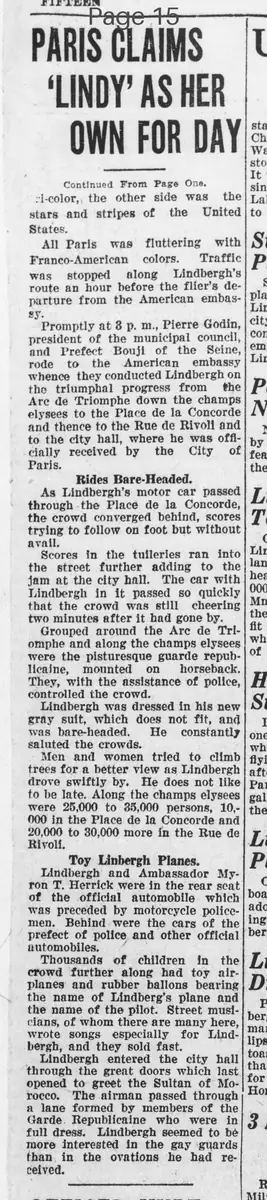
PARIS CLAIMS 'LINDY' AS HER OWN FOR DAY
Continued From Page One.
In color, the other side was the stars and stripes of the United States.
All Paris was fluttering with Franco-American colors.
Traffic was stopped along Lindbergh's route an hour before the flier's departure from the American embassy.
Promptly at 8 p. m., Pierre Godin, president of the municipal council, and Prefect Bouju of the Seine, rode to the American embassy whence they conducted Lindbergh on the triumphal progress from the Arc de Triomphe down the Champs Elysees to the Place de la Concorde and thence to the Rue de Rivoli and to the city hall, where he was officially received by the City of Paris.
Rides Bare-Headed.
As Lindbergh's motor car passed through the Place de la Concorde, the crowd converged behind, scores trying to follow on foot but without avail.
Scores in the Tuileries ran into the street further adding to the jam at the city hall. The car with Lindbergh in it passed so quickly that the crowd was still cheering two minutes after it had gone by.
Grouped around the Arc de Triomphe and along the Champs Elysees were the picturesque Garde Republicaine, mounted on horseback.
They, with the assistance of police, controlled the crowd.
Lindbergh was dressed in his new gray suit, which does not fit, and was bare-headed.
He constantly saluted the crowds.
Men and women tried to climb trees for a better view as Lindbergh drove swiftly by. He does not like to be late. Along the Champs Elysees were 25,000 to 35,000 persons, 10,000 in the Place de la Concorde and 20,000 to 30,000 more in the Rue de Rivoli.
Toy Lindbergh Planes.
Lindbergh and Ambassador Myron T. Herrick were in the rear seat of the official automobile which was preceded by motorcycle policemen. Behind were the cars of the prefect of police and other official automobiles.
Thousands of children in the crowd further along had toy airplanes and rubber balloons bearing the name of Lindbergh's plane and the name of the pilot. Street musicians, of whom there are many here, wrote songs especially for Lindbergh, and they sold fast.
Lindbergh entered the city hall through the great doors which last opened to greet the Sultan of Morocco. The airman passed through a lane formed by members of the Garde Republicaine who were in full dress. Lindbergh seemed to be more interested in the gay guards than in the ovations he had received.
Continued From Page One.
In color, the other side was the stars and stripes of the United States.
All Paris was fluttering with Franco-American colors.
Traffic was stopped along Lindbergh's route an hour before the flier's departure from the American embassy.
Promptly at 8 p. m., Pierre Godin, president of the municipal council, and Prefect Bouju of the Seine, rode to the American embassy whence they conducted Lindbergh on the triumphal progress from the Arc de Triomphe down the Champs Elysees to the Place de la Concorde and thence to the Rue de Rivoli and to the city hall, where he was officially received by the City of Paris.
Rides Bare-Headed.
As Lindbergh's motor car passed through the Place de la Concorde, the crowd converged behind, scores trying to follow on foot but without avail.
Scores in the Tuileries ran into the street further adding to the jam at the city hall. The car with Lindbergh in it passed so quickly that the crowd was still cheering two minutes after it had gone by.
Grouped around the Arc de Triomphe and along the Champs Elysees were the picturesque Garde Republicaine, mounted on horseback.
They, with the assistance of police, controlled the crowd.
Lindbergh was dressed in his new gray suit, which does not fit, and was bare-headed.
He constantly saluted the crowds.
Men and women tried to climb trees for a better view as Lindbergh drove swiftly by. He does not like to be late. Along the Champs Elysees were 25,000 to 35,000 persons, 10,000 in the Place de la Concorde and 20,000 to 30,000 more in the Rue de Rivoli.
Toy Lindbergh Planes.
Lindbergh and Ambassador Myron T. Herrick were in the rear seat of the official automobile which was preceded by motorcycle policemen. Behind were the cars of the prefect of police and other official automobiles.
Thousands of children in the crowd further along had toy airplanes and rubber balloons bearing the name of Lindbergh's plane and the name of the pilot. Street musicians, of whom there are many here, wrote songs especially for Lindbergh, and they sold fast.
Lindbergh entered the city hall through the great doors which last opened to greet the Sultan of Morocco. The airman passed through a lane formed by members of the Garde Republicaine who were in full dress. Lindbergh seemed to be more interested in the gay guards than in the ovations he had received.
What sub-type of article is it?
Historical Event
Personal Triumph
Heroic Act
What themes does it cover?
Triumph
Bravery Heroism
What keywords are associated?
Lindbergh Parade
Paris Reception
Hero Welcome
Triumphal Progress
Franco American Celebration
What entities or persons were involved?
Lindbergh
Pierre Godin
Prefect Bouju
Ambassador Myron T. Herrick
Where did it happen?
Paris
Story Details
Key Persons
Lindbergh
Pierre Godin
Prefect Bouju
Ambassador Myron T. Herrick
Location
Paris
Story Details
Lindbergh is honored with a triumphal procession through Paris from the American embassy to the city hall, greeted by massive crowds, officials, and decorations in Franco-American colors.