Thank you for visiting SNEWPapers!
Sign up free
Domestic News
April 8, 1814
Daily National Intelligencer
Washington, District Of Columbia
What is this article about?
Conclusion of Mr. Sheffey's speech in the House of Representatives opposing the Loan Bill and the War of 1812, critiquing administration policies from the rejected Monroe-Pinkney Treaty through embargoes, non-intercourse, and war declaration, defending minority opposition against charges of factionalism.
Clipping
OCR Quality
95%
Excellent
Full Text
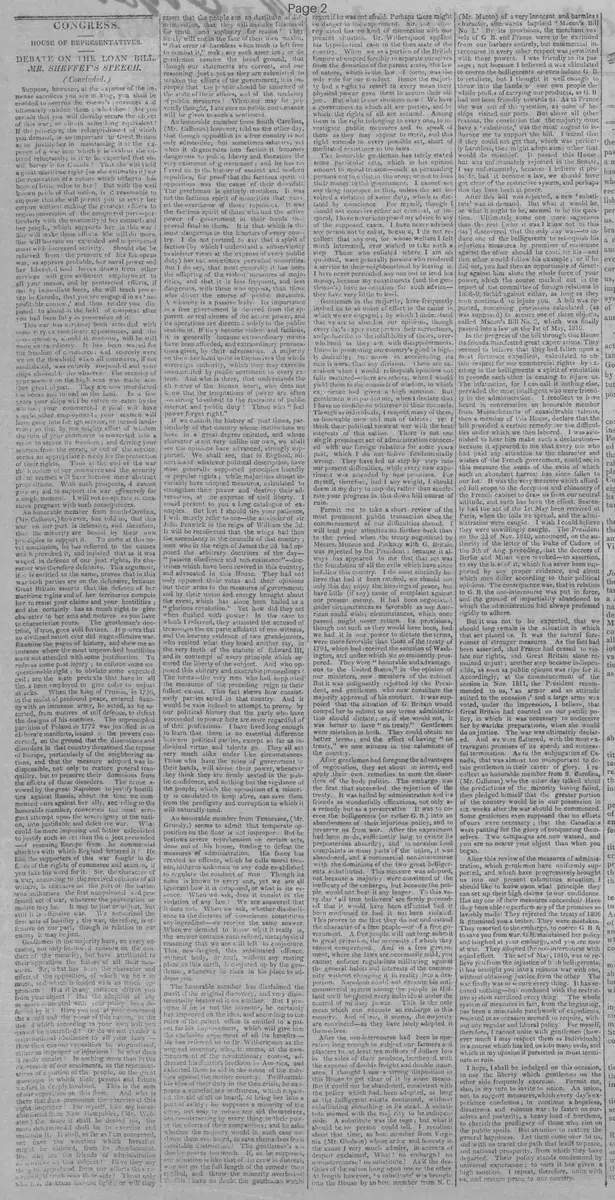
CONGRESS.
HOUSE OF REPRESENTATIVES.
DEBATE ON THE LOAN BILL.
MR. SHEFFEY'S SPEECH,
(Concluded.)
Suppose, however, at the expense of the immense sacrifices you are making, you shall be enabled to overrun the enemy's provinces and ultimately subdue them: what then? Are you certain that you will thereby secure the object of this war; or obtain something equivalent?
If the principle, the relinquishment of which you demand, is so important to Great Britain as to justify her in maintaining it at the expense of a war into which it is evident she entered reluctantly, is it to be expected that she will barter it for Canada? That she will yield a great maritime right (as she estimates it) for the restoration of a colony which hitherto has been of little value to her? But with the well known pride of that nation, is it reasonable to suppose that she will permit you to sever her empire without making the greatest efforts to regain possession of the conquered part—particularly with the unanimity of her councils and her people, which supports her in this war?
She will make those efforts. She will do more. She will harass our extended and ill protected coast with increased activity. Should she be relieved from the pressure of her European war, as appears probable, her naval power and her liberated land forces drawn from other services will give sufficient employment to all your means, and by protracted efforts, if not by immediate force, she will teach you even in Canada, that you are engaged in an unprofitable contest, and thus render you disposed to abandon the field of conquest after you had been fully in possession of it.
This war has certainly been attended with some very extraordinary appearances, and the consequences, should it continue, will be still more extraordinary. It has been waged for the freedom of commerce; and scarcely were we on the threshold when all commerce, if not annihilated, was entirely suspended and your ships chained to the wharves. The security of your seamen on the high seas was made another great object. They are now interdicted the ocean and turned on the land. In a few years your ships will be rotten or eaten by the worms; your commercial capital will have sought other employment; your seamen will have gone into foreign service, or turned landsmen; so that by one mighty effort of wisdom the ruin of your commerce is converted into a means to secure its freedom; and driving your seamen from the ocean, or out of the service, seems an appropriate remedy for the protection of their rights. Thus at the end of the war the freedom of our commerce and the security of our seamen will have become mere abstract propositions. With such prospects, I cannot give my aid to support the war offensively for a single moment. I will not co-operate in measures pregnant with such consequences.
An honorable member from South-Carolina, (Mr. Calhoun,) however, has told us, that this war on our part is defensive, and therefore, that the minority are bound by their own principles to support it. To come at this novel conclusion, he has referred to the causes which provoked it, and insisted that as it was waged in defence of our just rights, its character was therefore defensive. This argument, if it is entitled to the name, proves that in this war both parties are on the defensive, because Great Britain asserts that the defence of her maritime rights and of her territories compels her to resist your claims and your hostilities; and she certainly has as much right to give character to her acts and motives as you have to characterize yours. The gentleman's doctrine, if true, goes still further. It proves that no civilized nation ever did wage offensive war. Examine the pages of history, and shew me an instance where the most unprovoked hostilities were not attended with some justification. To redress some past injury; to enforce some unquestionable right; to obviate some expected evil; are the state pretexts that have in all times been employed to give color to unjust attacks. When the king of Prussia, in 1756, in the midst of profound peace, entered Saxony with an immense army, he acted, as he asserted, from motives of self defence, to defeat the designs of his enemies. The unprincipled partition of Poland in 1772 was justified in an elaborate manifesto, issued by the powers concerned, on the ground that the dissentions and disorders in that country threatened the repose of Europe, particularly of the neighboring nations, and that the measure adopted was indispensable, not only to restore general tranquility, but to preserve their dominions from the effects of those disorders. The cause avowed by the great Napoleon to justify hostilities against Russia, about the time we commenced ours against her ally, according to the honorable member, converted the most arrogant attempt upon the sovereignty of the nation, into justifiable and defensive war. What could be more imposing and better calculated to justify such an act than the object pretended—of rescuing Europe from the commercial shackles with which England fettered it? He like the supporters of this war fought in defence of the rights of commerce and seamen, if you take his word for it. Sir, the character of a war, according to the received opinions of all writers, is offensive on the part of the nation who authorizes the first unequivocal and professed act of war, whatever the provocation or motive may be. It may be just or unjust, but still it is offensive war. We authorized the first acts of hostility; the war, therefore, is offensive on our part, though in relation to our enemy it may be just.
Gentlemen in the majority have, on every occasion, not only bestowed censure on the conduct of the minority, but have attributed to their opposition the failure of all their measures. Sir, what has been the character and effect of the opposition, of which we hear so much, and which is loaded with so much opprobrium? Has it in any instance driven you from your object? Has the adoption of any measure connected with your policy been defeated by it? Have you not at your command the sword and the purse of this nation, in the use of which according to your own will you cannot be controlled? Or do we not render a constitutional obedience to all your laws—How then can our opposition be stigmatized, either as improper or injurious? In what does it really consist? In nothing more than in the expression of our sentiments, as the representatives of a portion of the people, on the great questions in which their present and future welfare is deeply involved. This is the sum of our opposition on this floor. And who is there that dare pronounce the exercise of this right improper? For myself, like my honorable friend from New Hampshire, (Mr. Webster) the more it shall be denied me, the more determined I shall be to exercise and maintain it. It shall, as far as I am concerned, not have the sanction which hereafter might be claimed, from its abandonment.
But why are the friends of administration so sensitive on this subject? Have they any thing to apprehend from our efforts thus restricted, in truth is on their side? Those only who have a bad cause fear the light; or will they assert that the people are so destitute of discrimination, that they will mistake falsehood for truth, and sophistry for reason? They surely will not in the face of their own maxim, 'that error is harmless when truth is left free to combat it,' make any such assertion; or do gentlemen assume the broad ground, that though our statements are correct, and our reasoning just; yet as they are calculated to weaken the efforts of the government, it is improper that the people should be informed of the state of their affairs, and of the tendency of public measures? Whatever may be privately thought, I am sure no public countenance will be given to such a sentiment.
An honorable member from South Carolina, (Mr. Calhoun) however, told us the other day, that though opposition in a free country is not only admissible, but sometimes salutary, yet when it degenerates into faction it becomes dangerous to public liberty and threatens the very existence of government; and he has referred us to the history of ancient and modern republics, for proof that the factious spirit of opposition was the cause of their downfall. The gentleman is entirely mistaken. It was not the factious spirit of minorities that caused the overthrow of those republics. It was the factious spirit of those who had the active power of government in their hands that proved fatal to them. It is that which is the most dangerous to the liberties of every country. I do not pretend to say that a spirit of faction (by which I understand a subserviency to sinister views at the expense of every public duty) has not sometimes pervaded minorities. But I do say, that most generally it has been the offspring of the violent measures of majorities, and that it is less frequent, and less dangerous, with those who oppose, than those who direct the course of public measures.
A minority is a passive body. Its importance in a free government is derived from the apparent or real abuses of the active power, and its operations are directed solely to the public sentiment. If they become violent and factious, it is generally because extraordinary means have been afforded, and extraordinary provocations given, by their adversaries. A majority on the other hand unite in themselves the whole sovereign authority, which they may exercise uncontrolled by public sentiment to every extent. And who is there, that understands the character of the human heart, who does not know that the temptations of power are often too strong to submit to the restraints of public interest and public duty? Those who 'feel power forget right.'
If we consult the history of past times, particularly of that country whose institutions we have in a great degree imitated, and whose character is not very unlike our own, we shall see the opinions here advanced, strongly supported. We shall see, that in England, minorities of whatever political description, have most generally supported principles friendly to popular rights; while majorities almost invariably have adopted measures, calculated to strengthen their power and destroy their adversaries, at the expense of civil liberty. I could present to you a long catalogue of examples. But lest I should tire your patience, I will merely refer to one—the attainder of Sir John Fenwick in the reign of William the 3d. It will be recollected that the whigs had then the ascendancy in the councils of that country; men who in the reign of James the 2d had opposed the arbitrary doctrines of the day—'passive obedience and non-resistance'—doctrines which have been revived in this country, and advocated in this House. They had not only opposed their votes and their opinions but their arms to the measures of government; and by their union and energy brought about the event, which has since been hailed as a 'glorious revolution.' Yet how did they act when flushed with power? In the case to which I referred, they attainted the accused of treason, on the ex parte affidavit of one witness, and the hearsay evidence of two grand-jurors, who recited what they heard another say, in the very teeth of the statute of Edward III, and in contempt of every principle which secured the liberty of the subject. And who opposed this arbitrary and execrable proceedings? The tories—the very men who had supported the measures of the preceding reign to their fullest extent. This fact shews how consistently parties acted in that country. And it would be vain indeed to attempt to prove, by our political history that the party who have succeeded to power here are more regardful of their professions. I have lived long enough to learn that there is no essential difference between political parties, except so far as individual virtue and talents go. They all act very much alike under like circumstances. Those who have the reins of government in their hands, will abuse their power, whenever they think they are firmly seated in the public confidence, and nothing but the vigilance of the people, which the opposition of a minority is calculated to keep alive, can save them from the profligacy and corruption to which it will naturally tend.
An honorable member from Tennessee, (Mr. Grundy,) seems to admit that temperate opposition on the floor is not improper. But he bestows severe reprehension on certain acts, done out of his house, tending to defeat the measures of administration. His fancy has created an offence, which he calls moral treason, hitherto unknown to any code established to regulate the conduct of man. Though its name is known to every one, yet we are all ignorant how it is composed, or what is its essence. When we ask, does it consist in the violation of any law! We are answered that it does not. When we ask, whether disobedience to the dictates of conscience constitutes any ingredient—we receive the same answer. When we demand to know what it really is, the answer contains such refined, metaphysical reasoning that we are still left to conjecture. This new-fangled, this sublimated offence, without body, or soul, without any resting place on this earth, is conjured up by the gentleman, whenever he rises in his place to address you.
The honorable member has disclaimed the merit of the original discovery, and very disinterestedly bestowed it on another. But I presume if he is not the inventor, he certainly has improved on the idea, and according to the rules of the patent office is entitled to a patent for his improvement, which will give him the exclusive enjoyment of all its benefits.—He has referred us to Dr. Witherspoon as the original inventor, who, it seems, at the commencement of the revolutionary contest, addressed his Scottish brethren in America, and exhorted them to aid in the cause of the colonies against the mother country. To illustrate his idea of their duty in that crisis, he supposes a vessel at sea in distress, which required the aid of all on board, to bring her into a port of safety; he supposes a minority of the crew, not only to refuse any aid themselves, but counteracting by every thing in their power the efforts of their companions; and he asks whether the majority would in such case not throw them overboard, to save themselves from inevitable destruction? The gentleman's authority proves too much. If, as he supposes, our situation is like that of the crew in distress, why not go the full length of the remedy then applied, and throw the minority overboard? To this I have no doubt the gentleman would resort if he was not afraid. Perhaps there might be danger in the experiment. Sir, the authority cited has no kind of connection with our present situation. Dr. Witherspoon applied his hypothetical case to the then state of the country. When we as a portion of the British Empire attempted forcibly to separate ourselves from the dominion of the parent state, the law of nature, which is the law of force, was the only rule for our conduct. Hence the majority had a right to resort to every mean their physical power gave them to secure their object. But what is our situation now? We have a government to which all are parties, and by which the rights of all are secured. Among them is the right belonging to every one, to investigate public measures and to speak of them as they may appear to merit, and this right extends to every possible act, short of meditated resistance to the laws.
The honorable gentleman has lately stated some particular acts, which in his opinion amount to moral treason—such as persuading persons not to enlist in the army; or not to loan their money to the government. I cannot see any thing improper in this, unless the act involved a violation of some duty, which is dictated by conscience. For myself, though I should not conceive either act criminal, or immoral, I have never interposed my advice in any of the supposed cases. I have never advised any person not to enlist, because, I do not recollect that any one, for whose welfare I felt much interested, ever wished to take such a step. Those who enlisted where I am acquainted, were generally persons who rendered a service to their neighbourhood by leaving it. I have never persuaded any one not to lend his money, because my constituents (and the gentleman's) have no occasion for such advice—they have very little to lend.
Gentlemen in the majority, have frequently invited us to an union of effort in the cause in which we are engaged: by which I understand that we are to abandon our opinions, though every day's experience proves their correctness, and subscribe to the infallibility of theirs, overwhelmed as they are with disappointments. Union in promoting our country's good is highly desirable; but union in accelerating its ruin is worse than any division. There are occasions when I would relinquish opinions not fully matured—there are others, when I would yield them to the counsels of wisdom, to which experience had given a high sanction. But gentlemen will pardon me, when I declare that I have no confidence whatever in their counsels. Though as individuals, I respect many of them, as honorable men and men of talents; yet I think their political views at war with the best interests of this nation. There is not one single prominent act of administration connected with our foreign relations for some years past, which I do not believe fundamentally wrong. They have led us step by step into our present difficulties, while every new experiment was attended by new promises. For myself, therefore, had I any weight, I should deem it my duty to impede, rather than accelerate your progress in this down hill course of ruin.
Permit me to take a short review of the most prominent public transactions since the commencement of our difficulties abroad. I will lead your attention no further back than to the period when the treaty negotiated by Messrs. Munroe and Pinkney with G. Britain was rejected by the President; because it always has appeared to me that that act was the foundation of all the evils which have since befallen this country. I do most sincerely believe that had it been ratified, we should not only this day enjoy the blessings of peace, but have little (if any) cause of complaint against our present enemy. It had been negotiated under circumstances as favorable as any American could wish; circumstances, which once passed might never return. Its provisions, though not such as they would have been, had we had it in our power to dictate the terms, were more favorable than those of the treaty of 1794, which had received the sanction of Washington, and under which we so eminently prospered. They were 'honorable and advantageous to the United States,' in the opinion of our ministers, now members of the cabinet. But it was indignantly rejected by the President, and gentlemen who now constitute the majority approved of his conduct. It was supposed that the situation of G. Britain would compel her to submit to any terms administration should dictate: or, if she would not, it was better to have 'no treaty.' Gentlemen were mistaken in both. They could obtain no better terms; and the effect of having 'no treaty,' we now witness in the calamities of the country.
After gentlemen had foregone the advantages of negotiation, they set about to invent, and apply their own remedies to cure the disorders of the body politic. The embargo was the first that succeeded the rejection of the treaty. It was hailed by administration and its friends as wonderfully efficacious, not only as a remedy but as a preservative. It was to coerce the belligerents (or rather G. B.) into an abandonment of their injurious policy, and to preserve us from war. After the experiment had been made sufficiently long to evince its preposterous absurdity, and to occasion loud complaints in many parts of the union, it was abandoned, and a commercial non intercourse with the dominions of the two great belligerents substituted. This measure was adopted, not because a majority were convinced of the inefficacy of the embargo, but because the people would not bear it any longer. To this very day 'all true believers' are firmly persuaded that it would have been effectual had it been continued or had it not been violated. This proves to me that they do not understand the character of a free people—or of a free government. A free people will not long submit to great privation, the necessity of which they cannot comprehend. And in a free government, where the laws are necessarily mild, you cannot enforce regulations militating against the general habits and interests of the community without changing it in reality into a despotism. Napoleon could not execute his anti-commercial system among the people in Holland until he placed every individual under the control of military power. This is the only means which can execute an embargo in this country. And of this, it seems, the majority are convinced—as they have lately adopted it themselves.
After the non-intercourse had been in operation long enough to subject our farmers and planters to at least ten millions of dollars loss in the sales of their produce, burthened with the expense of double freight and double insurance, I thought I saw a strong disposition in this House to get clear of it by some means. But it could not be abandoned, consistent with the policy which had been adopted, as long as the belligerent edicts continued, without substituting something in its stead. A substitute seemed with the majority to be indispensable. A substitute was the rage; but what it should be no person could tell. I recollect about that time, an hon. member from Virginia (Mr. Gholson) whose ardor and honesty in the cause I very much admire, in accents of despair exclaimed, What! no embargo! no non-intercourse! no substitute! As if the destinies of the nation hung upon one or the other. At length however, 'a substitute' was brought into the House by an hon. member from N. C. (Mr. Macon) of a very innocent and harmless character, afterwards baptised 'Macon's Bill No. 1.' By its provisions, the merchant vessels of G. B. and France were to be excluded from our harbors entirely, but commercial intercourse in every other respect was permitted with those powers. I was friendly to its passage; not because I believed it was calculated to coerce the belligerents or even induce G. B. to retaliate, but I thought it well enough to throw into the hands of our own people the whole profits of carrying our products, as G. B. had not been friendly towards us. As to France she was out of the question, as none of her ships visited our ports. But above all other reasons, the conviction that the majority must have a 'substitute,' was the most cogent to influence me to support the bill. I feared that if they could not get that, which was perfectly harmless, they might adopt some other that would do mischief. It passed this House, but was unfortunately rejected in the Senate. I say unfortunately, because I believe it probable, had it become a law, we should have got clear of the restrictive system, and perhaps this day have been at peace.
After this bill was rejected, a new 'substitute' was in demand. But what it would be, or what it ought to be, seemed to be the question. Ultimately some one more sagacious than the rest (who it was I know not to this day) discovered that the only way was—to induce one of the belligerents to relinquish his injurious measures by promises of resistance against the other should he continue his—and that other would follow his example: or if he did not, you had then an opportunity of directing against him alone the whole force of your power, which the course marked out in the report of the committee of foreign relations in 1808-9, forbid against either, as long as they both continued to injure you. A bill was reported, containing provisions calculated (as was supposed) to secure one of these objects, called Macon's Bill No. 2, which was finally passed into a law on the 1st of May, 1810.
In the progress of the bill through this House its friends manifested great expectations. They seemed to believe that they had fallen upon a most fortunate expedient, calculated to obtain respect for our commercial rights by exciting in the belligerents a spirit of emulation to precede each other in ceasing to injure us. The infatuation, for I can call it nothing else, pervaded the most intelligent who were friendly to the administration. I recollect to have heard in conversation an honorable member from Massachusetts of considerable talents, then a member of this House, declare that the bill provided a certain remedy for the difficulties under which we then labored. I was astonished to hear him make such a declaration—because it appeared to me that every one who had paid any attention to the character and wishes of the French government, could see in this measure the seeds of the evils of which such an abundant harvest has since fallen to our lot. It was the very measure which afforded full scope to the deception and chicanery of the French cabinet to draw us from our neutral attitude, and such has been the effect. Scarcely had the act of the 1st May been received at Paris, when the toils we spread, and the administration were caught. I wish I could believe they were unwillingly caught. The President on the 2d of Nov. 1810, announced, on the authority of the letter of the Duke of Cadore of the 5th of Aug. preceding, that the decrees of Berlin and Milan were revoked—an assertion, to say the best of it, which has never been supported by any proper evidence, and about which men differ according to their political opinions. The consequence was, that in relation to G. B. the non-intercourse was put in force, and the ground of impartiality abandoned to which the administration had always professed rigidly to adhere.
But it was not to be expected, that we should long remain in the situation in which that act placed us. It was the natural forerunner of stronger measures. As the fact had been asserted, that France had ceased to violate our rights, and Great Britain alone remained unjust; another step became indispensable, as soon as public opinion was ripe for it. Accordingly, at the commencement of the session in Nov. 1811, the President recommended to us, an armor and an attitude suited to the occasion; and a large army was voted, under the impression, I believe, that Great Britain had counted on our pacific policy, in which it was necessary to undeceive her by warlike preparations, when she would do us justice. The war was ultimately declared. And we were flattered, with the most extravagant promises of its speedy and successful termination. As to the subjugation of Canada, that was almost too unimportant to detain gentlemen in their career of glory. I recollect an honorable member from S. Carolina, (Mr. Calhoun) who the other day talked about the predictions of the minority having failed, then pledged himself that the greater portion of the country would be in our possession in six weeks after the war should be commenced. Some gentlemen even supposed that no efforts of ours were necessary; that the Canadians were panting for the glory of conquering themselves. Two campaigns are now wasted, and you are no nearer your object than when you began.
After this review of the measures of administration, which gentlemen have uniformly supported, and which have progressively brought us into our present calamitous situation, I should like to know upon what principle they can set up their high claims to our confidence. Has any one of their measures succeeded? Have they been able to perform any of the promises so lavishly made? They rejected the treaty of 1806 & promised you a better. They were mistaken. They resorted to the embargo, to coerce G. B. & to save you from war. G. B. maintained her policy and laughed at your embargo, and you are now at war. They adopted the non-intercourse with equal effect. The act of May, 1810, was to relieve you from the injustice of both belligerents: it has brought you into a ruinous war with one, without obtaining justice from the other. The war finally was to secure every thing. It has secured nothing—but combined with the restrictive system sacrificed every thing. The whole system of measures in fact, from the beginning, has been a miserable patchwork of expedients, resorted to as occasion seemed to require, without any regular and liberal policy. For myself therefore, I cannot unite with gentlemen (however much I may respect them as individuals) in a course which has led us into many evils, and which in my opinion if persisted in must terminate in ruin.
I hope, I shall be indulged on this occasion, to use the liberty which gentlemen on the other side frequently exercise. Permit me, also, in my turn to invite to union. An union, not to support measures, which every day's experience condemns; to continue a hopeless, disastrous and ruinous war; to fasten on ourselves and posterity, a heavy load of burthens, to cherish the profligacy of those who riot on the public spoils. But an union to restore the general happiness. Let them come over to us, and with us travel the path that leads to peace, and national prosperity, from which they have departed. Their policy stands condemned by universal experience; to ours it has given a high sanction. I repeat, therefore, unite with us, and restore peace to our country.
HOUSE OF REPRESENTATIVES.
DEBATE ON THE LOAN BILL.
MR. SHEFFEY'S SPEECH,
(Concluded.)
Suppose, however, at the expense of the immense sacrifices you are making, you shall be enabled to overrun the enemy's provinces and ultimately subdue them: what then? Are you certain that you will thereby secure the object of this war; or obtain something equivalent?
If the principle, the relinquishment of which you demand, is so important to Great Britain as to justify her in maintaining it at the expense of a war into which it is evident she entered reluctantly, is it to be expected that she will barter it for Canada? That she will yield a great maritime right (as she estimates it) for the restoration of a colony which hitherto has been of little value to her? But with the well known pride of that nation, is it reasonable to suppose that she will permit you to sever her empire without making the greatest efforts to regain possession of the conquered part—particularly with the unanimity of her councils and her people, which supports her in this war?
She will make those efforts. She will do more. She will harass our extended and ill protected coast with increased activity. Should she be relieved from the pressure of her European war, as appears probable, her naval power and her liberated land forces drawn from other services will give sufficient employment to all your means, and by protracted efforts, if not by immediate force, she will teach you even in Canada, that you are engaged in an unprofitable contest, and thus render you disposed to abandon the field of conquest after you had been fully in possession of it.
This war has certainly been attended with some very extraordinary appearances, and the consequences, should it continue, will be still more extraordinary. It has been waged for the freedom of commerce; and scarcely were we on the threshold when all commerce, if not annihilated, was entirely suspended and your ships chained to the wharves. The security of your seamen on the high seas was made another great object. They are now interdicted the ocean and turned on the land. In a few years your ships will be rotten or eaten by the worms; your commercial capital will have sought other employment; your seamen will have gone into foreign service, or turned landsmen; so that by one mighty effort of wisdom the ruin of your commerce is converted into a means to secure its freedom; and driving your seamen from the ocean, or out of the service, seems an appropriate remedy for the protection of their rights. Thus at the end of the war the freedom of our commerce and the security of our seamen will have become mere abstract propositions. With such prospects, I cannot give my aid to support the war offensively for a single moment. I will not co-operate in measures pregnant with such consequences.
An honorable member from South-Carolina, (Mr. Calhoun,) however, has told us, that this war on our part is defensive, and therefore, that the minority are bound by their own principles to support it. To come at this novel conclusion, he has referred to the causes which provoked it, and insisted that as it was waged in defence of our just rights, its character was therefore defensive. This argument, if it is entitled to the name, proves that in this war both parties are on the defensive, because Great Britain asserts that the defence of her maritime rights and of her territories compels her to resist your claims and your hostilities; and she certainly has as much right to give character to her acts and motives as you have to characterize yours. The gentleman's doctrine, if true, goes still further. It proves that no civilized nation ever did wage offensive war. Examine the pages of history, and shew me an instance where the most unprovoked hostilities were not attended with some justification. To redress some past injury; to enforce some unquestionable right; to obviate some expected evil; are the state pretexts that have in all times been employed to give color to unjust attacks. When the king of Prussia, in 1756, in the midst of profound peace, entered Saxony with an immense army, he acted, as he asserted, from motives of self defence, to defeat the designs of his enemies. The unprincipled partition of Poland in 1772 was justified in an elaborate manifesto, issued by the powers concerned, on the ground that the dissentions and disorders in that country threatened the repose of Europe, particularly of the neighboring nations, and that the measure adopted was indispensable, not only to restore general tranquility, but to preserve their dominions from the effects of those disorders. The cause avowed by the great Napoleon to justify hostilities against Russia, about the time we commenced ours against her ally, according to the honorable member, converted the most arrogant attempt upon the sovereignty of the nation, into justifiable and defensive war. What could be more imposing and better calculated to justify such an act than the object pretended—of rescuing Europe from the commercial shackles with which England fettered it? He like the supporters of this war fought in defence of the rights of commerce and seamen, if you take his word for it. Sir, the character of a war, according to the received opinions of all writers, is offensive on the part of the nation who authorizes the first unequivocal and professed act of war, whatever the provocation or motive may be. It may be just or unjust, but still it is offensive war. We authorized the first acts of hostility; the war, therefore, is offensive on our part, though in relation to our enemy it may be just.
Gentlemen in the majority have, on every occasion, not only bestowed censure on the conduct of the minority, but have attributed to their opposition the failure of all their measures. Sir, what has been the character and effect of the opposition, of which we hear so much, and which is loaded with so much opprobrium? Has it in any instance driven you from your object? Has the adoption of any measure connected with your policy been defeated by it? Have you not at your command the sword and the purse of this nation, in the use of which according to your own will you cannot be controlled? Or do we not render a constitutional obedience to all your laws—How then can our opposition be stigmatized, either as improper or injurious? In what does it really consist? In nothing more than in the expression of our sentiments, as the representatives of a portion of the people, on the great questions in which their present and future welfare is deeply involved. This is the sum of our opposition on this floor. And who is there that dare pronounce the exercise of this right improper? For myself, like my honorable friend from New Hampshire, (Mr. Webster) the more it shall be denied me, the more determined I shall be to exercise and maintain it. It shall, as far as I am concerned, not have the sanction which hereafter might be claimed, from its abandonment.
But why are the friends of administration so sensitive on this subject? Have they any thing to apprehend from our efforts thus restricted, in truth is on their side? Those only who have a bad cause fear the light; or will they assert that the people are so destitute of discrimination, that they will mistake falsehood for truth, and sophistry for reason? They surely will not in the face of their own maxim, 'that error is harmless when truth is left free to combat it,' make any such assertion; or do gentlemen assume the broad ground, that though our statements are correct, and our reasoning just; yet as they are calculated to weaken the efforts of the government, it is improper that the people should be informed of the state of their affairs, and of the tendency of public measures? Whatever may be privately thought, I am sure no public countenance will be given to such a sentiment.
An honorable member from South Carolina, (Mr. Calhoun) however, told us the other day, that though opposition in a free country is not only admissible, but sometimes salutary, yet when it degenerates into faction it becomes dangerous to public liberty and threatens the very existence of government; and he has referred us to the history of ancient and modern republics, for proof that the factious spirit of opposition was the cause of their downfall. The gentleman is entirely mistaken. It was not the factious spirit of minorities that caused the overthrow of those republics. It was the factious spirit of those who had the active power of government in their hands that proved fatal to them. It is that which is the most dangerous to the liberties of every country. I do not pretend to say that a spirit of faction (by which I understand a subserviency to sinister views at the expense of every public duty) has not sometimes pervaded minorities. But I do say, that most generally it has been the offspring of the violent measures of majorities, and that it is less frequent, and less dangerous, with those who oppose, than those who direct the course of public measures.
A minority is a passive body. Its importance in a free government is derived from the apparent or real abuses of the active power, and its operations are directed solely to the public sentiment. If they become violent and factious, it is generally because extraordinary means have been afforded, and extraordinary provocations given, by their adversaries. A majority on the other hand unite in themselves the whole sovereign authority, which they may exercise uncontrolled by public sentiment to every extent. And who is there, that understands the character of the human heart, who does not know that the temptations of power are often too strong to submit to the restraints of public interest and public duty? Those who 'feel power forget right.'
If we consult the history of past times, particularly of that country whose institutions we have in a great degree imitated, and whose character is not very unlike our own, we shall see the opinions here advanced, strongly supported. We shall see, that in England, minorities of whatever political description, have most generally supported principles friendly to popular rights; while majorities almost invariably have adopted measures, calculated to strengthen their power and destroy their adversaries, at the expense of civil liberty. I could present to you a long catalogue of examples. But lest I should tire your patience, I will merely refer to one—the attainder of Sir John Fenwick in the reign of William the 3d. It will be recollected that the whigs had then the ascendancy in the councils of that country; men who in the reign of James the 2d had opposed the arbitrary doctrines of the day—'passive obedience and non-resistance'—doctrines which have been revived in this country, and advocated in this House. They had not only opposed their votes and their opinions but their arms to the measures of government; and by their union and energy brought about the event, which has since been hailed as a 'glorious revolution.' Yet how did they act when flushed with power? In the case to which I referred, they attainted the accused of treason, on the ex parte affidavit of one witness, and the hearsay evidence of two grand-jurors, who recited what they heard another say, in the very teeth of the statute of Edward III, and in contempt of every principle which secured the liberty of the subject. And who opposed this arbitrary and execrable proceedings? The tories—the very men who had supported the measures of the preceding reign to their fullest extent. This fact shews how consistently parties acted in that country. And it would be vain indeed to attempt to prove, by our political history that the party who have succeeded to power here are more regardful of their professions. I have lived long enough to learn that there is no essential difference between political parties, except so far as individual virtue and talents go. They all act very much alike under like circumstances. Those who have the reins of government in their hands, will abuse their power, whenever they think they are firmly seated in the public confidence, and nothing but the vigilance of the people, which the opposition of a minority is calculated to keep alive, can save them from the profligacy and corruption to which it will naturally tend.
An honorable member from Tennessee, (Mr. Grundy,) seems to admit that temperate opposition on the floor is not improper. But he bestows severe reprehension on certain acts, done out of his house, tending to defeat the measures of administration. His fancy has created an offence, which he calls moral treason, hitherto unknown to any code established to regulate the conduct of man. Though its name is known to every one, yet we are all ignorant how it is composed, or what is its essence. When we ask, does it consist in the violation of any law! We are answered that it does not. When we ask, whether disobedience to the dictates of conscience constitutes any ingredient—we receive the same answer. When we demand to know what it really is, the answer contains such refined, metaphysical reasoning that we are still left to conjecture. This new-fangled, this sublimated offence, without body, or soul, without any resting place on this earth, is conjured up by the gentleman, whenever he rises in his place to address you.
The honorable member has disclaimed the merit of the original discovery, and very disinterestedly bestowed it on another. But I presume if he is not the inventor, he certainly has improved on the idea, and according to the rules of the patent office is entitled to a patent for his improvement, which will give him the exclusive enjoyment of all its benefits.—He has referred us to Dr. Witherspoon as the original inventor, who, it seems, at the commencement of the revolutionary contest, addressed his Scottish brethren in America, and exhorted them to aid in the cause of the colonies against the mother country. To illustrate his idea of their duty in that crisis, he supposes a vessel at sea in distress, which required the aid of all on board, to bring her into a port of safety; he supposes a minority of the crew, not only to refuse any aid themselves, but counteracting by every thing in their power the efforts of their companions; and he asks whether the majority would in such case not throw them overboard, to save themselves from inevitable destruction? The gentleman's authority proves too much. If, as he supposes, our situation is like that of the crew in distress, why not go the full length of the remedy then applied, and throw the minority overboard? To this I have no doubt the gentleman would resort if he was not afraid. Perhaps there might be danger in the experiment. Sir, the authority cited has no kind of connection with our present situation. Dr. Witherspoon applied his hypothetical case to the then state of the country. When we as a portion of the British Empire attempted forcibly to separate ourselves from the dominion of the parent state, the law of nature, which is the law of force, was the only rule for our conduct. Hence the majority had a right to resort to every mean their physical power gave them to secure their object. But what is our situation now? We have a government to which all are parties, and by which the rights of all are secured. Among them is the right belonging to every one, to investigate public measures and to speak of them as they may appear to merit, and this right extends to every possible act, short of meditated resistance to the laws.
The honorable gentleman has lately stated some particular acts, which in his opinion amount to moral treason—such as persuading persons not to enlist in the army; or not to loan their money to the government. I cannot see any thing improper in this, unless the act involved a violation of some duty, which is dictated by conscience. For myself, though I should not conceive either act criminal, or immoral, I have never interposed my advice in any of the supposed cases. I have never advised any person not to enlist, because, I do not recollect that any one, for whose welfare I felt much interested, ever wished to take such a step. Those who enlisted where I am acquainted, were generally persons who rendered a service to their neighbourhood by leaving it. I have never persuaded any one not to lend his money, because my constituents (and the gentleman's) have no occasion for such advice—they have very little to lend.
Gentlemen in the majority, have frequently invited us to an union of effort in the cause in which we are engaged: by which I understand that we are to abandon our opinions, though every day's experience proves their correctness, and subscribe to the infallibility of theirs, overwhelmed as they are with disappointments. Union in promoting our country's good is highly desirable; but union in accelerating its ruin is worse than any division. There are occasions when I would relinquish opinions not fully matured—there are others, when I would yield them to the counsels of wisdom, to which experience had given a high sanction. But gentlemen will pardon me, when I declare that I have no confidence whatever in their counsels. Though as individuals, I respect many of them, as honorable men and men of talents; yet I think their political views at war with the best interests of this nation. There is not one single prominent act of administration connected with our foreign relations for some years past, which I do not believe fundamentally wrong. They have led us step by step into our present difficulties, while every new experiment was attended by new promises. For myself, therefore, had I any weight, I should deem it my duty to impede, rather than accelerate your progress in this down hill course of ruin.
Permit me to take a short review of the most prominent public transactions since the commencement of our difficulties abroad. I will lead your attention no further back than to the period when the treaty negotiated by Messrs. Munroe and Pinkney with G. Britain was rejected by the President; because it always has appeared to me that that act was the foundation of all the evils which have since befallen this country. I do most sincerely believe that had it been ratified, we should not only this day enjoy the blessings of peace, but have little (if any) cause of complaint against our present enemy. It had been negotiated under circumstances as favorable as any American could wish; circumstances, which once passed might never return. Its provisions, though not such as they would have been, had we had it in our power to dictate the terms, were more favorable than those of the treaty of 1794, which had received the sanction of Washington, and under which we so eminently prospered. They were 'honorable and advantageous to the United States,' in the opinion of our ministers, now members of the cabinet. But it was indignantly rejected by the President, and gentlemen who now constitute the majority approved of his conduct. It was supposed that the situation of G. Britain would compel her to submit to any terms administration should dictate: or, if she would not, it was better to have 'no treaty.' Gentlemen were mistaken in both. They could obtain no better terms; and the effect of having 'no treaty,' we now witness in the calamities of the country.
After gentlemen had foregone the advantages of negotiation, they set about to invent, and apply their own remedies to cure the disorders of the body politic. The embargo was the first that succeeded the rejection of the treaty. It was hailed by administration and its friends as wonderfully efficacious, not only as a remedy but as a preservative. It was to coerce the belligerents (or rather G. B.) into an abandonment of their injurious policy, and to preserve us from war. After the experiment had been made sufficiently long to evince its preposterous absurdity, and to occasion loud complaints in many parts of the union, it was abandoned, and a commercial non intercourse with the dominions of the two great belligerents substituted. This measure was adopted, not because a majority were convinced of the inefficacy of the embargo, but because the people would not bear it any longer. To this very day 'all true believers' are firmly persuaded that it would have been effectual had it been continued or had it not been violated. This proves to me that they do not understand the character of a free people—or of a free government. A free people will not long submit to great privation, the necessity of which they cannot comprehend. And in a free government, where the laws are necessarily mild, you cannot enforce regulations militating against the general habits and interests of the community without changing it in reality into a despotism. Napoleon could not execute his anti-commercial system among the people in Holland until he placed every individual under the control of military power. This is the only means which can execute an embargo in this country. And of this, it seems, the majority are convinced—as they have lately adopted it themselves.
After the non-intercourse had been in operation long enough to subject our farmers and planters to at least ten millions of dollars loss in the sales of their produce, burthened with the expense of double freight and double insurance, I thought I saw a strong disposition in this House to get clear of it by some means. But it could not be abandoned, consistent with the policy which had been adopted, as long as the belligerent edicts continued, without substituting something in its stead. A substitute seemed with the majority to be indispensable. A substitute was the rage; but what it should be no person could tell. I recollect about that time, an hon. member from Virginia (Mr. Gholson) whose ardor and honesty in the cause I very much admire, in accents of despair exclaimed, What! no embargo! no non-intercourse! no substitute! As if the destinies of the nation hung upon one or the other. At length however, 'a substitute' was brought into the House by an hon. member from N. C. (Mr. Macon) of a very innocent and harmless character, afterwards baptised 'Macon's Bill No. 1.' By its provisions, the merchant vessels of G. B. and France were to be excluded from our harbors entirely, but commercial intercourse in every other respect was permitted with those powers. I was friendly to its passage; not because I believed it was calculated to coerce the belligerents or even induce G. B. to retaliate, but I thought it well enough to throw into the hands of our own people the whole profits of carrying our products, as G. B. had not been friendly towards us. As to France she was out of the question, as none of her ships visited our ports. But above all other reasons, the conviction that the majority must have a 'substitute,' was the most cogent to influence me to support the bill. I feared that if they could not get that, which was perfectly harmless, they might adopt some other that would do mischief. It passed this House, but was unfortunately rejected in the Senate. I say unfortunately, because I believe it probable, had it become a law, we should have got clear of the restrictive system, and perhaps this day have been at peace.
After this bill was rejected, a new 'substitute' was in demand. But what it would be, or what it ought to be, seemed to be the question. Ultimately some one more sagacious than the rest (who it was I know not to this day) discovered that the only way was—to induce one of the belligerents to relinquish his injurious measures by promises of resistance against the other should he continue his—and that other would follow his example: or if he did not, you had then an opportunity of directing against him alone the whole force of your power, which the course marked out in the report of the committee of foreign relations in 1808-9, forbid against either, as long as they both continued to injure you. A bill was reported, containing provisions calculated (as was supposed) to secure one of these objects, called Macon's Bill No. 2, which was finally passed into a law on the 1st of May, 1810.
In the progress of the bill through this House its friends manifested great expectations. They seemed to believe that they had fallen upon a most fortunate expedient, calculated to obtain respect for our commercial rights by exciting in the belligerents a spirit of emulation to precede each other in ceasing to injure us. The infatuation, for I can call it nothing else, pervaded the most intelligent who were friendly to the administration. I recollect to have heard in conversation an honorable member from Massachusetts of considerable talents, then a member of this House, declare that the bill provided a certain remedy for the difficulties under which we then labored. I was astonished to hear him make such a declaration—because it appeared to me that every one who had paid any attention to the character and wishes of the French government, could see in this measure the seeds of the evils of which such an abundant harvest has since fallen to our lot. It was the very measure which afforded full scope to the deception and chicanery of the French cabinet to draw us from our neutral attitude, and such has been the effect. Scarcely had the act of the 1st May been received at Paris, when the toils we spread, and the administration were caught. I wish I could believe they were unwillingly caught. The President on the 2d of Nov. 1810, announced, on the authority of the letter of the Duke of Cadore of the 5th of Aug. preceding, that the decrees of Berlin and Milan were revoked—an assertion, to say the best of it, which has never been supported by any proper evidence, and about which men differ according to their political opinions. The consequence was, that in relation to G. B. the non-intercourse was put in force, and the ground of impartiality abandoned to which the administration had always professed rigidly to adhere.
But it was not to be expected, that we should long remain in the situation in which that act placed us. It was the natural forerunner of stronger measures. As the fact had been asserted, that France had ceased to violate our rights, and Great Britain alone remained unjust; another step became indispensable, as soon as public opinion was ripe for it. Accordingly, at the commencement of the session in Nov. 1811, the President recommended to us, an armor and an attitude suited to the occasion; and a large army was voted, under the impression, I believe, that Great Britain had counted on our pacific policy, in which it was necessary to undeceive her by warlike preparations, when she would do us justice. The war was ultimately declared. And we were flattered, with the most extravagant promises of its speedy and successful termination. As to the subjugation of Canada, that was almost too unimportant to detain gentlemen in their career of glory. I recollect an honorable member from S. Carolina, (Mr. Calhoun) who the other day talked about the predictions of the minority having failed, then pledged himself that the greater portion of the country would be in our possession in six weeks after the war should be commenced. Some gentlemen even supposed that no efforts of ours were necessary; that the Canadians were panting for the glory of conquering themselves. Two campaigns are now wasted, and you are no nearer your object than when you began.
After this review of the measures of administration, which gentlemen have uniformly supported, and which have progressively brought us into our present calamitous situation, I should like to know upon what principle they can set up their high claims to our confidence. Has any one of their measures succeeded? Have they been able to perform any of the promises so lavishly made? They rejected the treaty of 1806 & promised you a better. They were mistaken. They resorted to the embargo, to coerce G. B. & to save you from war. G. B. maintained her policy and laughed at your embargo, and you are now at war. They adopted the non-intercourse with equal effect. The act of May, 1810, was to relieve you from the injustice of both belligerents: it has brought you into a ruinous war with one, without obtaining justice from the other. The war finally was to secure every thing. It has secured nothing—but combined with the restrictive system sacrificed every thing. The whole system of measures in fact, from the beginning, has been a miserable patchwork of expedients, resorted to as occasion seemed to require, without any regular and liberal policy. For myself therefore, I cannot unite with gentlemen (however much I may respect them as individuals) in a course which has led us into many evils, and which in my opinion if persisted in must terminate in ruin.
I hope, I shall be indulged on this occasion, to use the liberty which gentlemen on the other side frequently exercise. Permit me, also, in my turn to invite to union. An union, not to support measures, which every day's experience condemns; to continue a hopeless, disastrous and ruinous war; to fasten on ourselves and posterity, a heavy load of burthens, to cherish the profligacy of those who riot on the public spoils. But an union to restore the general happiness. Let them come over to us, and with us travel the path that leads to peace, and national prosperity, from which they have departed. Their policy stands condemned by universal experience; to ours it has given a high sanction. I repeat, therefore, unite with us, and restore peace to our country.
What sub-type of article is it?
Politics
What keywords are associated?
Congress Debate
Loan Bill
War Opposition
Sheffey Speech
Administration Critique
Minority Rights
What entities or persons were involved?
Mr. Sheffey
Mr. Calhoun
Mr. Webster
Mr. Grundy
Mr. Gholson
Mr. Macon
Domestic News Details
Key Persons
Mr. Sheffey
Mr. Calhoun
Mr. Webster
Mr. Grundy
Mr. Gholson
Mr. Macon
Event Details
Mr. Sheffey concludes his speech arguing against offensive war measures, predicting failure in conquering Canada, critiquing the war's origins and administration's failed policies like embargoes and non-intercourse, defending minority opposition as constitutional, and inviting unity for peace.