Thank you for visiting SNEWPapers!
Sign up free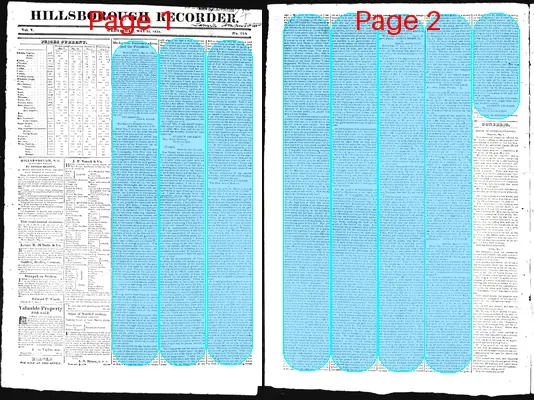
The Hillsborough Recorder
Hillsboro, Orange County, North Carolina
What is this article about?
Publication in 1824 of private 1816-1817 letters between Andrew Jackson and James Monroe discussing Indian land cessions, cabinet appointments including Secretary of War, political philosophy on parties, and recommendations for figures like William J. Drayton and James Gadsden, amid forming Monroe's administration.
Merged-components note: This is a continuation of the article on the correspondence between General Jackson and President Monroe regarding cabinet formation and political matters, spanning pages 1 and 2 with sequential reading order.
Clippings
1 of 2
OCR Quality
Full Text
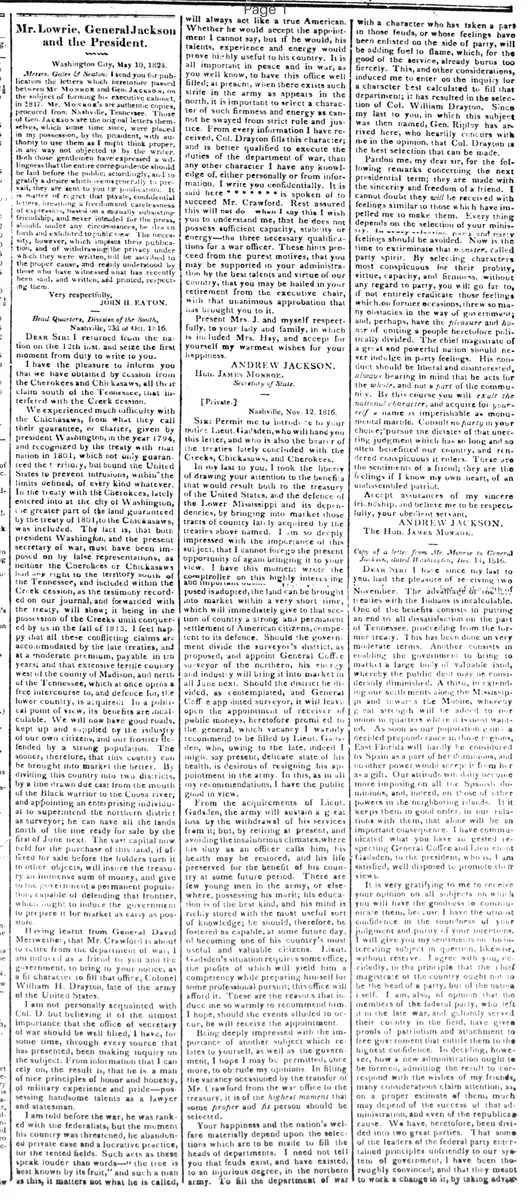
Washington City, May 10, 1824.
Messrs. Gales & Seaton: I send you for publication the letters which heretofore passed between Mr. Monroe and Gen. Jackson, on the subject of forming his executive cabinet, in 1817. Mr. Monroe's are authentic copies, procured from Nashville, Tennessee. Those of Gen. Jackson are the original letters themselves, which some time since, were placed in my possession, by the president, with authority to use them as I might think proper, in any way not objected to by the writer. Both those gentlemen have expressed a willingness that the entire correspondence should be laid before the public; accordingly, and to gratify a desire which seems generally to prevail, they are sent to you for publication. It is matter of regret that private, confidential letters, breathing a freedom and carelessness of expression, based on a mutually subsisting friendship, and never intended for the press, should, under any circumstances, be drawn forth and exhibited to public view. The necessity, however, which impels their publication, and of withdrawing the privacy under which they were written, will be ascribed to the proper cause, and readily understood by those who have witnessed what has recently been said, and written, and printed, respecting them.
Very respectfully,
JOHN H. EATON.
Head Quarters, Division of the South,
Nashville, 23d of Oct. 1816.
Dear Sir: I returned from the nation on the 12th inst. and seize the first moment from duty to write to you.
I have the pleasure to inform you that we have obtained by cession from the Cherokees and Chickasaws, all their claim south of the Tennessee, that interfered with the Creek cession. We experienced much difficulty with the Chickasaws, from what they call their guarantee, or charter, given by president Washington, in the year 1794, and recognized by the treaty with that nation in 1801; which not only guaranteed the territory, but bound the United States to prevent intrusions, within the limits defined, of every kind whatever.
In the treaty with the Cherokees, lately entered into at the city of Washington, the greater part of the land guaranteed by the treaty of 1801, to the Chickasaws, was included. The fact is, that both president Washington, and the present secretary of war, must have been imposed on by false representations, as neither the Cherokees or Chickasaws had any right to the territory south of the Tennessee, and included within the Creek cession, as the testimony recorded on our journal, and forwarded with the treaty, will show; it being in the possession of the Creeks until conquered by us in the fall of 1813. I feel happy that all these conflicting claims are accommodated by the late treaties, and at a moderate premium, payable in ten years; and that extensive fertile country west of the county of Madison, and north of the Tennessee, which at once opens a free intercourse to, and defence for, the lower country, is acquired: In a political point of view, its benefits are incalculable. We will now have good roads, kept up and supplied by the industry of our own citizens, and our frontier defended by a strong population. The sooner, therefore, that this country can be brought into market the better. By dividing this country into two districts, by a line drawn due east from the mouth of the Black warrior to the Coosa river; and appointing an enterprising individual to superintend the northern district as surveyor; he can have all the lands north of the line ready for sale by the first of June next. The vast capital now held for the purchase of this land, if offered for sale before the holders turn it to other objects, will insure the treasury an immense sum of money, and give to the government a permanent population, capable of defending that frontier, which ought to induce the government to prepare it for market as early as possible.
Having learnt from General David Meriwether, that Mr. Crawford is about to retire from the department of war, I am induced as a friend to you and the government, to bring to your notice, as a fit character to fill that office, Colonel William J. Drayton, late of the army of the United States.
I am not personally acquainted with Col. D. but believing it of the utmost importance that the office of secretary of war should be well filled, I have, for some time, through every source that has presented, been making inquiry on the subject. From information that I can rely on, the result is, that he is a man of nice principles of honor and honesty of military experience and pride—possessing handsome talents as a lawyer and statesman.
I am told before the war, he was ranked with the federalists, but the moment his country was threatened, he abandoned private ease and a lucrative practice, for the tented fields. Such acts as these speak louder than words—'the tree is best known by its fruit,' and such a man it matters not what he is called, will always act like a true American.
Whether he would accept the appointment I cannot say, but if he would, his talents, experience and energy would prove highly useful to his country. It is all important in peace and in war, as you well know, to have this office well filled; at present, when there exists such strife in the army as appears in the north, it is important to select a character of such firmness and energy as cannot be swayed from strict rule and justice. From every information I have received, Col. Drayton fills this character; and is better qualified to execute the duties of the department of war, than any other character I have any knowledge of, either personally or from information. I write you confidentially. It is said here * * * * * * is spoken of to succeed Mr. Crawford. Rest assured this will not do when I say this I wish you to understand me, that he does not possess sufficient capacity, stability or energy—tho three necessary qualifications for a war officer. These hints proceed from the purest motives, that you may be supported in your administration by the best talents and virtue of our Country, that you may be hailed in your retirement from the executive chair, with that unanimous approbation that has brought you to it.
Present Mrs. J. and myself respectfully, to your lady and family, in which is included Mrs. Hay, and accept for yourself my warmest wishes for your happiness.
ANDREW JACKSON.
Hon. JAMES MONROE,
Secretary of State.
[Private.]
Nashville, Nov. 12. 1816.
Sir: Permit me to introduce to your notice Lieut. Gadsden, who will hand you this letter, and who is also the bearer of the treaties lately concluded with the Creeks, Chickasaws, and Cherokees.
In my last to you, I took the liberty of drawing your attention to the benefits that would result both to the treasury of the United States, and the defence of the Lower Mississippi and its dependencies, by bringing into market those tracts of country lately acquired by the treaties above named. I am so deeply impressed with the importance of this subject, that I cannot forego the present opportunity of again bringing it to your view. I have this moment wrote the comptroller on this highly interesting and important subject. If the plan proposed is adopted, the land can be brought into market within a very short time, which will immediately give to that section of country a strong and permanent settlement of American citizens, competent to its defence. Should the government divide the surveyor's district, as proposed, and appoint General Coffee surveyor of the northern, his energy and industry will bring it into market in all June next. Should the district be divided, as contemplated, and General Coffee appointed surveyor, it will leave open the appointment of receiver of public moneys, heretofore promised to the general, which vacancy I warmly recommend to be filled by Lieut. Gadsden, who, owing to the late, indeed I might say present, delicate state of his health, is desirous of resigning his appointment in the army. In this, as in all my recommendations, I have the public good in view.
From the acquirements of Lieut. Gadsden, the army will sustain a great loss by the withdrawal of his services from it: but, by retiring at present, and avoiding the insalubrious climates, where his duty as an officer calls him, his health may be restored, and his life preserved for the benefit of his country at some future period. There are few young men in the army, or elsewhere, possessing his merit; his education is of the best kind, and his mind is richly stored with the most useful sort of knowledge: he should, therefore, be fostered as capable, at some future day, of becoming one of his country's most useful and valuable citizens. Lieut. Gadsden's situation requires some office, the profits of which will yield him a competency while preparing himself for some professional pursuit; this office will afford it. These are the reasons that induce me so warmly to recommend him. I hope, should the events alluded to occur, he will receive the appointment.
Being deeply impressed with the importance of another subject which relates to yourself, as well as the government, I hope I may be permitted, once more, to obtrude my opinions. In filling the vacancy occasioned by the transfer of Mr. Crawford from the war office to the treasury, it is of the highest moment that some proper and fit person should be selected.
Your happiness and the nation's welfare materially depend upon the selections which are to be made to fill the heads of departments. I need not tell you that feuds exist, and have existed, to an injurious degree, in the northern army. To fill the department of war with a character who has taken a part in those feuds, or whose feelings have been enlisted on the side of party, will be adding fuel to flame, which, for the good of the service, already burns too fiercely. This, and other considerations, induced me to enter on the inquiry for a character best calculated to fill that department; it has resulted in the selection of Col. William Drayton. Since my last to you, in which this subject was then named, Gen. Ripley has arrived here, who heartily concurs with me in the opinion, that Col. Drayton is the best selection that can be made.
Pardon me, my dear sir, for the following remarks concerning the next presidential term; they are made with the sincerity and freedom of a friend. I cannot doubt they will be received with feelings similar to those which have impelled me to make them. Every thing depends on the selection of your ministry. Party and party feelings should be avoided. Now is the time to exterminate that monster, called party spirit. By selecting characters most conspicuous for their probity, virtue, capacity, and firmness, without any regard to party, you will go far to, if not entirely eradicate those feelings which, on former occasions, threw so many obstacles in the way of government; and, perhaps, have the pleasure and honor of uniting a people heretofore politically divided. The chief magistrate of a great and powerful nation should never indulge in party feelings. His conduct should be liberal and disinterested, always bearing in mind that he acts for the whole, and not a part of the community. By this course you will exalt the national character, and acquire for yourself a name as imperishable as monumental marble. Consult no party in your choice; pursue the dictates of that unerring judgment which has so long and so often benefited our country, and rendered conspicuous its rulers. These are the sentiments of a friend; they are the feelings if I know my own heart, of an undissembled patriot.
Accept assurances of my sincere friendship, and believe me to be respectfully, your obedient servant,
ANDREW JACKSON.
The Hon. JAMES MONROE.
Copy of a letter from Mr. Monroe to General Jackson, dated Washington, Dec. 14, 1816.
Dear Sir: I have since my last to you, had the pleasure of receiving two letters from you of November. The advantages of the treaties with the Indians is incalculable. One of the benefits consists in putting an end to all dissatisfaction on the part of Tennessee, proceeding from the former treaty. This has been done on very moderate terms. Another consists in enabling the government to bring to market a large body of valuable land, whereby the public debt may be considerably diminished. A third, in extending our settlements along the Mississippi and towards the Mobile, whereby great strength will be added to our union in quarters where it is most wanted. As soon as our population gain a decided preponderance in those regions, East Florida will hardly be considered by Spain as a part of her dominions, and no other power would accept it from her as a gift. Our attitude was, daily become more imposing on all the Spanish dominions, and, indeed, on those of other powers in the neighboring islands. It it keeps them in good order, in our relations with them, that alone will be an important consequence. I have communicated what you have suggested respecting General Coffee and Lieutenant Gadsden, to the president, who is, I am satisfied, well disposed to promote the views.
It is very gratifying to me to receive your opinion on all subjects on which you will have the goodness to communicate them, because I have the utmost confidence in the soundness of your judgment and purity of your intentions. I will give you my sentiments on the interesting subject in question, likewise, without reserve. I agree with you, decidedly, in the principle that the chief magistrate of the country ought not to be the head of a party, but of the nation itself. I am, also, of opinion that the members of the federal party, who left it in the late war, and gallantly served their country in the field, have given proofs of patriotism and attachment to free government that entitle them to the highest confidence. In deciding, however, how a new administration ought to be formed, admitting the result to correspond with the wishes of my friends, many considerations claim attention, as, on a proper estimate of them, much may depend of the success of that administration, and even of the republican cause. We have, heretofore, been divided into two great parties. That some of the leaders of the federal party entertained principles unfriendly to our system of government, I have been thoroughly convinced; and that they meant to work a change in it, by taking advantage
Under favorable circumstances, I am equally satisfied. It happened that I was a member of congress, under the confederation, just before the change made by the adoption of the present constitution; and, afterwards, of the senate, beginning shortly after its adoption. In the former, I served three years, and, in the latter, rather a longer term. In these stations, I saw no indications of the kind suggested. It was an epoch at which the views of men were most likely to unfold themselves, as, if anything favorable to a higher toned government was to be obtained, that was the time. The movement in France tended, also, then, to test the opinions and principles of men, which was disclosed in a manner to leave no doubt on my mind of what I have suggested. No daring attempt was ever made, because there was no opportunity for it. I thought that Washington was opposed to their schemes, and not being able to take him with them, that they were forced to work, in regard to him, underhanded, using his name and standing with the nation, as far as circumstances permitted, to serve their purposes. The opposition, which was carried on with great firmness, checked the career of this party, and kept it within moderate limits. Many of the circumstances on which my opinion is founded, took place in debate and in society, and therefore find no place in any public document. I am satisfied, however, that sufficient proof exists, founded on facts and opinions of distinguished individuals, which became public, to justify that which I have formed.
The contest between the parties never ceased, from its commencement to the present time, nor do I think that it can be said now to have ceased. You saw the height to which the opposition was carried in the late war; the embarrassment it gave the government; the aid it gave to the enemy. The victory at New Orleans, for which we owe so much to you, and to the gallant freemen who fought under you, and the honorable peace which took place at that time, have checked the opposition, if they have not overwhelmed it. I may add that the daring measure of the Hartford Convention, when unfriended views which had been long before entertained, but never so fully understood, contributed, also, in an eminent degree, to reduce the opposition to its present state. It is under such circumstances that the election of a successor to Mr. Madison has taken place, and that a new administration is to commence its service. The election has been made by the republican party, supposing that it has succeeded, and of a person known to be devoted to that cause. How shall he act? How organize the administration, so far as dependent on him, when in that station? How fill the vacancies existing at the time? The dangerous purposes which I have adverted to, were never adopted, if they were known, especially in their full extent, by any large portion of the federal party, but were confined to certain leaders, and they principally to the eastward. The manly and patriotic conduct of a great proportion of that party in other states, I might, perhaps, say of all, who had an opportunity of displaying it, is a convincing proof of this fact. But still southern and eastern federalists have been connected together as a party, have acted together heretofore, and, although their conduct has been different, of late especially, yet the distinction between republicans and federalists, even in the southern and middle and western states, has not been fully done away. To give effect to free government and secure it from future danger, ought not its decided friends, who stood firm in the day of trial, to be principally relied on? Would not the association of any of their opponents in the administration itself, wound their feelings, or at least of very many of them, to the injury of the republican cause? Might it not be considered, by the other party, as an offer of compromise with them, which would lessen the ignominy due to the counsels which produced the Hartford Convention, and thereby have a tendency to revive that party on its former principles? My impression is, that the administration should rest strongly, on the republican party, inclining towards the other a spirit of moderation, and evincing a desire to discriminate between its members, and to bring the whole into the republican fold, as quietly as possible. Many men, very distinguished for their talents, are of opinion that the existence of the federal party is necessary to keep union and order in the republican ranks; that is, that free government cannot exist without parties. This is not my opinion. That the ancient republics were always divided into parties: that the English government is maintained by an opposition, that is by the existence of a party in opposition to the ministry—I well know. But I think that the cause of these divisions is to be found in certain defects of those governments, rather than in human nature, and that we have happily avoided those defects in our system. The first object is, to save the cause, which can be done by those who are devoted to it only, and of course by keeping them together: or in other words, by not disgusting them, by the party acting with courtesy to the other party, thereby making the generous spirit of the republican party and keeping one that is liberal. The second is, to prevent the reorganization, and revival of the federal party, which, if my hypothesis is true that the existence of party is not necessary to free government, and the other opinion which I have advanced is well founded, that the great body of the federal party are republican, will not be found impracticable. To accomplish both objects, and thereby exterminate all party divisions in our country, and give new strength and stability to our government, is a great undertaking, not easily executed. I am, nevertheless, decidedly of opinion that it may be done, and, should the experiment fail, I shall conclude that its failure was imputable more to the want of a correct knowledge of all circumstances claiming attention, and of sound judgment in the measures adopted, than to any other cause. I agree, I think, perfectly, with you, in the grand object, that moderation should be shown to the federal party, and even a generous policy be adopted towards it: the only difference between us seems to be how far shall that spirit be indulged in the outset; and it is to make you thoroughly acquainted with my views on this highly important subject, that I have written to you so freely on it. Of the gentleman of whom you have spoken, I think as you do, of which I gave him proof when in the department of war, by placing him in the board of officers for digesting and reporting a system of discipline for the army; and, afterwards, by other tokens of confidence; and I add, with pleasure, that I should be gratified, regarding the feelings and claims above stated, to find an opportunity, at a proper time hereafter, should the event in contemplation occur, to add other proofs of my good opinion and high respect for him.
In the formation of an administration, it appears to me, that the representative principle ought to be respected, in a certain degree, at least, and that the head of a department (there being four), should be taken from the four great sections of the union, the east, the middle, the south and the west. This principle should not be always adhered to, great emergencies and transcendent talents would always justify a departure from it. But it would produce a good effect to attend to it when practicable. Each part of the union would be gratified by it; and the knowledge of local details, and means which would be thereby brought into the cabinet, would be useful. I am no wise compromised in respect to any one, but free to act, should I have to act, according to my judgment, in which I am thankful for the opinions of my friends, and particularly for yours.
On the subject of fortifications, or works for the defence of the coast and frontiers, an arrangement has lately been presented, with which I wish you to be well acquainted. You have, heretofore, I presume, been apprised that Gen. Bernard, of the French corps of engineers, under the recommendation of Gen. La Fayette, and many others of great distinction in France, had offered his services to the U. States, and that the president had been authorized, by a resolution of congress, to accept them, confining his rank to the grade of the chief of our corps. This resolution being communicated to Gen. Bernard, by the late secretary of war, to whom he was known, he came over in compliance with the invitation which accompanied it. From Mr. Gallatin he brought letters, stating that he was the 7th in rank in the corps, and inferior to none in reputation and talents, if not the first. It required much delicacy in the arrangement, to take advantage of his knowledge and experience, in a manner acceptable to himself, without wounding the feelings of the others of our own corps; who have rendered such useful services, and were entitled to the confidence and protection of their country. The arrangement adopted, will, I think, accomplish fully, both objects. The president has instituted a board of officers, to consist of five members, two of high rank in the corps, Gen. Bernard, the engineer at each station, (of young Gadsden, for example, at New Orleans) and the naval officer commanding there, whose duty it is made to examine the whole coast, and report such works as are necessary for its defence, to the chief engineer, who shall report the same to the secretary of war, with his remarks to be laid before the president. McRee and Totten are spoken of, for the two first, who, with Gen. Bernard, will continue till the service is performed, the two latter will change with the station. The General commanding each division will be officially apprised of this arrangement, that he may be present when he pleases, and give such aid as he may think fit. The attention of the board will be directed to the inland frontiers, likewise. In this way, it is thought that the feelings of no one can be hurt. We shall have four of our officers in every consultation, to one foreigner, so that, if the opinion of the latter becomes of any essential use, it must be by his convincing his colleagues, when they differ, that he has reason on his side. I have seen General Bernard, and find him a modest, unassuming man, who preferred our country, in the present state of France, to any in Europe, in some of which he was offered employment, and in any of which he might probably have found it. I understand that he is never to have the command of the corps, but will rank second, or third in it.
This letter you will perceive is highly confidential: a relation which I wish always to exist between us. Write me, as you have done, without reserve—and the more so, the more gratifying your communications will be.
With great respect, and sincere regard, yours, JAMES MONROE.
Nashville, January 6, 1817.
Dear Sir: I have to acknowledge the receipt of your letter of the 14th December last, which I have read with great interest and much satisfaction.
Your idea of the importance of the acquisition of territory from the Indians, is certainly correct, and all the importance you attach to it will be realized. The sooner these lands are brought into market, a permanent security will be given to what I deem the most important, as well as most vulnerable, part of the union. This country once settled, our fortifications of defence in the lower country completed, all Europe will cease to look at it with an eye to conquest. There is no other point. America united, that continent Europe can expect to invade with success.
On the other subjects embraced in my letter, as well as this, I gave you my crude ideas with the candor of friendship. I am much gratified that you receive them as intended. It was the purest friendship for you individually, combined with the good of our country, that dictated the liberty I took in writing you. The importance of the station you were about to fill to our country and yourself, the injury to reputation that the chief magistrate may sustain, from the acts of a weak cabinet, the various interests that will arise to recommend their favorite candidate, and, from experience in the late war, the mischief that die arise to our national character by wickedness or weakness; induce me to give you my candid opinion, on the importance of the character that should fill that office. I had made, by this purpose, the most extensive inquiry in my power from the most impartial sources for a suitable character combining virtue, honor, and energy, with talents, and all united in the individual. I am fully impressed with the propriety as well as the policy you have pointed out, of taking the heads of departments from the four great sections of the United States, where each section can afford a character of qualifications; where that cannot be done, fitness, and not locality, ought to govern—the executive being entitled to the best talents, when combined with other necessary qualifications, that the Union can afford.
I have read, with much satisfaction, that part of your letter on the rise, progress, and policy, of the Federalists. It is, in my opinion, a just expression. I am free to declare, had I commanded the military department when the Hartford Convention met, it had been the last act of my life. I should have punished the three principal leaders of the party. I am certain an independent court-martial would have convicted them under the 2d section of the act establishing rules and regulations for the government of the army of the United States. These kind of men, although called federalists, are really monarchists, and traitors to the constituted government. But, I am of opinion that there are men called federalists that are honest, virtuous, and really attached to our government, and, although they differ in many respects and opinions with the republicans, still they will risk everything in its defence. It is, therefore, a favorite adage with me, that the "tree is known by its fruit." Experience in the late war taught me to know, that it is not those who cry patriotism loudest who are the greatest friends to their country, or will risk most in its defence. The senate of Rome had a Sempronius; America has hers. See, therefore, I see a character, with manly firmness, give his opinion, but when overruled by a majority, fly to support that majority, protecting the eagles of his country, meeting every privation and danger for a love of country, and the security of its independent rights, I care not by what name he is called: I believe him to be a true American, worthy the confidence of his country, and of every good man. Such a character will never do an act injurious to his country. Such is the character given to me of Colonel [D.]. Believing in the recommendation, I was, and still am, confident he is well qualified to fill the office with credit to himself and benefit to his country, and to aid you in the arduous station a grateful country has called you to fill. Permit me to add, that names of themselves, are but bubbles, and sometimes used for the most wicked purposes. I will name one instance. I have, once upon a time, been denounced as a federalist. You will smile when I name the cause. When your country put up your name in opposition to Mr. M. I was one of those who gave you the preference, and for reason that, in the event of war, which was then probable, you would steer the vessel of state, with more energy, &c. &c.; that Mr. M. was one of the best of men, and a great civilian. I always thought but I always believed that the mind of a philosopher could not dwell on blood and carnage with any composure, of course that he was not well fitted for a stormy sea. I was immediately branded with the epithet Federalist, and you also. But I trust, when compared with the good old adage, of the tree being known by its fruit, it was unjustly applied to either.
To conclude, my dear sir, my whole letter was intended to put you on your guard against American Sempronius's, that you might exercise your own judgment in the choice of your own ministry, by which you would glide smoothly through your administration, with honor to yourself and benefit to your country. This was my motive: this the first wish of my heart, to see you, when I am in retirement, endeavoring to raise a broken and debilitated constitution, administering the government with the full approbation of all good men, pursuing an undeviating course, alone dictated by your own independent, matured judgment.
Present Mrs. J. and myself respectfully to your lady, and accept for yourself our best wishes, and believe me to be your most obedient servant,
ANDREW JACKSON.
The Hon. JAMES MONROE.
Copy of a letter from Mr. Monroe, dated Washington, March 1st, 1817, to Gen. Jackson.
Dear Sir: I owe you a long letter by Gen. Bernard, and intended to have written you another, but had not time: so constantly have I been engaged in highly important business, that I have not had a moment for my friends.
In the course of last summer, the president offered the department of war to Mr. Clay, who then declined it. Since it was known that the suffrages of my fellow-citizens had decided in my favor, I renewed to him the offer, which he has again declined. My mind was immediately fixed on you, though I doubted whether I ought to wish to draw you from the command of the army to the south, where, in case of any emergency, no one could supply your place. At this moment, our friend Mr. Campbell, called, and informed me that you wished me not to nominate you. In this state, I have revolved the subject, and thought that Col. [name redacted], though it is uncertain whether he will serve. His experience, long and meritorious services, give him a claim over younger men in that state.
I shall take a person for the department of state from the eastward: and Mr. Adams's claims by long service, in our diplomatic concerns, appearing to entitle him to the preference, supported by his acknowledged abilities and integrity, his nomination will go to the senate. Mr. Crawford, it is expected, will remain in the treasury. After all that has been said, I have thought that I should put the administration more on national grounds, by taking the secretary of state from the eastward, than from this quarter, or the south, or west. By this arrangement, there can be no cause to suspect unfair combination for improper purposes. Each member will stand on his own merit, and the people respect us all, according to our conduct. To each, I will act impartially, and of each, expect the performance of his duty. While I am here, I shall take the administration, first, for the country and its cause; secondly, to give effect to the government of the people, through me, for the term of my appointment, and not for the aggrandizement of any one.
With great respect, and sincere regard, yours, JAMES MONROE.
Nashville, March 18, 1817.
Dear Sir: I had the pleasure this day of receiving your letter of the 1st instant. That by Gen. Bernard I have not received. I learn by this day's mail that he has reached Knoxville, and will be on in a few days.
My friend Judge Campbell was instructed, and fully authorized, to make the communication to you that he did, and, I hope, gave you fully my reasons for my determination and wishes on that subject.
I have no hesitation in saying you have made the best selection to fill the department of state that could be made. Mr. Adams, in the hour of difficulty, will be an able helpmate, and I am convinced his appointment will afford general satisfaction. No person stands higher in my estimation than [name redacted]. He is a well tried patriot, and if he accepts, will, with a virtuous zeal, discharge the duties of the office as far as his abilities will enable him. I cannot disguise to you my opinion on this occasion; my anxious solicitude for your public and private welfare requires of me candor on all occasions: and I am compelled to say to you, that the arrangements of this worthy man are not competent to the discharge of the multiplied duties of this department. I, therefore, hope he may not accept the appointment. I am fearful, if he does, he will not add much splendor to his present well earned standing as a public character. Should he accept, rest assured that, as long as I remain in the army, it will afford me great pleasure in obeying your orders through him, and rendering his situation and duty easy and pleasant as far as circumstances will place it in my power.
I am aware of the difficulties that surround you in the selection of your cabinet. But the plan you have adopted, of making all considerations yield to the general weal, will bring you to retirement with the salutations and applause of all the virtuous, wise and good; and should you be properly seconded by the congress of the United States, you will be enabled to place the union in a state of security and prosperity that cannot be shaken by the convulsions of Europe. To this end you can calculate with confidence on my feeble exertions, so long as my constitution may permit me to be useful. I have looked forward to that happy period when, under your guidance, our government would be in the "full tide of successful experiment" when I would retire from public life, and endeavor to regain a much enfeebled constitution. Should you be properly seconded in your views, this period will arrive, as soon as the measures you adopt for the defence of the frontier are carried into effect, by completing those fortifications that have been and may be selected for its defence, by erecting foundries and armories, and organizing and classing the militia. Then, we will have peace: for then we will be prepared for war. Every man having a gun in his hand, all Europe combined cannot hurt us. Then, all the world will be anxious to be at peace with us: because all will see we wish peace with all, but are prepared for defence against those who may attempt to infringe our national rights.
Accept assurances of my best wishes, and believe me to be, respectfully, your most obedient servant,
ANDREW JACKSON.
JAMES MONROE, President of the United States.
In declining the appointment of secretary of war
What sub-type of article is it?
What keywords are associated?
What entities or persons were involved?
Where did it happen?
Domestic News Details
Primary Location
Washington City
Event Date
May 10, 1824
Key Persons
Outcome
publication of confidential letters to address recent public discussions and clarify historical record on cabinet formation.
Event Details
John H. Eaton publishes private letters exchanged between Andrew Jackson and James Monroe in 1816-1817, covering Indian treaties ceding lands south of Tennessee, recommendations for cabinet positions like Secretary of War to William J. Drayton, advice on avoiding party politics, and Monroe's selections including John Quincy Adams for State and considerations for War.