Thank you for visiting SNEWPapers!
Sign up free
Editorial
March 19, 1896
Baptist Courier
Greenville, Columbia, Greenville County, Richland County, South Carolina
What is this article about?
This editorial reflects on the vast powers of human invention, construction, and intellect contrasted with the ultimate weakness revealed by death. It finds comfort in Christian doctrine, emphasizing Jesus' resurrection as a promise of immortality and victory over death for believers.
Clipping
OCR Quality
98%
Excellent
Full Text
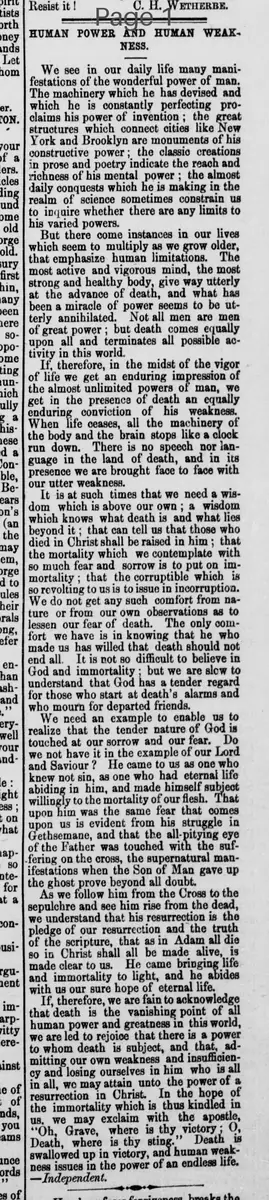
HUMAN POWER AND HUMAN WEAKNESS.
We see in our daily life many manifestations of the wonderful power of man. The machinery which he has devised and which he is constantly perfecting proclaims his power of invention; the great structures which connect cities like New York and Brooklyn are monuments of his constructive power; the classic creations in prose and poetry indicate the reach and richness of his mental power; the almost daily conquests which he is making in the realm of science sometimes constrain us to inquire whether there are any limits to his varied powers.
But there come instances in our lives which seem to multiply as we grow older, that emphasize human limitations. The most active and vigorous mind, the most strong and healthy body, give way utterly at the advance of death, and what has been a miracle of power seems to be utterly annihilated. Not all men are men of great power; but death comes equally upon all and terminates all possible activity in this world.
If, therefore, in the midst of the vigor of life we get an enduring impression of the almost unlimited powers of man, we get in the presence of death an equally enduring conviction of his weakness. When life ceases, all the machinery of the body and the brain stops like a clock run down. There is no speech nor language in the land of death, and in its presence we are brought face to face with our utter weakness.
It is at such times that we need a wisdom which is above our own: a wisdom which knows what death is and what lies beyond it; that can tell us that those who died in Christ shall be raised in him; that the mortality which we contemplate with so much fear and sorrow is to put on immortality; that the corruptible which is so revolting to us is to issue in incorruption.
We do not get any such comfort from nature or from our own observations as to lessen our fear of death. The only comfort we have is in knowing that he who made us has willed that death should not end all. It is not so difficult to believe in God and immortality; but we are slow to understand that God has a tender regard for those who start at death's alarms and who mourn for departed friends.
We need an example to enable us to realize that the tender nature of God is touched at our sorrow and our fear. Do we not have it in the example of our Lord and Saviour? He came to us as one who knew not sin, as one who had eternal life abiding in him, and made himself subject willingly to the mortality of our flesh. That upon him was the same fear that comes upon us is evident from his struggle in Gethsemane, and that the all-pitying eye of the Father was touched with the suffering on the cross, the supernatural manifestations when the Son of Man gave up the ghost prove beyond all doubt.
As we follow him from the Cross to the sepulchre and see him rise from the dead, we understand that his resurrection is the pledge of our resurrection and the truth of the scripture, that as in Adam all die so in Christ shall all be made alive, is made clear to us. He came bringing life and immortality to light, and he abides with us our sure hope of eternal life.
If, therefore, we are fain to acknowledge that death is the vanishing point of all human power and greatness in this world, we are led to rejoice that there is a power to whom death is subject, and that, admitting our own weakness and insufficiency and losing ourselves in him who is all in all, we may attain unto the power of a resurrection in Christ. In the hope of the immortality which is thus kindled in us, we may exclaim with the apostle, "O Grave, where is thy victory; O, Death, where is thy sting." Death is swallowed up in victory, and human weakness issues in the power of an endless life.
We see in our daily life many manifestations of the wonderful power of man. The machinery which he has devised and which he is constantly perfecting proclaims his power of invention; the great structures which connect cities like New York and Brooklyn are monuments of his constructive power; the classic creations in prose and poetry indicate the reach and richness of his mental power; the almost daily conquests which he is making in the realm of science sometimes constrain us to inquire whether there are any limits to his varied powers.
But there come instances in our lives which seem to multiply as we grow older, that emphasize human limitations. The most active and vigorous mind, the most strong and healthy body, give way utterly at the advance of death, and what has been a miracle of power seems to be utterly annihilated. Not all men are men of great power; but death comes equally upon all and terminates all possible activity in this world.
If, therefore, in the midst of the vigor of life we get an enduring impression of the almost unlimited powers of man, we get in the presence of death an equally enduring conviction of his weakness. When life ceases, all the machinery of the body and the brain stops like a clock run down. There is no speech nor language in the land of death, and in its presence we are brought face to face with our utter weakness.
It is at such times that we need a wisdom which is above our own: a wisdom which knows what death is and what lies beyond it; that can tell us that those who died in Christ shall be raised in him; that the mortality which we contemplate with so much fear and sorrow is to put on immortality; that the corruptible which is so revolting to us is to issue in incorruption.
We do not get any such comfort from nature or from our own observations as to lessen our fear of death. The only comfort we have is in knowing that he who made us has willed that death should not end all. It is not so difficult to believe in God and immortality; but we are slow to understand that God has a tender regard for those who start at death's alarms and who mourn for departed friends.
We need an example to enable us to realize that the tender nature of God is touched at our sorrow and our fear. Do we not have it in the example of our Lord and Saviour? He came to us as one who knew not sin, as one who had eternal life abiding in him, and made himself subject willingly to the mortality of our flesh. That upon him was the same fear that comes upon us is evident from his struggle in Gethsemane, and that the all-pitying eye of the Father was touched with the suffering on the cross, the supernatural manifestations when the Son of Man gave up the ghost prove beyond all doubt.
As we follow him from the Cross to the sepulchre and see him rise from the dead, we understand that his resurrection is the pledge of our resurrection and the truth of the scripture, that as in Adam all die so in Christ shall all be made alive, is made clear to us. He came bringing life and immortality to light, and he abides with us our sure hope of eternal life.
If, therefore, we are fain to acknowledge that death is the vanishing point of all human power and greatness in this world, we are led to rejoice that there is a power to whom death is subject, and that, admitting our own weakness and insufficiency and losing ourselves in him who is all in all, we may attain unto the power of a resurrection in Christ. In the hope of the immortality which is thus kindled in us, we may exclaim with the apostle, "O Grave, where is thy victory; O, Death, where is thy sting." Death is swallowed up in victory, and human weakness issues in the power of an endless life.
What sub-type of article is it?
Moral Or Religious
What keywords are associated?
Human Power
Human Weakness
Death
Immortality
Resurrection
Christian Faith
Eternal Life
What entities or persons were involved?
God
Christ
Jesus
Apostle
Editorial Details
Primary Topic
Human Power And Weakness In The Face Of Death, With Christian Hope Of Resurrection
Stance / Tone
Reflective And Consoling Through Faith
Key Figures
God
Christ
Jesus
Apostle
Key Arguments
Human Inventions And Achievements Demonstrate Vast Power.
Death Reveals Human Limitations And Ends All Activity.
Christian Wisdom Provides Comfort Beyond Nature's Observations.
Jesus' Life, Death, And Resurrection Pledge Immortality For Believers.
In Christ, Death's Victory Is Overcome, Leading To Eternal Life.