Thank you for visiting SNEWPapers!
Sign up free
Letter to Editor
March 22, 1808
The Enquirer
Richmond, Henrico County, Virginia
What is this article about?
A letter from 'Amicus' in the New-York Public Advertiser urges New York Republicans to unite behind James Madison as the next president, praising his long service to the nation and criticizing divisive factions supporting Clinton and Monroe that attack Madison and threaten party unity.
Clipping
OCR Quality
95%
Excellent
Full Text
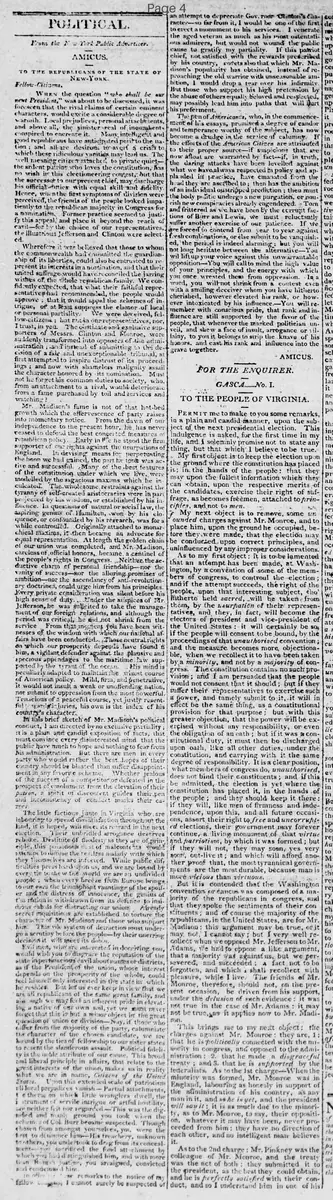
POLITICAL.
From the New-York Public Advertiser.
AMICUS.
TO THE REPUBLICANS OF THE STATE OF NEW-YORK.
Fellow-Citizens:
When the question "who shall be our next President" was about to be discussed, it was foreseen that the rival claims of certain eminent characters would excite a considerable degree of warmth. Local prejudices, personal attachments, and above all, the sinister zeal of incumbents conspired to increase it. Many intelligent and good republicans have anticipated peril to the nation; and all are desirous to avert a crisis to which these ridiculous vanities may lead us. The well-meaning citizens attached to private quiet, the ardent patriot who loves the constitution, has no wish in this electioneering contest, but that the successor to our present chief, may discharge his official duties with equal skill and fidelity.
Hence, when the first symptoms of division were perceived, the friends of the people looked impatiently to the republican majority in Congress for a nomination. Former practice seemed to justify this appeal, and place it beyond the reach of cavil—for by the choice of our representatives, the illustrious Jefferson and Clinton were selected.
Wherefore it was believed that those to whom the commonwealth had committed the guardianship of its liberties, could also be entrusted to represent its interests in a nomination, and that their united suffrage would have reconciled the jarring wishes of the whole republican family. We confidently expected, that what their faithful representatives had recommended, the people would approve; that it would appal the schemes of intrigue, or at least suppress the clamour of local or personal partiality. We were deceived, fellow-citizens; but not in our representatives, nor, I trust, in you. The obstinate and exclusive supporters of Messrs. Clinton and Monroe, were suddenly transformed into opposers of the administration; and instead of submitting to the decision of a fair and unexceptionable tribunal, at first attempted to inspire distrust of its proceedings: and now with shameless malignity assail the character honored by its nomination. Must not he forget his common duties to society, who, from an attachment to a rival, would deteriorate from a fame purchased by toil and services and watching?
Mr. Madison's fame is not of that hot-bed growth which the effervescence of party raises into momentary notice. From the dawn of our independence to the present hour, he has never ceased to defend the best concerted measures of republican policy. Early in life he stood the firm supporter of our rights against the usurpations of England.
In devising means for perpetuating the boon we had gained, the part he took was active and successful. Many of the best features of the constitution under which we live, were modelled by the sagacious maxims which he inculcated. The wholesome restraints against the tyranny of self-created aristocracies were in part projected by his wisdom, or established by his influence. In questions of natural or social law, the aspiring genius of Hamilton, won by his eloquence, or confounded by his research, was for a while controlled. Originally attached to monarchical maxims, it then became an advocate for equal representation. At length the golden chain of our union was completed, and Mr. Madison, careless of official honors, became a centinel of the people's rights in Congress. Neither the seductive charm of personal friendship—nor the vanity of success—nor the alluring promises of ambition—nor the ascendancy of anti-revolutionary doctrines, could urge him from his principles.
Every private consideration was silent before his high sense of duty. Under the auspices of Mr. Jefferson, he was solicited to take the management of our foreign relations, and although the period was critical, he did not shrink from the service. From that moment you have been witnesses of the wisdom with which our national affairs have been conducted. Those neutral rights on which our prosperity depends, have found in him a vigilant defender against the plausible and specious appendages to the maritime law supported by the tyrant of the ocean. His mind is peculiarly adapted to maintain the wisest course of American policy. Mild, firm, and penetrative, it would not insult a weak or unoffending nation, nor submit to oppression from the most powerful. Tenacious of a peaceful course, yet justly resentful of injuries, his own is the index of his country's character.
In this brief sketch of Mr. Madison's political conduct, I am directed by no exclusive partiality; it is a plain and candid exposition of facts, that must convince every disinterested mind that the public have much to hope and nothing to fear from his administration. But there are men in every party who would rather the best hopes of their country should be blasted than suffer disappointment in any favorite scheme. Whether jealous of the success of a competitor or defeated in the prospect of emolument from the elevation of their patron, a spirit of discontent guides their pen and inconsistency of conduct marks their career.
The little factious junto in Virginia who are labouring to spread dissatisfaction throughout the land, it is hoped, will meet its reward in the next election. Their unbridled arrogance deserves rebuke. Destitute of modesty as they are of principle, this poisonous cast of malcontents would attempt to diffuse the restless malady with which they themselves are infected. While public difficulties press hard upon us, and we are bound by every tie to show the world we are an undivided people; when every breeze from Europe brings to our ears the triumphant vauntings of the spoiler and the distress of innocence, the genius of the nation is withdrawn from its defense to insiduous cabals for distracting our union. Already secret inquisitions are established to torture the character of Mr. Madison and those who support him. This vile system of detraction must undergo a scrutiny before the people—by their unerring decision it will meet its doom.
Evil men, who are interested in deceiving you, would wish you to disgrace the reputation of the state in pertinacious cavil about names or districts, as if the President of the union, whose interest depends on the prosperity of the whole, could feel himself only interested in the state in which he resides. But let us ever keep in view that we are all republicans of the same great family, and as such we may feel an inherent pride in elevating a native of our own soil, yet we must never forget that this is but a minor object in the great question of union or division—Nay, if those who differ from the majority of the party, calumniate the character of the chosen candidate, we are bound by the ties of fellowship to our sister states to resent the slanderous assault. Political fidelity is the noble attribute of our cause. This broad and liberal principle in affairs, that relate to the great interests of the union, makes us in reality what we are in name, Citizens of the United States. Upon this extended scale of patriotism all local prejudices vanish—Partial attachments, the errics on which little wranglers dwell, the instrument of servile intrigue or artful hostility, are neither felt nor regarded—This was the dignified and manly ground you took when the schemes of Col. Burr became suspected. Though chosen from amongst yourselves, you were the first to denounce him—His treachery, unknown to others, you undertook to drag from its concealment—you sacrificed the fond attachment by which you had distinguished him, and with more than just ice, you arraigned, convicted and condemned him.
In offering these remarks to the notice of my fellow-citizens, I cannot surely be suspected of an attempt to depreciate Gov. Clinton's character—so far from it, I would be one of the first to erect a monument to his services. I venerate the aged veteran as much as his most ostentatious admirers, but would not wound the public cause to gratify my partiality. If this patriot chief, not satisfied with the rewards prescribed by his country, covets also that which Mr. Madison's popularity has obtained, instead of reproaching the old warrior with unseasonable ambition, I would drop a tear over his infirmity.
But those who support his high pretensions by the abuse of others equally beloved and respected, may possibly lead him into paths that will hurt his preferment.
The pen of Americanus, who, in the commencement of his essays, promised a degree of candor and temperance worthy of the subject, has now become a drudge in the service of calumny. If the efforts of the American Citizen are attributed to their proper source—if suspicions that are now afloat are warranted by fact—if, in truth, the daring attacks have been levelled against what we have always respected in policy and applauded in practice, have emanated from the head they are ascribed to: then has the ambition of an individual outstripped prediction; then must the body politic undergo a new purgation, or nourish new conspiracies already engendered. Torn and frittered as we have been by the corrupt factions of Burr and Lewis, we must reluctantly suffer another exercise of our patience. If we are forced to contend from year to year against fresh combinations, or else submit to be vanquished, the period is indeed alarming: but you will not long hesitate between the alternative—You will lift up your voice against this unwarrantable opposition—You will call to mind the high value of your principles, and the energy with which you once wrested them from oppression. In a word, you will not shrink from a contest even with a smiling deceiver whom you have hitherto cherished, however elevated his rank, or however intoxicated by his influence.—You will remember with conscious pride, that rank and influence are still supported by the favor of the people, that whenever the masked politician unveils and shows a face of insult, arrogance or villainy, to you it belongs to strip the knave of his honors, and cast his rank and influence into the grave together.
AMICUS.
From the New-York Public Advertiser.
AMICUS.
TO THE REPUBLICANS OF THE STATE OF NEW-YORK.
Fellow-Citizens:
When the question "who shall be our next President" was about to be discussed, it was foreseen that the rival claims of certain eminent characters would excite a considerable degree of warmth. Local prejudices, personal attachments, and above all, the sinister zeal of incumbents conspired to increase it. Many intelligent and good republicans have anticipated peril to the nation; and all are desirous to avert a crisis to which these ridiculous vanities may lead us. The well-meaning citizens attached to private quiet, the ardent patriot who loves the constitution, has no wish in this electioneering contest, but that the successor to our present chief, may discharge his official duties with equal skill and fidelity.
Hence, when the first symptoms of division were perceived, the friends of the people looked impatiently to the republican majority in Congress for a nomination. Former practice seemed to justify this appeal, and place it beyond the reach of cavil—for by the choice of our representatives, the illustrious Jefferson and Clinton were selected.
Wherefore it was believed that those to whom the commonwealth had committed the guardianship of its liberties, could also be entrusted to represent its interests in a nomination, and that their united suffrage would have reconciled the jarring wishes of the whole republican family. We confidently expected, that what their faithful representatives had recommended, the people would approve; that it would appal the schemes of intrigue, or at least suppress the clamour of local or personal partiality. We were deceived, fellow-citizens; but not in our representatives, nor, I trust, in you. The obstinate and exclusive supporters of Messrs. Clinton and Monroe, were suddenly transformed into opposers of the administration; and instead of submitting to the decision of a fair and unexceptionable tribunal, at first attempted to inspire distrust of its proceedings: and now with shameless malignity assail the character honored by its nomination. Must not he forget his common duties to society, who, from an attachment to a rival, would deteriorate from a fame purchased by toil and services and watching?
Mr. Madison's fame is not of that hot-bed growth which the effervescence of party raises into momentary notice. From the dawn of our independence to the present hour, he has never ceased to defend the best concerted measures of republican policy. Early in life he stood the firm supporter of our rights against the usurpations of England.
In devising means for perpetuating the boon we had gained, the part he took was active and successful. Many of the best features of the constitution under which we live, were modelled by the sagacious maxims which he inculcated. The wholesome restraints against the tyranny of self-created aristocracies were in part projected by his wisdom, or established by his influence. In questions of natural or social law, the aspiring genius of Hamilton, won by his eloquence, or confounded by his research, was for a while controlled. Originally attached to monarchical maxims, it then became an advocate for equal representation. At length the golden chain of our union was completed, and Mr. Madison, careless of official honors, became a centinel of the people's rights in Congress. Neither the seductive charm of personal friendship—nor the vanity of success—nor the alluring promises of ambition—nor the ascendancy of anti-revolutionary doctrines, could urge him from his principles.
Every private consideration was silent before his high sense of duty. Under the auspices of Mr. Jefferson, he was solicited to take the management of our foreign relations, and although the period was critical, he did not shrink from the service. From that moment you have been witnesses of the wisdom with which our national affairs have been conducted. Those neutral rights on which our prosperity depends, have found in him a vigilant defender against the plausible and specious appendages to the maritime law supported by the tyrant of the ocean. His mind is peculiarly adapted to maintain the wisest course of American policy. Mild, firm, and penetrative, it would not insult a weak or unoffending nation, nor submit to oppression from the most powerful. Tenacious of a peaceful course, yet justly resentful of injuries, his own is the index of his country's character.
In this brief sketch of Mr. Madison's political conduct, I am directed by no exclusive partiality; it is a plain and candid exposition of facts, that must convince every disinterested mind that the public have much to hope and nothing to fear from his administration. But there are men in every party who would rather the best hopes of their country should be blasted than suffer disappointment in any favorite scheme. Whether jealous of the success of a competitor or defeated in the prospect of emolument from the elevation of their patron, a spirit of discontent guides their pen and inconsistency of conduct marks their career.
The little factious junto in Virginia who are labouring to spread dissatisfaction throughout the land, it is hoped, will meet its reward in the next election. Their unbridled arrogance deserves rebuke. Destitute of modesty as they are of principle, this poisonous cast of malcontents would attempt to diffuse the restless malady with which they themselves are infected. While public difficulties press hard upon us, and we are bound by every tie to show the world we are an undivided people; when every breeze from Europe brings to our ears the triumphant vauntings of the spoiler and the distress of innocence, the genius of the nation is withdrawn from its defense to insiduous cabals for distracting our union. Already secret inquisitions are established to torture the character of Mr. Madison and those who support him. This vile system of detraction must undergo a scrutiny before the people—by their unerring decision it will meet its doom.
Evil men, who are interested in deceiving you, would wish you to disgrace the reputation of the state in pertinacious cavil about names or districts, as if the President of the union, whose interest depends on the prosperity of the whole, could feel himself only interested in the state in which he resides. But let us ever keep in view that we are all republicans of the same great family, and as such we may feel an inherent pride in elevating a native of our own soil, yet we must never forget that this is but a minor object in the great question of union or division—Nay, if those who differ from the majority of the party, calumniate the character of the chosen candidate, we are bound by the ties of fellowship to our sister states to resent the slanderous assault. Political fidelity is the noble attribute of our cause. This broad and liberal principle in affairs, that relate to the great interests of the union, makes us in reality what we are in name, Citizens of the United States. Upon this extended scale of patriotism all local prejudices vanish—Partial attachments, the errics on which little wranglers dwell, the instrument of servile intrigue or artful hostility, are neither felt nor regarded—This was the dignified and manly ground you took when the schemes of Col. Burr became suspected. Though chosen from amongst yourselves, you were the first to denounce him—His treachery, unknown to others, you undertook to drag from its concealment—you sacrificed the fond attachment by which you had distinguished him, and with more than just ice, you arraigned, convicted and condemned him.
In offering these remarks to the notice of my fellow-citizens, I cannot surely be suspected of an attempt to depreciate Gov. Clinton's character—so far from it, I would be one of the first to erect a monument to his services. I venerate the aged veteran as much as his most ostentatious admirers, but would not wound the public cause to gratify my partiality. If this patriot chief, not satisfied with the rewards prescribed by his country, covets also that which Mr. Madison's popularity has obtained, instead of reproaching the old warrior with unseasonable ambition, I would drop a tear over his infirmity.
But those who support his high pretensions by the abuse of others equally beloved and respected, may possibly lead him into paths that will hurt his preferment.
The pen of Americanus, who, in the commencement of his essays, promised a degree of candor and temperance worthy of the subject, has now become a drudge in the service of calumny. If the efforts of the American Citizen are attributed to their proper source—if suspicions that are now afloat are warranted by fact—if, in truth, the daring attacks have been levelled against what we have always respected in policy and applauded in practice, have emanated from the head they are ascribed to: then has the ambition of an individual outstripped prediction; then must the body politic undergo a new purgation, or nourish new conspiracies already engendered. Torn and frittered as we have been by the corrupt factions of Burr and Lewis, we must reluctantly suffer another exercise of our patience. If we are forced to contend from year to year against fresh combinations, or else submit to be vanquished, the period is indeed alarming: but you will not long hesitate between the alternative—You will lift up your voice against this unwarrantable opposition—You will call to mind the high value of your principles, and the energy with which you once wrested them from oppression. In a word, you will not shrink from a contest even with a smiling deceiver whom you have hitherto cherished, however elevated his rank, or however intoxicated by his influence.—You will remember with conscious pride, that rank and influence are still supported by the favor of the people, that whenever the masked politician unveils and shows a face of insult, arrogance or villainy, to you it belongs to strip the knave of his honors, and cast his rank and influence into the grave together.
AMICUS.
What sub-type of article is it?
Persuasive
Political
What themes does it cover?
Politics
What keywords are associated?
Presidential Election
James Madison
Republican Unity
George Clinton
James Monroe
Party Division
National Union
What entities or persons were involved?
Amicus
Republicans Of The State Of New York
Letter to Editor Details
Author
Amicus
Recipient
Republicans Of The State Of New York
Main Argument
republicans should unite to support james madison as the next president, recognizing his proven fidelity and wisdom, while rejecting divisive attacks from clinton and monroe supporters that threaten national unity.
Notable Details
Praises Madison's Role In Independence, Constitution, And Foreign Policy Under Jefferson
Criticizes Virginia Faction And 'Americanus' For Calumny
References Past Denunciation Of Burr's Schemes
Urges Fidelity To Union Over Local Attachments