Thank you for visiting SNEWPapers!
Sign up free
Alexandria Daily Gazette, Commercial & Political
Alexandria, Virginia
What is this article about?
An anonymous Republican critiques the appointment of Henry Dearborn as commander for the conquest of Canada during the War of 1812, decrying his incompetence, illiteracy, and partisan bias. The letter lambasts the administration's secretaries for weakness and delay, calling for new leadership to ensure victory and honorable peace.
Clipping
OCR Quality
Full Text
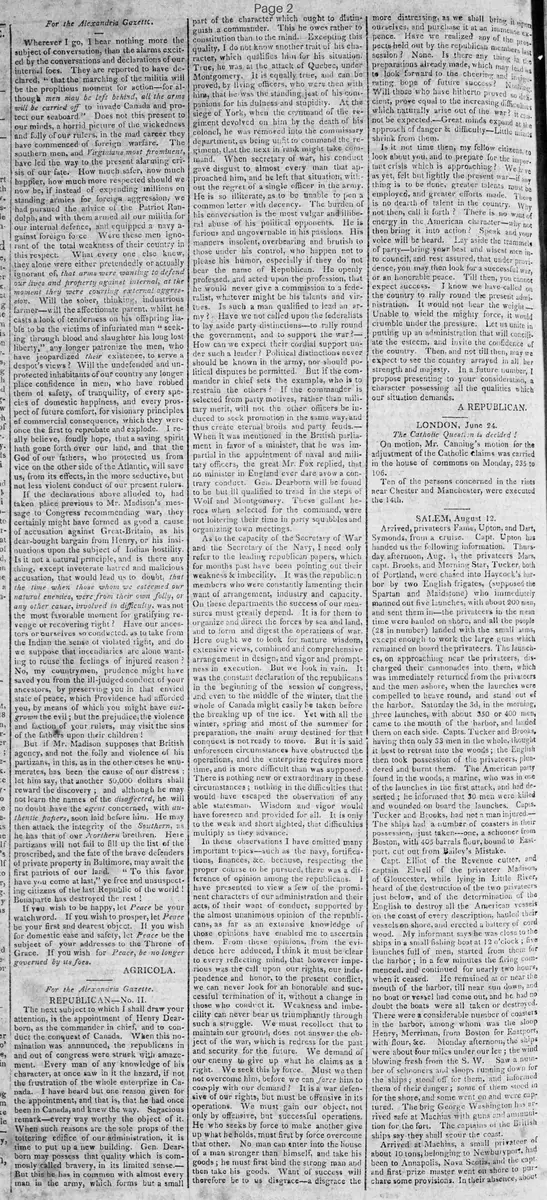
REPUBLICAN--No. II.
The next subject to which I shall draw your attention, is the appointment of Henry Dearborn, as the commander in chief, and to conduct the conquest of Canada. When this nomination was announced, the republicans in and out of congress were struck with amazement. Every man of any knowledge of his character, at once saw in it the hazard, if not the frustration of the whole enterprize in Canada. I have heard but one reason given for the appointment, and that is, that he had once been in Canada, and knew the way. Sagacious remark--every way worthy the object of it. When such reasons are the sole props of the tottering edifice of our administration, it is time to put up a new building. Gen. Dearborn may possess that quality which is commonly called bravery, in its limited sense.-- But this he has in common with almost every man in the army, which forms but a small part of the character which ought to distinguish a commander. This he owes rather to constitution than to the mind. Excepting this quality, I do not know another trait of his character, which qualifies him for his situation. True, he was at the attack of Quebec, under Montgomery. It is equally true, and can be proved, by living officers, who were then with him, that he was the standing jest of his companions for his dulness and stupidity. At the siege of York, when the command of the regiment devolved on him by the death of his colonel, he was removed into the commissary department, as being unfit to command the regiment, that the next in rank might take command. When secretary of war, his conduct gave disgust to almost every man that approached him, and he left that situation, without the regret of a single officer in the army. He is so illiterate, as to be unable to pen a common letter with decency. The burden of his conversation is the most vulgar and illiberal abuse of his political opponents. He is furious and ungovernable in his passions. His manners insolent, overbearing and brutish to those under his control, who happen not to please his humor, especially if they do not bear the name of Republican. He openly professed, and acted upon the profession, that he would never give a commission to a federalist, whatever might be his talents and virtues. Is such a man qualified to lead an army? Have we not called upon the federalists to lay aside party distinctions--to rally round the government, and to support the war?-- How can we expect their cordial support under such a leader? Political distinctions never should be known in the army, nor should political disputes be permitted. But if the commander in chief sets the example, who is to restrain the others? If the commander is selected from party motives, rather than military merit, will not the other officers be induced to seek promotion in the same way, and thus create eternal broils and party feuds.-- When it was mentioned in the British parliament in favor of a minister, that he was impartial in the appointment of naval and military officers, the great Mr. Fox replied, that no minister in England ever dare avow a contrary conduct. Gen. Dearborn will be found to be but ill qualified to tread in the steps of Wolf and Montgomery. These gallant heroes when selected for the command, were not loitering their time in party squabbles and organizing town meetings.
As to the capacity of the Secretary of War and the Secretary of the Navy, I need only refer to the leading republican papers, which for months past have been pointing out their weakness & imbecility. It was the republican members who were constantly lamenting their want of arrangement, industry and capacity. On these departments the success of our measures must greatly depend. It is for them to organize and direct the forces by sea and land, and to form and digest the operations of war. Here ought we to look for mature wisdom, extensive views, combined and comprehensive arrangement in design, and vigor and promptness in execution. But we look in vain. It was the constant declaration of the republicans in the beginning of the session of congress, and even to the middle of the winter, that the whole of Canada might easily be taken before the breaking up of the ice. Yet with all the winter, spring and most of the summer for preparation, the main army destined for that conquest is not ready to move. But it is said unforeseen circumstances have obstructed the operations, and the enterprize requires more time, and is more difficult than was supposed. There is nothing new or extraordinary in these circumstances; nothing in the difficulties that would have escaped the observation of any able statesman. Wisdom and vigor would have foreseen and provided for all. It is only to the weak and short sighted, that difficulties multiply as they advance.
In these observations I have omitted many important topics--such as the navy, fortifications, finances, &c. because, respecting the proper course to be pursued, there was a difference of opinion among the republicans. I have presented to view a few of the prominent characters of our administration and their acts, of their want of conduct, supported by the almost unanimous opinion of the republicans, as far as an extensive knowledge of those opinions have enabled me to ascertain them. From these opinions, from the evidence here adduced, I think it must be clear to every reflecting mind, that however imperious was the call upon our rights, our independence and honor, to the present conflict, we can never look for an honorable and successful termination of it, without a change in those who conduct it. Weakness and imbecility can never bear us triumphantly through such a struggle. We must recollect that to maintain our ground, does not answer the object of the war, which is redress for the past and security for the future. We demand of our enemy to give up what he claims as a right. We seek this by force. Must we then not overcome him, before we can force him to comply with our demand? It is a war defensive of our rights, but must be offensive in its operations. We must gain our object, not only by offensive, but successful operations. He who seeks by force to make another give up what he holds, must first by force overcome that other. No man can enter into the house of a man stronger than himself, and take his goods; he must first bind the strong man and then take his goods. Want of success will therefore be to us disgrace--a disgrace the more distressing, as we shall bring it upon ourselves.
Have we realized it at any time? Have we purchased prospects hold out by the republican members last session? None. Is there any thing in preparations already made which may lead to look forward to the cheering and invigorating? Nothing.
Will those who have hitherto proved so unequal to the increasing difficulties which naturally arise out of the war it cannot be expected?
Great minds expand at the approach of danger & difficulty--Little minds shrink from them.
Is it not time then, my fellow citizens, to look about you, and to prepare for the important crisis which is approaching? We have as yet, felt but lightly the present war--if any thing is to be done, greater talents must be employed, and greater efforts made. There is no dearth of talent in the country. Why not then, call it forth? There is no want of energy in the American character--why not then bring it into action? Speak and your voice will be heard. Lay aside the trammels of party--bring your best and wisest men into council, and rest assured, that under providence, you may then look for a successful war, or an honorable peace. Till then, you cannot expect success. I know we have called on the country to rally round the present administration. It would not bear the weight--. Unable to wield the mighty force, it would crumble under the pressure. Let us unite in putting up an administration that will conciliate the esteem, and invite the confidence of the country. Then, and not till then, may we expect to see the country arrayed in all her strength and majesty. In a future number, I propose presenting to your consideration, a character possessing all the qualities which our situation demands.
A REPUBLICAN.
What sub-type of article is it?
What themes does it cover?
What keywords are associated?
What entities or persons were involved?
Letter to Editor Details
Author
A Republican
Recipient
For The Alexandria Gazette
Main Argument
the appointment of henry dearborn as commander for the conquest of canada is a grave error due to his incompetence, illiteracy, and partisan bias; the administration's weaknesses demand a change in leadership to achieve successful offensive operations and honorable peace in the war.
Notable Details