Thank you for visiting SNEWPapers!
Sign up free
Story
March 21, 1878
The Wheeling Daily Register
Wheeling, Ohio County, West Virginia
What is this article about?
Mr. Goode of Virginia introduces a congressional bill for a life insurance system for U.S. naval and marine corps officers, modeled after Russia's, to provide for their families through premiums deducted from pay, with no extra rates for hazardous duties.
Clipping
OCR Quality
98%
Excellent
Full Text
INSURANCE FOR OUR NAVAL OFFICERS.
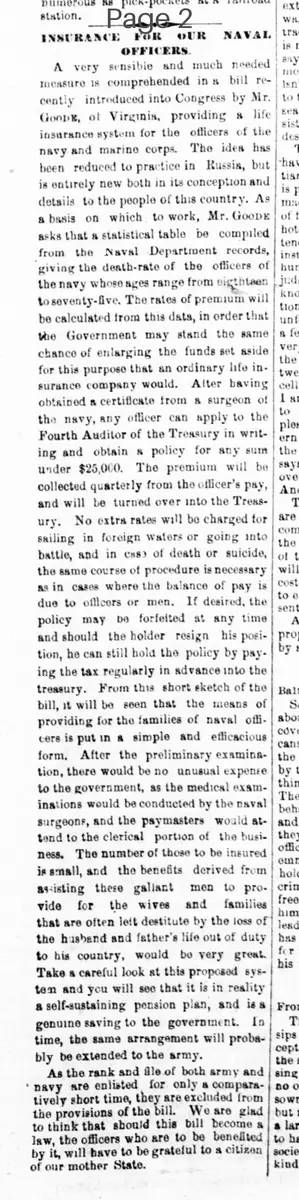
A very sensible and much needed measure is comprehended in a bill recently introduced into Congress by Mr. Goode, of Virginia, providing a life insurance system for the officers of the navy and marine corps. The idea has been reduced to practice in Russia, but is entirely new both in its conception and details to the people of this country. As a basis on which to work, Mr. Goode asks that a statistical table be compiled from the Naval Department records, giving the death-rate of the officers of the navy whose ages range from eighteen to seventy-five. The rates of premium will be calculated from this data, in order that the Government may stand the same chance of enlarging the funds set aside for this purpose that an ordinary life insurance company would. After having obtained a certificate from a surgeon of the navy, any officer can apply to the Fourth Auditor of the Treasury in writing and obtain a policy for any sum under $25,000. The premium will be collected quarterly from the officer's pay, and will be turned over into the Treasury. No extra rates will be charged for sailing in foreign waters or going into battle, and in case of death or suicide the same course of procedure is necessary as in cases where the balance of pay is due to officers or men. If desired, the policy may be forfeited at any time and should the holder resign his position, he can still hold the policy by paying the tax regularly in advance into the treasury. From this short sketch of the bill, it will be seen that the means of providing for the families of naval officers is put in a simple and efficacious form. After the preliminary examination, there would be no unusual expense to the government, as the medical examinations would be conducted by the naval surgeons, and the paymasters would attend to the clerical portion of the business. The number of those to be insured is small, and the benefits derived from assisting these gallant men to provide for the wives and families that are often left destitute by the loss of the husband and father's life out of duty to his country, would be very great. Take a careful look at this proposed system and you will see that it is in reality a self-sustaining pension plan, and is a genuine saving to the government. In time, the same arrangement will probably be extended to the army.
As the rank and file of both army and navy are enlisted for only a comparatively short time, they are excluded from the provisions of the bill. We are glad to think that should this bill become a law, the officers who are to be benefited by it, will have to be grateful to a citizen of our mother State.
A very sensible and much needed measure is comprehended in a bill recently introduced into Congress by Mr. Goode, of Virginia, providing a life insurance system for the officers of the navy and marine corps. The idea has been reduced to practice in Russia, but is entirely new both in its conception and details to the people of this country. As a basis on which to work, Mr. Goode asks that a statistical table be compiled from the Naval Department records, giving the death-rate of the officers of the navy whose ages range from eighteen to seventy-five. The rates of premium will be calculated from this data, in order that the Government may stand the same chance of enlarging the funds set aside for this purpose that an ordinary life insurance company would. After having obtained a certificate from a surgeon of the navy, any officer can apply to the Fourth Auditor of the Treasury in writing and obtain a policy for any sum under $25,000. The premium will be collected quarterly from the officer's pay, and will be turned over into the Treasury. No extra rates will be charged for sailing in foreign waters or going into battle, and in case of death or suicide the same course of procedure is necessary as in cases where the balance of pay is due to officers or men. If desired, the policy may be forfeited at any time and should the holder resign his position, he can still hold the policy by paying the tax regularly in advance into the treasury. From this short sketch of the bill, it will be seen that the means of providing for the families of naval officers is put in a simple and efficacious form. After the preliminary examination, there would be no unusual expense to the government, as the medical examinations would be conducted by the naval surgeons, and the paymasters would attend to the clerical portion of the business. The number of those to be insured is small, and the benefits derived from assisting these gallant men to provide for the wives and families that are often left destitute by the loss of the husband and father's life out of duty to his country, would be very great. Take a careful look at this proposed system and you will see that it is in reality a self-sustaining pension plan, and is a genuine saving to the government. In time, the same arrangement will probably be extended to the army.
As the rank and file of both army and navy are enlisted for only a comparatively short time, they are excluded from the provisions of the bill. We are glad to think that should this bill become a law, the officers who are to be benefited by it, will have to be grateful to a citizen of our mother State.
What sub-type of article is it?
Historical Event
What themes does it cover?
Family
Justice
Moral Virtue
What keywords are associated?
Naval Officers Insurance
Congress Bill
Life Insurance System
Mr Goode
Virginia
Navy Families
What entities or persons were involved?
Mr. Goode
Where did it happen?
United States Congress
Story Details
Key Persons
Mr. Goode
Location
United States Congress
Event Date
Recently
Story Details
Bill introduced by Mr. Goode provides life insurance for naval and marine officers via premiums from pay, covering up to $25,000, with policies managed by Treasury, benefiting families without extra government cost.