Thank you for visiting SNEWPapers!
Sign up free
Editorial
May 23, 1901
The Middleburgh Post
Middleburg, Snyder County, Pennsylvania
What is this article about?
Editorial debates the business value of college education, quoting Charles M. Schwab's view favoring early practical starts over college, but counters that educated individuals offer broader intelligence and contributions to industry, emphasizing character over credentials.
Clipping
OCR Quality
98%
Excellent
Full Text
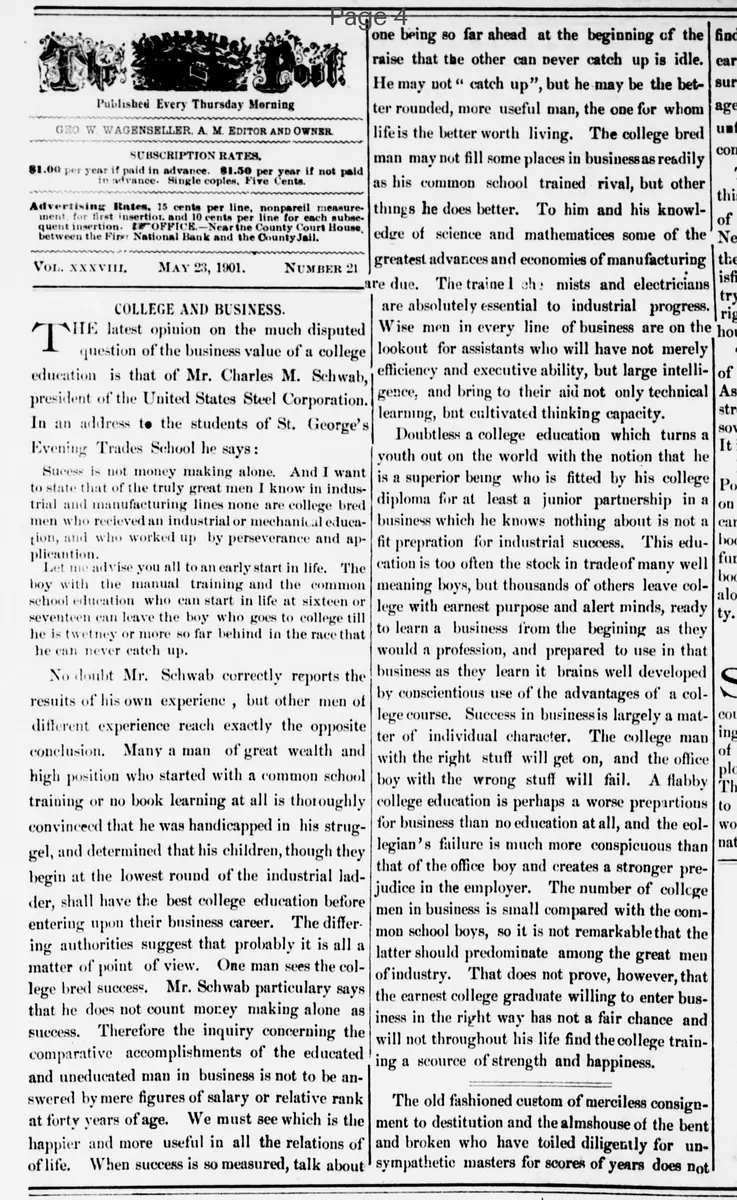
COLLEGE AND BUSINESS.
THE latest opinion on the much disputed question of the business value of a college education is that of Mr. Charles M. Schwab, president of the United States Steel Corporation. In an address to the students of St. George's Evening Trades School he says:
Success is not money making alone. And I want to state that of the truly great men I know in industrial and manufacturing lines none are college bred men who received an industrial or mechanical education, and who worked up by perseverance and application.
Let me advise you all to an early start in life. The boy with the manual training and the common school education who can start in life at sixteen or seventeen can leave the boy who goes to college till he is twenty or more so far behind in the race that he can never catch up.
No doubt Mr. Schwab correctly reports the results of his own experience, but other men of different experience reach exactly the opposite conclusion. Many a man of great wealth and high position who started with a common school training or no book learning at all is thoroughly convinced that he was handicapped in his struggle, and determined that his children, though they begin at the lowest round of the industrial ladder, shall have the best college education before entering upon their business career.
The differing authorities suggest that probably it is all a matter of point of view. One man sees the college bred success. Mr. Schwab particularly says that he does not count money making alone as success. Therefore the inquiry concerning the comparative accomplishments of the educated and uneducated man in business is not to be answered by mere figures of salary or relative rank at forty years of age. We must see which is the happier and more useful in all the relations of life. When success is so measured, talk about one being so far ahead at the beginning of the race that the other can never catch up is idle.
He may not 'catch up,' but he may be the better rounded, more useful man, the one for whom life is the better worth living. The college bred man may not fill some places in business as readily as his common school trained rival, but other things he does better. To him and his knowledge of science and mathematics some of the greatest advances and economies of manufacturing are due. The trained chemists and electricians are absolutely essential to industrial progress.
Wise men in every line of business are on the lookout for assistants who will have not merely efficiency and executive ability, but large intelligence, and bring to their aid not only technical learning, but cultivated thinking capacity.
Doubtless a college education which turns a youth out on the world with the notion that he is a superior being who is fitted by his college diploma for at least a junior partnership in a business which he knows nothing about is not a fit preparation for industrial success. This education is too often the stock in trade of many well meaning boys, but thousands of others leave college with earnest purpose and alert minds, ready to learn a business from the beginning as they would a profession, and prepared to use in that business as they learn it brains well developed by conscientious use of the advantages of a college course.
Success in business is largely a matter of individual character. The college man with the right stuff will get on, and the office boy with the wrong stuff will fail. A flabby college education is perhaps a worse preparation for business than no education at all, and the collegian's failure is much more conspicuous than that of the office boy and creates a stronger prejudice in the employer.
The number of college men in business is small compared with the common school boys, so it is not remarkable that the latter should predominate among the great men of industry. That does not prove, however, that the earnest college graduate willing to enter business in the right way has not a fair chance and will not throughout his life find the college training a source of strength and happiness.
The old fashioned custom of merciless consignment to destitution and the almshouse of the bent and broken who have toiled diligently for unsympathetic masters for scores of years
THE latest opinion on the much disputed question of the business value of a college education is that of Mr. Charles M. Schwab, president of the United States Steel Corporation. In an address to the students of St. George's Evening Trades School he says:
Success is not money making alone. And I want to state that of the truly great men I know in industrial and manufacturing lines none are college bred men who received an industrial or mechanical education, and who worked up by perseverance and application.
Let me advise you all to an early start in life. The boy with the manual training and the common school education who can start in life at sixteen or seventeen can leave the boy who goes to college till he is twenty or more so far behind in the race that he can never catch up.
No doubt Mr. Schwab correctly reports the results of his own experience, but other men of different experience reach exactly the opposite conclusion. Many a man of great wealth and high position who started with a common school training or no book learning at all is thoroughly convinced that he was handicapped in his struggle, and determined that his children, though they begin at the lowest round of the industrial ladder, shall have the best college education before entering upon their business career.
The differing authorities suggest that probably it is all a matter of point of view. One man sees the college bred success. Mr. Schwab particularly says that he does not count money making alone as success. Therefore the inquiry concerning the comparative accomplishments of the educated and uneducated man in business is not to be answered by mere figures of salary or relative rank at forty years of age. We must see which is the happier and more useful in all the relations of life. When success is so measured, talk about one being so far ahead at the beginning of the race that the other can never catch up is idle.
He may not 'catch up,' but he may be the better rounded, more useful man, the one for whom life is the better worth living. The college bred man may not fill some places in business as readily as his common school trained rival, but other things he does better. To him and his knowledge of science and mathematics some of the greatest advances and economies of manufacturing are due. The trained chemists and electricians are absolutely essential to industrial progress.
Wise men in every line of business are on the lookout for assistants who will have not merely efficiency and executive ability, but large intelligence, and bring to their aid not only technical learning, but cultivated thinking capacity.
Doubtless a college education which turns a youth out on the world with the notion that he is a superior being who is fitted by his college diploma for at least a junior partnership in a business which he knows nothing about is not a fit preparation for industrial success. This education is too often the stock in trade of many well meaning boys, but thousands of others leave college with earnest purpose and alert minds, ready to learn a business from the beginning as they would a profession, and prepared to use in that business as they learn it brains well developed by conscientious use of the advantages of a college course.
Success in business is largely a matter of individual character. The college man with the right stuff will get on, and the office boy with the wrong stuff will fail. A flabby college education is perhaps a worse preparation for business than no education at all, and the collegian's failure is much more conspicuous than that of the office boy and creates a stronger prejudice in the employer.
The number of college men in business is small compared with the common school boys, so it is not remarkable that the latter should predominate among the great men of industry. That does not prove, however, that the earnest college graduate willing to enter business in the right way has not a fair chance and will not throughout his life find the college training a source of strength and happiness.
The old fashioned custom of merciless consignment to destitution and the almshouse of the bent and broken who have toiled diligently for unsympathetic masters for scores of years
What sub-type of article is it?
Education
What keywords are associated?
College Education
Business Success
Charles Schwab
Industrial Progress
Manual Training
Character In Success
What entities or persons were involved?
Charles M. Schwab
United States Steel Corporation
St. George's Evening Trades School
Editorial Details
Primary Topic
Business Value Of College Education
Stance / Tone
Balanced Defense Of College Education's Broader Benefits
Key Figures
Charles M. Schwab
United States Steel Corporation
St. George's Evening Trades School
Key Arguments
Success Is Not Just Money Making But Overall Usefulness And Happiness
Early Practical Starts May Give Initial Advantage But College Provides Broader Intelligence
College Graduates Contribute To Industrial Progress Through Science And Math Knowledge
Business Leaders Seek Assistants With Cultivated Thinking Capacity
Individual Character Determines Success More Than Education Alone
Earnest College Graduates Have Fair Chances In Business