Thank you for visiting SNEWPapers!
Sign up free
Editorial
July 10, 1819
Alexandria Gazette & Daily Advertiser
Alexandria, Virginia
What is this article about?
An editorial praising true Christian honesty, defined as acting by conscience regardless of law, exemplified by an anecdote of a hermit guiding soldiers to forage in his own field rather than a neighbor's during a German war.
Clipping
OCR Quality
98%
Excellent
Full Text
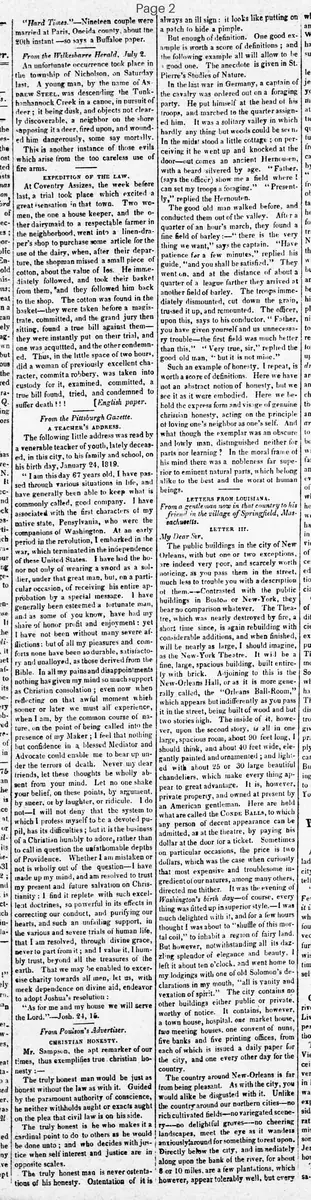
From Poulsons Advertiser.
CHRISTIAN HONESTY.
Mr. Sampson, the apt remarker of our times, thus exemplifies true Christian honesty:--
The truly honest man would be just as honest without the law as with it. Guided by the paramount authority of conscience, he neither withholds aught or exacts aught on the plea that civil law is on his side.
The truly honest is he who makes it a cardinal point to do to others as he would be done unto: and who decides with justice when self interest and justice are in opposite scales.
The truly honest man is never ostentatious of his honesty. Ostentation of it is always an ill sign: it looks like putting on a patch to hide a pimple.
But enough of definition. One good example is worth a score of definitions; and the following example all will allow to be a good one. The anecdote is given in St. Pierre's Studies of Nature.
In the last war in Germany, a captain of the cavalry was ordered out on a foraging party. He put himself at the head of his troops, and marched to the quarter assigned him. It was a solitary valley in which hardly any thing but woods could be seen. In the midst stood a little cottage; on perceiving it he went up and knocked at the door--out comes an ancient Hermit, with a beard silvered by age. "Father (says the officer) show me a field where I can set my troops a foraging." "Presently," replied the Hermit.
The good old man walked before, and conducted them out of the valley. After a quarter of an hour's march, they found a fine field of barley:--"there is the very thing we want," says the captain. "Have patience for a few minutes," replied his guide, "and you shall be satisfied." They went on, and at the distance of about a quarter of a league farther they arrived at another field of barley. The troops immediately dismounted, cut down the grain, trussed it up, and remounted. The officer, upon this, says to his conductor, "Father, you have given yourself and us unnecessary trouble--the first field was much better than this." "Very true, sir," replied the good old man, "but it is not mine."
Such an example of honesty, I repeat, is worth a score of definitions. Here we have not an abstract notion of honesty, but we see it as it were embodied. Here we behold the express form and visage of genuine Christian honesty, acting on the principle of loving one's neighbor as one's self. And what though the exemplar was an obscure and lowly man, distinguished neither for parts nor learning? In the moral frame of his mind there was a nobleness far superior to eminent natural parts, which belong alike to the best and the worst of human beings.
CHRISTIAN HONESTY.
Mr. Sampson, the apt remarker of our times, thus exemplifies true Christian honesty:--
The truly honest man would be just as honest without the law as with it. Guided by the paramount authority of conscience, he neither withholds aught or exacts aught on the plea that civil law is on his side.
The truly honest is he who makes it a cardinal point to do to others as he would be done unto: and who decides with justice when self interest and justice are in opposite scales.
The truly honest man is never ostentatious of his honesty. Ostentation of it is always an ill sign: it looks like putting on a patch to hide a pimple.
But enough of definition. One good example is worth a score of definitions; and the following example all will allow to be a good one. The anecdote is given in St. Pierre's Studies of Nature.
In the last war in Germany, a captain of the cavalry was ordered out on a foraging party. He put himself at the head of his troops, and marched to the quarter assigned him. It was a solitary valley in which hardly any thing but woods could be seen. In the midst stood a little cottage; on perceiving it he went up and knocked at the door--out comes an ancient Hermit, with a beard silvered by age. "Father (says the officer) show me a field where I can set my troops a foraging." "Presently," replied the Hermit.
The good old man walked before, and conducted them out of the valley. After a quarter of an hour's march, they found a fine field of barley:--"there is the very thing we want," says the captain. "Have patience for a few minutes," replied his guide, "and you shall be satisfied." They went on, and at the distance of about a quarter of a league farther they arrived at another field of barley. The troops immediately dismounted, cut down the grain, trussed it up, and remounted. The officer, upon this, says to his conductor, "Father, you have given yourself and us unnecessary trouble--the first field was much better than this." "Very true, sir," replied the good old man, "but it is not mine."
Such an example of honesty, I repeat, is worth a score of definitions. Here we have not an abstract notion of honesty, but we see it as it were embodied. Here we behold the express form and visage of genuine Christian honesty, acting on the principle of loving one's neighbor as one's self. And what though the exemplar was an obscure and lowly man, distinguished neither for parts nor learning? In the moral frame of his mind there was a nobleness far superior to eminent natural parts, which belong alike to the best and the worst of human beings.
What sub-type of article is it?
Moral Or Religious
What keywords are associated?
Christian Honesty
Conscience
Moral Example
Anecdote
Neighbor Love
German War
Foraging
What entities or persons were involved?
Mr. Sampson
St. Pierre
Ancient Hermit
Captain Of The Cavalry
Editorial Details
Primary Topic
Exemplifying Christian Honesty Through Anecdote
Stance / Tone
Moral Exhortation Praising Genuine Honesty
Key Figures
Mr. Sampson
St. Pierre
Ancient Hermit
Captain Of The Cavalry
Key Arguments
Honest Man Acts By Conscience, Not Just Law
Do Unto Others As You Would Be Done Unto
Justice Over Self Interest
Avoid Ostentation Of Honesty
Example Of Hermit Allowing Forage Only In His Own Field