Thank you for visiting SNEWPapers!
Sign up free
Phenix Gazette
Alexandria, Virginia
What is this article about?
In Charleston, SC, a large Union and State Rights Party meeting on Tuesday evening opposed Nullification and the Tariff, adopted resolutions calling for a Southern Convention if Congress fails to adjust the Tariff, supported Andrew Jackson's re-election, and expressed sympathy for the death of General Sumter.
Clipping
OCR Quality
Full Text
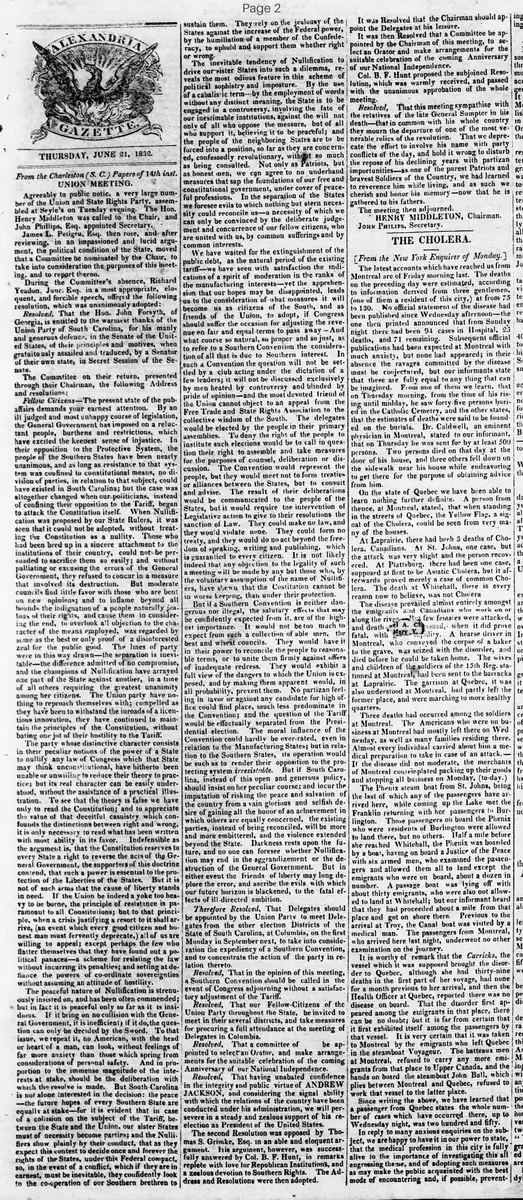
UNION MEETING.
Agreeably to public notice, a very large number of the Union and State Rights Party, assembled at Seyle's on Tuesday evening. The Hon. Henry Middleton was called to the Chair, and John Phillips, Esq. appointed Secretary.
James L. Petigru, Esq. then rose, and after reviewing, in an impassioned and lucid argument, the political condition of the State, moved that a Committee be nominated by the Chair, to take into consideration the purposes of this meeting, and to report thereon.
During the Committee's absence, Richard Yeadon, Junr. Esq. in a most appropriate, eloquent, and forcible speech, offered the following resolution, which was unanimously adopted:
Resolved, That the Hon. John Forsyth, of Georgia, is entitled to the warmest thanks of the Union Party of South Carolina, for his manly and generous defence, in the Senate of the United States, of their principles and motives, when gratuitously assailed and traduced, by a Senator of their own state, in Secret Session of the Senate.
The Committee on their return, presented through their Chairman, the following Address and resolutions:
Fellow Citizens—The present state of the public affairs demands your earnest attention. By an ill judged and most unhappy course of legislation, the General Government has imposed on a reluctant people, burthens and restrictions, which have excited the keenest sense of injustice. In their opposition to the Protective System, the people of the Southern States have been nearly unanimous, and as long as resistance to that system was confined to constitutional means, no division of parties, in relation to that subject, could have existed in South Carolina; but the case was altogether changed when our politicians, instead of confining their opposition to the Tariff, began to attack the Constitution itself. When Nullification was proposed by our State Rulers, it was seen that it could not be adopted, without treating the Constitution as a nullity. Those who had been bred up in a sincere attachment to the institutions of their country, could not be persuaded to sacrifice them so easily; and without palliating or excusing the errors of the General Government, they refused to concur in a measure that involved its destruction. But moderate councils find little favor with those who are bent on new opinions; and to inflame beyond all bounds the indignation of a people naturally jealous of their rights, and cause them in considering the end, to overlook all objection to the character of the means employed, was regarded by some as the best or only proof of a disinterested zeal for the public good. The lines of party were in this way drawn—the separation is inevitable—the difference admitted of no compromise, and the champions of Nullification have arrayed one part of the State against another, in a time of all others requiring the greatest unanimity among her citizens. The Union party have nothing to reproach themselves with; compelled as they have been to withstand the inroads of a licentious innovation, they have continued to maintain the principles of the Constitution, without bating one jot of their hostility to the Tariff: The party whose distinctive character consists in their peculiar notions of the power of a State to nullify any law of Congress which that State may think unconstitutional, have hitherto been unable or unwilling to reduce their theory to practice; but its real character can be easily understood, without the assistance of a practical illustration. To see that the theory is false we have only to read the Constitution; and to appreciate the value of that deceitful casuistry which confounds the distinctions between right and wrong, it is only necessary to read what has been written with most ability in its favor. Indefensible as the argument is, that the Constitution reserves to every State a right to reverse the acts of the General Government, the supporters of this doctrine contend, that such a power is essential to the protection of the Liberties of the States. But it is not of such arms that the cause of liberty stands in need. If the Union be indeed a yoke too heavy to be borne, the principle of resistance is paramount to all Constitutions; but to that principle, when a crisis justifying a resort to it shall arrive, (an event which every good citizen and honest man must fervently deprecate,) all of us are willing to appeal; except perhaps the few who flatter themselves that they have found out a political panacea—a scheme for resisting the law without incurring its penalties; and setting at defiance the powers of co-ordinate sovereignties without assuming an attitude of hostility.
The peaceful nature of Nullification is strenuously insisted on, and has been often commended; but in fact it is peaceful only so far as it is insidious. If it bring on no collision with the General Government, it is inefficient; if it do, the question can only be decided by the Sword. To that issue, we repeat it, no American, with the head or heart of a man, can look, without feelings of far more anxiety than those which spring from considerations of personal safety. And in proportion to the immense magnitude of the interests at stake, should be the deliberation with which the resolve is made. But South-Carolina is not alone interested in the decision: the peace—the future hopes of every Southern State are equally at stake—for it is evident that in case of a collision on the subject of the Tariff, between the State and the Union, our sister States must of necessity become parties; and the Nullifiers show plainly by their conduct, that as they expect this contest to decide once and forever the rights of the States, under this Federal compact, so, in the event of a conflict, which if they are in earnest, must be inevitable, they confidently look to the co-operation of our Southern brethren to sustain them. They rely on the jealousy of the States against the increase of the Federal power, by the humiliation of a member of the Confederacy, to uphold and support them whether right or wrong:
The inevitable tendency of Nullification to drive our sister States into such a dilemma, reveals the most odious feature in this scheme of political sophistry and imposture. By the use of a cabalistic term—by the employment of words without any distinct meaning, the State is to be engaged in a controversy, involving the fate of our inestimable institutions, against the will not only of all who oppose the measure, but of all who support it, believing it to be peaceful; and the people of the neighboring States are to be forced into a position, so far as they are concerned, confessedly revolutionary, without so much as being consulted. Not only as Patriots, but as honest men, we can agree to no underhand measures that sap the foundations of our free and constitutional government, under cover of peace ful professions. In the separation of the States we foresee evils to which nothing but stern necessity could reconcile us—a necessity of which we can only be convinced by the deliberate judgement and concurrence of our fellow citizens, who are united with us, by common sufferings and by common interests.
We have waited for the extinguishment of the public debt, as the natural period of the existing tariff—we have seen with satisfaction the indications of a spirit of moderation in the ranks of the manufacturing interests—yet the apprehension that our hopes may be disappointed, leads us to the consideration of what measures it will become us as citizens of the South, and as friends of the Union, to adopt, if Congress should suffer the occasion for adjusting the revenue on fair and equal terms to pass away—And what course so natural, so proper and so just, as to refer to a Southern Convention the consideration of all that is due to Southern interest. In such a Convention the question will not be settled by a club acting under the dictation of a few leaders; it will not be discussed exclusively by men heated by controversy and blinded by pride of opinion—and the most devoted friend of the Union cannot object to an appeal from the Free Trade and State Rights Association to the collective wisdom of the South. The delegates would be elected by the people in their primary assemblies. To deny the right of the people to institute such elections would be to call in question their right to assemble and take measures for the purposes of counsel, deliberation or discussion. The Convention would represent the people, but they would meet not to form treaties or alliances between the States, but to consult and advise. The result of their deliberations would be communicated to the people of the States, but it would require the intervention of Legislative action to give to their resolutions the sanction of Law. They could make no law, and they would violate none. They could form no treaty, and they would do no act beyond the freedom of speaking, writing and publishing, which is guaranteed to every citizen. It is not likely indeed that any objection to the legality of such a meeting will be made by any but those who, by the voluntary assumption of the name of Nullifiers, have shewn that the Constitution cannot be in worse keeping, than under their protection.
But if a Southern Convention is neither dangerous nor illegal, the salutary effects that may be confidently expected from it, are of the highest importance. It would not be too much to expect from such a collection of able men, the best and wisest councils. They would have it in their power to reconcile the people to reasonable terms, or to unite them firmly against offers of inadequate redress. They would exhibit a full view of the dangers to which the Union is exposed, and by making them apparent would, in all probability, prevent them. No partizan feeling in favor or against any candidate for high office could find place, much less predominate in the Convention; and the question of the Tariff would be effectually separated from the Presidential election. The moral influence of the Convention could hardly be over-rated, even in relation to the Manufacturing States; but in relation to the Southern States, its operation would be such as to render their opposition to the protecting system irresistible. But if South Carolina, instead of this open and generous policy, should insist on her peculiar course; and incur the imputation of risking the peace and salvation of the country from a vain glorious and selfish desire of gaining all the honor of an achievement in which others are equally concerned, the existing parties, instead of being reconciled, will be more and more embittered, and the violence extended beyond the State. Darkness rests upon the future, and no one can foresee whether Nullification may end in the aggrandizement or the destruction of the General Government. But in either event the friends of liberty may long deplore the error, and ascribe the evils with which our future horizon is blackened, to the fatal effects of ill-directed ambition.
Therefore Resolved, That Delegates should be appointed by the Union Party to meet Delegates from the other election Districts of the State of South Carolina, at Columbia, on the first Monday in September next, to take into consideration the expediency of a Southern Convention, and to concentrate the action of the party in relation thereto.
Resolved, That in the opinion of this meeting, a Southern Convention should be called in the event of Congress adjourning without a satisfactory adjustment of the Tariff.
Resolved, That our Fellow-Citizens of the Union Party throughout the State, be invited to meet in their several districts, and take measures for procuring a full attendance at the meeting of Delegates in Columbia.
Resolved, That a committee of be appointed to select an Orator, and make arrangements for the suitable celebration of the coming Anniversary of our National Independence.
Resolved, That having unabated confidence in the integrity and public virtue of ANDREW JACKSON, and considering the signal ability with which the relations of the country have been conducted under his administration, we will persevere in a steady and zealous support of his re-election as President of the United States.
The second Resolution was opposed by Thomas S. Grimke, Esq. in an able and eloquent argument. his argument, however, was successfully answered by Col. B. F. Hunt, in remarks replete with love for Republican Institutions, and a zealous devotion to Southern Rights. The Address and Resolutions were then adopted.
It was Resolved that the Chairman should appoint the Delegates at his leisure.
It was then Resolved that a Committee be appointed by the Chairman of this meeting, to select an Orator and make arrangements for the suitable celebration of the coming Anniversary of our National Independence.
Col. B. F. Hunt proposed the subjoined Resolution, which was warmly received, and passed with the unanimous approbation of the whole meeting:
Resolved, That this meeting sympathise with the relatives of the late General Sumter in his death—that in common with his whole country they mourn the departure of one of the most venerable relics of the revolution. That we deprecate the effort to involve his name with party conflicts of the day, and hold it wrong to disturb the repose of his declining years with partizan importunities—as one of the purest Patriots and bravest Soldiers of the Country, we had learned to reverence him while living, and as such we cherish and honor his memory—now that he is gathered to his fathers.
The meeting then adjourned.
HENRY MIDDLETON, Chairman.
John Phillips, Secretary.
What sub-type of article is it?
What keywords are associated?
What entities or persons were involved?
Where did it happen?
Domestic News Details
Primary Location
Charleston, S. C.
Event Date
Tuesday Evening, As Reported In Charleston Papers Of 14th Inst.
Key Persons
Outcome
resolutions adopted unanimously, including calls for a southern convention, support for andrew jackson's re-election, and sympathy for general sumter's death; meeting adjourned.
Event Details
A large meeting of the Union and State Rights Party assembled at Seyle's, chaired by Hon. Henry Middleton. Speeches and arguments reviewed the political condition, opposing Nullification and the Tariff while upholding the Constitution. Resolutions thanked Hon. John Forsyth, proposed a Southern Convention if Tariff not adjusted, invited district meetings, supported Jackson's re-election, and mourned General Sumter.