Thank you for visiting SNEWPapers!
Sign up free
Literary
December 24, 1869
The Conservative
Mcconnelsville, Morgan County, Ohio
What is this article about?
Thomas Jefferson's 1814 letter excerpt to Dr. Walter Jones provides a detailed, admiring sketch of George Washington's character, intellect, prudence, leadership in war and governance, and role in establishing American liberties, portraying him as a wise, good, and great man.
Clipping
OCR Quality
98%
Excellent
Full Text
Miscellaneous.
JEFFERSON'S PORTRAIT OF
WASHINGTON
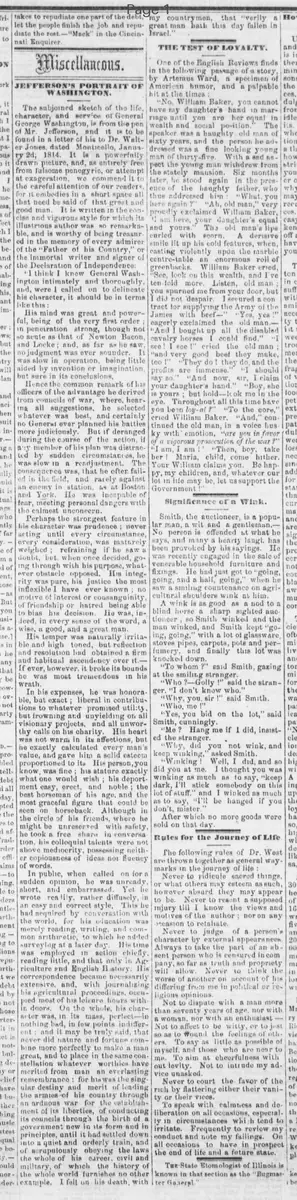
The subjoined sketch of the life, character, and services of General George Washington, is from the pen of Mr. Jefferson, and it is to be found in a letter of his to Dr. Walter Jones, dated Monticello, January 2d, 1814. It is a powerfully drawn picture, and, as entirely free from fulsome panegyric, or attempt at exaggeration, we commend it to the careful attention of our readers, for it embodies in a short space all that need be said of that great and good man. It is written in the concise and vigorous style for which its illustrious author was so remarkable, and is worthy of being treasured in the memory of every admirer of the "Father of his Country," or the immortal writer and signer of the Declaration of Independence:
I think I knew General Washington intimately and thoroughly; and were I called on to delineate his character, it should be in terms like this :
His mind was great and powerful, being of the very first order; in penetration strong, though not so acute as that of Newton, Bacon and Locke: and as far as he saw, no judgment was ever sounder. It was slow in operation, being little aided by invention or imagination; but sure in its conclusions. Hence the common remark of his officers of the advantage he derived from councils of war. Where, hearing all suggestions, he selected whatever was best ; and certainly no General ever planned his battles more judiciously. But if deranged during the course of the action, if any member of his plan was deranged by sudden circumstances, he was slow in a readjustment. The consequence was, that he often failed in the field, and rarely against an enemy in station, as at Boston and York. He was incapable of fear, meeting personal dangers with the calmest unconcern.
Perhaps the strongest feature in his character was prudence; never acting until every circumstance, every consideration, was maturely weighed; refraining if he saw a doubt, but, when once decided, going through with his purpose, whatever obstacle opposed. His integrity was pure, his justice the most inflexible I have ever known; no motive of interest or consanguinity, of friendship or hatred, being able to bias his decision. He was, indeed, in every sense of the word, a wise, a good, and a great man.
His temper was naturally irritable and high toned, but reflection and resolution had obtained a firm and habitual ascendency over it. If ever, however, it broke its bounds he was most tremendous in his wrath.
In his expenses, he was honorable, but exact; liberal in contributions to whatever promised utility, but frowning and unyielding on all visionary projects, and all unworthy calls on his charity. His heart was not warm in its affections, but he exactly calculated every man's value, and gave him a solid esteem proportioned to it. His person, you know, was fine; his stature exactly what one would wish ; his deportment easy, erect, and noble: the best horseman of his age, and the most graceful figure that could be seen on horseback. Although in the circle of his friends, where he might be unreserved with safety, he took a free share in conversation, his colloquial talents were not above mediocrity, possessing neither copiousness of ideas nor fluency of words.
In public, when called on for a sudden opinion, he was unready, short, and embarrassed. Yet he wrote readily, rather diffusely, in an easy and correct style. This he had acquired by conversation with the world, for his education was merely reading, writing, and common arithmetic, to which he added surveying at a later day. His time was employed in action chiefly, reading little, and that only in Agriculture and English History. His correspondence became necessarily extensive, and, with journalizing his agricultural proceedings, occupied most of his leisure hours within doors. On the whole, his character was, in its mass, perfect-in nothing bad, in few points indifferent; and it may be truly said, that never did nature and fortune combine more perfectly to make a man great, and to place in the same constellation whatever worthies have merited from man an everlasting remembrance : for his was the singular destiny and merit of leading the armies of his country through an arduous war for the establishment of its liberties, of conducting its councils through the birth of a government new in its form and in principles, until it had settled down into a quiet and orderly train, and of scrupulously obeying the laws through the whole of his career, civil and military, of which the history of the world furnishes no other example. I felt on his death, with my countrymen, that "verily a great man hath this day fallen in Israel."
JEFFERSON'S PORTRAIT OF
WASHINGTON
The subjoined sketch of the life, character, and services of General George Washington, is from the pen of Mr. Jefferson, and it is to be found in a letter of his to Dr. Walter Jones, dated Monticello, January 2d, 1814. It is a powerfully drawn picture, and, as entirely free from fulsome panegyric, or attempt at exaggeration, we commend it to the careful attention of our readers, for it embodies in a short space all that need be said of that great and good man. It is written in the concise and vigorous style for which its illustrious author was so remarkable, and is worthy of being treasured in the memory of every admirer of the "Father of his Country," or the immortal writer and signer of the Declaration of Independence:
I think I knew General Washington intimately and thoroughly; and were I called on to delineate his character, it should be in terms like this :
His mind was great and powerful, being of the very first order; in penetration strong, though not so acute as that of Newton, Bacon and Locke: and as far as he saw, no judgment was ever sounder. It was slow in operation, being little aided by invention or imagination; but sure in its conclusions. Hence the common remark of his officers of the advantage he derived from councils of war. Where, hearing all suggestions, he selected whatever was best ; and certainly no General ever planned his battles more judiciously. But if deranged during the course of the action, if any member of his plan was deranged by sudden circumstances, he was slow in a readjustment. The consequence was, that he often failed in the field, and rarely against an enemy in station, as at Boston and York. He was incapable of fear, meeting personal dangers with the calmest unconcern.
Perhaps the strongest feature in his character was prudence; never acting until every circumstance, every consideration, was maturely weighed; refraining if he saw a doubt, but, when once decided, going through with his purpose, whatever obstacle opposed. His integrity was pure, his justice the most inflexible I have ever known; no motive of interest or consanguinity, of friendship or hatred, being able to bias his decision. He was, indeed, in every sense of the word, a wise, a good, and a great man.
His temper was naturally irritable and high toned, but reflection and resolution had obtained a firm and habitual ascendency over it. If ever, however, it broke its bounds he was most tremendous in his wrath.
In his expenses, he was honorable, but exact; liberal in contributions to whatever promised utility, but frowning and unyielding on all visionary projects, and all unworthy calls on his charity. His heart was not warm in its affections, but he exactly calculated every man's value, and gave him a solid esteem proportioned to it. His person, you know, was fine; his stature exactly what one would wish ; his deportment easy, erect, and noble: the best horseman of his age, and the most graceful figure that could be seen on horseback. Although in the circle of his friends, where he might be unreserved with safety, he took a free share in conversation, his colloquial talents were not above mediocrity, possessing neither copiousness of ideas nor fluency of words.
In public, when called on for a sudden opinion, he was unready, short, and embarrassed. Yet he wrote readily, rather diffusely, in an easy and correct style. This he had acquired by conversation with the world, for his education was merely reading, writing, and common arithmetic, to which he added surveying at a later day. His time was employed in action chiefly, reading little, and that only in Agriculture and English History. His correspondence became necessarily extensive, and, with journalizing his agricultural proceedings, occupied most of his leisure hours within doors. On the whole, his character was, in its mass, perfect-in nothing bad, in few points indifferent; and it may be truly said, that never did nature and fortune combine more perfectly to make a man great, and to place in the same constellation whatever worthies have merited from man an everlasting remembrance : for his was the singular destiny and merit of leading the armies of his country through an arduous war for the establishment of its liberties, of conducting its councils through the birth of a government new in its form and in principles, until it had settled down into a quiet and orderly train, and of scrupulously obeying the laws through the whole of his career, civil and military, of which the history of the world furnishes no other example. I felt on his death, with my countrymen, that "verily a great man hath this day fallen in Israel."
What sub-type of article is it?
Essay
What themes does it cover?
Political
Liberty Freedom
Patriotism
What keywords are associated?
Washington
Jefferson
Character
Leadership
Revolution
Prudence
Integrity
Liberties
Founding
Patriotism
What entities or persons were involved?
Mr. Jefferson
Literary Details
Title
Jefferson's Portrait Of Washington
Author
Mr. Jefferson
Subject
Letter To Dr. Walter Jones, Dated Monticello, January 2d, 1814
Form / Style
Concise And Vigorous Prose Sketch
Key Lines
I Think I Knew General Washington Intimately And Thoroughly; And Were I Called On To Delineate His Character, It Should Be In Terms Like This :
His Mind Was Great And Powerful, Being Of The Very First Order; In Penetration Strong, Though Not So Acute As That Of Newton, Bacon And Locke: And As Far As He Saw, No Judgment Was Ever Sounder.
He Was, Indeed, In Every Sense Of The Word, A Wise, A Good, And A Great Man.
I Felt On His Death, With My Countrymen, That "Verily A Great Man Hath This Day Fallen In Israel."