Thank you for visiting SNEWPapers!
Sign up free
The National Intelligencer And Washington Advertiser
Washington, District Of Columbia
What is this article about?
Denmark's official counter-declaration responding to the British Minister's memorial, asserting the unalterable nature of international law, defending strict neutrality, upholding treaties with France despite its government changes, and rejecting British claims on neutral shipping and privateers during the war.
Merged-components note: Danish counter declaration is a diplomatic state paper in the foreign news section; relabel to foreign_news and merge continuation.
Clipping
OCR Quality
Full Text
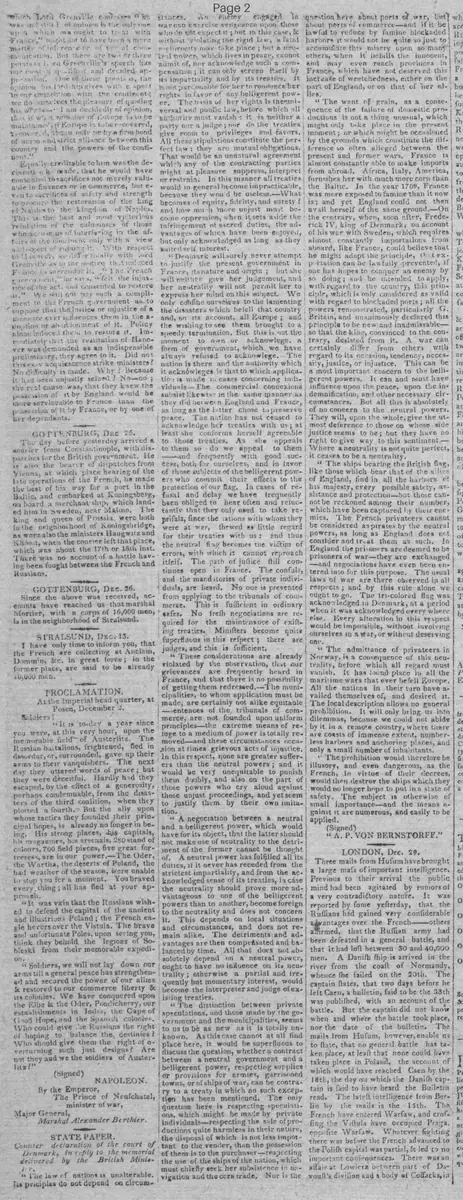
Counter declaration of the court of Denmark, in reply to the memorial delivered by the British Minister.
"The law of nations is unalterable. Its principles do not depend on circumstances. An enemy engaged in war can exercise vengeance upon those who do not expect it: but in this case, & without violating the rigid law, a fatal reciprocity may take place; but a neutral government, which lives in peace, cannot admit of, nor acknowledge such a compensation; it can only screen itself by its impartiality and by its treaties. It is not pardonable for her to renounce her rights in favor of any belligerent power. The basis of her rights is the universal and public law, before which all authority must vanish: it is neither a party nor a judge; nor do the treaties give room to privileges and favors. All these stipulations constitute the perfect law: they are mutual obligations. That would be an unnatural agreement which any of the contracting parties might at pleasure suppress, interpret or restrain: In this manner all treaties would in general become impracticable, because they would be useless.--What becomes of equity, fidelity, and surety? and how much more unjust must become oppression, when it sets aside the infringement of sacred duties, the advantages of which have been enjoyed, but only acknowledged as long as they suited self interest.
"Denmark will surely never attempt to justify the present government in France, its nature and origin; but she will neither give her judgement, and her neutrality will not permit her to express her mind on this subject. We only confine ourselves to the lamenting the disasters which befell that country and, on its account, all Europe; and the wishing to see them brought to a speedy termination. But this is not the moment to own or acknowledge a form of government, which we have always refused to acknowledge. -The nation is there and the authority which it acknowledges is that to which application is made in cases concerning individuals-The commercial connections subsist likewise in the same manner as they did between England and France, as long as the latter chose to preserve peace. The nation has not ceased to acknowledge her treaties with us; at least she conforms herself agreeable to those treaties. As she appeals to them so do we appeal to them -and frequently with good success, both for ourselves, and in favor of those subjects of the belligerent powers who commit their effects to the protection of our flag. In cases of refusal and delay we have frequently been obliged to hear often and reluctantly that they only used to take reprisals, since the nations with whom they were at war, shewed as little regard for their treaties with us: and thus the neutral flag becomes the victim of errors, with which it cannot reproach itself. The path of justice still continues open in France. The consuls, and the mandatories of private individuals, are heard. No one is prevented from applying to the tribunals of commerce. This is sufficient in ordinary cases. No fresh negociations are required for the maintenance of existing treaties. Ministers become quite superfluous in this respect; there are judges, and this is sufficient.
"These considerations are already violated by the observation, that our grievances are frequently heard in France, and that there is no possibility of getting them redressed.--The municipalities, to whom application must be made, are certainly not alike equitable -sentences of the tribunals of commerce, are not founded upon uniform principles--the extreme means of refuge to a medium of power is totally removed—and these circumstances occasion at times grievous acts of injustice. In this respect, none are greater sufferers than the neutral powers; and it would be very unequitable to punish them doubly, and also on the part of those powers who cry aloud against those unjust proceedings, and yet seem to justify them by their own initiation.
"A negociation between a neutral and a belligerent power, which would have for its object, that the latter should not make use of neutrality to the detriment of the former cannot be thought of. A neutral power has fulfilled all its duties, if it never has receded from the strictest impartiality, and from the acknowledged sense of its treaties, in case the neutrality should prove more advantageous to one of the belligerent powers than to another, become foreign to the neutrality and does not concern it. This depends on local situations and circumstances, and does not remain alike. The detriments and advantages are then compensated and balanced by time. All that does not absolutely depend on a neutral power, ought to have no influence on it- neutrality; otherwise a partial and frequently but momentary interest, would become the interpreter and judge of existing treaties.
"The distinction between private speculations, and those made by the government and the municipalities, seems to us to be as new as it is totally unknown. As this case cannot at all find place here, it would be superfluous to discuss the question, whether a contract between a neutral government and a belligerent power, respecting supplies or provisions for armies, garrisoned towns, or of ships of war, can be contrary to a treaty in which no such exception has been mentioned. The only question here is respecting speculations, which might be made by private individuals-respecting the sale of productions quite harmless in their nature, the disposal of which is not less important to the vender, than the possession of them is to the purchaser-respecting the use of the ships of the nation, which must chiefly seek her subsistence in navigation and the sea trade. Nor is the question here about ports of war, but about ports of commerce-and if it be lawful to reduce by famine blockaded harbors it would not be quite so just to accumulate this misery upon so many others, when it befalls the innocent, and may even reach provinces in France. which have not deserved this incidence of wretchedness. either on the part of England, or on that of her allies.
"The want of grain, as a consequence of the failure of domestic productions is not a thing unusual, which might only take place in the present moment; or which might be occasioned by the grounds which constitute the difference so often alledged between the present and former wars. France is almost constantly able to make imports from abroad. Africa. Italy, America, furnishes her with much more corn than the Baltic. In the year 1795, France was more exposed to famine than it now is: and yet England could not then avail herself of the same ground.-On the contrary, when, soon after, Frederick IV. king of Denmark, on account of his war with Sweden, which requires almost constantly importations from abroad, like France, could believe that he might adopt the principle, that exportation can be lawfully prevented, if one has hopes to conquer an enemy by so doing; and he intended to apply, with regard to the country, this principle, which is only considered as valid with regard to blockaded ports; all the powers remonstrated, particularly G. Britain, and unanimously declared this principle to be new and inadmissable-- so that the king, convinced to the contrary, desisted from it. A war can certainly differ from others with regard to its occasion, tendency, necessity, justice, or injustice. This can be a most important concern to the belligerent powers. It can and must have influence upon the peace, upon the indemnification, and other necessary circumstances. But all this is absolutely of no concern to the neutral powers. They will, upon the whole, give the utmost deference to those on whose side justice seems to be; but they have no right to give way to this sentiment.- Where a neutrality is not quite perfect, it ceases to be a neutrality.
"The ships bearing the British flag, like those which bear that of the allies of England, find in all the harbors of his majesty, every possible safety, assistance and protection-but those cannot be reckoned among their number, which have been captured by their enemies. The French privateers cannot be considered as pirates by the neutral powers, as long as England does not consider and treat them as such. In England the prisoners are deemed to be prisoners of war-they are exchanged and negociations have even been entered into for this purpose. The usual laws of war are there observed in all respects; and by this rule alone we ought to go. The tri-colored flag was acknowledged in Denmark. at a period when it was acknowledged every where else. Every alteration in this respect would be impossible, without involving ourselves in a war, or without deserving one.
"The admittance of privateers in Norway, is a consequence of this neutrality, before which all regard must vanish. It has found place in all the maritime wars that ever befell Europe. All the nations in their turn have availed themselves of. and desired it. The local description allows no general prohibition. It will only bring us into dilemmas, because we could not abide by it in a remote country, where there are coasts of immense extent, numberless harbors and anchoring places, and only a small number of inhabitants. The prohibition would therefore be illusory, and even dangerous, as the French, in virtue of their decrees, would then destroy the ships which they would no longer hope to put in a state of safety. The subject is otherwise of small importance-and the means against it are numerous, and easily to be applied.
(Signed)
"A. P. VON BERNSTORFF."
What sub-type of article is it?
What keywords are associated?
What entities or persons were involved?
Where did it happen?
Foreign News Details
Primary Location
Denmark
Key Persons
Outcome
denmark asserts its neutrality, upholds treaties with france, rejects british interference in neutral trade and privateer admissions, emphasizing impartiality under international law.
Event Details
The Court of Denmark issues a counter-declaration responding to the British Minister's memorial, defending the principles of neutrality, the unalterability of international law and treaties, refusal to judge France's government, protection of neutral flags, and admission of privateers in Norwegian ports as consistent with historical practice.