Thank you for visiting SNEWPapers!
Sign up free
Literary
July 30, 1909
Dakota County Herald
Dakota City, Dakota County, Nebraska
What is this article about?
An etymological note on the word 'mendicant,' tracing its origins to Chaucer's 'Canterbury Tales' in the 'Sumpnour's Tale,' where it describes friars wedded to poverty and continence.
Clipping
OCR Quality
95%
Excellent
Full Text
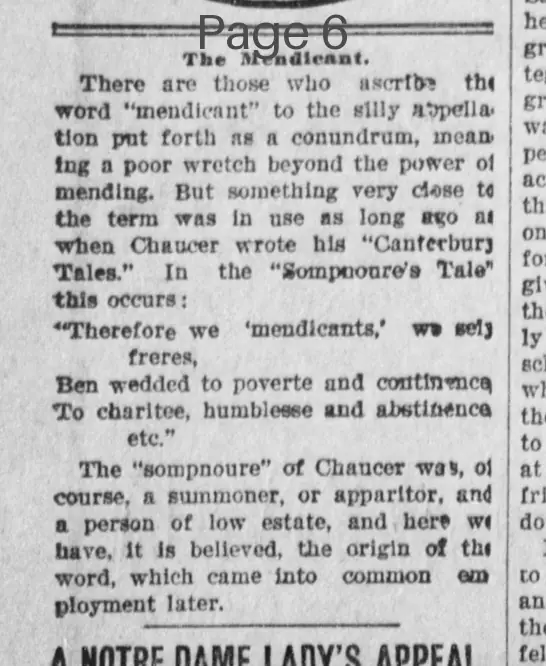
The Mendicant
There are those who ascribe the word "mendicant" to the silly appellation put forth as a conundrum, meaning a poor wretch beyond the power of mending. But something very close to the term was in use as long ago as when Chaucer wrote his "Canterbury Tales." In the "Sumpnour's Tale" this occurs:
"Therefore we mendicants, wosely freres, Ben wedded to poverte and continence To charitee, humblesse and abstinence etc."
The "sompnoure" of Chaucer was, of course, a summoner, or apparitor, and a person of low estate, and here we have, it is believed, the origin of the word, which came into common employment later.
There are those who ascribe the word "mendicant" to the silly appellation put forth as a conundrum, meaning a poor wretch beyond the power of mending. But something very close to the term was in use as long ago as when Chaucer wrote his "Canterbury Tales." In the "Sumpnour's Tale" this occurs:
"Therefore we mendicants, wosely freres, Ben wedded to poverte and continence To charitee, humblesse and abstinence etc."
The "sompnoure" of Chaucer was, of course, a summoner, or apparitor, and a person of low estate, and here we have, it is believed, the origin of the word, which came into common employment later.
What sub-type of article is it?
Essay
What themes does it cover?
Religious
Moral Virtue
What keywords are associated?
Mendicant
Etymology
Chaucer
Canterbury Tales
Friars
Poverty
Literary Details
Title
The Mendicant
Subject
Etymology Of Mendicant From Chaucer
Key Lines
"Therefore We Mendicants, Wosely Freres, Ben Wedded To Poverte And Continence To Charitee, Humblesse And Abstinence Etc."