Thank you for visiting SNEWPapers!
Sign up free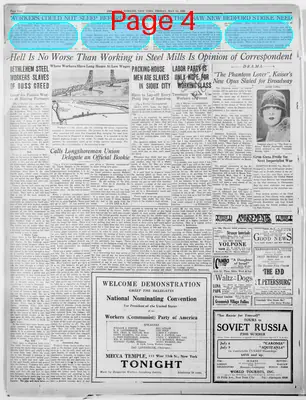
The Daily Worker
Chicago, Cook County, Illinois
What is this article about?
Textile workers in New Bedford, Mass., strike against a 10% wage cut, the second that year, after prior cuts totaling 45% since the war. Families of up to 11 live on $17 weekly wages, facing starvation and poor conditions. Workers International Relief appeals for contributions to provide food and aid.
Clipping

OCR Quality
Full Text
(By a Worker Correspondent)
NEW BEDFORD, Mass. (By mail).-I am enclosing one of the handbills given out by the relief for the strikers in New Bedford. Maybe you can use it? We are still all on strike and will stay on strike until we get our demands. You know, comrade, that if they cut our wages, which are now about $17 a week, by ten percent, we can't live. We would have to move away from here or just die. If all the workers could see what goes on here they could not sleep before they sent us help.
MEIXOS.
Editor's Note: The following are some extracts from the handbill from New Bedford. It is issued by the Workers International Relief which is supplying food and clothing to the textile strikers. The address of the Relief is 12 Rodney French Boulevard, New Bedford. Mass.
Joseph Madeiras and wife have nine children, the oldest 16 years, the youngest 7 weeks. This family of eleven has been living on the wages of the father, which were $17.00 before the strike. He was employed as a speed tender in the Potomska Mills.
There are thousands of such families in New Bedford, Mass., where 30,000 textile workers are on strike against a 10% wage-cut, the second one this year.
Since the war there have been four wage-cuts totaling 45%, and now another wage-cut is being forced upon these already miserably under-paid workers.
Well known economists estimate that it takes $1,800 a year to keep a family of five in food, clothing and shelter on a very moderate basis. One naturally asks how a family of eleven lives on $17.00 a week, which, when lost days are discounted, amounts to about $950 a year. The answer is that they do not live--they just exist. Their food lacks nourishment, their clothing is poor and mostly rags, altho they weave the finest of cloth. Their housing is unsanitary, overcrowded, without baths, and very poorly furnished. Thus they habitate, existing without joy of life.
Is it any wonder they are on strike?
Ten per cent off the present wage means $15.30 a week. Some strikers say, we might just as well drown our children and ourselves as die a slow death by starvation.
We urge you to send us as large a contribution as possible, so that we can bring bread and milk to the children and a little soup to the adults. With your help we can do it.
WORKERS INTERNATIONAL RELIEF FOR NEW BEDFORD TEXTILE STRIKERS.
What sub-type of article is it?
What themes does it cover?
What keywords are associated?
What entities or persons were involved?
Where did it happen?
Story Details
Key Persons
Location
New Bedford, Mass.
Story Details
Worker correspondent MEIXOS reports on the ongoing strike of 30,000 textile workers against a 10% wage cut, highlighting family hardships like Joseph Madeiras's family of 11 living on $17 weekly. Handbill from Workers International Relief details poverty, unsanitary conditions, and urges contributions for food and clothing.