Thank you for visiting SNEWPapers!
Sign up free
Martinsburgh Gazette
Martinsburg, Berkeley County, West Virginia
What is this article about?
The Treaty of Alliance was signed on March 1, 1814, at Chaumont by Austria, Russia, Britain, and Prussia. It commits the allies to prosecute the war against France if peace proposals are rejected, maintaining 150,000 troops each, no separate peace, and includes a British subsidy of 5 million pounds sterling for 1814, plus defensive alliance provisions for 20 years.
Merged-components note: These components form a single continuous article on the Treaty of Alliance, with text flowing sequentially across reading orders 8-10.
Clipping
OCR Quality
Full Text
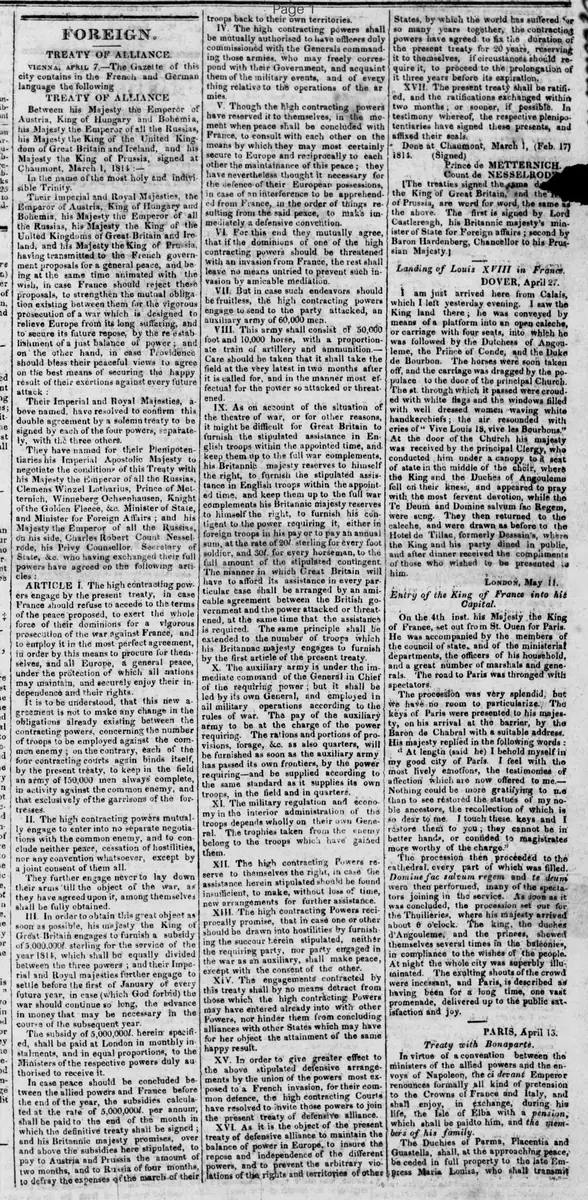
TREATY OF ALLIANCE.
VIENNA, APRIL 7.—The Gazette of this city contains in the French and German language the following
TREATY OF ALLIANCE
Between his Majesty the Emperor of Austria, King of Hungary and Bohemia, his Majesty the Emperor of all the Russias, his Majesty the King of the United Kingdom of Great Britain and Ireland, and his Majesty the King of Prussia, signed at Chaumont, March 1, 1814:—
In the name of the most holy and indivisible Trinity.
Their Imperial and Royal Majesties, the Emperor of Austria, King of Hungary and Bohemia, his Majesty the Emperor of all the Russias, his Majesty the King of the United Kingdoms of Great-Britain and Ireland, and his Majesty the King of Prussia, having transmitted to the French government proposals for a general peace, and being at the same time animated with the wish, in case France should reject these proposals, to strengthen the mutual obligation existing between them for the vigorous prosecution of a war which is designed to relieve Europe from its long suffering, and to secure its future repose, by the re-establishment of a just balance of power; and on the other hand, in case Providence should bless their peaceful views to agree on the best means of securing the happy result of their exertions against every future attack:
Their Imperial and Royal Majesties, above named, have resolved to confirm this double agreement by a solemn treaty to be signed by each of the four powers, separately, with the three others.
They have named for their Plenipotentiaries his Imperial Apostolic Majesty to negotiate the conditions of this Treaty with his Majesty the Emperor of all the Russias, Clemens Winzel Lotharius, Prince of Metternich, Winneberg Ochsenhausen, Knight of the Golden Fleece, &c. Minister of State, and Minister for Foreign Affairs; and his Majesty the Emperor of all the Russias, on his side, Charles Robert Count Nesselrode, his Privy Counsellor, Secretary of State, &c. who having exchanged their full powers have agreed on the following articles:
ARTICLE I. The high contracting powers engage by the present treaty, in case France should refuse to accede to the terms of the peace proposed, to exert the whole force of their dominions for a vigorous prosecution of the war against France, and to employ it in the most perfect agreement, in order by this means to procure for themselves, and all Europe, a general peace, under the protection of which all nations may maintain, and securely enjoy their independence and their rights.
It is to be understood, that this new agreement is not to make any change in the obligations already existing between the contracting powers, concerning the number of troops to be employed against the common enemy; on the contrary, each of the four contracting courts again binds itself, by the present treaty, to keep in the field an army of 150,000 men always complete, in activity against the common enemy, and that exclusively of the garrisons of the fortresses.
II. The high contracting powers mutually engage to enter into no separate negotiations with the common enemy, and to conclude neither peace, cessation of hostilities, nor any convention whatsoever, except by a joint consent of them all.
They further engage never to lay down their arms 'till the object of the war, as they have agreed upon it, among themselves shall be fully obtained.
III. In order to obtain this great object as soon as possible, his Majesty the King of Great-Britain engages to furnish a subsidy of 5,000,000l. sterling for the service of the year 1814, which shall be equally divided between the three powers; and their Imperial and Royal majesties further engage to settle before the first of January of every future year, in case (which God forbid) the war should continue so long, the advance in money that may be necessary in the course of the subsequent year.
The subsidy of 5,000,000l. herein specified, shall be paid at London in monthly instalments, and in equal proportions, to the Ministers of the respective powers duly authorised to receive it.
In case peace should be concluded between the allied powers and France before the end of the year, the subsidies calculated at the rate of 5,000,000l. per annum; shall be paid to the end of the month in which the definitive treaty shall be signed; and his Britannic majesty promises, over and above the subsidies here stipulated, to pay to Austria and Prussia the amount of two months, and to Russia of four months, to defray the expenses of the march of their
troops back to their own territories.
IV. The high contracting powers shall be mutually authorised to have officers duly commissioned with the Generals commanding those armies, who may freely correspond with their Government, and acquaint them of the military events, and of every thing relative to the operations of the armies.
V. Though the high contracting powers have reserved it to themselves, in the moment when peace shall be concluded with France, to consult with each other on the means by which they may most certainly secure to Europe and reciprocally to each other the maintenance of this peace; they have nevertheless thought it necessary for the defence of their European possessions, in case of an interference to be apprehended from France, in the order of things resulting from the said peace, to make immediately a defensive convention.
VI. For this end they mutually agree, that if the dominions of one of the high contracting powers should be threatened with an invasion from France, the rest shall leave no means untried to prevent such invasion by amicable mediation.
VII. But in case such endeavors should be fruitless, the high contracting powers engage to send to the party attacked, an auxiliary army of 60,000 men.
VIII. This army shall consist of 50,000 foot and 10,000 horse, with a proportionate train of artillery and ammunition.—Care should be taken that it shall take the field at the very latest in two months after it is called for, and in the manner most effectual for the power so attacked or threatened.
IX. As on account of the situation of the theatre of war, or for other reasons, it might be difficult for Great Britain to furnish the stipulated assistance in English troops within the appointed time, and keep them up to the full war complements, his Britannic majesty reserves to himself the right, to furnish the stipulated assistance in English troops within the appointed time, and keep them up to the full war complements his Britannic majesty reserves to himself the right, to furnish his contingent to the power requiring it, either in foreign troops in his pay or to pay an annual sum, at the rate of 20l. sterling for every foot soldier, and 50l. for every horseman, to the full amount of the stipulated contingent.
The manner in which Great Britain will have to afford its assistance in every particular case shall be arranged by an amicable agreement between the British government and the power attacked or threatened, at the same time that the assistance is required. The same principle shall be extended to the number of troops which his Britannic majesty engages to furnish by the first article of the present treaty.
X. The auxiliary army is under the immediate command of the General in Chief of the requiring power; but it shall be led by its own General, and employed in all military operations according to the rules of war. The pay of the auxiliary army to be at the charge of the power requiring. The rations and portions of provisions, forage, &c. as also quarters, will be furnished as soon as the auxiliary army has passed its own frontiers, by the power requiring—and be supplied according to the same standard as it supplies its own troops, in the field and in quarters.
XI. The military regulation and economy in the interior administration of the troops depends wholly on their own General. The trophies taken from the enemy belong to the troops which have gained them.
XII. The high contracting Powers reserve to themselves the right, in case the assistance herein stipulated should be found insufficient, to make, without loss of time, new arrangements for further assistance.
XIII. The high contracting Powers reciprocally promise, that in case one or other should be drawn into hostilities by furnishing the succour herein stipulated, neither the requiring party, nor party engaged in the war as an auxiliary, shall make peace, except with the consent of the other.
XIV. The engagements contracted by this treaty shall by no means detract from those which the high contracting Powers may have entered already into with other Powers, nor hinder them from concluding alliances with other States which may have for her object the attainment of the same happy result.
XV. In order to give greater effect to the above stipulated defensive arrangements by the union of the powers most exposed to a French invasion, for their common defence, the high contracting Courts have resolved to invite those powers to join the present treaty of defensive alliance.
XVI. As it is the object of the present treaty of defensive alliance to maintain the balance of power in Europe, to insure the repose and independence of the different powers, and to prevent the arbitrary violations of the rights and territories of other
States, by which the world has suffered so many years together, the contracting powers have agreed to fix the duration of the present treaty for 20 years, reserving it to themselves, if circumstances should require it, to proceed to the prolongation of it three years before its expiration,
XVII. The present treaty shall be ratified, and the ratifications exchanged within two months; or sooner, if possible. In testimony whereof, the respective plenipotentiaries have signed these presents, and affixed their seals.
Done at Chaumont, March 1, (Feb. 17) 1814.
(Signed)
Prince de METTERNICH
Count de NESSELRODE
[The treaties signed the same day with the King of Great Britain, and the King of Prussia, are word for word, the same as the above. The first is signed by Lord Castlereagh, his Britannic majesty's minister of State for Foreign affairs; second by Baron Hardenberg, Chancellor to his Prussian Majesty.]
What sub-type of article is it?
What keywords are associated?
What entities or persons were involved?
Where did it happen?
Foreign News Details
Primary Location
Chaumont
Event Date
March 1, 1814
Key Persons
Outcome
alliance committed to war against france if peace rejected; each power to maintain 150,000 troops; britain to provide 5,000,000l. subsidy for 1814; defensive alliance for 20 years with auxiliary forces if invaded.
Event Details
The Treaty of Alliance signed at Chaumont on March 1, 1814, between Austria, Russia, Britain, and Prussia strengthens their coalition. In case France rejects peace proposals, they agree to prosecute the war vigorously, avoid separate negotiations, and secure Europe's balance of power. Includes troop commitments, subsidies, and defensive provisions against future French aggression.