Thank you for visiting SNEWPapers!
Sign up free
Editorial
October 14, 1848
The Caledonian
Saint Johnsbury, Caledonia County, Vermont
What is this article about?
This Whig editorial uses the 1844 election to argue that Liberty Party votes in New York elected Polk despite his popular vote minority, leading to Texas annexation, Mexican War, and slavery expansion. It warns that Free Soil (Van Buren) third-party efforts in 1848 will similarly enable pro-slavery Democrat Cass via electoral splits and potential House vote by slave states.
Clipping
OCR Quality
98%
Excellent
Full Text
From the Portland Advertiser
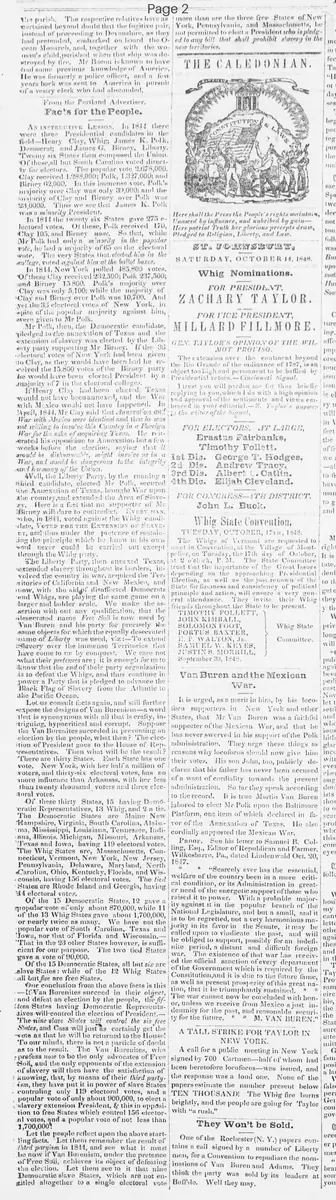
Facts for the People.
AN instructive LESSON. In 1844 there were three Presidential candidates in the field—Henry Clay, Whig; James K. Polk, Democrat; and James G. Birney, Liberty.
Twenty six States then composed the Union. Of these, all but South Carolina voted directly for electors. The popular vote was 2,675,000. Clay received 1,283,000; Polk, 1,337,000; and Birney 62,000. In this immense vote, Polk's majority over Clay was only 39,000: and the majority of Clay and Birney over Polk was 23,000. Thus we see that James K. Polk was a minority President.
In 1844 the twenty six States gave 275 electoral votes. Of these, Polk received 170, Clay 105, and Birney none. So that, while Mr Polk had only a minority in the popular vote, he had a majority of 65 on the electoral vote. The very States that elected him in the college, voted against him at the ballot boxes.
In 1844, New York polled 485,800 votes. Of these Clay received 232,500; Polk 237,500; and Birney 15,800. Polk's majority over Clay was only 5,100; while the majority of Clay and Birney over Polk was 10,700. And yet the 33 electoral votes of New York, in spite of the popular majority against him, were given to Mr Polk.
Mr Polk, then, the Democratic candidate, pledged to the annexation of Texas and the extension of slavery was elected by the Liberty party supporting Mr Birney. If the 36 electoral votes of New York had been given to Clay, as they would have been had he received the 15,800 votes of the Birney party she would have been elected President by a majority of 7 in the electoral colleges.
If Henry Clay had been elected, Texas would not have been annexed, and the War with Mexico would not have happened. In April, 1844, Mr Clay said that, Annexation and War with Mexico were identical and that he was not willing to involve this Country in a Foreign War for the sake of acquiring Texas. He reiterated his opposition to Annexation but a few weeks before the election, saying that it should be dishonorable, might involve us in a War, and would be dangerous to the integrity and harmony of the Union.
Well, the Liberty Party, by then running a third candidate, elected Mr Polk, secured the Annexation of Texas, brought War upon the country, and extended the Area of slavery. Here is a fact that no supporter of Mr Birney will dare to contradict. Every Man, who, in 1844, voted against the Whig candidate, VOTED FOR THE EXTENSION OF SLAVERY, and is under the pretence of sustaining the principle which he knew was his own ruin never could be carried out except through the Whig party,
The Liberty Party, then annexed Texas, extended slavery throughout its borders, involved the country in war, acquired the Territories of California and New Mexico, and now, with the aid of disaffected Democrats and Whigs, are playing the same game on a larger and bolder scale. We make the assertion without any qualification, that the desecrated name Free Soil is now used by Van Buren and his party for precisely the same objects for which the equally desecrated name of Liberty was used, viz:—To extend Slavery over the immense Territories that have come to us by conquest. We care not what their pretences are; it is enough for us to know that the end of their party organization is to defeat the Whigs, and thus continue in power a Party that is pledged to advance the Black Flag of Slavery from the Atlantic to the Pacific Ocean.
Let us consult facts again, and still further expose the designs of Van Burenism—a word that is synonymous with all that is crafty, intriguing, hypocritical and corrupt.
Suppose the Van Burenites succeeded in preventing an election by the people, what then? The election of President goes to the House of Representatives. Then what will be the result?
There are thirty States. Each State has one vote. New York, with her half a million of voters, and thirty-six electoral votes, has no more influence than Arkansas, with her less than twenty thousand voters and three electoral votes.
Of these thirty States, 15 having Democratic Representatives, 13 Whig, and 2 a tie, The Democratic States are Maine, New Hampshire, Virginia, South Carolina, Alabama, Mississippi, Louisiana, Tennessee, Indiana, Illinois, Michigan, Missouri, Arkansas, Texas and Iowa, having 119 electoral votes.
The Whig States are, Massachusetts, Connecticut, Vermont, New York, New Jersey, Pennsylvania, Delaware, Maryland, North Carolina, Ohio, Kentucky, Florida, and Wisconsin, having 156 electoral votes. The tied States are Rhode Island and Georgia, having 14 electoral votes.
Of the 15 Democratic States, 12 gave a popular vote of only about 870,000, while 11 of the 13 Whig States gave about 1,700,000, or nearly twice as many. We have not the popular vote of South Carolina, Texas and Iowa, nor that of Florida and Wisconsin.— That in the 23 other States however, is sufficient for our purpose. The two tied States gave a vote of 90,000.
Of the 15 Democratic States, all but six are slave States: while of the 13 Whig States all but five are free States.
Our conclusion from the above facts is this —If Van Burenites succeed in their object, and defeat an election by the people, the fifteen States having Democratic Representatives will control the election of President.— The nine slave States will control the six free States, and Cass will just as certainly get the vote as that he will be returned to the House!
To our minds, there is not a particle of doubt as to the result. The Van Burenites, who profess not to be the only advocates of Free Soil, and the only opponents of the extension of slavery will then have the satisfaction of knowing, that, by means of their third partyism, they have put it in power of slave States controlling only 119 electoral votes, and a popular vote of only about 900,000, to elect a slavery extension President, & this in opposition to free States which control 156 electoral votes, and a popular vote of not less than 1,700,000!
Let the people reflect upon the above startling facts. Let them remember the result of third partyism in 1844, and see what it must be now if Van Burenism, under the pretence of Free Soil, achieves its object of defeating the election. Let them see to it that nine Democratic slave States, which are not entitled altogether to a single electoral vote
Facts for the People.
AN instructive LESSON. In 1844 there were three Presidential candidates in the field—Henry Clay, Whig; James K. Polk, Democrat; and James G. Birney, Liberty.
Twenty six States then composed the Union. Of these, all but South Carolina voted directly for electors. The popular vote was 2,675,000. Clay received 1,283,000; Polk, 1,337,000; and Birney 62,000. In this immense vote, Polk's majority over Clay was only 39,000: and the majority of Clay and Birney over Polk was 23,000. Thus we see that James K. Polk was a minority President.
In 1844 the twenty six States gave 275 electoral votes. Of these, Polk received 170, Clay 105, and Birney none. So that, while Mr Polk had only a minority in the popular vote, he had a majority of 65 on the electoral vote. The very States that elected him in the college, voted against him at the ballot boxes.
In 1844, New York polled 485,800 votes. Of these Clay received 232,500; Polk 237,500; and Birney 15,800. Polk's majority over Clay was only 5,100; while the majority of Clay and Birney over Polk was 10,700. And yet the 33 electoral votes of New York, in spite of the popular majority against him, were given to Mr Polk.
Mr Polk, then, the Democratic candidate, pledged to the annexation of Texas and the extension of slavery was elected by the Liberty party supporting Mr Birney. If the 36 electoral votes of New York had been given to Clay, as they would have been had he received the 15,800 votes of the Birney party she would have been elected President by a majority of 7 in the electoral colleges.
If Henry Clay had been elected, Texas would not have been annexed, and the War with Mexico would not have happened. In April, 1844, Mr Clay said that, Annexation and War with Mexico were identical and that he was not willing to involve this Country in a Foreign War for the sake of acquiring Texas. He reiterated his opposition to Annexation but a few weeks before the election, saying that it should be dishonorable, might involve us in a War, and would be dangerous to the integrity and harmony of the Union.
Well, the Liberty Party, by then running a third candidate, elected Mr Polk, secured the Annexation of Texas, brought War upon the country, and extended the Area of slavery. Here is a fact that no supporter of Mr Birney will dare to contradict. Every Man, who, in 1844, voted against the Whig candidate, VOTED FOR THE EXTENSION OF SLAVERY, and is under the pretence of sustaining the principle which he knew was his own ruin never could be carried out except through the Whig party,
The Liberty Party, then annexed Texas, extended slavery throughout its borders, involved the country in war, acquired the Territories of California and New Mexico, and now, with the aid of disaffected Democrats and Whigs, are playing the same game on a larger and bolder scale. We make the assertion without any qualification, that the desecrated name Free Soil is now used by Van Buren and his party for precisely the same objects for which the equally desecrated name of Liberty was used, viz:—To extend Slavery over the immense Territories that have come to us by conquest. We care not what their pretences are; it is enough for us to know that the end of their party organization is to defeat the Whigs, and thus continue in power a Party that is pledged to advance the Black Flag of Slavery from the Atlantic to the Pacific Ocean.
Let us consult facts again, and still further expose the designs of Van Burenism—a word that is synonymous with all that is crafty, intriguing, hypocritical and corrupt.
Suppose the Van Burenites succeeded in preventing an election by the people, what then? The election of President goes to the House of Representatives. Then what will be the result?
There are thirty States. Each State has one vote. New York, with her half a million of voters, and thirty-six electoral votes, has no more influence than Arkansas, with her less than twenty thousand voters and three electoral votes.
Of these thirty States, 15 having Democratic Representatives, 13 Whig, and 2 a tie, The Democratic States are Maine, New Hampshire, Virginia, South Carolina, Alabama, Mississippi, Louisiana, Tennessee, Indiana, Illinois, Michigan, Missouri, Arkansas, Texas and Iowa, having 119 electoral votes.
The Whig States are, Massachusetts, Connecticut, Vermont, New York, New Jersey, Pennsylvania, Delaware, Maryland, North Carolina, Ohio, Kentucky, Florida, and Wisconsin, having 156 electoral votes. The tied States are Rhode Island and Georgia, having 14 electoral votes.
Of the 15 Democratic States, 12 gave a popular vote of only about 870,000, while 11 of the 13 Whig States gave about 1,700,000, or nearly twice as many. We have not the popular vote of South Carolina, Texas and Iowa, nor that of Florida and Wisconsin.— That in the 23 other States however, is sufficient for our purpose. The two tied States gave a vote of 90,000.
Of the 15 Democratic States, all but six are slave States: while of the 13 Whig States all but five are free States.
Our conclusion from the above facts is this —If Van Burenites succeed in their object, and defeat an election by the people, the fifteen States having Democratic Representatives will control the election of President.— The nine slave States will control the six free States, and Cass will just as certainly get the vote as that he will be returned to the House!
To our minds, there is not a particle of doubt as to the result. The Van Burenites, who profess not to be the only advocates of Free Soil, and the only opponents of the extension of slavery will then have the satisfaction of knowing, that, by means of their third partyism, they have put it in power of slave States controlling only 119 electoral votes, and a popular vote of only about 900,000, to elect a slavery extension President, & this in opposition to free States which control 156 electoral votes, and a popular vote of not less than 1,700,000!
Let the people reflect upon the above startling facts. Let them remember the result of third partyism in 1844, and see what it must be now if Van Burenism, under the pretence of Free Soil, achieves its object of defeating the election. Let them see to it that nine Democratic slave States, which are not entitled altogether to a single electoral vote
What sub-type of article is it?
Partisan Politics
Slavery Abolition
War Or Peace
What keywords are associated?
1844 Election
Third Party
Slavery Extension
Texas Annexation
Mexican War
Electoral College
Free Soil
Van Burenism
Whig Party
What entities or persons were involved?
Henry Clay
James K. Polk
James G. Birney
Martin Van Buren
Lewis Cass
Liberty Party
Free Soil Party
Whig Party
Democratic Party
Editorial Details
Primary Topic
Dangers Of Third Party Votes Aiding Pro Slavery Candidates In 1844 And 1848 Elections
Stance / Tone
Strongly Anti Third Party, Pro Whig, Warning Against Inadvertent Support For Slavery Extension
Key Figures
Henry Clay
James K. Polk
James G. Birney
Martin Van Buren
Lewis Cass
Liberty Party
Free Soil Party
Whig Party
Democratic Party
Key Arguments
Polk Won 1844 Election With Minority Popular Vote Due To Electoral College And Liberty Votes In New York
Liberty Party's 15,800 Votes In New York Gave Its Electoral Votes To Polk, Electing Him Over Clay
Polk's Election Led To Texas Annexation, Mexican War, And Slavery Extension
Voting Against Whig Candidate In 1844 Effectively Supported Slavery Extension
Free Soil Party In 1848 Will Split Votes To Help Elect Pro Slavery Cass
If No Majority, House Election Would Favor Democratic Slave States Over Whig Free States