Thank you for visiting SNEWPapers!
Sign up free
Literary
August 31, 1839
The Connecticut Observer, And New York Congregationalist
Hartford, Hartford County, Connecticut
What is this article about?
Patrick Henry writes a letter to his newly married daughter, advising her on achieving marital happiness through prudent, amiable conduct, avoiding opposition to her husband, maintaining politeness, cultivating her mind with moral literature, and managing domestic affairs with economy and charity.
Clipping
OCR Quality
98%
Excellent
Full Text
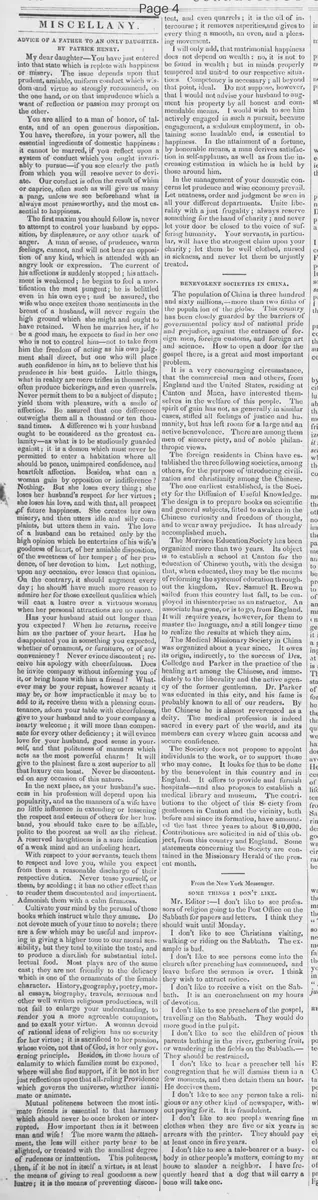
ADVICE OF A FATHER TO AN ONLY DAUGHTER.
BY PATRICK HENRY.
My dear daughter—You have just entered into that state which is replete with happiness or misery. The issue depends upon that prudent, amiable, uniform conduct which wisdom and virtue so strongly recommend, on the one hand, or on that imprudence which a want of reflection or passion may prompt on the other.
You are allied to a man of honor, of talents, and of an open generous disposition. You have, therefore, in your power, all the essential ingredients of domestic happiness: it cannot be marred, if you reflect upon a system of conduct which you ought invariably to pursue—if you see clearly the path from which you will resolve never to deviate. Our conduct is often the result of whim or caprice, often such as will give us many a pang, unless we see beforehand what is always most praiseworthy, and the most essential to happiness.
The first maxim you should follow is, never to attempt to control your husband by opposition, by displeasure, or any other mark of anger. A man of sense, of prudence, warm feelings, cannot, and will not bear an opposition of any kind, which is attended with an angry look or expression. The current of his affections is suddenly stopped; his attachment is weakened; he begins to feel a mortification the most pungent; he is belittled even in his own eye; and be assured, the wife who once excites those sentiments in the breast of a husband, will never regain the high ground which she might and ought to have retained. When he marries her, if he be a good man, he expects to find in her one who is not to control him—not to take from him the freedom of acting as his own judgment shall direct, but one who will place such confidence in him, as to believe that his prudence is his best guide. Little things, what in reality are mere trifles in themselves, often produce bickerings, and even quarrels. Never permit them to be a subject of dispute; yield them with pleasure, with a smile of affection. Be assured that one difference outweighs them all a thousand or ten thousand times. A difference with your husband ought to be considered as the greatest calamity—as what is to be studiously guarded against; it is a demon which must never be permitted to enter a habitation where all should be peace, unimpaired confidence, and heartfelt affection. Besides, what can a woman gain by opposition or indifference? Nothing. But she loses every thing; she loses her husband's respect for her virtues; she loses his love, and with that, all prospect of future happiness. She creates her own misery, and then utters idle and silly complaints, but utters them in vain. The love of a husband can be retained only by the high opinion which he entertains of his wife's goodness of heart, of her amiable disposition, of the sweetness of her temper; of her prudence, of her devotion to him. Let nothing, upon any occasion, ever lessen that opinion. On the contrary, it should augment every day; he should have much more reason to admire her for those excellent qualities which will cast a lustre over a virtuous woman when her personal attractions are no more.
Has your husband staid out longer than you expected? When he returns, receive him as the partner of your heart. Has he disappointed you in something you expected, whether of ornament, or furniture, or of any conveniency? Never evince discontent; receive his apology with cheerfulness. Does he invite company without informing you of it, or bring home with him a friend? Whatever may be your repast, however scanty it may be, or how impracticable it may be to add to it, receive them with a pleasing countenance, adorn your table with cheerfulness, give to your husband and to your company a hearty welcome; it will more than compensate for every other deficiency; it will evince love for your husband, good sense in yourself, and that politeness of manners which acts as the most powerful charm! It will give to the plainest fare a zest superior to all that luxury can boast. Never be discontented on any occasion of this nature.
In the next place, as your husband's success in his profession will depend upon his popularity, and as the manners of a wife have no little influence in extending or lessening the respect and esteem of others for her husband, you should take care to be affable, polite to the poorest as well as the richest. A reserved haughtiness is a sure indication of a weak mind and an unfeeling heart.
With respect to your servants, teach them to respect and love you, while you expect from them a reasonable discharge of their respective duties. Never tease yourself, or them, by scolding; it has no other effect than to render them discontented and impertinent. Admonish them with a calm firmness.
Cultivate your mind by the perusal of those books which instruct while they amuse. Do not devote much of your time to novels; there are a few which may be useful and improving in giving a higher tone to our moral sensibility, but they tend to vitiate the taste, and to produce a disrelish for substantial intellectual food. Most plays are of the same cast; they are not friendly to the delicacy which is one of the ornaments of the female character. History, geography, poetry, moral essays, biography, travels, sermons and other well written religious productions, will not fail to enlarge your understanding, to render you a more agreeable companion, and to exalt your virtue. A woman devoid of rational ideas of religion has no security for her virtue; it is sacrificed to her passion, whose voice, not that of God, is her only governing principle. Besides, in those hours of calamity to which families must be exposed, where will she find support, if it be not in her just reflections upon that all-ruling Providence which governs the universe, whether inanimate or animate.
Mutual politeness between the most intimate friends is essential to that harmony which should never be once broken or interrupted. How important then is it between man and wife! The more warm the attachment, the less will either party bear to be slighted, or treated with the smallest degree of rudeness or inattention. This politeness, then, if it be not in itself a virtue, is at least the means of giving to real goodness a new lustre; it is the means of preventing discontent, and even quarrels; it is the oil of intercourse; it removes asperities, and gives to every thing a smooth, an even, and a pleasing movement.
I will only add, that matrimonial happiness does not depend on wealth: no, it is not to be found in wealth; but in minds properly tempered and united to our respective situations. Competency is necessary; all beyond that point, ideal. Do not suppose, however that I would not advise your husband to augment his property by all honest and commendable means. I would wish to see him actively engaged in such a pursuit, because engagement, a sedulous employment, in obtaining some laudable end, is essential to happiness. In the attainment of a fortune by honorable means, a man derives satisfaction in self-applause, as well as from the increasing estimation in which he is held by those around him.
In the management of your domestic concerns let prudence and wise economy prevail. Let neatness, order and judgment be seen in all your different departments. Unite liberality with a just frugality; always reserve something for the hand of charity; and never let your door be closed to the voice of suffering humanity. Your servants, in particular, will have the strongest claim upon your charity: let them be well clothed, nursed in sickness, and never let them be unjustly treated.
BY PATRICK HENRY.
My dear daughter—You have just entered into that state which is replete with happiness or misery. The issue depends upon that prudent, amiable, uniform conduct which wisdom and virtue so strongly recommend, on the one hand, or on that imprudence which a want of reflection or passion may prompt on the other.
You are allied to a man of honor, of talents, and of an open generous disposition. You have, therefore, in your power, all the essential ingredients of domestic happiness: it cannot be marred, if you reflect upon a system of conduct which you ought invariably to pursue—if you see clearly the path from which you will resolve never to deviate. Our conduct is often the result of whim or caprice, often such as will give us many a pang, unless we see beforehand what is always most praiseworthy, and the most essential to happiness.
The first maxim you should follow is, never to attempt to control your husband by opposition, by displeasure, or any other mark of anger. A man of sense, of prudence, warm feelings, cannot, and will not bear an opposition of any kind, which is attended with an angry look or expression. The current of his affections is suddenly stopped; his attachment is weakened; he begins to feel a mortification the most pungent; he is belittled even in his own eye; and be assured, the wife who once excites those sentiments in the breast of a husband, will never regain the high ground which she might and ought to have retained. When he marries her, if he be a good man, he expects to find in her one who is not to control him—not to take from him the freedom of acting as his own judgment shall direct, but one who will place such confidence in him, as to believe that his prudence is his best guide. Little things, what in reality are mere trifles in themselves, often produce bickerings, and even quarrels. Never permit them to be a subject of dispute; yield them with pleasure, with a smile of affection. Be assured that one difference outweighs them all a thousand or ten thousand times. A difference with your husband ought to be considered as the greatest calamity—as what is to be studiously guarded against; it is a demon which must never be permitted to enter a habitation where all should be peace, unimpaired confidence, and heartfelt affection. Besides, what can a woman gain by opposition or indifference? Nothing. But she loses every thing; she loses her husband's respect for her virtues; she loses his love, and with that, all prospect of future happiness. She creates her own misery, and then utters idle and silly complaints, but utters them in vain. The love of a husband can be retained only by the high opinion which he entertains of his wife's goodness of heart, of her amiable disposition, of the sweetness of her temper; of her prudence, of her devotion to him. Let nothing, upon any occasion, ever lessen that opinion. On the contrary, it should augment every day; he should have much more reason to admire her for those excellent qualities which will cast a lustre over a virtuous woman when her personal attractions are no more.
Has your husband staid out longer than you expected? When he returns, receive him as the partner of your heart. Has he disappointed you in something you expected, whether of ornament, or furniture, or of any conveniency? Never evince discontent; receive his apology with cheerfulness. Does he invite company without informing you of it, or bring home with him a friend? Whatever may be your repast, however scanty it may be, or how impracticable it may be to add to it, receive them with a pleasing countenance, adorn your table with cheerfulness, give to your husband and to your company a hearty welcome; it will more than compensate for every other deficiency; it will evince love for your husband, good sense in yourself, and that politeness of manners which acts as the most powerful charm! It will give to the plainest fare a zest superior to all that luxury can boast. Never be discontented on any occasion of this nature.
In the next place, as your husband's success in his profession will depend upon his popularity, and as the manners of a wife have no little influence in extending or lessening the respect and esteem of others for her husband, you should take care to be affable, polite to the poorest as well as the richest. A reserved haughtiness is a sure indication of a weak mind and an unfeeling heart.
With respect to your servants, teach them to respect and love you, while you expect from them a reasonable discharge of their respective duties. Never tease yourself, or them, by scolding; it has no other effect than to render them discontented and impertinent. Admonish them with a calm firmness.
Cultivate your mind by the perusal of those books which instruct while they amuse. Do not devote much of your time to novels; there are a few which may be useful and improving in giving a higher tone to our moral sensibility, but they tend to vitiate the taste, and to produce a disrelish for substantial intellectual food. Most plays are of the same cast; they are not friendly to the delicacy which is one of the ornaments of the female character. History, geography, poetry, moral essays, biography, travels, sermons and other well written religious productions, will not fail to enlarge your understanding, to render you a more agreeable companion, and to exalt your virtue. A woman devoid of rational ideas of religion has no security for her virtue; it is sacrificed to her passion, whose voice, not that of God, is her only governing principle. Besides, in those hours of calamity to which families must be exposed, where will she find support, if it be not in her just reflections upon that all-ruling Providence which governs the universe, whether inanimate or animate.
Mutual politeness between the most intimate friends is essential to that harmony which should never be once broken or interrupted. How important then is it between man and wife! The more warm the attachment, the less will either party bear to be slighted, or treated with the smallest degree of rudeness or inattention. This politeness, then, if it be not in itself a virtue, is at least the means of giving to real goodness a new lustre; it is the means of preventing discontent, and even quarrels; it is the oil of intercourse; it removes asperities, and gives to every thing a smooth, an even, and a pleasing movement.
I will only add, that matrimonial happiness does not depend on wealth: no, it is not to be found in wealth; but in minds properly tempered and united to our respective situations. Competency is necessary; all beyond that point, ideal. Do not suppose, however that I would not advise your husband to augment his property by all honest and commendable means. I would wish to see him actively engaged in such a pursuit, because engagement, a sedulous employment, in obtaining some laudable end, is essential to happiness. In the attainment of a fortune by honorable means, a man derives satisfaction in self-applause, as well as from the increasing estimation in which he is held by those around him.
In the management of your domestic concerns let prudence and wise economy prevail. Let neatness, order and judgment be seen in all your different departments. Unite liberality with a just frugality; always reserve something for the hand of charity; and never let your door be closed to the voice of suffering humanity. Your servants, in particular, will have the strongest claim upon your charity: let them be well clothed, nursed in sickness, and never let them be unjustly treated.
What sub-type of article is it?
Epistolary
Essay
What themes does it cover?
Moral Virtue
Social Manners
Religious
What keywords are associated?
Marital Advice
Wifely Conduct
Domestic Happiness
Moral Instruction
Politeness
Prudence
Charity
Patrick Henry
What entities or persons were involved?
By Patrick Henry.
Literary Details
Title
Advice Of A Father To An Only Daughter.
Author
By Patrick Henry.
Subject
Advice To A Newly Married Daughter On Conduct, Marital Harmony, And Domestic Duties.
Key Lines
The First Maxim You Should Follow Is, Never To Attempt To Control Your Husband By Opposition, By Displeasure, Or Any Other Mark Of Anger.
A Difference With Your Husband Ought To Be Considered As The Greatest Calamity—As What Is To Be Studiously Guarded Against; It Is A Demon Which Must Never Be Permitted To Enter A Habitation Where All Should Be Peace, Unimpaired Confidence, And Heartfelt Affection.
The Love Of A Husband Can Be Retained Only By The High Opinion Which He Entertains Of His Wife's Goodness Of Heart, Of Her Amiable Disposition, Of The Sweetness Of Her Temper; Of Her Prudence, Of Her Devotion To Him.
Cultivate Your Mind By The Perusal Of Those Books Which Instruct While They Amuse.
Matrimonial Happiness Does Not Depend On Wealth: No, It Is Not To Be Found In Wealth; But In Minds Properly Tempered And United To Our Respective Situations.