Thank you for visiting SNEWPapers!
Sign up free
The New Hampshire Gazette
Portsmouth, Rockingham County, New Hampshire
What is this article about?
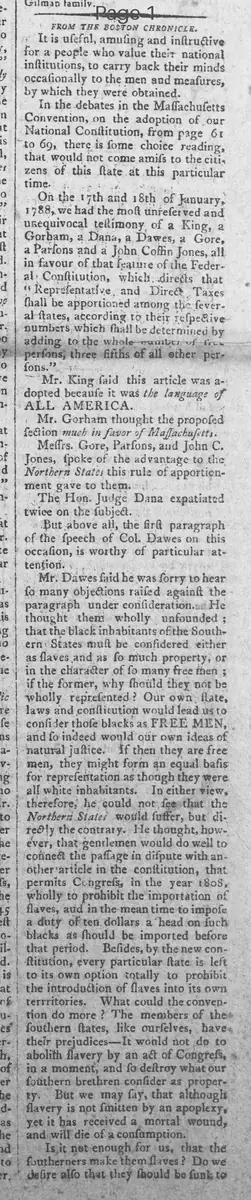
Editorial from the Boston Chronicle reflects on 1788 Massachusetts Convention debates, quoting supporters like King, Gorham, Dana, Dawes, Gore, Parsons, and Jones who favored the Constitution's three-fifths clause for apportioning representation and taxes, arguing it benefits Northern states and wounds slavery.
Merged-components note: Clear textual continuation of the editorial from the Boston Chronicle on the Constitution and slavery, spanning across pages in sequential reading order.
Clippings
1 of 2
OCR Quality
Full Text
It is useful, amusing and instructive
for a people who value their national
institutions, to carry back their minds
occasionally to the men and measures,
by which they were obtained.
In the debates in the Massachusetts
Convention, on the adoption of our
National Constitution, from page 61
to 69, there is some choice reading,
that would not come amiss to the citi-
zens of this state at this particular
time.
On the 17th and 18th of January,
1788, we had the most unreserved and
unequivocal testimony of a King, a
Gorham, a Dana, a Dawes, a Gore,
a Parsons and a John Coffin Jones, all
in favour of that feature of the Feder-
al Constitution, which directs that
"Representatives and Direct Taxes
shall be apportioned among the sever-
al states, according to their respective
numbers which shall be determined by
adding to the whole number of free-
persons, three fifths of all other per-
sons."
Mr. King said this article was a-
dopted because it was the language of
ALL AMERICA.
Mr. Gorham thought the proposed
section much in favor of Massachusetts.
Messrs. Gore, Parsons, and John C.
Jones, spoke of the advantage to the
Northern States this rule of apportion-
ment gave to them.
The Hon. Judge Dana expatiated
twice on the subject.
But above all, the first paragraph
of the speech of Col. Dawes on this
occasion, is worthy of particular at-
tention.
Mr. Dawes said he was sorry to hear
so many objections raised against the
paragraph under consideration. He
thought them wholly unfounded;
that the black inhabitants of the South-
tern States must be considered either
as slaves and as so much property, or
in the character of so many free men;
if the former, why should they not be
wholly represented? Our own laws,
and constitution would lead us to
consider those blacks as FREE MEN.
and so indeed would our own ideas of
natural justice. If then they are free
men, they might form an equal basis
for representation as though they were
all white inhabitants. In either view,
therefore, he could not see that the
Northern States would suffer, but di-
rectly the contrary. He thought, how-
ever, that gentlemen would do well to
connect the passage in dispute with an-
other article in the constitution, that
permits Congress, in the year 1808,
wholly to prohibit the importation of
slaves, and in the mean time to impose
a duty of ten dollars a head on such
blacks as should be imported before
that period. Besides, by the new con-
stitution, every particular state is left
to its own option totally to prohibit
the introduction of slaves into its own
territories. What could the conven-
tion do more? The members of the
southern states, like ourselves, have
their prejudices--It would not do to
abolish slavery by an act of Congress,
in a moment, and so destroy what our
southern brethren consider as proper-
ty. But we may say, that although
slavery is not smitten by an apoplexy,
yet it has received a mortal wound,
and will die of a consumption.
Is it not enough for us, that the
southerners make them slaves? Do we
desire also that they should be sunk to
Beasts? Because proprietors have consented to curtail them of two fifths of their humanity, will free men, will men of feeling and piety in Massachusetts insist that they shall be blotted from the record of heaven? Because their incessant labors are devoted to the culture of the earth, does it follow of course that the agriculture of our country is nothing benefited by their toil? Will we value ourselves on our commerce, and not allow any consideration to those who furnish the means of all our commerce and all our boasting?
It was a tribute to the honest prejudices of this portion of our Union, that the southern portion consented to consider a slave only three fifths of a man: if we insist on annihilating him altogether, the transgression will be heavy on our own heads, and we must look to the consequences.
Shall that trumpet which has founded the notes of Union, and led the vanguard of freedom, become the tocsin of discord, and hurry us into that slavery which we so abhor, even to look upon?
Our Washington has told us—and it would be truth if he had not—that our National Constitution is the sheet anchor of our peace at home and safety abroad: of our prosperity, of that very liberty which we so highly prize. It is the ark of all our hopes; and the prop on which the fabric rests—the apportionment in question is the main away this, and we are all afloat on the wide ocean of confusion, without rudder, compass or sail: left at the mercy of wild waves without, and the more uncontrollable wildness of the passions within.
What sub-type of article is it?
What keywords are associated?
What entities or persons were involved?
Editorial Details
Primary Topic
Defense Of The Three Fifths Clause For Representation And Taxation
Stance / Tone
Supportive Of The Constitutional Compromise On Slavery
Key Figures
Key Arguments