Thank you for visiting SNEWPapers!
Sign up free
Story
September 13, 1814
The New Hampshire Gazette
Portsmouth, Rockingham County, New Hampshire
What is this article about?
Commodore Joshua Barney's letter details his command's defense at the Battle of Bladensburg on August 24, 1814, during the British invasion of Washington. His artillery and marines held off the enemy until outflanked, ammunition depleted, and Barney wounded, leading to his parole by British officers.
Clipping
OCR Quality
95%
Excellent
Full Text
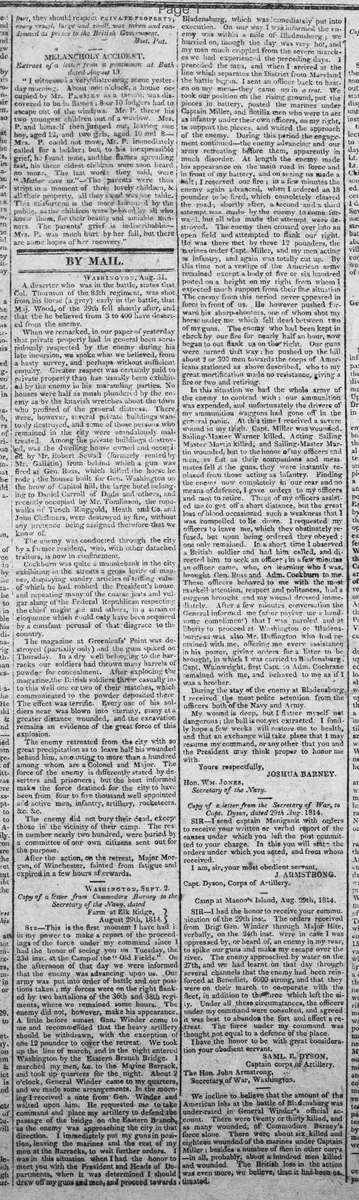
Washington, Sept. 2.
Copy of a letter from Commodore Barney to the
Secretary of the Navy, dated
Farm at Elk Ridge,
August 29th, 1814.
SIR—This is the first moment I have had it
in my power to make a report of the proceed-
ings of the force under my command since I
had the honor of seeing you on Tuesday, the
23d inst. at the Camp of the "Old Fields." On
the afternoon of that day we were informed
that the enemy was advancing upon us. Our
army was put into order of battle and our posi-
tions taken; my forces were on the right flank-
ed by two battalions of the 36th and 38th regi-
ments, where we remained some hours. The
enemy did not, however, make his appearance.
A little before sunset Gen. Winder came to
me and recommended that the heavy artillery
should be withdrawn, with the exception of
one 12 pounder to cover the retreat. We took
up the line of march and in the night entered
Washington by the Eastern Branch Bridge. I
marched my men, &c. to the Marine Barrack,
and took up quarters for the night. About 2
o'clock, General Winder came to my quarters,
and we made some arrangements. In the morn-
ing I received a note from Gen. Winder and
waited upon him. He requested me to take
command and place my artillery to defend the
passage of the bridge on the Eastern Branch,
as the enemy was approaching the city in that
direction. I immediately put my guns in posi-
tion, leaving the marines and the rest of my
men at the Barracks, to wait further orders. I
was in this situation when I had the honor to
meet you with the President and Heads of De-
partments, when it was determined I should
draw off my guns and men, and proceed towards
Bladensburg, which was immediately put into
execution. On our way I was informed the en-
emy was within a mile of Bladensburg; we
hurried on, though the day was very hot, and
my men much crippled from the severe march-
es we had experienced the preceding days. I
preceded the men, and when I arrived at the
line which separates the District from Maryland
the battle began. I sent an officer back to hast-
en on my men—they came up in a trot. We
took our position on the rising ground, put the
pieces in battery, posted the marines under
Captain Miller, and flotilla men who were to act
as infantry under their own officers, on my right,
to support the pieces, and waited the approach
of the enemy. During this period the engage-
ment continued—the enemy advancing and our
army retreating before them, apparently in
much disorder. At length the enemy made
his appearance on the main road in force and
in front of my battery, and on seeing us made a
halt; I reserved our fire; in a few minutes the
enemy again advanced, when I ordered an 18
pounder to be fired, which completely cleared
the road; shortly after, a second and a third
attempt was made by the enemy to come for-
ward, but all who made the attempt were de-
stroved. The enemy then crossed over into an
open field and attempted to flank our right.
He was there met by three 12 pounders, the
marines under Capt. Miller, and my men acting
as infantry, and again was totally cut up. By
this time not a vestige of the American army
remained except a body of five or six hundred
posted on a height on my right from whom I
expected much support from their fine situation
The enemy from this period never appeared in
force in front of us. He however pushed for-
ward his sharp-shooters, one of whom shot my
horse under me which fell dead between two
of my guns. The enemy who had been kept in
check by our fire for nearly half an hour, now
began to out flank us on the right. Our guns
were turned that way: he pushed up the hill
about 200 or 300 men towards the corps of Amer-
ican stationed as above described, who to my
great mortification made no resistance, giving a
fire or two and retiring.
In this situation we had the whole army of
the enemy to contend with; our ammunition
was expended, and unfortunately the drivers of
my ammunition waggons had gone off in the
general panic. At this time I received a severe
wound in my thigh. Capt. Miller was wounded,
Sailing-Master Warner killed, Acting Sailing
Master Martin killed, and Sailing-Master Mar-
tin wounded; but to the honor of my officers and
men, as fast as their companions and mess-
mates fell at the guns, they were instantly re-
placed from those acting as infantry. Finding
the enemy now completely in our rear and no
means of defence, I gave orders to my officers
and men to retire. Three of my officers assist-
ed me to get off a short distance, but the great
loss of blood occasioned such a weakness that I
was compelled to lie down. I requested my
officers to leave me, which they obstinately re-
fused, but upon being ordered they obeyed;
one only remained. In a short time I observed
a British soldier and had him called, and di-
rected him to seek an officer in a few minutes
an officer came, who, on learning who I was,
brought Gen. Ross and Adm. Cockburn to me.
These officers behaved to me with the most
marked attention, respect and politeness, had a
surgeon brought and my wound dressed imme-
diately. After a few minutes conversation the
General informed me (after paying me a hand-
some compliment) that I was paroled and at
liberty to proceed at Washington or Bladen-
burg—as was also Mr. Huffington who had re-
mained with me, offering me every assistance
in his power, giving orders for a litter to be
brought, in which I was carried to Bladensburg.
Capt. Wainwright, first Capt. to Adm. Cochrane
remained with me, and behaved to me as if I
was a brother.
During the stay of the enemy at Bladensburg
I received the most polite attention from the
officers both of the Navy and Army.
My wound is deep, but I flatter myself not
dangerous; the ball is not yet extracted. I fond-
ly hope a few weeks will restore me to health,
and that an exchange will take place that I may
resume my command, or any other that you and
the President may think proper to honor me
with.
Yours respectfully,
JOSHUA BARNEY.
Hon. WM. Jones,
Secretary of the Navy.
Copy of a letter from Commodore Barney to the
Secretary of the Navy, dated
Farm at Elk Ridge,
August 29th, 1814.
SIR—This is the first moment I have had it
in my power to make a report of the proceed-
ings of the force under my command since I
had the honor of seeing you on Tuesday, the
23d inst. at the Camp of the "Old Fields." On
the afternoon of that day we were informed
that the enemy was advancing upon us. Our
army was put into order of battle and our posi-
tions taken; my forces were on the right flank-
ed by two battalions of the 36th and 38th regi-
ments, where we remained some hours. The
enemy did not, however, make his appearance.
A little before sunset Gen. Winder came to
me and recommended that the heavy artillery
should be withdrawn, with the exception of
one 12 pounder to cover the retreat. We took
up the line of march and in the night entered
Washington by the Eastern Branch Bridge. I
marched my men, &c. to the Marine Barrack,
and took up quarters for the night. About 2
o'clock, General Winder came to my quarters,
and we made some arrangements. In the morn-
ing I received a note from Gen. Winder and
waited upon him. He requested me to take
command and place my artillery to defend the
passage of the bridge on the Eastern Branch,
as the enemy was approaching the city in that
direction. I immediately put my guns in posi-
tion, leaving the marines and the rest of my
men at the Barracks, to wait further orders. I
was in this situation when I had the honor to
meet you with the President and Heads of De-
partments, when it was determined I should
draw off my guns and men, and proceed towards
Bladensburg, which was immediately put into
execution. On our way I was informed the en-
emy was within a mile of Bladensburg; we
hurried on, though the day was very hot, and
my men much crippled from the severe march-
es we had experienced the preceding days. I
preceded the men, and when I arrived at the
line which separates the District from Maryland
the battle began. I sent an officer back to hast-
en on my men—they came up in a trot. We
took our position on the rising ground, put the
pieces in battery, posted the marines under
Captain Miller, and flotilla men who were to act
as infantry under their own officers, on my right,
to support the pieces, and waited the approach
of the enemy. During this period the engage-
ment continued—the enemy advancing and our
army retreating before them, apparently in
much disorder. At length the enemy made
his appearance on the main road in force and
in front of my battery, and on seeing us made a
halt; I reserved our fire; in a few minutes the
enemy again advanced, when I ordered an 18
pounder to be fired, which completely cleared
the road; shortly after, a second and a third
attempt was made by the enemy to come for-
ward, but all who made the attempt were de-
stroved. The enemy then crossed over into an
open field and attempted to flank our right.
He was there met by three 12 pounders, the
marines under Capt. Miller, and my men acting
as infantry, and again was totally cut up. By
this time not a vestige of the American army
remained except a body of five or six hundred
posted on a height on my right from whom I
expected much support from their fine situation
The enemy from this period never appeared in
force in front of us. He however pushed for-
ward his sharp-shooters, one of whom shot my
horse under me which fell dead between two
of my guns. The enemy who had been kept in
check by our fire for nearly half an hour, now
began to out flank us on the right. Our guns
were turned that way: he pushed up the hill
about 200 or 300 men towards the corps of Amer-
ican stationed as above described, who to my
great mortification made no resistance, giving a
fire or two and retiring.
In this situation we had the whole army of
the enemy to contend with; our ammunition
was expended, and unfortunately the drivers of
my ammunition waggons had gone off in the
general panic. At this time I received a severe
wound in my thigh. Capt. Miller was wounded,
Sailing-Master Warner killed, Acting Sailing
Master Martin killed, and Sailing-Master Mar-
tin wounded; but to the honor of my officers and
men, as fast as their companions and mess-
mates fell at the guns, they were instantly re-
placed from those acting as infantry. Finding
the enemy now completely in our rear and no
means of defence, I gave orders to my officers
and men to retire. Three of my officers assist-
ed me to get off a short distance, but the great
loss of blood occasioned such a weakness that I
was compelled to lie down. I requested my
officers to leave me, which they obstinately re-
fused, but upon being ordered they obeyed;
one only remained. In a short time I observed
a British soldier and had him called, and di-
rected him to seek an officer in a few minutes
an officer came, who, on learning who I was,
brought Gen. Ross and Adm. Cockburn to me.
These officers behaved to me with the most
marked attention, respect and politeness, had a
surgeon brought and my wound dressed imme-
diately. After a few minutes conversation the
General informed me (after paying me a hand-
some compliment) that I was paroled and at
liberty to proceed at Washington or Bladen-
burg—as was also Mr. Huffington who had re-
mained with me, offering me every assistance
in his power, giving orders for a litter to be
brought, in which I was carried to Bladensburg.
Capt. Wainwright, first Capt. to Adm. Cochrane
remained with me, and behaved to me as if I
was a brother.
During the stay of the enemy at Bladensburg
I received the most polite attention from the
officers both of the Navy and Army.
My wound is deep, but I flatter myself not
dangerous; the ball is not yet extracted. I fond-
ly hope a few weeks will restore me to health,
and that an exchange will take place that I may
resume my command, or any other that you and
the President may think proper to honor me
with.
Yours respectfully,
JOSHUA BARNEY.
Hon. WM. Jones,
Secretary of the Navy.
What sub-type of article is it?
Military Action
Historical Event
Heroic Act
What themes does it cover?
Bravery Heroism
Catastrophe
Survival
What keywords are associated?
Battle Of Bladensburg
War Of 1812
British Invasion
American Artillery
Commodore Barney
Wound And Parole
What entities or persons were involved?
Joshua Barney
Gen. Winder
Capt. Miller
Gen. Ross
Adm. Cockburn
Adm. Cochrane
Capt. Wainwright
Where did it happen?
Bladensburg, Near Washington
Story Details
Key Persons
Joshua Barney
Gen. Winder
Capt. Miller
Gen. Ross
Adm. Cockburn
Adm. Cochrane
Capt. Wainwright
Location
Bladensburg, Near Washington
Event Date
August 24, 1814
Story Details
Commodore Barney recounts positioning his artillery and marines at Bladensburg to defend against British forces; they repelled advances and flanked attacks until outflanked, ammunition exhausted, and Barney wounded; he was then paroled by British officers.