Thank you for visiting SNEWPapers!
Sign up free
The Daily Herald
New Haven, New Haven County, Connecticut
What is this article about?
U.S. Senate in Washington, D.C., on March 15 confirmed Roger B. Taney as Chief Justice, Philip P. Barbour as Associate Judge, and Amos Kendall as Postmaster General. Debated Mr. Clay's land bill, passing motion to take it up 24-23; Mr. Ewing spoke on economic threats to currency and banks.
Clipping
OCR Quality
Full Text
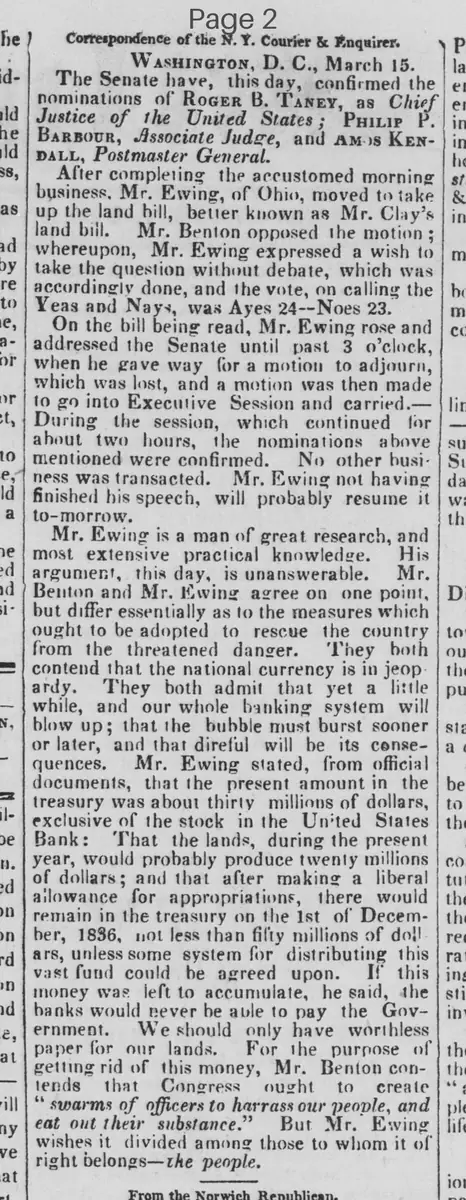
Washington, D. C., March 15.
The Senate have, this day, confirmed the nominations of Roger B. Taney, as Chief Justice of the United States; Philip P. Barbour, Associate Judge, and Amos Kendall, Postmaster General.
After completing the accustomed morning business, Mr. Ewing, of Ohio, moved to take up the land bill, better known as Mr. Clay's land bill. Mr. Benton opposed the motion; whereupon, Mr. Ewing expressed a wish to take the question without debate, which was accordingly done, and the vote, on calling the Yeas and Nays, was Ayes 24--Noes 23.
On the bill being read, Mr. Ewing rose and addressed the Senate until past 3 o'clock, when he gave way for a motion to adjourn, which was lost, and a motion was then made to go into Executive Session and carried.-
During the session, which continued for about two hours, the nominations above mentioned were confirmed. No other business was transacted. Mr. Ewing not having finished his speech, will probably resume it to-morrow.
Mr. Ewing is a man of great research, and most extensive practical knowledge. His argument, this day, is unanswerable.
Mr. Benton and Mr. Ewing agree on one point, but differ essentially as to the measures which ought to be adopted to rescue the country from the threatened danger. They both contend that the national currency is in jeopardy. They both admit that yet a little while, and our whole banking system will blow up; that the bubble must burst sooner or later, and that direful will be its consequences.
Mr. Ewing stated, from official documents, that the present amount in the treasury was about thirty millions of dollars, exclusive of the stock in the United States Bank: That the lands, during the present year, would probably produce twenty millions of dollars; and that after making a liberal allowance for appropriations, there would remain in the treasury on the 1st of December, 1836, not less than fifty millions of dollars, unless some system for distributing this vast fund could be agreed upon. If this money was left to accumulate, he said, the banks would never be able to pay the Government. We should only have worthless paper for our lands. For the purpose of getting rid of this money, Mr. Benton contends that Congress ought to create "swarms of officers to harrass our people, and eat out their substance." But Mr. Ewing wishes it divided among those to whom it of right belongs-the people.
What sub-type of article is it?
What keywords are associated?
What entities or persons were involved?
Where did it happen?
Domestic News Details
Primary Location
Washington, D. C.
Event Date
March 15
Key Persons
Outcome
nominations confirmed: roger b. taney as chief justice of the united states; philip p. barbour as associate judge; amos kendall as postmaster general. vote on taking up the land bill: ayes 24 - noes 23.
Event Details
The Senate confirmed nominations in Executive Session. After morning business, Mr. Ewing moved to take up Mr. Clay's land bill, opposed by Mr. Benton; the motion passed 24-23. Mr. Ewing addressed the Senate on the bill and economic issues including national currency and banking system until past 3 o'clock. Session adjourned without completing the speech.