Thank you for visiting SNEWPapers!
Sign up free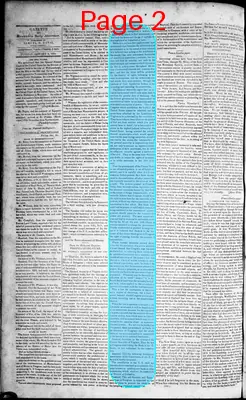
Alexandria Gazette & Daily Advertiser
Alexandria, Virginia
What is this article about?
The Virginia General Assembly declares the federal Bank of the United States unconstitutional, criticizes a recent Supreme Court decision upholding it, and proposes a constitutional amendment to prohibit Congress from establishing banks outside the District of Columbia.
Clipping

OCR Quality
Full Text
While it is evident that controversies must sometimes arise between the national & state governments as to the extent of their powers; it is believed that so long as the patriotism of the people (the only permanent foundation of republican institutions) continue, the former will find its security, not only in the great strength and resources which it possesses, but in a deep sense throughout the nation of connected interests and common danger; and that the latter will be protected by the identity of rights belonging to the state sovereignties, and the redeeming control which they may exercise, through the medium of their legislative bodies, in expounding and amending the constitution.
The General Assembly regret that an occasion has occurred which calls upon them to perform the painful duty of declaring, that the federal government has transcended its constitutional limits by an important and unwarranted assumption of power. The act of Congress which establishes the bank of the United States cannot be admitted and has never been admitted by the Legislature of Virginia to be authorised by the constitution. They have hitherto been silent on the subject of that act, from motives which it is unnecessary here to detail; but a late solemn decision in the highest judicial tribunal of the United States having asserted the validity thereof, on principles which would equally sanction the most daring usurpation of rights reserved to the states, the interposition of the general assembly is imperatively required, not only to prevent an injurious misapprehension of their sentiments, but to seek an adequate security against a recurrence of the evil. They at the same time disclaim any desire to impair the rights of property, or to invite resistance to the law aforesaid.
That the government of the United States is one of limited powers, is on all hands admitted; and it is equally clear that it possesses no further powers than those enumerated in the constitution, all other powers being expressly reserved to the states or to the people. The powers granted to Congress being, from its configuration, legislative, and the physical execution thereof by that body in the nature of things impracticable, it necessarily follows that Congress would have the right to pass laws for the execution of its powers, without any express provision in the constitution to that effect. But those laws could not be proper or valid which instead of being restricted to the execution of a power granted, should prescribe the exercise of a power not granted. The most cogent reasons and highly respectable authorities prove that by the 3d art. 8th sect. 18th clause, it was not intended to enlarge the powers previously enumerated as granted to congress; nor is it believed that there is in the language of that clause which gives to Congress the right of passing laws for the erection of corporations.
Where various measures present themselves for the execution of a power granted, it is not denied that Congress may exercise its discretion in selecting those which may be considered necessary for a complete and beneficial execution of the power; but this discretion, which of course involves a mere question of expediency, must be limited by the restriction, that the measures selected be proper, that is appropriate, or in other words be strictly confined to the execution of a power granted. Whatever may be the usual signification of the word "proper," it is believed that it must bear the meaning here given to it, when applied to the execution of a power and coupled with the word necessary.
That a law be appropriate is therefore not a matter of discretion, but a limit of power, beyond which Congress cannot pass, without travelling out of the constitutional charter.
When the law in question is brought to the test above mentioned, it will be found not to be an appropriate measure for the execution of a power granted, but the exercise of a substantive power, from which some incidental, uncertain, and occasional benefit may be expected in the exercise of one or more enumerated powers. If a law can be justified on this ground, there are evidently no limits to the discretion of Congress; and the whole fabric of our municipal policy is completely at the mercy of the national legislature.
Resolved, therefore, as the opinion of the General Assembly of Virginia, That the law of Congress establishing the Bank of the U. States, is not authorised by the constitution.
Resolved, That the following declaratory amendment of the Constitution of the U. S. be and is hereby proposed:
The constitution of the U. S. shall not hereafter be so construed as to authorise Congress to erect or establish any bank or other corporation, which shall not be confined to the District of Columbia.
Resolved, That our Senators and Representatives in Congress be requested to use their exertions to procure the adoption of the foregoing proposed amendment.
What sub-type of article is it?
What keywords are associated?
Where did it happen?
Domestic News Details
Primary Location
Virginia
Outcome
the general assembly declares the bank unconstitutional and proposes an amendment restricting congress from establishing banks outside the district of columbia; requests senators and representatives to seek adoption.
Event Details
The Virginia General Assembly expresses regret over the federal government's assumption of power via the Bank of the United States act, deems it unauthorized by the Constitution, criticizes a recent Supreme Court decision upholding it, and resolves to propose a constitutional amendment limiting such establishments to the District of Columbia.