Thank you for visiting SNEWPapers!
Sign up free
Norfolk Gazette And Publick Ledger
Norfolk, Virginia
What is this article about?
Summary of 14 public acts passed by the Virginia General Assembly in December 1804, covering topics like public printer duties, slave meetings, poor relief, militia regulations, penal laws, and court practices. Also notes rejection of a Massachusetts-proposed constitutional amendment and a resolution on Bank of Virginia directors.
Clipping
OCR Quality
Full Text
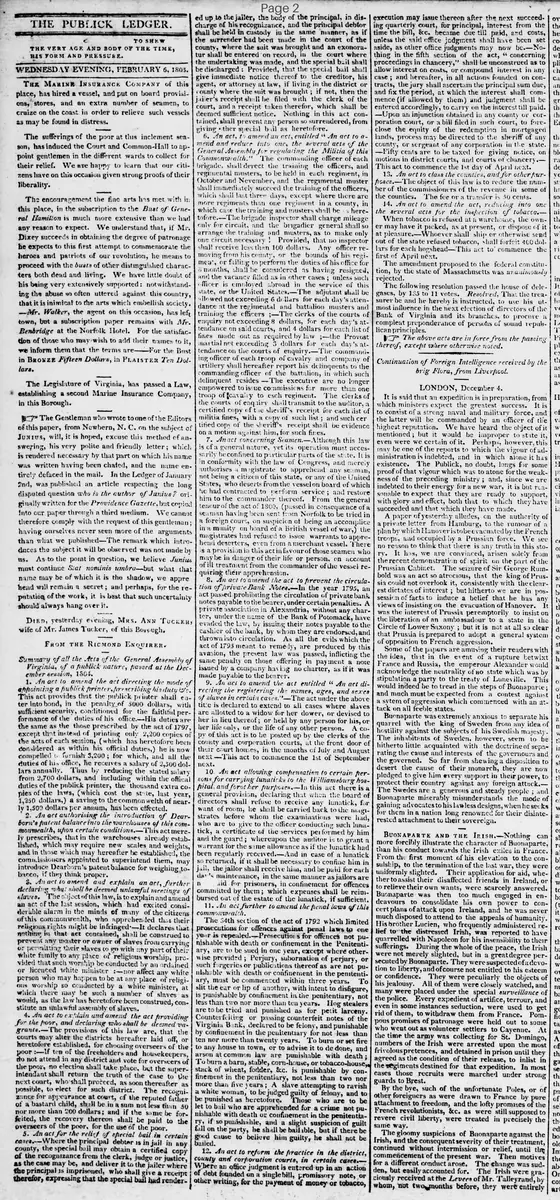
Summary of all the Acts of the General Assembly of Virginia, of a publick nature, passed at the December Session, 1804.
1. An act to amend the act directing the mode of appointing a publick printer, prescribing his duty &c. This act provides that the publick printer shall enter into bond, in the penalty of 5000 dollars, with sufficient security, conditioned for the faithful performance of the duties of his office.—His duties are the same as those prescribed by the act of 1797, except that instead of printing only 2,200 copies of the acts of each session, (which has heretofore been considered as within his official duties,) he is now compelled to furnish 3,200; for which, and all the duties of his office, he receives a salary of 2,500 dollars annually. Thus by reducing the stated salary from 2,700 dollars, and including within the official duties of the publick printer, the thousand extra copies of the laws, (which cost the state, last year, 1,250 dollars,) a saving to the commonwealth of nearly 1,500 dollars per annum, has been effected.
2. An act authorising the introduction of Dearborn's patent balance into the warehouses of this commonwealth, upon certain conditions.—This act merely prescribes, that in the warehouses already established, which may require new scales and weights, and in those which may hereafter be established, the commissioners appointed to superintend them, may introduce Dearborn's patent balance for weighing tobacco, if they think proper.
3. An act to amend and explain an act, further declaring what shall be deemed unlawful meetings of slaves. The object of this law, is to explain and amend an act of the last session, which had excited considerable alarm in the minds of many of the citizens of this commonwealth, who apprehended that their religious rights might be infringed—It declares that nothing in that act contained, shall be construed to prevent any master or owner of slaves from carrying or permitting their slaves to go with any part of their white family to any place of religious worship, provided that such worship be conducted by an ordained or licenced white minister:—nor affect any white person who may happen to be at any place of religious worship so conducted by a white minister, at which there may be such a number of slaves as would, as the law has heretofore been construed, constitute an unlawful assembly of slaves.
4. An act to explain and amend the act providing for the poor, and declaring who shall be deemed vagrants.—The provisions of this law are, that the courts may alter the districts hereafter laid off, or heretofore established, for choosing overseers of the poor:—if ten of the freeholders and housekeepers, do not attend in any district and vote for overseers of the poor, no election shall take place, but the superintendent shall return the truth of the case to the next court, who shall proceed, as soon thereafter as possible, to elect for such district. The recognizance for appearance at court, of the reputed father of a bastard child, shall be in a sum not less than 50 nor more than 200 dollars; and if the same be forfeited, the recovery thereon shall be paid to the overseers of the poor, for the use of the poor.
5. An act for the relief of special bail in certain cases.—Where the principal debtor is in jail in any county, the special bail may obtain a certified copy of the recognizance from the clerk, judge or justice, as the case may be, and deliver it to the jailer where the principal is imprisoned, who shall give a receipt therefor, expressing that the special bail had rendered up to the jailer, the body of the principal, in discharge of his recognizance, and the principal debtor shall be held in custody in the same manner, as if the surrender had been made in the court of the county, where the suit was brought and an exoneratur shall be entered on record, in the court where the undertaking was made, and the special bail shall be discharged: Provided, that the special bail shall give immediate notice thereof to the creditor, his agent, or attorney at law, if living in the district or county where the suit was brought; if not, then the jailer's receipt shall be filed with the clerk of the court, and a receipt taken therefor, which shall be deemed sufficient notice. Nothing in this act contained, shall prevent any person so surrendered, from giving their special bail as heretofore.
6. An act, to amend an act, entitled 'An act to amend and reduce into one, the several acts of the General Assembly for regulating the Militia of this Commonwealth.' The commanding officer of each brigade, shall direct the training the officers, and regimental musters, to be held in each regiment, in October and November, and the regimental muster shall immediately succeed the training of the officers, which shall last three days, except where there are more regiments than one regiment in a county, in which case the training and musters shall be as heretofore.—The brigade inspector shall charge mileage only for circuit, and the brigadier general shall so arrange the training and musters, as to make only one circuit necessary! Provided, that no inspector shall receive less than 100 dollars. Any officer removing from his county, or the bounds of his regiment, or failing to perform the duties of his office for 8 months, shall be considered as having resigned, and the vacancy filled as in other cases; unless such officer is employed abroad in the service of this state, or the United States.—The adjutant shall be allowed not exceeding 6 dollars for each day's attendance at the regimental and battalion musters and training the officers:—The clerks of the courts of enquiry not exceeding 8 dollars, for each day's attendance on said courts, and 4 dollars for each list of fines made out as required by law;—the Provost martial not exceeding 3 dollars for each day's attendance on the courts of enquiry.—The commanding officer of each troop of cavalry and company of artillery shall hereafter report his delinquents to the commanding officer of the battalion, in which such delinquent resides—The executive are no longer empowered to issue commissions for more than one troop of cavalry to each regiment. The clerks of the courts of enquiry shall transmit to the auditor, a certified copy of the sheriff's receipt for each list of militia fines, with a copy of such list; and such certified copy of the sheriff's receipt shall be evidence on a motion against him, for such fines.
7. An act concerning Seamen.—Although this law is of a general nature, yet its operation must necessarily be confined to particular parts of the state. It is in conformity with the law of Congress, and merely authorises a magistrate to apprehend any seaman, not being a citizen of this state, or any of the United States, who deserts from the vessel on board of which he had contracted to perform service; and restore him to the commander thereof. From the general tenor of the act of 1800, (passed in consequence of a seaman having been sent from Norfolk to be tried in a foreign court, on suspicion of being an accomplice in a mutiny on board of a British vessel of war,) the magistrates had refused to issue warrants to apprehend deserters, even from a merchant vessel. There is a provision in this act in favour of those seamen who may be in danger of their life or person, on account of ill treatment from the commander of the vessel requiring their apprehension.
8. An act to amend the act to prevent the circulation of private Bank Notes. In the year 1795, an act passed prohibiting the circulation of private bank notes payable to the bearer, under certain penalties. A private association in Alexandria, without any charter, under the name of the Bank of Potomac, have evaded the law, by issuing their notes payable to the cashier of the bank, by whom they are endorsed, and thrown into circulation. As all the evils which the act of 1795 meant to remedy, are produced by this evasion, the present law was passed, inflicting the same penalty on those offering in payment a note issued by a company having no charter, as if it was made payable to the bearer.
9. An act to amend the act entitled 'An act directing the registering the names, ages, and sexes of slaves in certain cases.' The act under the above title is declared to extend to all cases where slaves are allotted to a widow for her dower, or devised to her in lieu thereof; or held by any person for his, or her life only, or the life of any other person. A copy of this act is to be posted up by the clerks of the county and corporation courts, at the front door of their court houses, in the months of July and August next—This act to commence the 1st of September next.
10. An act allowing compensation to certain persons for carrying lunaticks to the Williamsburg hospital, and for other purposes.—In this act there is a general provision, declaring that when the board of directors shall refuse to receive any lunatick, for want of room, he shall be carried back to the magistrates before whom the examinations were had, who are to give to the officer conducting such lunatick, a certificate of the services performed by him and the guard; whereupon the auditor is to grant a warrant for the same allowance as if the lunatick had been regularly received.—And in case of a lunatick so returned, if it shall be necessary to confine him in jail, the jailor shall receive him, and be paid for each day's maintenance, in the same manner as jailors are paid for prisoners, in confinement for offences committed by them; which expenses shall be reimbursed out of the estate of the lunatick, if sufficient.
11. An act further to amend the penal laws of this commonwealth. The 54th section of the act of 1792 which limited prosecutions for offences against penal laws to one year is repealed.—Prosecutions for offences not punishable with death or confinement in the Penitentiary, are to be sued in one year, except where otherwise provided; Perjury, subornation of perjury, or such forgeries or publications thereof as are not punishable with death or confinement in the penitentiary, must be commenced within three years. To slit the ear or lip of another, with intent to disfigure, is punishable by confinement in the penitentiary, not less than two nor more than ten years. Hog stealers are to be tried and punished as for petit larceny. Counterfeiting or passing counterfeit notes of the Virginia Bank, declared to be felony, and punishable by confinement in the penitentiary for not less than ten nor more than twenty years. To burn or set fire to any house in town, or to advise it to be done, and arson at common law are punishable with death; To burn a barn, stable, corn-house, or tobacco-house, stack of wheat, fodder, &c. is punishable by confinement in the penitentiary, not less than two nor more than five years; A slave attempting to ravish a white woman, to be judged guilty of felony, and to be punished as heretofore. Those who are to be let to bail who are apprehended for a crime not punishable with death or confinement in the penitentiary, if so punishable, and a slight suspicion of guilt fall on the party, he shall be bailable, but if there be good cause to believe him guilty, he shall not be bailed.
12. An act to reform the practice in the district, county and corporation courts, in certain cases.—Where an office judgment is entered up in an action of debt founded on a single bill, promissory note, or other writing, for the payment of money or tobacco, execution may issue thereon after the next succeeding quarterly court, for principal, interest from the time the bill, &c. became due till paid, and costs, unless the said office judgment shall have been set aside, as other office judgments may now be.—Nothing in the fifth section of the act, 'concerning proceedings in chancery,' shall be unconstrued as to allow interest on costs, or compound interest in any case; and hereafter, in all actions founded on contracts, the jury shall ascertain the principal sum due, and fix the period, at which the interest shall commence (if allowed by them) and judgment shall be entered accordingly, to carry on the interest till paid. —Upon an injunction obtained in any county or corporation court, or a bill filed in such court, to foreclose the equity of the redemption in mortgaged lands, process may be directed to the sheriff of any county, or sergeant of any corporation in the state. —Fifty cents are to be taxed for giving notice, on motions in district courts, and courts of chancery.— This act to commence the 1st day of April next.
13. An act to class the counties, and for other purposes.—The object of this law is to reduce the number of the commissioners of the revenue in some of the counties. The fee for a transfer is 50 cents.
14. An act to amend the act, reducing into one the several acts for the inspection of tobacco.— When tobacco is refused at a warehouse, the owner may have it picked, as at present, or dispose of it at pleasure.—Whoever shall ship or otherwise send out of the state refused tobacco, shall forfeit 400 dollars for each hogshead—This act to commence the first of April next.
The amendment proposed to the federal constitution, by the state of Massachusetts was unanimously rejected.
The following resolution passed the house of delegates, by 135 to 11 votes. Resolved, That the treasurer be and he hereby is instructed, to use his utmost influence in the next election of directors of the Bank of Virginia and its branches, to procure a compleat preponderance of persons of sound republican principles.
The above acts are in force from the passing thereof, except where otherwise noted.
What sub-type of article is it?
What keywords are associated?
Where did it happen?
Domestic News Details
Primary Location
Virginia
Event Date
December 1804
Event Details
Summary of 14 public acts passed by the Virginia General Assembly during the December 1804 session, including amendments to laws on public printer, tobacco weighing, slave meetings, poor relief, special bail, militia regulations, seamen, bank notes, slave registration, lunatics, penal laws, court practices, county classification, and tobacco inspection. Additional notes on unanimous rejection of a Massachusetts-proposed federal constitutional amendment and a resolution (135-11) instructing the treasurer to influence Bank of Virginia director elections toward republican principles.