Thank you for visiting SNEWPapers!
Sign up free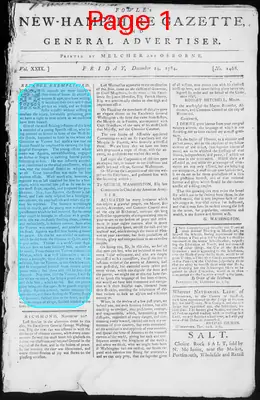
Fowle's New Hampshire Gazette And General Advertiser
Portsmouth, Rockingham County, New Hampshire
What is this article about?
Young Spanish officer Aguirre is publicly whipped for violating a law against employing Indians for baggage in the West Indies. Humiliated, he pursues the Viceroy across 9000 miles to Havana, Quito, Mexico, and beyond, eventually stabbing him to death and then himself.
Merged-components note: The image overlaps spatially with the bounding box of the story and is likely an illustration for the 'REVENGE EXEMPLIFIED' narrative.
Clipping
OCR Quality
Full Text
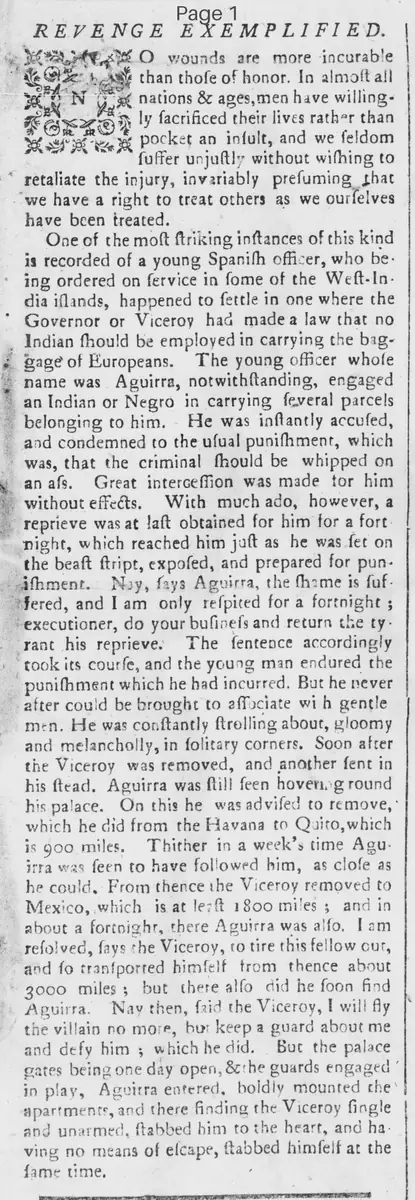
No wounds are more incurable than those of honor. In almost all nations & ages, men have willingly sacrificed their lives rather than pocket an insult, and we seldom suffer unjustly without wishing to retaliate the injury, invariably presuming that we have a right to treat others as we ourselves have been treated.
One of the most striking instances of this kind is recorded of a young Spanish officer, who being ordered on service in some of the West-Indies, happened to settle in one where the Governor or Viceroy had made a law that no Indian should be employed in carrying the baggage of Europeans. The young officer whose name was Aguirre, notwithstanding, engaged an Indian or Negro in carrying several parcels belonging to him. He was instantly accused, and condemned to the usual punishment, which was, that the criminal should be whipped on an ass. Great intercession was made for him without effect. With much ado, however, a reprieve was at last obtained for him for a fortnight, which reached him just as he was set on the beast stripped, exposed, and prepared for punishment. Now, says Aguirre, the shame is suffered, and I am only respited for a fortnight; executioner, do your business and return me the warrant of his reprieve. The sentence accordingly took its course, and the young man endured the punishment which he had incurred. But he never after could be brought to associate with gentlemen. He was constantly strolling about, gloomy and melancholy, in solitary corners. Soon after the Viceroy was removed, and another sent in his stead. Aguirre was still seen hovering round his palace. On this he was advised to remove, which he did from the Havana to Quito, which is 900 miles. Thither in a week's time Aguirre was seen to have followed him, as close as he could. From thence the Viceroy removed to Mexico, which is at least 1800 miles: and in about a fortnight, there Aguirre was also. I am resolved, says the Viceroy, to tire this fellow out, and so transported himself from thence about 3000 miles; but there also did he soon find Aguirre. Nay then, said the Viceroy, I will fly the villain no more, but keep a guard about me and defy him; which he did. But the palace gates being one day open, & the guards engaged in play, Aguirre entered, boldly mounted the apartments, and there finding the Viceroy single and unarmed, stabbed him to the heart, and having no means of escape, stabbed himself at the same time.
What sub-type of article is it?
What themes does it cover?
What keywords are associated?
What entities or persons were involved?
Where did it happen?
Story Details
Key Persons
Location
West Indies, Havana, Quito, Mexico
Story Details
Young officer Aguirre is whipped publicly for employing an Indian carrier against the Viceroy's law. Enduring the shame, he pursues the Viceroy over thousands of miles across colonies, finally assassinating him and then committing suicide.