Thank you for visiting SNEWPapers!
Sign up free
Editorial
July 14, 1896
Evening Bulletin
Honolulu, Honolulu County, Hawaii
What is this article about?
Editorial examines Chinese and Japanese competition in Honolulu's trade and labor, crediting economic growth to agricultural expansion like sugar, coffee, and pineapple, but urges government restrictions on further Asiatic immigration to safeguard local social and political development.
Clipping
OCR Quality
98%
Excellent
Full Text
ASIATIC COMPETITION
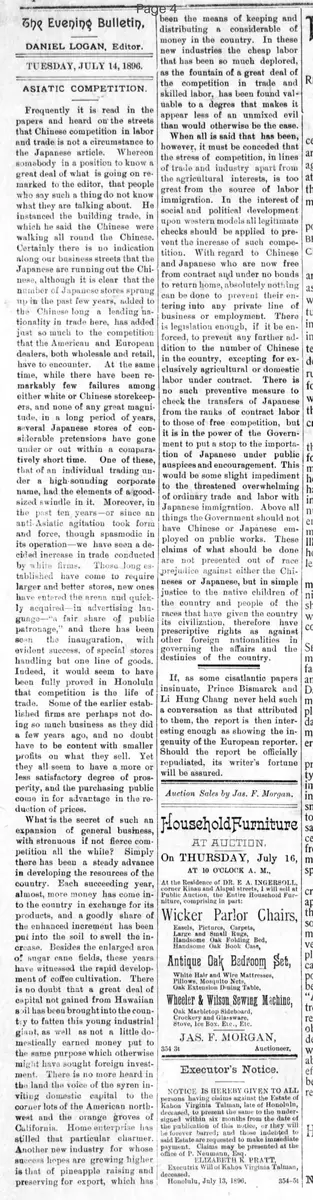
Frequently it is read in the papers and heard on the streets that Chinese competition in labor and trade is not a circumstance to the Japanese article. Whereon somebody in a position to know a great deal of what is going on remarked to the editor, that people who say such a thing do not know what they are talking about. He instanced the building trade, in which he said the Japanese were walking all round the Chinese. Certainly there is no indication along our business streets that the Japanese are running out the Chinese, although it is clear that the number of Japanese stores sprung up in the past few years, added to the Chinese long a leading nationality in trade here, has added just so much to the competition that the American and European dealers, both wholesale and retail have to encounter. At the same time, while there have been remarkably few failures among either white or Chinese storekeepers, and none of any great magnitude, in a long period of years. Several Japanese stores of considerable pretensions have gone under or out within a comparatively short time. One of these, that of an individual trading under a high-sounding corporate name, had the elements of a good sized swindle in it. Moreover, in the past ten years—or since an anti-Asiatic agitation took form and force, though spasmodic in its operation—we have seen a decided increase in trade conducted by white firms. Those long established have come to require larger and better stores, new ones have entered the arena and quickly acquired—in advertising language—'a fair share of public patronage,' and there has been seen the inauguration, with evident success, of special stores handling but one line of goods. Indeed, it would seem to have been fully proved in Honolulu that competition is the life of trade. Some of the earlier established firms are perhaps not doing so much business as they did a few years ago, and no doubt have to be content with smaller profits on what they sell. Yet they all seem to have a more or less satisfactory degree of prosperity, and the purchasing public come in for advantage in the reduction of prices.
What is the secret of such an expansion of general business, with strenuous if not fierce competition all the while? Simply there has been a steady advance in developing the resources of the country. Each succeeding year, almost, more money has come into the country in exchange for its products, and a goodly share of the enhanced increment has been put into the soil to swell the increase. Besides the enlarged area of sugar cane fields, these years have witnessed the rapid development of coffee cultivation. There is no doubt that a great deal of capital not gained from Hawaiian soil has been brought into the country to fatten this young industrial giant, as well as not a little domestically earned money put to the same purpose which otherwise might have sought foreign investment. There is no more heard in the land the voice of the syren inviting domestic capital to the corner lots of the American northwest and the orange groves of California. Home enterprise has stilled that particular charmer. Another new industry for whose success hopes are growing higher is that of pineapple raising and preserving for export, which has been the means of keeping and distributing a considerable of money in the country. In these new industries the cheap labor that has been so much deplored, as the fountain of a great deal of the competition in trade and skilled labor, has been found valuable to a degree that makes it appear less of an unmixed evil than would otherwise be the case. When all is said that has been, however, it must be conceded that the stress of competition, in lines of trade and industry apart from the agricultural interests, is too great from the source of labor immigration. In the interest of social and political development upon western models all legitimate checks should be applied to prevent the increase of such competition. With regard to Chinese and Japanese who are now free from contract and under no bonds to return home, absolutely nothing can be done to prevent their entering into any private line of business or employment. There is legislation enough, if it be enforced, to prevent any further addition to the number of Chinese in the country, excepting for exclusively agricultural or domestic labor under contract. There is no such preventive measure to check the transfers of Japanese from the ranks of contract labor to those of free competition, but it is in the power of the Government to put a stop to the importation of Japanese under public auspices and encouragement. This would be some slight impediment to the threatened overwhelming of ordinary trade and labor with Japanese immigration. Above all things the Government should not have Chinese or Japanese employed on public works. These claims of what should be done are not presented out of race prejudice against either the Chinese or Japanese, but in simple justice to the native children of the country and people of the races that have given the country its civilization, therefore have prescriptive rights as against other foreign nationalities in governing the affairs and the destinies of the country.
Frequently it is read in the papers and heard on the streets that Chinese competition in labor and trade is not a circumstance to the Japanese article. Whereon somebody in a position to know a great deal of what is going on remarked to the editor, that people who say such a thing do not know what they are talking about. He instanced the building trade, in which he said the Japanese were walking all round the Chinese. Certainly there is no indication along our business streets that the Japanese are running out the Chinese, although it is clear that the number of Japanese stores sprung up in the past few years, added to the Chinese long a leading nationality in trade here, has added just so much to the competition that the American and European dealers, both wholesale and retail have to encounter. At the same time, while there have been remarkably few failures among either white or Chinese storekeepers, and none of any great magnitude, in a long period of years. Several Japanese stores of considerable pretensions have gone under or out within a comparatively short time. One of these, that of an individual trading under a high-sounding corporate name, had the elements of a good sized swindle in it. Moreover, in the past ten years—or since an anti-Asiatic agitation took form and force, though spasmodic in its operation—we have seen a decided increase in trade conducted by white firms. Those long established have come to require larger and better stores, new ones have entered the arena and quickly acquired—in advertising language—'a fair share of public patronage,' and there has been seen the inauguration, with evident success, of special stores handling but one line of goods. Indeed, it would seem to have been fully proved in Honolulu that competition is the life of trade. Some of the earlier established firms are perhaps not doing so much business as they did a few years ago, and no doubt have to be content with smaller profits on what they sell. Yet they all seem to have a more or less satisfactory degree of prosperity, and the purchasing public come in for advantage in the reduction of prices.
What is the secret of such an expansion of general business, with strenuous if not fierce competition all the while? Simply there has been a steady advance in developing the resources of the country. Each succeeding year, almost, more money has come into the country in exchange for its products, and a goodly share of the enhanced increment has been put into the soil to swell the increase. Besides the enlarged area of sugar cane fields, these years have witnessed the rapid development of coffee cultivation. There is no doubt that a great deal of capital not gained from Hawaiian soil has been brought into the country to fatten this young industrial giant, as well as not a little domestically earned money put to the same purpose which otherwise might have sought foreign investment. There is no more heard in the land the voice of the syren inviting domestic capital to the corner lots of the American northwest and the orange groves of California. Home enterprise has stilled that particular charmer. Another new industry for whose success hopes are growing higher is that of pineapple raising and preserving for export, which has been the means of keeping and distributing a considerable of money in the country. In these new industries the cheap labor that has been so much deplored, as the fountain of a great deal of the competition in trade and skilled labor, has been found valuable to a degree that makes it appear less of an unmixed evil than would otherwise be the case. When all is said that has been, however, it must be conceded that the stress of competition, in lines of trade and industry apart from the agricultural interests, is too great from the source of labor immigration. In the interest of social and political development upon western models all legitimate checks should be applied to prevent the increase of such competition. With regard to Chinese and Japanese who are now free from contract and under no bonds to return home, absolutely nothing can be done to prevent their entering into any private line of business or employment. There is legislation enough, if it be enforced, to prevent any further addition to the number of Chinese in the country, excepting for exclusively agricultural or domestic labor under contract. There is no such preventive measure to check the transfers of Japanese from the ranks of contract labor to those of free competition, but it is in the power of the Government to put a stop to the importation of Japanese under public auspices and encouragement. This would be some slight impediment to the threatened overwhelming of ordinary trade and labor with Japanese immigration. Above all things the Government should not have Chinese or Japanese employed on public works. These claims of what should be done are not presented out of race prejudice against either the Chinese or Japanese, but in simple justice to the native children of the country and people of the races that have given the country its civilization, therefore have prescriptive rights as against other foreign nationalities in governing the affairs and the destinies of the country.
What sub-type of article is it?
Immigration
Economic Policy
Labor
What keywords are associated?
Asiatic Competition
Japanese Immigration
Chinese Labor
Honolulu Trade
Agricultural Development
Labor Restrictions
Economic Expansion
What entities or persons were involved?
Chinese
Japanese
American And European Dealers
Government
Native Children
White Firms
Editorial Details
Primary Topic
Asiatic Competition In Honolulu Trade And Labor
Stance / Tone
Advocating Restrictions On Asiatic Immigration To Protect Local Interests
Key Figures
Chinese
Japanese
American And European Dealers
Government
Native Children
White Firms
Key Arguments
Japanese Competition Rivals Or Exceeds Chinese In Some Sectors Like Building Trade
Increased Asiatic Stores Heighten Competition But White Firms Have Expanded Successfully
Economic Growth Stems From Agricultural Development In Sugar, Coffee, And Pineapple
Cheap Asiatic Labor Benefits Agriculture But Harms Non Agricultural Trade And Skilled Labor
Enforce Laws To Limit Chinese Immigration Except For Contracted Agricultural/Domestic Work
Stop Government Encouraged Japanese Importation And Employment On Public Works
Restrictions Needed For Social And Political Development On Western Models, Not Racial Prejudice