Thank you for visiting SNEWPapers!
Sign up free
The Virginia Gazette
Richmond, Williamsburg, Richmond County, Virginia
What is this article about?
This editorial critiques the shift from elective to hereditary monarchy in England, arguing that elective kingship fosters liberty and progress while hereditary rule leads to tyranny and decline. It traces English history from Anglo-Saxon times through various monarchs, highlighting lost opportunities to restore elective governance.
Merged-components note: These two components form a single continuous essay on the transition from elective to hereditary monarchy in England, with opinionated historical analysis; the second component continues directly from the incomplete sentence in the first.
Clippings
1 of 2
OCR Quality
Full Text
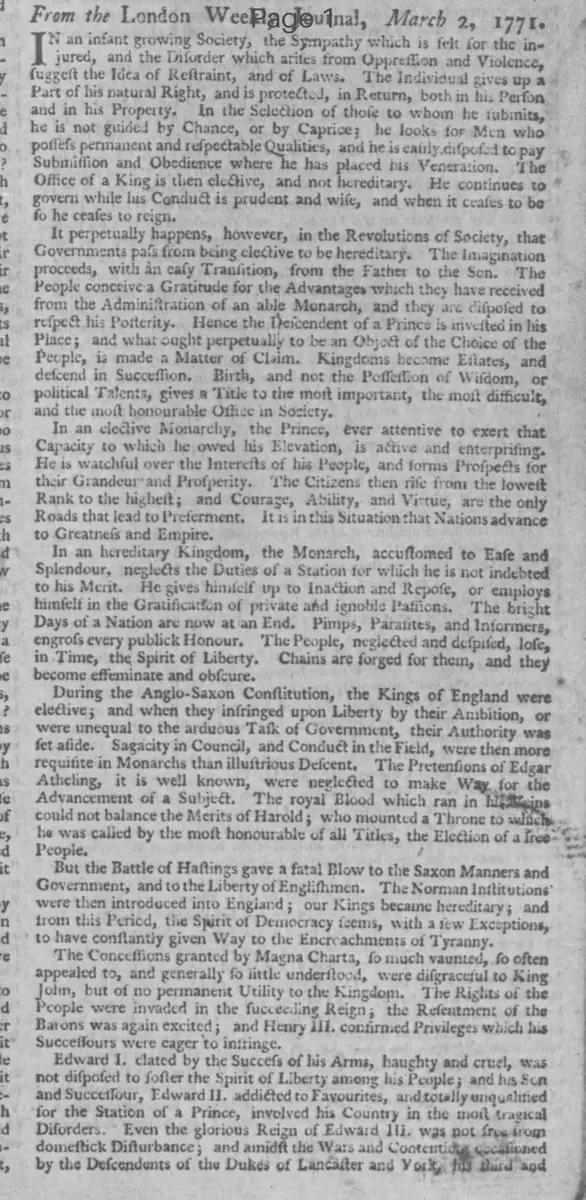
It perpetually happens, however, in the Revolutions of Society, that Governments pass from being elective to be hereditary. The Imagination proceeds, with an easy Transition, from the Father to the Son. The People conceive a Gratitude for the Advantages which they have received from the Administration of an able Monarch, and they are disposed to repeat his Posterity. Hence the Descendent of a Prince is invested in his Place; and what ought perpetually to be an Object of the Choice of the People, is made a Matter of Claim. Kingdoms become Estates, and descend in Succession. Birth, and not the Possession of Wisdom, or political Talents, gives a Title to the most important, the most difficult, and the most honourable Office in Society.
In an elective Monarchy, the Prince, ever attentive to exert that Capacity to which he owed his Elevation, is active and enterprising. He is watchful over the Interests of his People, and forms Projects for their Grandeur and Prosperity. The Citizens then rise from the lowest Rank to the highest; and Courage, Ability, and Virtue, are the only Roads that lead to Preferment. It is in this Situation that Nations advance to Greatness and Empire.
In an hereditary Kingdom, the Monarch, accustomed to Ease and Splendour, neglects the Duties of a Station for which he is not indebted to his Merit. He gives himself up to Inaction and Repose, or employs himself in the Gratification of private and ignoble Passions. The bright Days of a Nation are now at an End. Pimps, Parasites, and Informers, engross every publick Honour. The People, neglected and despised, lose, in Time, the Spirit of Liberty. Chains are forged for them, and they become effeminate and obscure.
During the Anglo-Saxon Constitution, the Kings of England were elective; and when they infringed upon Liberty by their Ambition, or were unequal to the arduous Task of Government, their Authority was set aside. Sagacity in Council, and Conduct in the Field, were then more requisite in Monarchs than illustrious Descent. The Pretensions of Edgar Atheling, it is well known, were neglected to make Way for the Advancement of a Subject. The royal Blood which ran in his Veins could not balance the Merits of Harold; who mounted a Throne to which he was called by the most honourable of all Titles, the Election of a free People.
But the Battle of Hastings gave a fatal Blow to the Saxon Manners and Government, and to the Liberty of Englishmen. The Norman Institutions were then introduced into England; our Kings became hereditary; and from this Period, the Spirit of Democracy seems, with a few Exceptions, to have constantly given Way to the Encroachments of Tyranny.
The Concessions granted by Magna Charta, so much vaunted, so often appealed to, and generally so little understood, were disgraceful to King John, but of no permanent Utility to the Kingdom. The Rights of the People were invaded in the succeeding Reign; the Resentment of the Barons was again excited; and Henry III. confirmed Privileges which his Successours were eager to infringe.
Edward I. elated by the Success of his Arms, haughty and cruel, was not disposed to foster the Spirit of Liberty among his People; and his Son and Successour, Edward II. addicted to Favourites, and totally unqualified for the Station of a Prince, involved his Country in the most tragical Disorders. Even the glorious Reign of Edward III. was not free from domestick Disturbance; and amidst the Wars and Contention occasioned by the Descendents of the Dukes of Lancaster and York, his third and
If the ancient Saxons had continued to elect their Kings, the Spirit of Democracy was banished from among the People; who ambitiously contended to support the two famous Factions, known under the Names of the Red and White Roses. They should have returned to their ancient Method of Election; they should have set aside the Pretensions of the Chiefs; and England would not have been deluged with Blood for near a Century.
Richard II. had neither Capacity nor Honesty; Henry IV. governed his Subjects more by Terror than Affection; and under both, the royal Prerogative was rather increased than diminished. Henry V. able and ambitious, added to the Pretensions of the Crown; and, if the Incapacity of Henry VI. rendered him of little Importance, the Conduct of his Queen was exorbitant and tyrannical, and introduced those Disorders which paved the Way for the Usurpation of Richard III.
Henry VII. by introducing the Alienation of Property in Land, disabled the Nobles from opposing his Measures; and the Reign of Henry VIII. was as absolute as that of an eastern Despot. The Government of Mary was not less violent and sanguinary. The Administration of Elizabeth was attended with Advantages, but these Advantages did not respect the Liberty of the Subject. King James was quite enamoured of Prerogative, and inculcated in his unfortunate Son those Maxims which brought him to the Scaffold. The Death of Charles opened the Way for the Advancement of Cromwell, who governed without Controul; and the Tyranny of the Protectorship was succeeded by the Return of Royalty. The People had it in their Power to new model the Government, and lost the Opportunity.
Charles II. though indolent, and addicted to Pleasure, was yet sagacious and political. He promoted the Interest of the Crown, by removing every Suspicion from the People. His Sceptre passed, with Tranquillity, into the Hands of the Duke of York. James II. was ambitious, but possessed no political Talents. His Pride did not allow him to conceal his Views. Revengeful, obstinate, and cruel, he could not desist from Enterprizes of which it was easy to foresee the Consequences. He fled from a Throne, under the Ruins of which he should have perished; and the English had another Opportunity to make their Crown elective. The Cabals of a Faction prevailed over the Prospect of Liberty, and the Prince of Orange was called to the Government of England. King William, of a dark and severe Disposition, distrustful and jealous, inflexible, and ignorant of the People whom he was to govern, acted rather with the Caprice and Humour of a Tyrant than the Tenderness of a Prince who respects his People and the Laws. Men protected in their religious Rights felt too strongly the Obligation, and were not sufficiently careful to attend to their civil Privileges. The Reserve of this Monarch was explained into political Discernment and Prudence; and though he scarce ever attempted a Siege which he did not raise, and never fought a Battle which he did not lose, he has been extolled as a Prodigy of Heroism.
The immediate Successors of William did not relinquish the Plan of acting to the regal Prerogatives; and at present, we have to dread, it is thought, the Encroachments of a Power that would overthrow every Claim of the Subject. In the constant War which has subsisted between the King and the People since the Conquest of the Duke of Normandy, we may perceive the Disadvantage of an hereditary Form of Administration; but though the People, at present, complain of Grievances and Infringements, we trust that they are rather alarmed than oppressed. In those Junctures, however, of a State, when Indignities are carried to Extremity, and when the most valuable Rights of the People are invaded, they look into History; and contemplating the elective Form, and the Liberty of the Saxon Constitution, may perceive a Remedy to their Calamities. The sacred Flame that burns in the Bosom of the Patriot will, in such a Situation, be transported from one Citizen to another; one glorious Effort will remove them from the Attempts of Tyranny, and place them under a Government where the Prince will owe to his Merit his Advancement, and the Continuance of his Dignity.
What sub-type of article is it?
What keywords are associated?
What entities or persons were involved?
Editorial Details
Primary Topic
Shift From Elective To Hereditary Monarchy In England And Its Impact On Liberty
Stance / Tone
Critical Of Hereditary Monarchy, Advocating Elective Kingship To Preserve Liberty
Key Figures
Key Arguments