Thank you for visiting SNEWPapers!
Sign up free
The New Hampshire Gazette
Portsmouth, Rockingham County, New Hampshire
What is this article about?
U.S. House of Representatives proceedings from February 2-5, covering debates on military establishment reduction and continuation, national debt interest payments, fortifications report, duties on snuff, ship Enterprize drawback, post-office amendments, manufactures memorials, old government debts, and sugar refiners' remonstrance.
Merged-components note: These two components form a continuous report on Federal House of Representatives proceedings from February 2 to 5, 1795; sequential reading orders and adjacent spatial positions confirm they belong to the same story.
Clipping
OCR Quality
Full Text
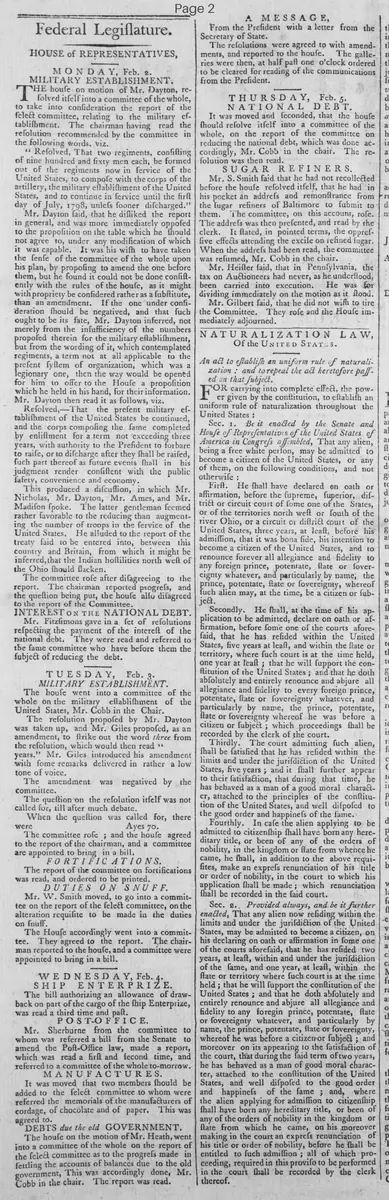
HOUSE of REPRESENTATIVES,
MONDAY, Feb. 2.
MILITARY ESTABLISHMENT.
The house on motion of Mr. Dayton, resolved itself into a committee of the whole, to take into consideration the report of the select committee, relating to the military establishment. The chairman having read the resolution recommended by the committee in the following words, viz.
"Resolved, That two regiments, consisting of nine hundred and sixty men each, be formed out of the regiments now in service of the United States, to compose with the corps of the artillery, the military establishment of the United States, and to continue in service until the first day of July, 1798, unless sooner discharged."
Mr. Dayton said, that he disliked the report in general, and was more immediately opposed to the proposition on the table which he should not agree to, under any modification of which it was capable. It was his wish to have taken the sense of the committee of the whole upon his plan, by proposing to amend the one before them, but he found it could not be done consistently with the rules of the house, as it might with propriety be considered rather as a substitute, than an amendment. If the one under consideration should be negatived, and that such ought to be its fate, Mr. Dayton inferred, not merely from the insufficiency of the numbers proposed therein for the military establishment, but from the wording of it, which contemplated regiments, a term not at all applicable to the present system of organization, which was a legionary one, then the way would be opened for him to offer to the House a proposition which he held in his hand, for their information.
Mr. Dayton then read it as follows, viz.
Resolved, That the present military establishment of the United States be continued, and the corps composing the same completed by enlistment for a term not exceeding three years, with authority to the President to forbear to raise, or to discharge after they shall be raised, such part thereof as future events shall in his judgment render consistent with the public safety, convenience and economy.
This produced a discussion, in which Mr. Nicholas, Mr. Dayton, Mr. Ames, and Mr. Madison spoke. The latter gentleman seemed rather favorable to the reducing than augmenting the number of troops in the service of the United States. He alluded to the report of the treaty said to be entered into, between this country and Britain, from which it might be inferred, that the Indian hostilities northwest of the Ohio should slacken.
The committee rose after disagreeing to the report. The chairman reported progress, and the question being put, the house also disagreed to the report of the Committee.
INTEREST ON THE NATIONAL DEBT
Mr. Fitzsimons gave in a set of resolutions respecting the payment of the interest of the national debt. They were read and referred to the same committee who have before them the subject of reducing the debt.
TUESDAY, Feb. 3.
MILITARY ESTABLISHMENT
The house went into a committee of the whole on the military establishment of the United States, Mr. Cobb in the Chair. The resolution proposed by Mr. Dayton was taken up, and Mr. Giles proposed, as an amendment, to strike out the word three from the resolution, which would then read years. Mr. Giles introduced his amendment with some remarks delivered in rather a low tone of voice.
The amendment was negatived by the committee.
The question on the resolution itself was not called for, till after much debate.
When the question was called for, there were
Ayes 70.
The committee rose; and the house agreed to the report of the chairman, and a committee are appointed to bring in a bill.
FORTIFICATIONS
The report of the committee on fortifications was read, and ordered to be printed.
DUTIES ON SNUFF.
Mr. W. Smith moved, to go into a committee on the report of the select committee, on the alteration requisite to be made in the duties on snuff.
The House accordingly went into a committee. They agreed to the report. The chairman reported to the house, and a committee were appointed to bring in a bill.
WEDNESDAY, Feb. 4.
SHIP ENTERPRIZE.
The bill authorizing an allowance of drawback on part of the cargo of the ship Enterprize, was read a third time and passed.
POST-OFFICE.
Mr. Sherburne from the committee to whom was referred a bill from the Senate to amend the Post-Office law, made a report, which was read a first and second time, and referred to a committee of the whole to-morrow.
MANUFACTURES.
It was moved that two members should be added to the select committee to whom were referred the memorials of the manufacturers of cordage, of chocolate and of paper. This was agreed to.
DEBTS due the old GOVERNMENT.
The house on the motion of Mr. Heath, went into a committee of the whole on the report of the select committee as to the progress made in settling the accounts of balances due to the old government. This was accordingly done, Mr. Cobb in the chair. The report was read.
A MESSAGE.
From the President with a letter from the Secretary of State.
The resolutions were agreed to with amendments, and reported to the house. The galleries were then, at half past one o'clock ordered to be cleared for reading of the communications from the President.
THURSDAY, Feb. 5.
NATIONAL DEBT.
It was moved and seconded, that the house should resolve itself into a committee of the whole, on the report of the committee on reducing the national debt, which was done accordingly, Mr. Cobb in the chair. The resolution was then read.
SUGAR REFINERS.
Mr. S. Smith said that he had not recollected before the house resolved itself, that he had in his pocket an address and remonstrance from the sugar refiners of Baltimore to submit to them. The committee, on this account, rose.
The address was then presented, and read by the clerk. It stated, in pointed terms, the oppressive effects attending the excise on refined sugar.
When the address had been read, the committee was resumed, Mr. Cobb in the chair.
Mr. Heister said, that in Pennsylvania, the tax on Auctioneers had never, as he understood, been carried into execution. He was for dividing immediately on the motion as it stood.
Mr. Gilbert said, that he did not wish to tire the Committee. They rose and the House immediately adjourned.
What sub-type of article is it?
What themes does it cover?
What keywords are associated?
What entities or persons were involved?
Where did it happen?
Story Details
Key Persons
Location
United States House Of Representatives
Event Date
Feb. 2 To Feb. 5
Story Details
The House debated and rejected a proposal to form two new regiments for the military establishment, instead adopting Mr. Dayton's resolution to continue and complete the existing establishment for up to three years with presidential discretion. Other matters included resolutions on national debt interest, fortifications report, duties on snuff, ship Enterprize bill passage, post-office amendments, manufactures committee expansion, old government debts settlement, and sugar refiners' remonstrance against excise taxes.