Thank you for visiting SNEWPapers!
Sign up free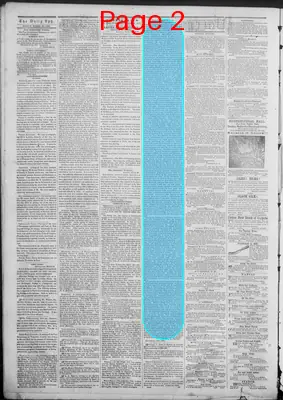
Editorial
March 21, 1853
Worcester Daily Spy
Worcester, Worcester County, Massachusetts
What is this article about?
An editorial from the Albany Cultivator argues that agriculture requires knowledge of multiple sciences like chemistry, botany, and geology, advocating for thorough scientific education for farmers through schools and legislation to improve farming practices.
Clipping

OCR Quality
95%
Excellent
Full Text
From the Albany Cultivator.
The Science of Agriculture,
The art of agriculture is pretty generally well understood in this country, probably (considering all circumstances) as well as in any other. Our farmers can do all the work, and do it well too. But the science, the theory of agriculture, is not so well understood. Agricultural science embraces a considerable number of other sciences. Indeed, it is a combination of sciences, for there are very few that do not enter into the practice of the farmer. He may not know it, but it is true, nevertheless. Let us enumerate them.—
The farmer should be a chemist, mineralogist, and geologist, because he practices these sciences every day of his life, whether he knows it or not.—He should be a botanist, for he practices it very largely; he should be a physician, for he has frequent occasion to resort to this science, in both man and beast; he should be an entomologist, for no class of profession has as much interest in this branch of knowledge as the farmer; he should be well versed in natural history, and he often is without knowing a syllable of its theoretical principles; and he should be an astronomer, and this, too, he is, quite too often, ignorantly; he should be a political economist, for in him, at last, the public welfare takes refuge in all its troubles, and from him it derives all its strength—the enlightened farmers constitute the State. If agriculture be a science composed of nearly all other sciences, it is also an art, composed of or comprising nearly all other arts. The farmer ought to be and frequently is a blacksmith; some of his family are bakers and brewers; he is a carpenter, a machinist, and quite frequently an engineer.—
Now, if all this be true, what class of a human family require so general and so thorough an education as the farmer, to make them masters of their profession? It seems to the writer that the world acts most preposterously in bestowing a thorough, a liberal education upon those who are to practice a single, simple science, and withholding it from him who is to practice all the sciences and all the arts. Farmers themselves are too apt to take the same course, by educating at the university one of their sons, who is destined to be a doctor or a lawyer, and contenting themselves with giving their other sons and daughters, who are to be farmers and farmers' wives, the simplest of a country school education. They would seem to reason somewhat like this—"Doctoring and lawyering come from education, and farming by nature," a remark actually made to me by an old and respectable farmer. That even the art of farming is incapable of easy and quick acquirement, every farmer knows; but that the science, the theory of farming, as well as the handscraft, should be expected to be obtained more easily, and in less time than those of the other professions, is, of all human errors, the most unaccountable. It is true a boy raised upon a farm and diligently performing the labors of a working farmer will acquire the handicraft of the art by the time he is of lawful age without the aid of school education—he may do so without being able to write his name. But then what sort of a farmer is he? A mere mechanical operator, who is obliged to follow the patterns and examples of his predecessors, being incapable of improving them in form or substance, not knowing anything of the theory of their operation or upon what principles they may be changed for the better.—
The common blacksmith knows not why he blows the bellows—he only knows he increases the heat of his forge by it, but he knows not why; and so the merely practical farmer knows that by doing certain things he produces certain results, if the season be propitious; because such things produced such effects in his predecessors time, but he knows not why. If the blacksmith and the farmer knew all about the theory upon which their labors depended for their effects, how much more effectively, and with how much more certainty of results, would they not both labor? I have seen stable manure applied to land already too rich in such material, and have heard wonder expressed because it did not produce results there equal to those it produced on land where it was wanted. I have seen lime applied to land wherein there was already a superabundance, and withheld where it was much wanted, all because the operators were unacquainted with the chemistry that properly belongs to their profession. Suppose the dairywoman knew the theory of the operation of churning, the philosophy, if you please, of the separation of the butter from the milk or cream?—how many hours of hard labor would such knowledge save her; and how much more butter would she not obtain from her milk.
Even in the kitchen of every farm house, yes every city dwelling-house, there are numerous chemical operations constantly going on, which, if properly understood, would result greatly to the advantage and comfort of all. The simple preparation of a cup of coffee will depend for its result upon a chemical operation, and the beverage will be good or bad, according as it shall be prepared in accordance with correct chemical principles. Generally, cooks have made coffee so often under the instruction of others that they know how to make it properly, but they have not the least idea of the philosophy of the work. The same may be said of all other operations in cooking. But the greater interests, such as making, saving, and applying manures; analyzing soil, selecting and applying renovators (lime, &c.,) and mixing soils—these all require a knowledge of chemistry, theoretical and practical. There are but few farms that have not different qualities of soil, in different places, in excess. Here, a low, "sour" bottom; there, an arid sand hill; here, a dead clay, and by the side of that river a wide margin of black vegetable mold. How speedily would the truly scientific farmer commence carrying sand to the clay, and clay and sand to the vegetable mold, and the latter to all the others—and by thus mixing the various soils, render the whole fertile? If he be in doubt whether the soils of his various fields contain the necessary quantity of lime, how easily can he ascertain that fact, and, if they do not, apply the proper quantity of this renovator. Possibly his soil is rich enough in vegetable organic matter; and if so, he ascertains the fact, and applies no more that class of manures, but resorts to chemical renovating.
And probably the reverse turns out to be the case—he has found lime and potash enough in the soil, and wants vegetable matter, and he applies it.—In fine, a knowledge of chemistry, vegetable physiology, and a modicum of common sense, will enable him to ascertain what articles of manure his various fields require, and thus avoid not only "carrying coals to New Castle," but paying dearly for them too. A general knowledge of chemistry and the kindred sciences would also put an effectual stop to blindfold and costly experiments. It would also put a stop to universal agricultural panaceas. Nobody would then think of saying that common soil, soda, lime, anything, was an universal manure. They would then be all good only where and when they were wanted in a soil.
But, says everybody, how can all this be done?—How can everybody be educated and made scientific? I answer, by introducing scientific education into all the schools. How many a farmer's son is taught French, Latin, Greek, mathematics, algebra, and a dozen other subjects, not one of which will ever be a hundredth part as useful to him as chemistry and vegetable physiology would be. Enough of chemistry and all the collateral sciences should be and can be taught in plain English, in any country school, to make every farmer a truly scientific agriculturist, and it seems to me the Legislatures of the States should take the matter in hand. In my opinion, there should be in every county of the State schools expressly for this object, at which teachers should be prepared to teach these sciences in the common schools.
GIDEON B. SMITH
The Science of Agriculture,
The art of agriculture is pretty generally well understood in this country, probably (considering all circumstances) as well as in any other. Our farmers can do all the work, and do it well too. But the science, the theory of agriculture, is not so well understood. Agricultural science embraces a considerable number of other sciences. Indeed, it is a combination of sciences, for there are very few that do not enter into the practice of the farmer. He may not know it, but it is true, nevertheless. Let us enumerate them.—
The farmer should be a chemist, mineralogist, and geologist, because he practices these sciences every day of his life, whether he knows it or not.—He should be a botanist, for he practices it very largely; he should be a physician, for he has frequent occasion to resort to this science, in both man and beast; he should be an entomologist, for no class of profession has as much interest in this branch of knowledge as the farmer; he should be well versed in natural history, and he often is without knowing a syllable of its theoretical principles; and he should be an astronomer, and this, too, he is, quite too often, ignorantly; he should be a political economist, for in him, at last, the public welfare takes refuge in all its troubles, and from him it derives all its strength—the enlightened farmers constitute the State. If agriculture be a science composed of nearly all other sciences, it is also an art, composed of or comprising nearly all other arts. The farmer ought to be and frequently is a blacksmith; some of his family are bakers and brewers; he is a carpenter, a machinist, and quite frequently an engineer.—
Now, if all this be true, what class of a human family require so general and so thorough an education as the farmer, to make them masters of their profession? It seems to the writer that the world acts most preposterously in bestowing a thorough, a liberal education upon those who are to practice a single, simple science, and withholding it from him who is to practice all the sciences and all the arts. Farmers themselves are too apt to take the same course, by educating at the university one of their sons, who is destined to be a doctor or a lawyer, and contenting themselves with giving their other sons and daughters, who are to be farmers and farmers' wives, the simplest of a country school education. They would seem to reason somewhat like this—"Doctoring and lawyering come from education, and farming by nature," a remark actually made to me by an old and respectable farmer. That even the art of farming is incapable of easy and quick acquirement, every farmer knows; but that the science, the theory of farming, as well as the handscraft, should be expected to be obtained more easily, and in less time than those of the other professions, is, of all human errors, the most unaccountable. It is true a boy raised upon a farm and diligently performing the labors of a working farmer will acquire the handicraft of the art by the time he is of lawful age without the aid of school education—he may do so without being able to write his name. But then what sort of a farmer is he? A mere mechanical operator, who is obliged to follow the patterns and examples of his predecessors, being incapable of improving them in form or substance, not knowing anything of the theory of their operation or upon what principles they may be changed for the better.—
The common blacksmith knows not why he blows the bellows—he only knows he increases the heat of his forge by it, but he knows not why; and so the merely practical farmer knows that by doing certain things he produces certain results, if the season be propitious; because such things produced such effects in his predecessors time, but he knows not why. If the blacksmith and the farmer knew all about the theory upon which their labors depended for their effects, how much more effectively, and with how much more certainty of results, would they not both labor? I have seen stable manure applied to land already too rich in such material, and have heard wonder expressed because it did not produce results there equal to those it produced on land where it was wanted. I have seen lime applied to land wherein there was already a superabundance, and withheld where it was much wanted, all because the operators were unacquainted with the chemistry that properly belongs to their profession. Suppose the dairywoman knew the theory of the operation of churning, the philosophy, if you please, of the separation of the butter from the milk or cream?—how many hours of hard labor would such knowledge save her; and how much more butter would she not obtain from her milk.
Even in the kitchen of every farm house, yes every city dwelling-house, there are numerous chemical operations constantly going on, which, if properly understood, would result greatly to the advantage and comfort of all. The simple preparation of a cup of coffee will depend for its result upon a chemical operation, and the beverage will be good or bad, according as it shall be prepared in accordance with correct chemical principles. Generally, cooks have made coffee so often under the instruction of others that they know how to make it properly, but they have not the least idea of the philosophy of the work. The same may be said of all other operations in cooking. But the greater interests, such as making, saving, and applying manures; analyzing soil, selecting and applying renovators (lime, &c.,) and mixing soils—these all require a knowledge of chemistry, theoretical and practical. There are but few farms that have not different qualities of soil, in different places, in excess. Here, a low, "sour" bottom; there, an arid sand hill; here, a dead clay, and by the side of that river a wide margin of black vegetable mold. How speedily would the truly scientific farmer commence carrying sand to the clay, and clay and sand to the vegetable mold, and the latter to all the others—and by thus mixing the various soils, render the whole fertile? If he be in doubt whether the soils of his various fields contain the necessary quantity of lime, how easily can he ascertain that fact, and, if they do not, apply the proper quantity of this renovator. Possibly his soil is rich enough in vegetable organic matter; and if so, he ascertains the fact, and applies no more that class of manures, but resorts to chemical renovating.
And probably the reverse turns out to be the case—he has found lime and potash enough in the soil, and wants vegetable matter, and he applies it.—In fine, a knowledge of chemistry, vegetable physiology, and a modicum of common sense, will enable him to ascertain what articles of manure his various fields require, and thus avoid not only "carrying coals to New Castle," but paying dearly for them too. A general knowledge of chemistry and the kindred sciences would also put an effectual stop to blindfold and costly experiments. It would also put a stop to universal agricultural panaceas. Nobody would then think of saying that common soil, soda, lime, anything, was an universal manure. They would then be all good only where and when they were wanted in a soil.
But, says everybody, how can all this be done?—How can everybody be educated and made scientific? I answer, by introducing scientific education into all the schools. How many a farmer's son is taught French, Latin, Greek, mathematics, algebra, and a dozen other subjects, not one of which will ever be a hundredth part as useful to him as chemistry and vegetable physiology would be. Enough of chemistry and all the collateral sciences should be and can be taught in plain English, in any country school, to make every farmer a truly scientific agriculturist, and it seems to me the Legislatures of the States should take the matter in hand. In my opinion, there should be in every county of the State schools expressly for this object, at which teachers should be prepared to teach these sciences in the common schools.
GIDEON B. SMITH
What sub-type of article is it?
Agriculture
Education
What keywords are associated?
Agricultural Science
Farmer Education
Chemistry In Farming
Soil Management
Scientific Agriculture
What entities or persons were involved?
Gideon B. Smith
Farmers
Editorial Details
Primary Topic
Scientific Education For Farmers
Stance / Tone
Advocacy For Comprehensive Scientific Training In Agriculture
Key Figures
Gideon B. Smith
Farmers
Key Arguments
Agriculture Combines Multiple Sciences Including Chemistry, Botany, Geology, And Others
Farmers Need Thorough Education To Master Their Profession, Unlike Single Science Professions
Practical Farmers Without Theory Follow Predecessors Blindly And Make Inefficient Choices
Knowledge Of Chemistry Improves Soil Management, Manure Application, And Daily Tasks Like Cooking
Scientific Education Should Be Introduced In Common Schools And Supported By State Legislatures