Thank you for visiting SNEWPapers!
Sign up free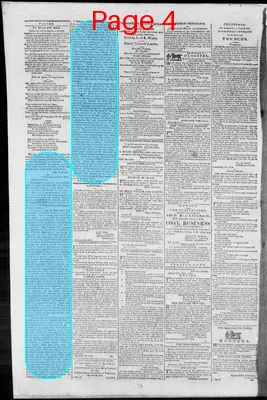
Letter to Editor
March 6, 1816
Virginia Argus
Richmond, Virginia
What is this article about?
A newspaper announces the publication of humorous letters from a young gentleman in Washington to his friend, critiquing congressional oratory. The first letter, dated January 7, 1816, satirizes the poor quality of speeches in the House of Representatives, contrasting newspaper reports with reality.
Clipping
OCR Quality
95%
Excellent
Full Text
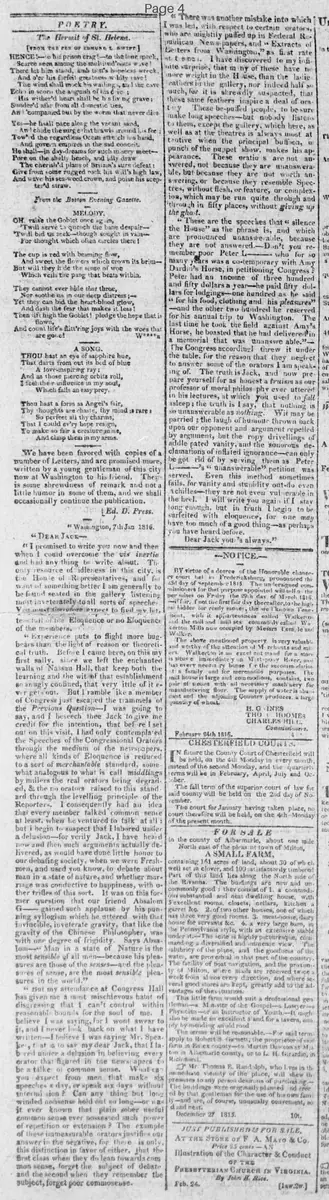
We have been favored with copies of a number of Letters, and are promised more, written by a young gentleman of this city now at Washington to his friend. There is some shrewdness of remark and not a little humor in some of them, and we shall occasionally continue the publication.
Just Ed. D. Press.
"Washington, 7th Jan 1816.
"Dear Jack
I promised to write you now and then when I could overcome the vis inertia and had any thing to write about. The only resource of idleness in this city is the House of Representatives, and for want of something better I am generally to be found seated in the gallery listening most inveterately to all sorts of speeches. You must sir, prepare to find my letter full of the Eloquence or no Eloquence of the members, or Experience puts to flight more bug-bears than the light of reason or theoretical truth. Before I came here, on this my first sally, since we left the enchanted walls of Nassau Hall, that keep both the learning and the wit of that establishment so snugly confined, that very little of it ever gets out. But I ramble like a member of Congress just escaped the trammels of the Previous Question—I was going to say, and I beseech thee Jack to give me credit for the intention, that ere I set out on this visit, I had only contemplated the Speeches of the Congressional Orators through the medium of the newspapers, where all kinds of Eloquence is reduced to a sort of merchantable standard, something analogous to what is call middlings by millers the real orators being degraded, & the no orators raised to this standard through the levelling principle of the Reporters, I consequently had an idea that every member talked common sense at least, when he ventured to talk at all: but I begin to suspect that I labored under a delusion—for verily Jack, I have heard now and then such arguments actually delivered, as would have done little honor to our debating society, when we were Freshmen, and used you know, to debate about man in a state of nature, and whether marriage was conducive to happiness, with other trifles of this sort. It was on this former question that our friend Absalom G—gained such applause by his punning syllogism which he uttered with that invincible, inveterate gravity, that like the gravity of the Chinese Philosopher, was with one degree of rigidity. Says Absalom—'Man in a state of Nature is the most sensible of all men—because his pleasures are those of the senses—and the pleasures of sense, are the most sensible pleasures in the world.'
"But my attendance at Congress Hall has given me a most mischievous habit of digressing that I can't control within reasonable bounds for the soul of me. I believe I was saying, for I wont swear to it, and I never look back on what I have written—I believe I was saying Mr. Speaker, to say my dear Jack, that I labored under a delusion in believing every orator that figured in the newspapers to be a talker of common sense. What can you expect from men that make six speeches a day, or speak six days without Intermission? Can any thing but long winded nonsense hold out so long—or was it ever known that plain sober useful common sense ever possessed such power of repetition or extension? The example of these immeasurable orators justifies our answer in the negative, for there is only this distinction in favor of either, that the first class when they do lean towards common sense, forget the subject of debate and the second when they remember the subject, forget poor common sense.
There was another mistake into which I was led, with respect to certain orators, who are mightily puffed up in Federal Republican News-papers, and 'Extracts of Letters from Washington,' as first rate stuff. I have discovered to my infinite surprise, that many of these have no more weight in the House than the lady feathers in the gallery, nor indeed half so much, for it is shrewdly suspected, that these same feathers inspire a deal of oratory. These be-puffed people, to be sure make long speeches—but nobody listens to them, except the gallery, which here, as well as at the theatres is always most attentive when the principal buffoon, or punch of the puppet show, makes his appearance. These orations are not answered, not because they are unanswerable, but because they are not worth answering, or because they resemble Spectres, without flesh, or feature, or complexion, which may be run quite through and through in fifty places, without giving up the ghost. These are the speeches that 'silence the House' as the phrase is, and which are pronounced unanswerable, because they are not answered.—Don't you remember poor Peter L—n. who 'for so many years was a co-temporary with Amy Dardin's Horse, in petitioning Congress? Peter had an income of three hundred and fifty dollars a year—he paid fifty dollars for lodgings—one hundred as he said 'for his food, clothing and his pleasures'—and the other two hundred he reserved for his annual trip to Washington. The last time he took the field against Amy's Horse, he boasted that he had delivered in a memorial that was unanswerable.' The Congress accordingly threw it under the table, for the reason that they neglect to answer some of the orators I am speaking of. The truth is Jack, and now prepare yourself for as honest a truism as our professor of moral philosophy ever uttered in his lectures, at which you used to fall asleep; the truth is I say, that nothing is so unanswerable as nothing. Wit may be parried; the laugh of humour thrown back upon our opponent and argument repelled by argument, but the ropy drivellings of addle pated vanity, and the sonorous declamations of inflated ignorance—can only be got rid of by serving them as Peter L—n's 'unanswerable' petition was served. Even this method sometimes fails. for vanity and stupidity out-do even Achilles—they are not even vulnerable in the heel. I will write you again if I stay long enough. but in truth I begin to be surfeited with eloquence, for one may have too much of a good thing—as perhaps you have heard before.
Dear Jack yours always."
Just Ed. D. Press.
"Washington, 7th Jan 1816.
"Dear Jack
I promised to write you now and then when I could overcome the vis inertia and had any thing to write about. The only resource of idleness in this city is the House of Representatives, and for want of something better I am generally to be found seated in the gallery listening most inveterately to all sorts of speeches. You must sir, prepare to find my letter full of the Eloquence or no Eloquence of the members, or Experience puts to flight more bug-bears than the light of reason or theoretical truth. Before I came here, on this my first sally, since we left the enchanted walls of Nassau Hall, that keep both the learning and the wit of that establishment so snugly confined, that very little of it ever gets out. But I ramble like a member of Congress just escaped the trammels of the Previous Question—I was going to say, and I beseech thee Jack to give me credit for the intention, that ere I set out on this visit, I had only contemplated the Speeches of the Congressional Orators through the medium of the newspapers, where all kinds of Eloquence is reduced to a sort of merchantable standard, something analogous to what is call middlings by millers the real orators being degraded, & the no orators raised to this standard through the levelling principle of the Reporters, I consequently had an idea that every member talked common sense at least, when he ventured to talk at all: but I begin to suspect that I labored under a delusion—for verily Jack, I have heard now and then such arguments actually delivered, as would have done little honor to our debating society, when we were Freshmen, and used you know, to debate about man in a state of nature, and whether marriage was conducive to happiness, with other trifles of this sort. It was on this former question that our friend Absalom G—gained such applause by his punning syllogism which he uttered with that invincible, inveterate gravity, that like the gravity of the Chinese Philosopher, was with one degree of rigidity. Says Absalom—'Man in a state of Nature is the most sensible of all men—because his pleasures are those of the senses—and the pleasures of sense, are the most sensible pleasures in the world.'
"But my attendance at Congress Hall has given me a most mischievous habit of digressing that I can't control within reasonable bounds for the soul of me. I believe I was saying, for I wont swear to it, and I never look back on what I have written—I believe I was saying Mr. Speaker, to say my dear Jack, that I labored under a delusion in believing every orator that figured in the newspapers to be a talker of common sense. What can you expect from men that make six speeches a day, or speak six days without Intermission? Can any thing but long winded nonsense hold out so long—or was it ever known that plain sober useful common sense ever possessed such power of repetition or extension? The example of these immeasurable orators justifies our answer in the negative, for there is only this distinction in favor of either, that the first class when they do lean towards common sense, forget the subject of debate and the second when they remember the subject, forget poor common sense.
There was another mistake into which I was led, with respect to certain orators, who are mightily puffed up in Federal Republican News-papers, and 'Extracts of Letters from Washington,' as first rate stuff. I have discovered to my infinite surprise, that many of these have no more weight in the House than the lady feathers in the gallery, nor indeed half so much, for it is shrewdly suspected, that these same feathers inspire a deal of oratory. These be-puffed people, to be sure make long speeches—but nobody listens to them, except the gallery, which here, as well as at the theatres is always most attentive when the principal buffoon, or punch of the puppet show, makes his appearance. These orations are not answered, not because they are unanswerable, but because they are not worth answering, or because they resemble Spectres, without flesh, or feature, or complexion, which may be run quite through and through in fifty places, without giving up the ghost. These are the speeches that 'silence the House' as the phrase is, and which are pronounced unanswerable, because they are not answered.—Don't you remember poor Peter L—n. who 'for so many years was a co-temporary with Amy Dardin's Horse, in petitioning Congress? Peter had an income of three hundred and fifty dollars a year—he paid fifty dollars for lodgings—one hundred as he said 'for his food, clothing and his pleasures'—and the other two hundred he reserved for his annual trip to Washington. The last time he took the field against Amy's Horse, he boasted that he had delivered in a memorial that was unanswerable.' The Congress accordingly threw it under the table, for the reason that they neglect to answer some of the orators I am speaking of. The truth is Jack, and now prepare yourself for as honest a truism as our professor of moral philosophy ever uttered in his lectures, at which you used to fall asleep; the truth is I say, that nothing is so unanswerable as nothing. Wit may be parried; the laugh of humour thrown back upon our opponent and argument repelled by argument, but the ropy drivellings of addle pated vanity, and the sonorous declamations of inflated ignorance—can only be got rid of by serving them as Peter L—n's 'unanswerable' petition was served. Even this method sometimes fails. for vanity and stupidity out-do even Achilles—they are not even vulnerable in the heel. I will write you again if I stay long enough. but in truth I begin to be surfeited with eloquence, for one may have too much of a good thing—as perhaps you have heard before.
Dear Jack yours always."
What sub-type of article is it?
Satirical
Comedic
Political
What themes does it cover?
Politics
What keywords are associated?
Congressional Oratory
Political Satire
Washington 1816
Speech Criticism
Newspaper Delusions
House Of Representatives
What entities or persons were involved?
Jack
Letter to Editor Details
Recipient
Jack
Main Argument
the writer satirizes the poor quality of congressional speeches, arguing that newspaper reports create delusions of eloquence, while in reality, many orators produce worthless, unanswerable nonsense that bores the house.
Notable Details
References To Nassau Hall (Princeton)
Punning Syllogism By Absalom G—
Analogy To Peter L—N's Unanswerable Petition
Critique Of Federal Republican Newspapers