Thank you for visiting SNEWPapers!
Sign up free
Letter to Editor
August 31, 1797
Gazette Of The United States, & Philadelphia Daily Advertiser
Philadelphia, Philadelphia County, Pennsylvania
What is this article about?
An anonymous communication from Albany defends President Washington's recall of diplomat James Monroe from France, accusing him and political disaffected of undermining government confidence through foreign appeals and domestic factions amid tensions with France.
Clipping
OCR Quality
95%
Excellent
Full Text
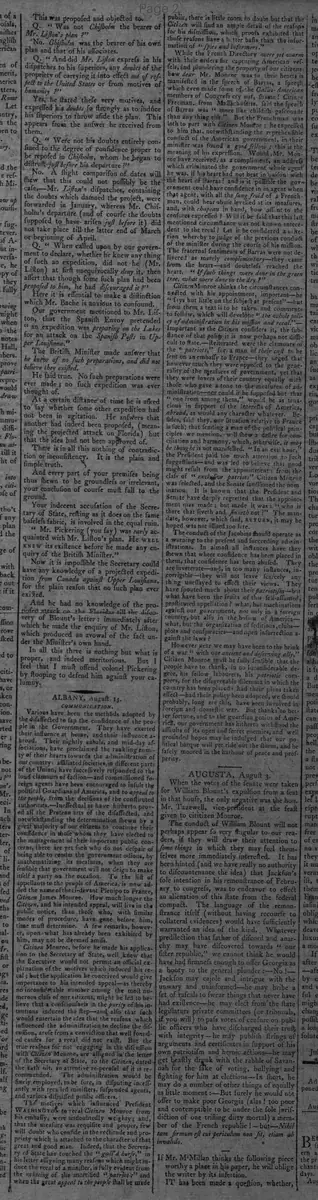
ALBANY, August 15.
COMMUNICATION.
Various have been the methods adopted by the disaffected to sap the confidence of the people in the Government. They have exerted their influence at home, and their influence abroad. Their nightly cabals, and mid-day associations, have proclaimed the rankling enmity of their hearts towards the administration of our country: affiliated societies, in different parts of the Union, have successively responded to the loud clamours of faction-and commissioned foreign agents have been encouraged to insult the political Guardians of America, and to appeal to the people, from the decisions of the constituted authorities.-Ineffectual as have hitherto proved all the Protean arts of the disaffected, and notwithstanding the determination shewn by a great majority of our citizens to continue their confidence in those whom they have elected to the management of their important public concerns, there are yet such who do not despair of being able to render the government odious, by anathematizing its measures, when they are sensible that government will not deign to make itself a party on the occasion. To the list of appellants to the people of America, is now added the name of the ci-devant Plenipo to France, Citizen James Monroe. How much longer the Citizen, and his intended appeal, will live in the public notice, than those who, with similar modes of procedure, have gone before him, time must determine. A few remarks, however, upon what has already been exhibited by him, may not be deemed amiss.
Citizen Monroe, before he made his application to the Secretary of State, well knew that the Executive would not permit an official explanation of the motives which induced his recall; but the application he conceived would give importance to his intended appeal-as thereby no inconsiderable number among the most numerous class of our citizens, might be led to believe that a consciousness in the purity of his intentions induced the step-and also that such would entertain the idea that the reasons which influenced the administration to decline the discussion, arose from a conviction that well founded causes for a recall did not exist. But the true reasons for not engaging in the discussion with Citizen Monroe, are assigned in the letter of the Secretary of State, to the Citizen, dated the 28th ult, an attentive re-perusal of it is recommended. The administration would be finely employed, to be sure, in disputing incessantly with recalled ministers, suspended agents, and various dismissed public officers.
The motives which influenced President Washington to recall Citizen Monroe from his embassy, were undoubtedly weighty; and, that the measure was requisite and proper, few will doubt who confide in the rectitude and propriety which is attached to the character of that great and good man. Indeed, that the Secretary of State has touched the "galled horse," in his letter assigning many reasons which might induce the recall of a minister, is fully evident from the wincing of the mortified "patriot:" and when the great appeal to the people shall be made public, there is little room to doubt but that the Citizen will find an ample detail of the reasons for his dismission, which proofs exhibited that those reasons have a better basis than the information of "spies and informers."
While the French Directory were yet warm with their orders for capturing American vessels, and plundering the property of our citizens, how dear Mr. Monroe was to their hearts is manifested in the speech of Barras, a speech which even made some of the Gallio American members of Congress cry out, shame! Citizen Freeman, from Massachusetts, said the speech of Barras was "more like childish gasconade than any thing else." But the Frenchman was loth to part with Citizen Monroe; he expressed to him that, notwithstanding the reprehensible conduct of the American government, in their minister was found a good fellow; this is the meaning of his expression. Would Mr. Monroe have received, as a compliment, an address which criminated the government whose agent he was, if his heart had not beat in union with the heart of Barras? and is it possible the government could have confidence in an agent when that agent, with all the sang froid of a Frenchman, could hear abuse levelled at its measures, and, with chapeau in hand, bow assent to the censures expressed? Will it be said that this last mentioned circumstance was not known antecedent to the recall? Let it be considered a criterion whereby to judge of the previous conduct of the minister during the course of his mission.
The fraternal sentiments of Barras were not delivered as merely complimentary-they came from the heart-and doubtless reached the heart. "If such things were done in the green tree, what were done in the dry?"
Citizen Monroe thinks the circumstances connected with his appointment, important-he "says but little on the subject at present" -but from them a text is to be taken, and comments to follow, which will develope "the whole policy of administration in his mission and recall."—Important as the Citizen considers it, the substance of that policy it is now perhaps not difficult to state,-Reiterated were the clamours of the "patriots," for a man of their cast to be sent on an embassy to France-they urged that however much they were opposed to the generality of the measures of government, yet that they were lovers of their country equally with those who gave a tone to the measures of administration -nor could it be supposed but that "one from among them," would be as tenacious in support of the interests of America, abroad, as would any character whatever. Besides, said they, our situation relative to France is such, that sending a man of the political principles we mention, will shew a desire for conciliation and harmony, which, otherwise, it may be thought is not manifested. "In an evil hour," the President paid too much attention to such suggestions-and was led to believe that good might result from the appointment: from the class of "exclusive patriots" Citizen Monroe was selected, and the Senate sanctioned the nomination. It is known that the President and Senate have deeply regretted that the appointment was made; but made it was: "who is there that liveth and sinneth not?" The mandate, however, which said, RETURN, it may be hoped was not issued too late.
The conduct of the Jacobins should operate as a warning to the present and succeeding administrations. In almost all instances have they shewn that where confidence has been placed in them, that confidence has been abused. They are inveterate-and, in too many instances, incorrigible-they will not leave scarcely any thing unessayed to effect their views. They have boasted much about their patriotism--but what have been the fruits of this self-assumed, prostituted appellation? what, but machinations against our government, not only in a foreign country, but also in the bosom of America- what, but the organization of seditious clubs- plots and conspiracies-and open insurrection against the laws?
However near we may have been to the brink of a war "with our ancient and deserving ally," Citizen Monroe must be fully sensible that the people have to thank, in no inconsiderable degree, his fellow labourers, his patriotic co-peers, for the disagreeable dilemma in which the country has been placed: had their plans taken effect--had their policy been adopted, we should probably, long ere this, have been involved in foreign and domestic war. But thanks to better fortune, and to the guardian genius of America, our government has hitherto withstood the assaults of its open and secret enemies, and well grounded hopes may be indulged that our political barque will yet ride out the storm, and be safely moored in the harbour of peace and prosperity.
COMMUNICATION.
Various have been the methods adopted by the disaffected to sap the confidence of the people in the Government. They have exerted their influence at home, and their influence abroad. Their nightly cabals, and mid-day associations, have proclaimed the rankling enmity of their hearts towards the administration of our country: affiliated societies, in different parts of the Union, have successively responded to the loud clamours of faction-and commissioned foreign agents have been encouraged to insult the political Guardians of America, and to appeal to the people, from the decisions of the constituted authorities.-Ineffectual as have hitherto proved all the Protean arts of the disaffected, and notwithstanding the determination shewn by a great majority of our citizens to continue their confidence in those whom they have elected to the management of their important public concerns, there are yet such who do not despair of being able to render the government odious, by anathematizing its measures, when they are sensible that government will not deign to make itself a party on the occasion. To the list of appellants to the people of America, is now added the name of the ci-devant Plenipo to France, Citizen James Monroe. How much longer the Citizen, and his intended appeal, will live in the public notice, than those who, with similar modes of procedure, have gone before him, time must determine. A few remarks, however, upon what has already been exhibited by him, may not be deemed amiss.
Citizen Monroe, before he made his application to the Secretary of State, well knew that the Executive would not permit an official explanation of the motives which induced his recall; but the application he conceived would give importance to his intended appeal-as thereby no inconsiderable number among the most numerous class of our citizens, might be led to believe that a consciousness in the purity of his intentions induced the step-and also that such would entertain the idea that the reasons which influenced the administration to decline the discussion, arose from a conviction that well founded causes for a recall did not exist. But the true reasons for not engaging in the discussion with Citizen Monroe, are assigned in the letter of the Secretary of State, to the Citizen, dated the 28th ult, an attentive re-perusal of it is recommended. The administration would be finely employed, to be sure, in disputing incessantly with recalled ministers, suspended agents, and various dismissed public officers.
The motives which influenced President Washington to recall Citizen Monroe from his embassy, were undoubtedly weighty; and, that the measure was requisite and proper, few will doubt who confide in the rectitude and propriety which is attached to the character of that great and good man. Indeed, that the Secretary of State has touched the "galled horse," in his letter assigning many reasons which might induce the recall of a minister, is fully evident from the wincing of the mortified "patriot:" and when the great appeal to the people shall be made public, there is little room to doubt but that the Citizen will find an ample detail of the reasons for his dismission, which proofs exhibited that those reasons have a better basis than the information of "spies and informers."
While the French Directory were yet warm with their orders for capturing American vessels, and plundering the property of our citizens, how dear Mr. Monroe was to their hearts is manifested in the speech of Barras, a speech which even made some of the Gallio American members of Congress cry out, shame! Citizen Freeman, from Massachusetts, said the speech of Barras was "more like childish gasconade than any thing else." But the Frenchman was loth to part with Citizen Monroe; he expressed to him that, notwithstanding the reprehensible conduct of the American government, in their minister was found a good fellow; this is the meaning of his expression. Would Mr. Monroe have received, as a compliment, an address which criminated the government whose agent he was, if his heart had not beat in union with the heart of Barras? and is it possible the government could have confidence in an agent when that agent, with all the sang froid of a Frenchman, could hear abuse levelled at its measures, and, with chapeau in hand, bow assent to the censures expressed? Will it be said that this last mentioned circumstance was not known antecedent to the recall? Let it be considered a criterion whereby to judge of the previous conduct of the minister during the course of his mission.
The fraternal sentiments of Barras were not delivered as merely complimentary-they came from the heart-and doubtless reached the heart. "If such things were done in the green tree, what were done in the dry?"
Citizen Monroe thinks the circumstances connected with his appointment, important-he "says but little on the subject at present" -but from them a text is to be taken, and comments to follow, which will develope "the whole policy of administration in his mission and recall."—Important as the Citizen considers it, the substance of that policy it is now perhaps not difficult to state,-Reiterated were the clamours of the "patriots," for a man of their cast to be sent on an embassy to France-they urged that however much they were opposed to the generality of the measures of government, yet that they were lovers of their country equally with those who gave a tone to the measures of administration -nor could it be supposed but that "one from among them," would be as tenacious in support of the interests of America, abroad, as would any character whatever. Besides, said they, our situation relative to France is such, that sending a man of the political principles we mention, will shew a desire for conciliation and harmony, which, otherwise, it may be thought is not manifested. "In an evil hour," the President paid too much attention to such suggestions-and was led to believe that good might result from the appointment: from the class of "exclusive patriots" Citizen Monroe was selected, and the Senate sanctioned the nomination. It is known that the President and Senate have deeply regretted that the appointment was made; but made it was: "who is there that liveth and sinneth not?" The mandate, however, which said, RETURN, it may be hoped was not issued too late.
The conduct of the Jacobins should operate as a warning to the present and succeeding administrations. In almost all instances have they shewn that where confidence has been placed in them, that confidence has been abused. They are inveterate-and, in too many instances, incorrigible-they will not leave scarcely any thing unessayed to effect their views. They have boasted much about their patriotism--but what have been the fruits of this self-assumed, prostituted appellation? what, but machinations against our government, not only in a foreign country, but also in the bosom of America- what, but the organization of seditious clubs- plots and conspiracies-and open insurrection against the laws?
However near we may have been to the brink of a war "with our ancient and deserving ally," Citizen Monroe must be fully sensible that the people have to thank, in no inconsiderable degree, his fellow labourers, his patriotic co-peers, for the disagreeable dilemma in which the country has been placed: had their plans taken effect--had their policy been adopted, we should probably, long ere this, have been involved in foreign and domestic war. But thanks to better fortune, and to the guardian genius of America, our government has hitherto withstood the assaults of its open and secret enemies, and well grounded hopes may be indulged that our political barque will yet ride out the storm, and be safely moored in the harbour of peace and prosperity.
What sub-type of article is it?
Persuasive
Political
Provocative
What themes does it cover?
Politics
What keywords are associated?
James Monroe
Recall From France
Washington Administration
Political Disaffection
French Directory
Barras Speech
Government Confidence
Letter to Editor Details
Main Argument
the letter defends president washington's recall of james monroe from his embassy in france as necessary and proper, criticizing monroe and disaffected factions for attempting to undermine public confidence in the government through appeals and associations.
Notable Details
References Secretary Of State's Letter Dated 28th Ult.
Mentions Barras's Speech Criticizing American Government.
Discusses Monroe's Alignment With French Directory Sentiments.