Thank you for visiting SNEWPapers!
Sign up free
Editorial
January 19, 1844
The Daily Madisonian
Washington, District Of Columbia
What is this article about?
An editorial from the N.Y. Evening Post criticizes Congress for likely failing to pass intelligent copyright legislation due to political distractions. It faults Rep. C.J. Ingersoll's bill for extending U.S. copyrights but excluding foreigners, arguing this harms American authors by favoring cheap British reprints. Advocates equal copyright for all authors or abolition of the law.
Clipping
OCR Quality
95%
Excellent
Full Text
From the N. Y. Evening Post.
THE COPYRIGHT QUESTION.
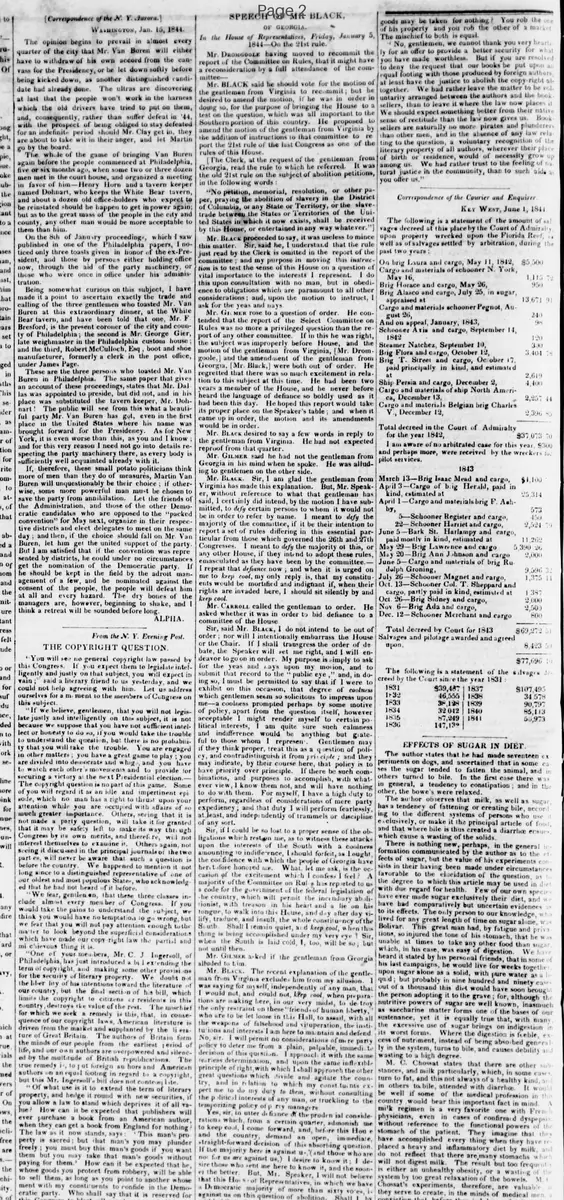
"You will see no general copyright law passed by this Congress. If you expect them to legislate intelligently and justly on that subject, you will expect in vain;" said a literary friend to us yesterday, and we could not help agreeing with him. Let us address ourselves for a moment to the members of Congress on this subject.
"If we believe, gentlemen, that you will not legislate justly and intelligently on this subject, it is not because we suppose that you have not sufficient intellect or honesty to do so, if you would take the trouble to understand the question, but there is no probability that you will take the trouble. You are engaged in other matters; you have a great game to play; you are divided into democrats and whigs, and you have to watch each other's movements and to provide for securing a victory at the next Presidential election.—The copyright question is no part of this game. Some of you will regard it as an idle and impertinent episode, which no man has a right to thrust upon your attention while you are occupied with affairs of so much greater importance. Others, seeing that it is not made a party question, will take it for granted that it may be safely left to make its way through Congress by its own merits, and therefore, will not interest themselves to examine it. Others again, not seeing it discussed in the principal journals of the two parties, will never be aware that such a question is before the country. We happened to mention it not long since to a distinguished representative of one of our oldest and most populous States, who acknowledged that he had not heard of it before.
We fear, gentlemen, that these three classes include almost every member of Congress. If you would take the pains to understand the subject, we think you would have no temptation to go wrong, but we fear that you will not pay attention enough to the matter to look beyond the superficial considerations which have made our copyright law the partial and mischievous thing it is.
One of your members, Mr. C. J. Ingersoll, of Philadelphia, has just introduced a bill extending the term of copyright, and making some other provisions for the security of literary property. We doubt not the liberality of his intentions toward the literature of our country, but the final section of his bill, which limits the copyright to citizens or residents in this country, destroys the value of the rest. The mischief for which we seek a remedy is this, that, in consequence of our copyright laws, American literature is driven from the market and supplanted by the literature of Great Britain. The authors of Britain form the minds of our people from the earliest period of life, and our own authors are overpowered and silenced by the multitude of British republications. The true remedy is, to put foreign authors and American authors on an equal footing in regard to a copyright, but this Mr. Ingersoll's bill does not contemplate.
Of what use is it to extend the term of literary property, and hedge it round with new securities, if you allow a law to stand which deprives it of all value? How can it be expected that publishers will ever purchase a book from an American author, when they can get a book from England for nothing? The law as it now stands, says: This man's property is sacred; but that man's you may plunder freely; you must buy this man's goods if you want them but you may take that man's goods without paying for them. How can it be expected that he, whose goods you protect from robbery, will be able to sell them, as long as you point to another whose goods may be taken for nothing? You rob the one of his property and you rob the other of a market. The mischief to both is equal.
No, gentlemen, we cannot thank you very heartily for an offer to provide a better security for what you have made worthless. But if you are resolved to deny the request that our books be put upon an equal footing with those produced by foreign authors, at least have the justice to abolish the copy-right altogether. We had rather leave the matter to be voluntarily arranged between the authors and the booksellers, than to leave it where the law now places it. We should expect something better from their native sense of rectitude than the law now gives us. Booksellers are naturally no more pirates and plunderers than other men, and in the absence of any law relating to the question, a voluntary recognition of the literary property of all authors, wherever their place of birth or residence, would of necessity grow up among us. We had rather trust to the feeling of natural justice in the community, than to such aid as you offer us."
THE COPYRIGHT QUESTION.
"You will see no general copyright law passed by this Congress. If you expect them to legislate intelligently and justly on that subject, you will expect in vain;" said a literary friend to us yesterday, and we could not help agreeing with him. Let us address ourselves for a moment to the members of Congress on this subject.
"If we believe, gentlemen, that you will not legislate justly and intelligently on this subject, it is not because we suppose that you have not sufficient intellect or honesty to do so, if you would take the trouble to understand the question, but there is no probability that you will take the trouble. You are engaged in other matters; you have a great game to play; you are divided into democrats and whigs, and you have to watch each other's movements and to provide for securing a victory at the next Presidential election.—The copyright question is no part of this game. Some of you will regard it as an idle and impertinent episode, which no man has a right to thrust upon your attention while you are occupied with affairs of so much greater importance. Others, seeing that it is not made a party question, will take it for granted that it may be safely left to make its way through Congress by its own merits, and therefore, will not interest themselves to examine it. Others again, not seeing it discussed in the principal journals of the two parties, will never be aware that such a question is before the country. We happened to mention it not long since to a distinguished representative of one of our oldest and most populous States, who acknowledged that he had not heard of it before.
We fear, gentlemen, that these three classes include almost every member of Congress. If you would take the pains to understand the subject, we think you would have no temptation to go wrong, but we fear that you will not pay attention enough to the matter to look beyond the superficial considerations which have made our copyright law the partial and mischievous thing it is.
One of your members, Mr. C. J. Ingersoll, of Philadelphia, has just introduced a bill extending the term of copyright, and making some other provisions for the security of literary property. We doubt not the liberality of his intentions toward the literature of our country, but the final section of his bill, which limits the copyright to citizens or residents in this country, destroys the value of the rest. The mischief for which we seek a remedy is this, that, in consequence of our copyright laws, American literature is driven from the market and supplanted by the literature of Great Britain. The authors of Britain form the minds of our people from the earliest period of life, and our own authors are overpowered and silenced by the multitude of British republications. The true remedy is, to put foreign authors and American authors on an equal footing in regard to a copyright, but this Mr. Ingersoll's bill does not contemplate.
Of what use is it to extend the term of literary property, and hedge it round with new securities, if you allow a law to stand which deprives it of all value? How can it be expected that publishers will ever purchase a book from an American author, when they can get a book from England for nothing? The law as it now stands, says: This man's property is sacred; but that man's you may plunder freely; you must buy this man's goods if you want them but you may take that man's goods without paying for them. How can it be expected that he, whose goods you protect from robbery, will be able to sell them, as long as you point to another whose goods may be taken for nothing? You rob the one of his property and you rob the other of a market. The mischief to both is equal.
No, gentlemen, we cannot thank you very heartily for an offer to provide a better security for what you have made worthless. But if you are resolved to deny the request that our books be put upon an equal footing with those produced by foreign authors, at least have the justice to abolish the copy-right altogether. We had rather leave the matter to be voluntarily arranged between the authors and the booksellers, than to leave it where the law now places it. We should expect something better from their native sense of rectitude than the law now gives us. Booksellers are naturally no more pirates and plunderers than other men, and in the absence of any law relating to the question, a voluntary recognition of the literary property of all authors, wherever their place of birth or residence, would of necessity grow up among us. We had rather trust to the feeling of natural justice in the community, than to such aid as you offer us."
What sub-type of article is it?
Legal Reform
Economic Policy
Foreign Affairs
What keywords are associated?
Copyright Law
International Copyright
American Literature
British Reprints
Congress Inaction
Ingersoll Bill
Literary Property
What entities or persons were involved?
Congress
Mr. C. J. Ingersoll
British Authors
American Authors
Publishers
Democrats
Whigs
Editorial Details
Primary Topic
Reform Of U.S. Copyright Law To Include Foreign Authors
Stance / Tone
Critical Of Congress And Ingersoll's Bill, Advocating Equal International Copyright
Key Figures
Congress
Mr. C. J. Ingersoll
British Authors
American Authors
Publishers
Democrats
Whigs
Key Arguments
Congress Unlikely To Legislate Intelligently On Copyright Due To Political Distractions
Ingersoll's Bill Extends U.S. Copyright But Excludes Foreigners, Rendering It Ineffective
Current Laws Favor British Literature By Allowing Free Reprints, Harming American Authors
True Remedy Is Equal Copyright For Foreign And American Authors
Publishers Won't Buy American Books If British Ones Are Free
Better To Abolish Copyright Than Maintain Partial Protection
Trust Voluntary Arrangements Over Flawed Laws